
Life, 1922-03-16 · page 10 of 34
Life — March 16, 1922 — page 10: what you’re looking at
What you’re looking at
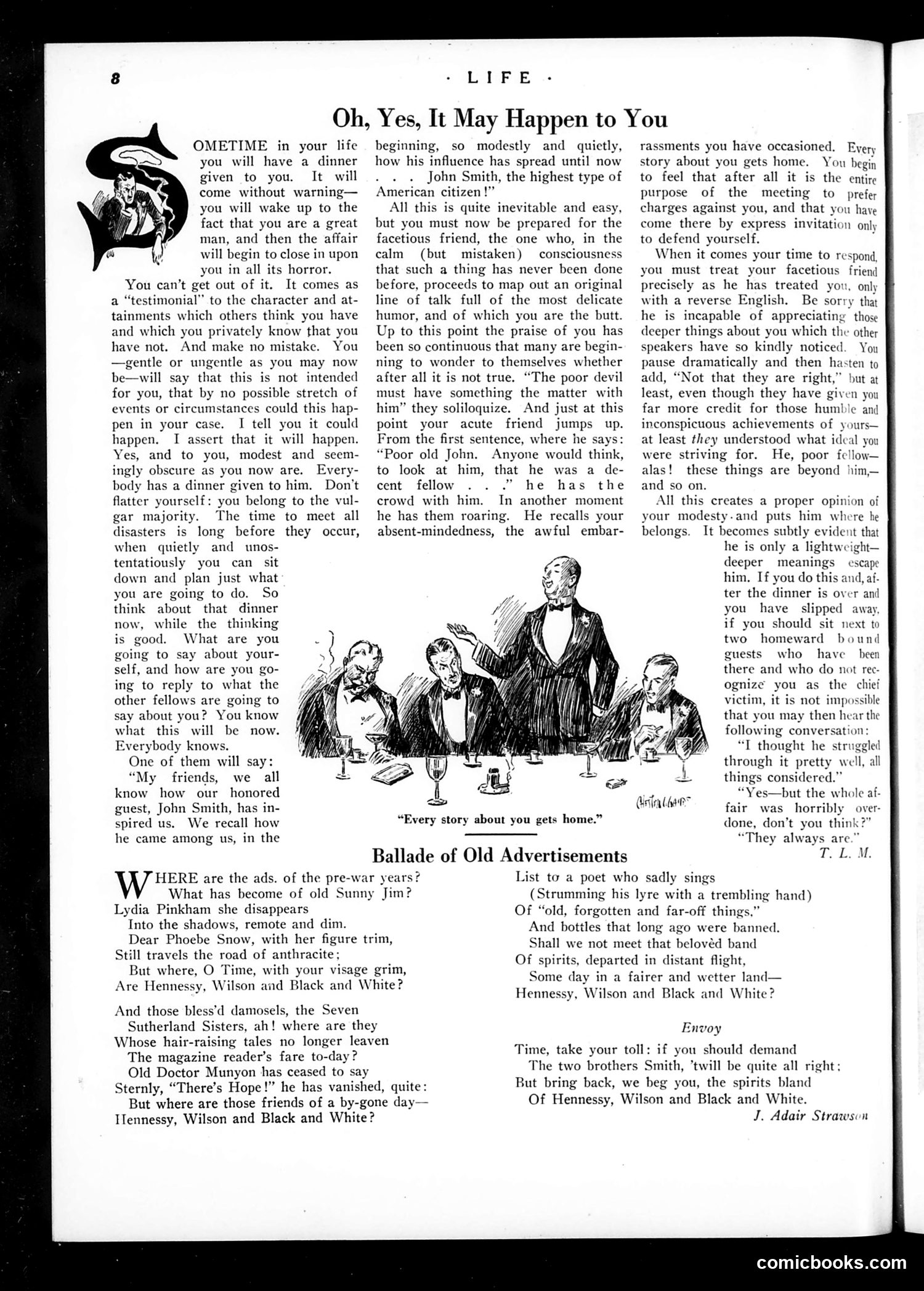
This article advises readers on handling social embarrassment at dinner parties. The accompanying illustration shows a well-dressed man at a formal dinner surrounded by other guests, captioned "Every story about you gets home." The piece warns that unflattering stories and gossip about you will inevitably circulate among your social circle, no matter how private you thought your indiscretions were. It counsels readers to prepare responses and maintain composure when facing such situations. The article also includes "Ballad of Old Advertisements," a nostalgic poem lamenting vanished pre-war advertising figures like "Sunny Jim," "Phoebe Snow," and brand mascots ("Hennessy, Wilson and Black and White"), reflecting on how advertising icons fade from cultural memory over time.
📄 Transcribed text from this page (OCR, searchable)
Machine-transcribed from the original scan — historical spelling and the odd misread are preserved.
* LIFE - Oh, Yes, It May Happen to You OMETIME in your life you will have a dinner given to you. It will come without warning— you will wake up to the fact that you are a great man, and then the affair will begin to close in upon you in all its horror. You can’t get out of it. It comes as a “testimonial” to the character and at- tainments which others think you have and which you privately know that you have not. And make no mistake. You —gentle or ungentle as you may now be—will say that this is not intended for you, that by no possible stretch of events or circumstances could this hap- pen in your case. I tell you it could happen. I assert that it will happen. Yes, and to you, modest and seem- ingly obscure as you now are. Every- body has a dinner given to him. Don't flatter yourself: you belong to the vul- gar majority. The time to meet all disasters is long before they occur, when quietly and unos- tentatiously you can sit down and plan just what you are going to do. So think about that dinner now, while the thinking is good. What are you going to say about your- self, and how are you go- ing to reply to what the other fellows are going to say about you? You know what this will be now. Everybody know One of them will say: “My friends, we all know how our honored guest, John Smith, has in- spired us. We recall how he came among us, in the beginning, so modestly and quietly, how his influence has spread until now John Smith, the highest type of American citizen!” All this is quite inevitable and easy, but you must now be prepared for the facetious friend, the one who, in the calm (but mistaken) consciousness that such a thing has never been done before, proceeds to map out an original line of talk full of the most delicate humor, and of which you are the butt. Up to this point the praise of you has been so continuous that many are begin- ning to wonder to themselves whether after all it is not true. “The poor devil must have something the matter with him” they soliloquize. And just at this point your acute friend jumps up. From the first sentence, where he says: “Poor old John. Anyone would think, to look at him, that he was a de- cent fellow . . .” he has the crowd with him. In another moment he has them roaring. He recalls your absent-mindedness, the awful embar- “Every story about you gets home.” rassments you have occasioned. Every story about you gets home. You begin to feel that after all it is the entire purpose of the meeting to prefer charges against you, and that you have come there by express invitation only to defend yourself. . When it comes your time to respond, you must treat your facetious friend precisely as he has with a reverse English. he is incapable of appreciating those deeper things about you which the other speakers have so kindly noticed pause dramatically and then hasten to add, “Not that they are right,” but at least, even though they have given you far more credit for those humble and inconspicuous achievements of yours— at least they understood what ideal you were striving for. He, poor fellow— alas! these things are beyond him— and so on. All this creates a proper opinion of your modesty-and puts him where he belongs. It becomes subtly evident that he is only a lightweight— deeper meanings escape him, If you do this and, af- ter the dinner is over and you have slipped away, if you should sit next to two homeward bound guests who have _ been there and who do not r ognize you as the chief victim, it is not impossible that you may then hear the following conversation: “T thought he struggled through it pretty well, all things considered.” “es—but the whole af- fair was horribly over- done, don’t you think “They always are.” TL You Csitea ash M. Ballade of Old Advertisements HERE are the ads. of the pre-war years? What has become of old Sunny Jim? Lydia Pinkham she disappears Into the shadows, remote and dim. Dear Phoebe Snow, with her figure trim, Still travels the road of anthracite; But where, O Time, with your visage grim, Are Hennessy, Wilson and Black and White? List to a poet who sadly sings (Strumming his lyre with a trembling hand) Of “old, forgotten and far-off things. And bottles that long ago were banned. Shall we not meet that belovéd band Of spirits, departed in distant flight, Some day in a fairer and wetter land— Hennessy, Wilson and Black and White? And those bless’d damosels, the Seven Sutherland Sisters, ah! where are they Whose hair-raising tales no longer leaven The magazine reader’s fare to-day? Old Doctor Munyon has ceased to say Sternly, “There’s Hope!” he has vanished, quite: But where are those friends of a by-gone day— Ifennessy, Wilson and Black and White? Envoy Time, take your toll: if you should demand The two brothers Smith, ‘twill be quite all right: But bring back, we beg you, the spirits bland Of Hennessy, Wilson and Black and White. J. Adair Strawson comicbooks.com