
Life, 1922-03-16 · page 24 of 34
Life — March 16, 1922 — page 24: what you’re looking at
What you’re looking at
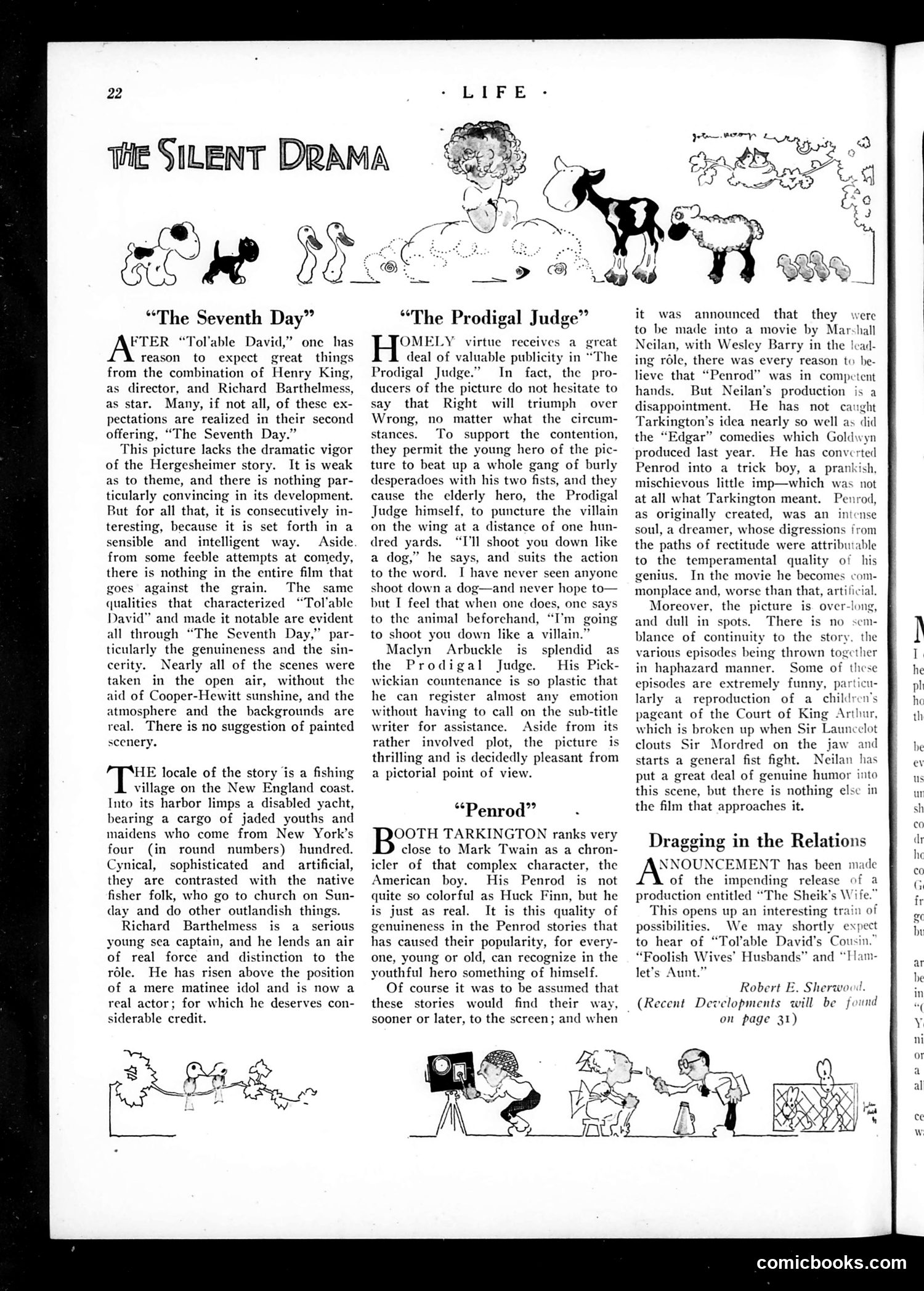
This page contains three film reviews from Life's cinema section, critiquing recent movie releases. **"The Seventh Day"** praises the collaboration of director Henry King and actor Richard Barthelmess, noting the film authentically captures a New England fishing village story. The reviewer appreciates its genuine atmosphere and outdoor cinematography, though finds it dramatically weaker than their previous collaboration "Tol'able David." **"The Prodigal Judge"** satirizes the film's heavy-handed morality—its insistence that Right triumphs over Wrong. The critic jokes about the hero's implausible feats (defeating gangs single-handedly, shooting at impossible distances), while praising actor Maclyn Arbuckle's expressive performance. **"Penrod"** adapts Booth Tarkington's popular boy-character stories. While acknowledging the source material's appeal and the competence of star Wesley Barry, the reviewer finds director Marshall Neilan's adaptation disappoints compared to earlier "Edgar" comedies, missing Tarkington's essential charm.
📄 Transcribed text from this page (OCR, searchable)
Machine-transcribed from the original scan — historical spelling and the odd misread are preserved.
22 “The Seventh Day” ol’'able David,’ one has EX teaan to expect great things from the combination of Henry King, as director, and Richard Barthelmess, as star. Many, if not all, of these ex- pectations are realized in their second offering, “The Seventh Day.” This picture lacks the dramatic vigor of the Hergesheimer story. It is weak as to theme, and there is nothing par- ticularly convincing in its development. But for all that, it is consecutively in- teresting, because it is set forth in a sensible and intelligent way. Aside from some feeble attempts at comedy, there is nothing in the entire film that goes against the grain. The same qualities that characterized “Tol'able David" and made it notable are evident all through “The Seventh Day,” par- ticularly the genuineness and the sin- cerity. Nearly all of the scenes were taken in the open air, without the aid of Cooper-Hewitt sunshine, and the atmosphere and the backgrounds are real. There is no suggestion of painted scenery. HE locale of the story is a fishing village on the New England coast. Into its harbor limps a disabled yacht, bearing a cargo of jaded youths and maidens who come from New York's four (in round numbers) hundred. Cynical, sophisticated and artificial, they are contrasted with the native fisher folk, who go to church on Sun- day and do other outlandish things. Richard Barthelmess is a_ serious young sea captain, and he lends an air of real force and distinction to the role. He has risen above the position of a mere matinee idol and is now a real actor; for which he deserves con- siderable credit. oa Sn g “The Prodigal Judge” OMELY virtue receives a great deal of valuable publicity in “The Prodigal Judge.” In fact, the pro- ducers of the picture do not hesitate to say that Right will triumph over Wrong, no matter what the circum- stances. To support the contention, they permit the young hero of the pic- ture to beat up a whole gang of burly desperadoes with his two fists, and they cause the elderly hero, the Prodigal Judge himself, to puncture the villain on the wing at a distance of one hun- dred yards. “I'll shoot you down like a dog,” he says, and suits the action to the word. I have never seen anyone shoot down a dog—and never hope to— but I feel that when one does, one says to the animal beforehand, “I’m going to shoot you down like a villain.” Maclyn Arbuckle is splendid as the Prodigal Judge. His Pick- wickian countenance is so plastic that he can register almost any emotion without having to call on the sub-title writer for a ance. Aside from its rather involved plot, the picture is thrilling and is decidedly pleasant from a pictorial point of view. “Penrod” : OOTH TARKINGTON ranks very close to Mark Twain as a chron- icler of that complex character, the American boy. His Penrod is not quite so colorful as Huck Finn, but he is just as real. It is this quality of genuineness in the Penrod stories that has caused their popularity, for every- one, young or old, can recognize in the youthful hero something of himself. Of course it was to be assumed that these stories would find their way, sooner or later, to the screen; and when \€ cae ne, bt Oe 0? 3 ud os , oS OF < CAD it was announced that they to be made into a movie by M Neilan, with Wesley Barry in the le: ing role, there every reason to be- lieve that “Penrod” was in competent hands. But Neilan’s production is a disappointment. He has not caught Tarkington’s idea nearly so well as did the “Edgar” comedies which Goldwyn produced last year. He has converted Penrod into a trick boy, a prankish, mischievous little imp—which was not at all what Tarkington meant. Penrod, as originally created, was an_ intcnse soul, a dreamer, whose digressions from the paths of rectitude were attributable to the temperamental quality of his genius. In the movie he becomes com- monplace and, worse than that, artilicial. Moreover, the picture is over-long, and dull in spots. There is no sem- blance of continuity to the story, the various episodes being thrown tc in haphazard manner. Some of these episodes are extremely funny, particu- larly a reproduction of a children’s pageant of the Court of King Arthur, which is broken up when Sir Launcclot clouts Sir Mordred on the jaw and starts a general fist fight. Neilan has put a great deal of genuine humor into this scene, but there is nothing else in the film that approaches it. were ether Dragging in the Relations ‘.NOUNCEMENT has been made of the impending release of a production entitled “The Sheik’s Wife.” This opens up an interesting train of possibilities. We may shortly e to hear of “Tol’able David's Cousin “Foolish Wives’ Husbands” and “11 let's Aunt.” Robert E. Sherwood. (Recent Developments will be found on page 31) Ra Ls comicbooks.com