
Life, 1922-03-16 · page 26 of 34
Life — March 16, 1922 — page 26: what you’re looking at
What you’re looking at
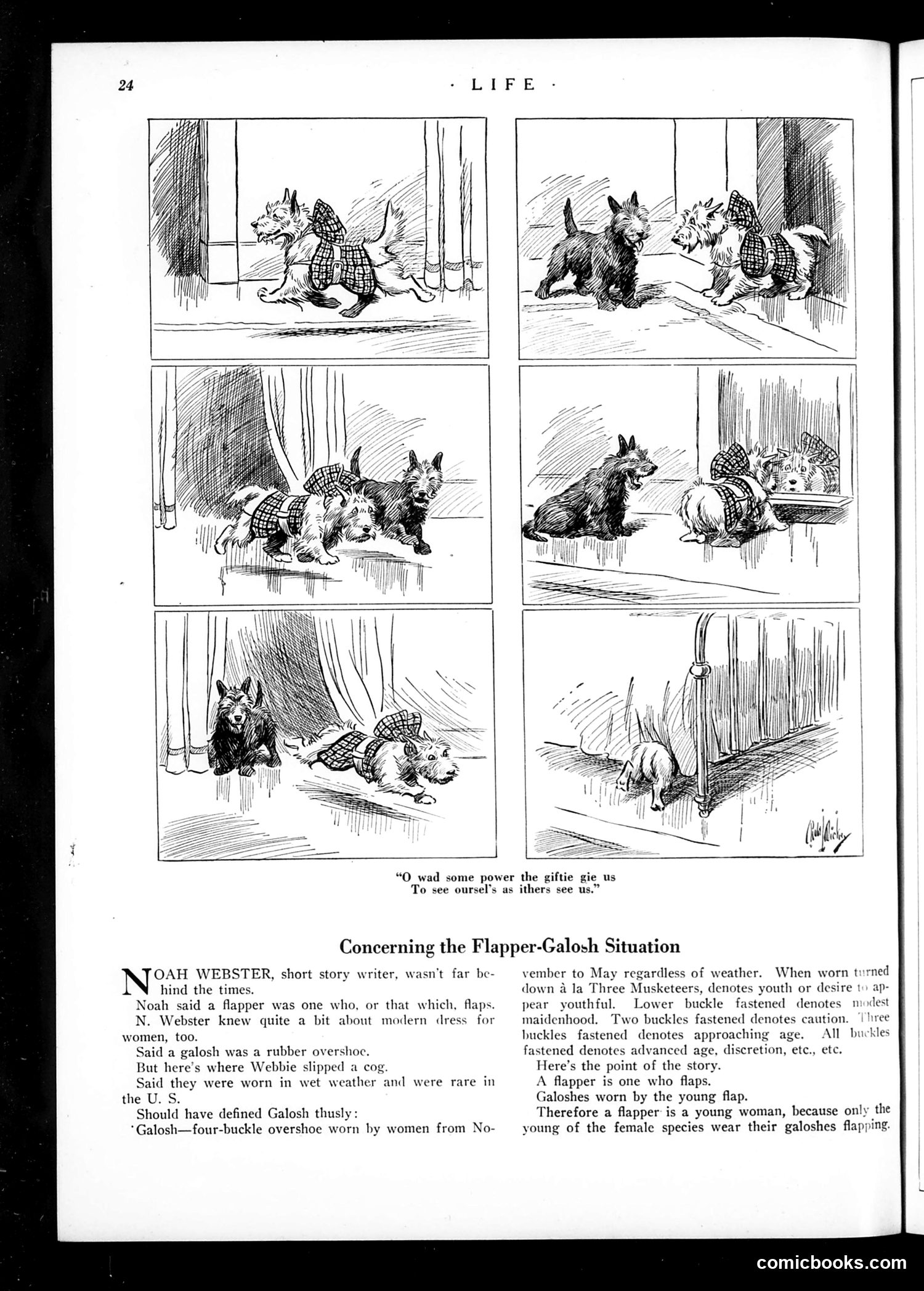
This 1920s satirical piece mocks the "flapper" fashion trend through a humorous redefinition of "galosh" (rubber overshoe). **The Joke:** The comic strip (top) shows small dogs wearing plaid jackets and galoshes, with the text playing on Scottish poet Robert Burns's famous line about seeing ourselves as others see us. The accompanying article humorously "corrects" Webster's Dictionary by redefining galosh based on how young women actually wore them—specifically, unbuckled or partially buttoned, creating a flapping sound as they walked. **The Social Satire:** Flappers were controversial modern young women (1920s) known for rejecting Victorian propriety. The piece gently mocks both the fashion itself and the age-based judgments embedded in how women wore their galoshes: young women flapped theirs fashionably; older women buttoned them properly for modesty and discretion. **The Point:** The absurd logical equation (flappers flap; galoshes flap when young women wear them; therefore flappers are young women) satirizes how trivial fashion choices became markers of generational identity and respectability.
📄 Transcribed text from this page (OCR, searchable)
Machine-transcribed from the original scan — historical spelling and the odd misread are preserved.
J “O wad some power the giftie gie us To see oursel’s as ithers see us.” Concerning the Flapper-Galosh Situation OAH WEBSTER, short story writer, wasn't far be- hind the times. Noah said a flapper was one who, or that which, flaps. N. Webster knew quite a bit about modern dress for women, too. Said a galosh was a rubber overshoc. But here’s where Webbie slipped a cog. Said they were worn in wet weather and were rare in the U. S. Should have defined Galosh thusly : *Galosh—four-buckle overshoe worn by women from No- vember to May regardless of weather. When worn turned down a la Three Musketeers, denotes youth or desire t ap- pear youthful. Lower buckle fastened denotes modest maidenhood. Two buckles fastened denotes caution. ‘| ree buckles fastened denotes approaching age. All buckles fastened denotes advanced age, discretion, etc., etc. Here’s the point of the story. A flapper is one who flaps. Galoshes worn by the young flap. Therefore a flapper is a young woman, because only the young of the female species wear their galoshes flapping. comicbooks.com