
Life, 1922-03-16 · page 20 of 34
Life — March 16, 1922 — page 20: what you’re looking at
What you’re looking at
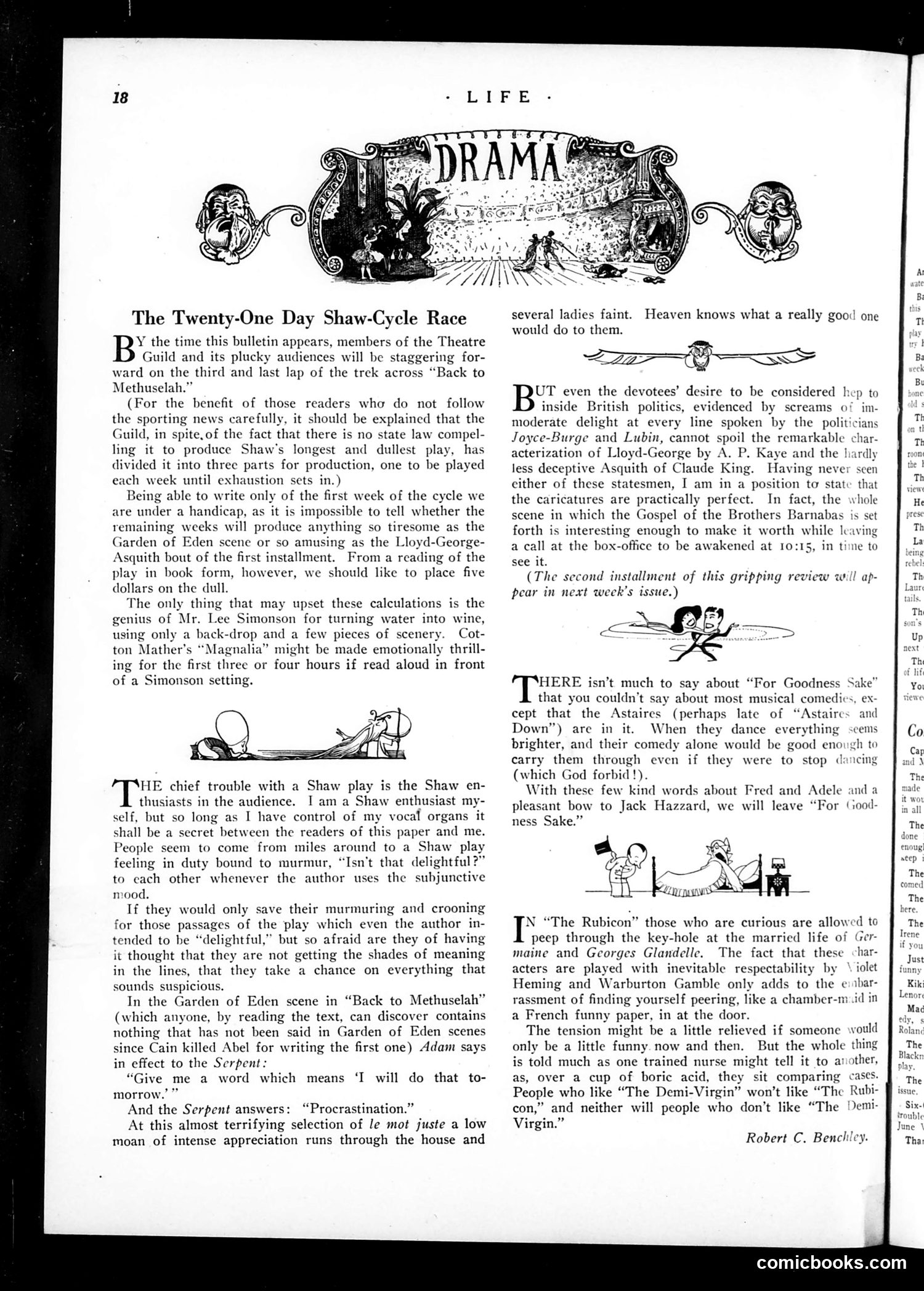
This is a satirical theater review of George Bernard Shaw's "Back to Methuselah," which the Theatre Guild divided into three weekly installments. The reviewer mocks both Shaw's verbose, tedious writing and the pretentious audience behavior it attracts. The satire targets Shaw enthusiasts who attend plays feeling "duty bound" to murmur appreciation at every intellectual line, fearing others will think them unsophisticated. The reviewer ridicules a specific moment where Adam asks the Serpent for a word meaning "procrastination"—a deliberately mundane philosophical exchange that causes audience members to "faint" with overwrought appreciation. The piece also praises the political caricatures of Lloyd-George and Asquith (characters in the play), noting their accuracy despite the reviewer's unfamiliarity with the actual statesmen. The overall joke: Shaw's play is tedious, but his devoted followers won't admit it, performing intellectual appreciation to appear cultured.
📄 Transcribed text from this page (OCR, searchable)
Machine-transcribed from the original scan — historical spelling and the odd misread are preserved.
The Twenty-One Day Shaw-Cycle Race Y the time this bulletin appears, members of the Theatre Guild and its plucky audiences will be staggering for- ward on the third and last lap of the trek across “Back to Methuselah.” (For the benefit of those readers who do not follow the sporting news carefully, it should be explained that the Guild, in spite.of the fact that there is no state law compel- ling it to produce Shaw's longest and dullest play, has divided it into three parts for production, one to be played each week until exhaustion sets in.) Being able to write only of the first week of the cycle we are under a handicap, as it is impossible to tell whether the remaining weeks will produce anything so tiresome as the Garden of Eden scene or so amusing as the Lloyd-George- Asquith bout of the first installment. From a reading of the play in book form, however, we should like to place five dollars on the dull. The only thing that may upset these calculations is the genius of Mr. Lee Simonson for turning water into wine, using only a back-drop and a few pieces of scenery. Cot- ton Mather’s “Magnalia” might be made emotionally thrill- ing for the first three or four hours if read aloud in front of a Simonson setting. HE chief trouble with a Shaw play is the Shaw en- thusiasts in the audience. I am a Shaw enthusiast my- self, but so long as I have control of my vocal organs it shall be a secret between the readers of this paper and me. People seem to come from miles around to a Shaw play feeling in duty bound to murmur, “Isn't that delightful?” to each other whenever the author uses the subjunctive mood. If they would only save their murmuring and crooning for those passages of the play which even the author in- tended to be “delightful,” but so afraid are they of having it thought that they are not getting the shades of meaning in the lines, that they take a chance on everything that sounds suspicious. In the Garden of Eden scene in “Back to Methuselah” (which anyone, by reading the text, can discover contains nothing that has not been said in Garden of Eden scenes since Cain killed Abel for writing the first one) Adam says in effect to the Serpent: “Give me a word which means ‘I morrow.’ ” And the Serpent answers: “Procrastination.” At this almost terrifying selection of le mot juste a low moan of intense appreciation runs through the house and will do that to- several ladies faint. would do to them. 2a Bz even the devotees’ desire to be considered hep to inside British politics, evidenced by screams o/ im- moderate delight at every line spoken by the politicians Joyce-Burge and Lubin, cannot spoil the remarkable char- acterization of Lloyd-George by A. P. Kaye and the hardly less deceptive Asquith of Claude King. Having never seen either of these statesmen, I am in a position to state that the caricatures are practically perfect. In fact, the whole scene in which the Gospel of the Brothers Barnabas is set forth is interesting enough to make it worth while leaving a call at the box-office to be awakened at 10:15, in time to see it. (The second installment of this gripping review will ap- pear in next week's issue.) Heaven knows what a really good one HERE isn’t much to say about “For Goodness Sake” that you couldn't say about most musical comedies, ex- cept that the Astaires (perhaps late of taires and Down”) are in it. When they dance everything seems brighter, and their comedy alone would be good enough to carry them through even if they were to stop dancing (which God forbid !). With these few kind words about Fred and Adele and a pleasant bow to Jack Hazzard, we will leave “For (iood- ness Sake.” | “The Rubicon” those who are curious are allowed to peep through the key-hole at the married life of Ger- maine and Georges Glandelle. The fact that these char- acters are played with inevitable respectability by \ iolet Heming and Warburton Gamble only adds to the e:bar- rassment of finding yourself peering, like a chamber-m id in a French funny paper, in at the door. The tension might be a little relieved if someone would only be a little funny. now and then. But the whole thing is told much as one trained nurse might tell it to another, as, over a cup of boric acid, they sit comparing cases. People who like “The Demi-Virgin” won't like “The Rub con,” and neither will people who don’t like “The Demi- Virgin.” Robert C. Benclile) comicbooks.com