
Life, 1922-03-16 · page 17 of 34
Life — March 16, 1922 — page 17: what you’re looking at
What you’re looking at
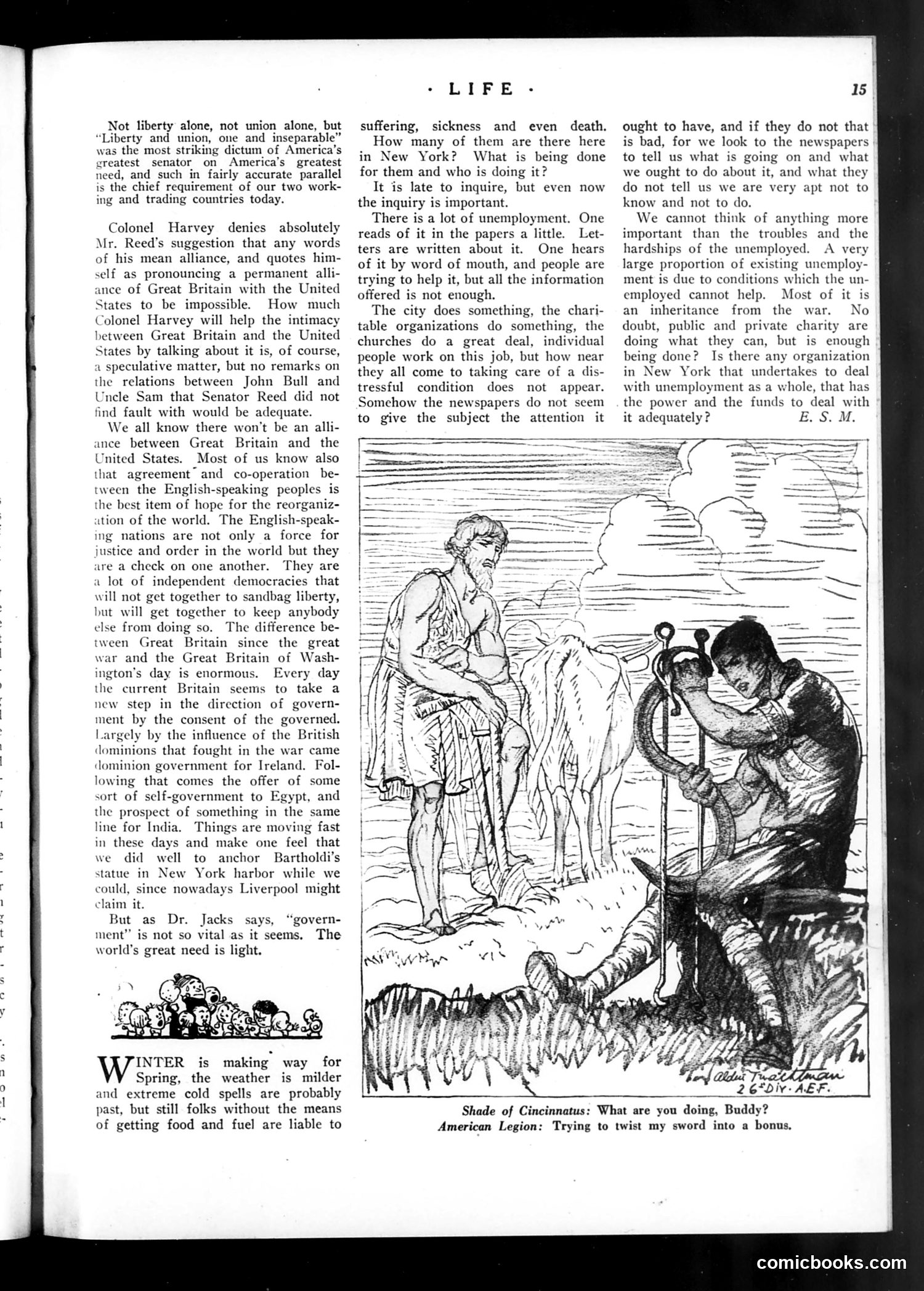
This *Life* magazine page addresses post-WWI American concerns through editorial commentary and a single cartoon. **The Editorial Content** discusses Anglo-American relations, praising cooperation between Britain and the United States while denying any formal alliance. It references Senator Reed's skepticism and Colonel Harvey's diplomatic efforts. The piece also pivots to unemployment and poverty in New York City, criticizing newspapers for insufficient coverage of winter hardship affecting jobless citizens. **The Cartoon** ("Shade of Cincinnati") depicts the American Legion (a veterans' organization founded after WWI) attempting to convert military swords into bonuses—referring to the actual bonus payment controversy. An apparition representing Cincinnati (invoking revolutionary patriotism) questions this action. The satire suggests the Legion's pursuit of financial compensation betrays military/patriotic ideals. **Context**: This reflects post-war veteran tensions, economic hardship, and debates over government responsibility versus private charity—issues dominating American discourse in the early 1920s.
📄 Transcribed text from this page (OCR, searchable)
Machine-transcribed from the original scan — historical spelling and the odd misread are preserved.
Not liberty alone, not union alone, but “Liberty and union, one and inseparable” was the most striking dictum of America’s greatest senator on America’s greatest need, and such in fairly accurate parallel is the chief requirement of our two work- ing and trading countries today. Colonel Harvey denies absolutely Mr. Reed’s suggestion that any words of his mean alliance, and quotes him- self as pronouncing a permanent alli- ance of Great Britain with the United States to be impossible. How much Colonel Harvey will help the intimacy between Great Britain and the United States by talking about it is, of course, 1 speculative matter, but no remarks on the relations between John Bull and Uncle Sam that Senator Reed did not find fault with would be adequate. We all know there won't be an alli- ance between Great Britain and the United States. Most of us know also that agreement” and co-operation be- tween the English-speaking peoples is the best item of hope for the reorganiz- ation of the world. The English-speak- ing nations are not only a force for justice and order in the world but they are a check on one another. They are a lot of independent democracies that will not get together to sandbag liberty, but will get together to keep anybody else from doing s The difference be- tween Great Britain since the great war and the Great Britain of Wash- ington’s day is enormous. Every day the current Britain seems to take a new step in the direction of govern- ment by the consent of the governed. Largely by the influence of the British dominions that fought in the war came dominion government for Ireland. Fol- lowing that comes the offer of some sort of self-government to Egypt, and the prospect of something in the same line for India. Things are moving fast in these days and make one feel that we did well to anchor Bartholdi’s statue in New York harbor while we could, since nowadays Liverpool might claim it. But as Dr. Jacks says, ment” is not so vital as it seems, world’s great need is light. “govern- The INTER is making way for Spring, the weather is milder and extreme cold spells are probably past, but still folks without the means of getting food and fuel are liable to * LIFE - suffering, sickness and even death. How many of them are there here in New York? What is being done for them and who is doing it? It is late to inquire, but even now the inquiry is important. There is a lot of unemployment. One reads of it in the papers a little. Let- ters are written about it. One hears of it by word of mouth, and people are trying to help it, but all the information offered is not enough. The city does something, the chari- table organizations do something, the churches do a great deal, individual people work on this job, but how near they all come to taking care of a dis- tressful condition does not appear. Somehow the newspapers do not seem to give the subject the attention it ought to have, and if they do not that is bad, for we look to the newspapers to tell us what is going on and what we ought to do about it, and what they do not tell us we are very apt not to know and not to do. We cannot think of anything more important than the troubles and the hardships of the unemployed. A very large proportion of existing unemploy- ment is due to conditions which the un- employed cannot help. Most of it is an inheritance from the war. No doubt, public and private charity are doing what they can, but is enough being done? Is there any organization in New York that undertakes to deal with unemployment as a whole, that has the power and the funds to deal with it adequately? Bhlui 5 26*Div- AEF. Shade of Cincinnatus: What are you doing, Buddy? American Legion: Trying to twist my sword into a bonus. comicbooks.com