
Life, 1922-03-16 · page 16 of 34
Life — March 16, 1922 — page 16: what you’re looking at
What you’re looking at
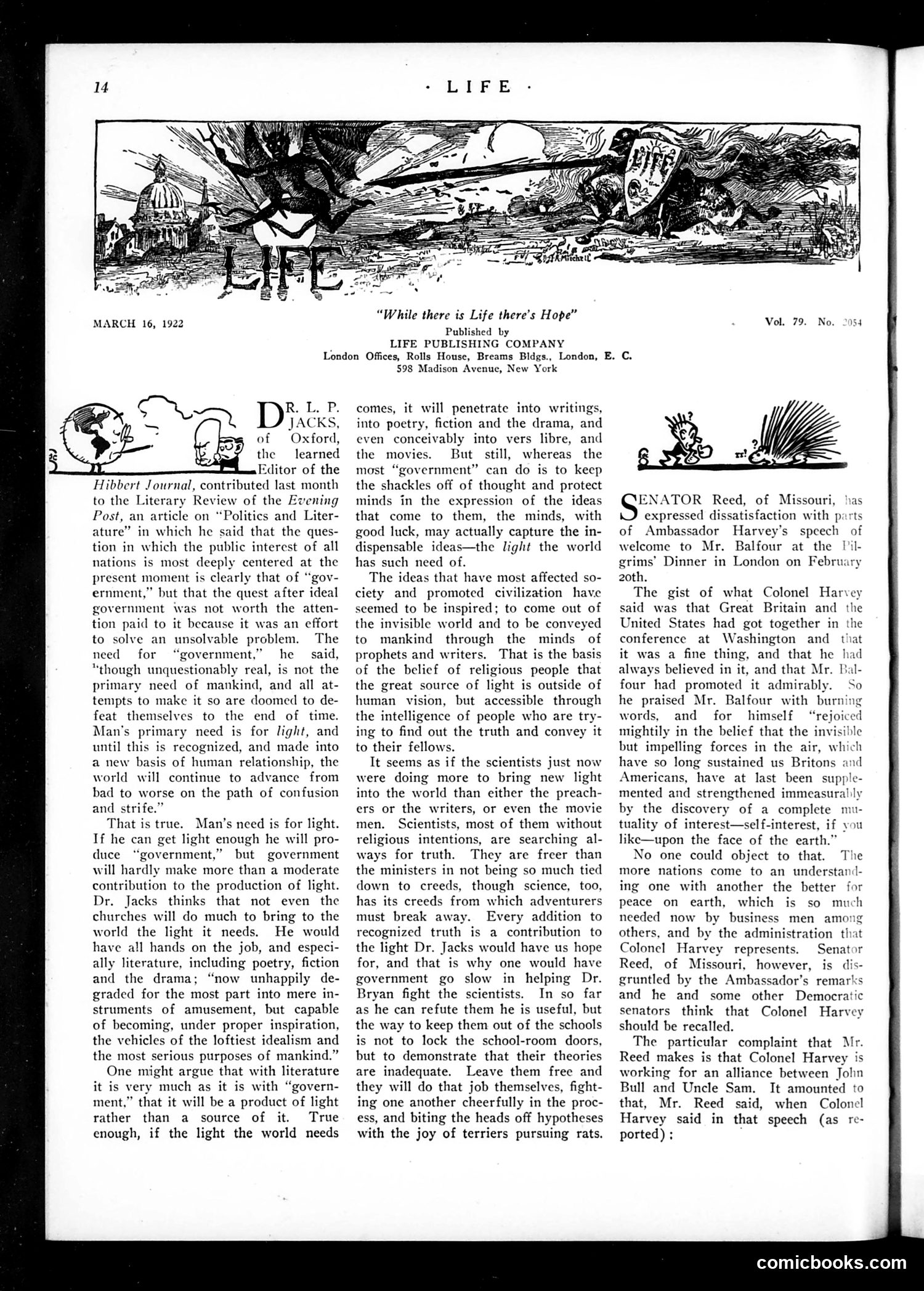
This page features an editorial by Dr. L.P. Jacks discussing the public's need for "light" — both literal illumination and intellectual/spiritual enlightenment. The article argues that literature, poetry, and drama should convey truth and inspire civilization rather than merely entertain. The piece critiques slow government support for scientific advancement and education, contrasting this with religious institutions' historical role in spreading knowledge. It advocates for freeing schools from restrictive theory and allowing intellectual experimentation. The final section addresses Senator Reed of Missouri's criticism of Colonel Harvey's pro-British remarks at a London dinner, suggesting political disagreement over Anglo-American relations. The cartoon header depicts a symbolic landscape with "LIFE" lettering, reinforcing themes of hope and illumination.
📄 Transcribed text from this page (OCR, searchable)
Machine-transcribed from the original scan — historical spelling and the odd misread are preserved.
MARCH 16, 1922 “While there is Life there's Hope” Published by LIFE PUBLISHING COMPANY Vol. 79. No. London Offices, Rolls House, Breams Bldgs., London, E. C. R. L. P. JACKS, of Oxford, the learned Editor of the Journal, contributed last month to the Literary Review of the Evening Post, an article on “Politics and Liter- ature” in which he said that the ques- tion in which the public interest of all nations is most deeply centered at the present moment is clearly that of “gov- ernment,” but that the quest after ideal government was not worth the atten- tion paid to it because it was an effort to solve an unsolvable problem. The need for “government,” he — said, “though unquestionably real, is not the primary need of mankind, and all at- tempts to make it so are doomed to de- feat themselves to the end of time. Man's primary need is for light, and until this is recognized, and made into a new basis of human relationship, the world will continue to advance from bad to worse on the path of confusion and strife.” That is true. Man's need is for light. If he can get light enough he will pro- duce “government,” but government will hardly make more than a moderate contribution to the production of light. Dr. Jacks thinks that not even the churches will do much to bring to the world the light it needs. He would have all hands on the job, and especi- ally literature, including poetry, fiction and the drama; “now unhappily de- graded for the most part into mere in- struments of amusement, but capable of becoming, under proper inspiration, the vehicles of the loftiest idealism and the most serious purposes of mankind.” One might argue that with literature it is very much as it is with “govern- ment,” that it will be a product of light rather than a source of it. True enough, if the light the world needs 598 Madison Avenue, New York comes, it will penetrate into writings, into poetry, fiction and the drama, and even conceivably into vers libre, and the movies. But still, whereas the most “government” can do is to keep the shackles off of thought and protect minds in the expression of the ideas that come to them, the minds, with good luck, may actually capture the in- dispensable ideas—the light the world has such need of. The ideas that have most affected so- ciety and promoted civilization have seemed to be inspired; to come out of the invisible world and to be conveyed to mankind through the minds of prophets and writers. That is the basis of the belief of religious people that the great source of light is outside of human vision, but accessible through the intelligence of people who are try- ing to find out the truth and convey it to their fellows. It seems as if the scientists just now were doing more to bring new light into the world than either the preach- ers or the writers, or even the movie men. Scientists, most of them without religious intentions, are searching al- ways for truth. They are freer than the ministers in not being so much tied down to creeds, though science, too, has its creeds from which adventurers must break away. Every addition to recognized truth is a contribution to the light Dr. Jacks would have us hope for, and that is why one would have government go slow in helping Dr. Bryan fight the scientists. In so far as he can refute them he is useful, but the way to keep them out of the schools is not to lock the school-room doors, but to demonstrate that their theories are inadequate. Leave them free and they will do that job themselves, fight- ing one another cheerfully in the proc- ess, and biting the heads off hypotheses with the joy of terriers pursuing rats. ENATOR Reed, of Missouri, has expressed dissatisfaction with parts of Ambassador Harvey’s speech of welcome to Mr. Balfour at the l’il- grims’ Dinner in London on February 20th. The gist of what Colonel Harvey said was that Great Britain and the United States had got together in the conference at Washington and_ that it was a fine thing, and that he h always believed in it, and that Mr. 1 four had promoted it admirably. he praised Mr. Balfour with burning words, and for himself “rejoiced mightily in the belief that the invisible but impelling forces in the air, which have so long sustained us Britons and Americans, have at last been sup mented and strengthened immeasur: by the discovery of a complete mu- tuality of interest—self-interest, if you like—upon the face of the earth.” No one could object to that. The more nations come to an understand- ing one with another the better for peace on earth, which is so much needed now by business men among others, and by the administration that Colonel Harvey represents. Senator Reed, of Missouri, however, is dis- gruntled by the Ambassador’s remarks and he and some other Democratic senators think that Colonel Harvey should be recalled. The particular complaint that Mr. Reed makes is that Colonel Harvey is working for an alliance between Jolin Bull and Uncle Sam. It amounted to that, Mr. Reed said, when Colonel Harvey said in that speech (as re- ported) ; comicbooks.com