
A complete issue · 34 pages · 1922
Life — February 16, 1922
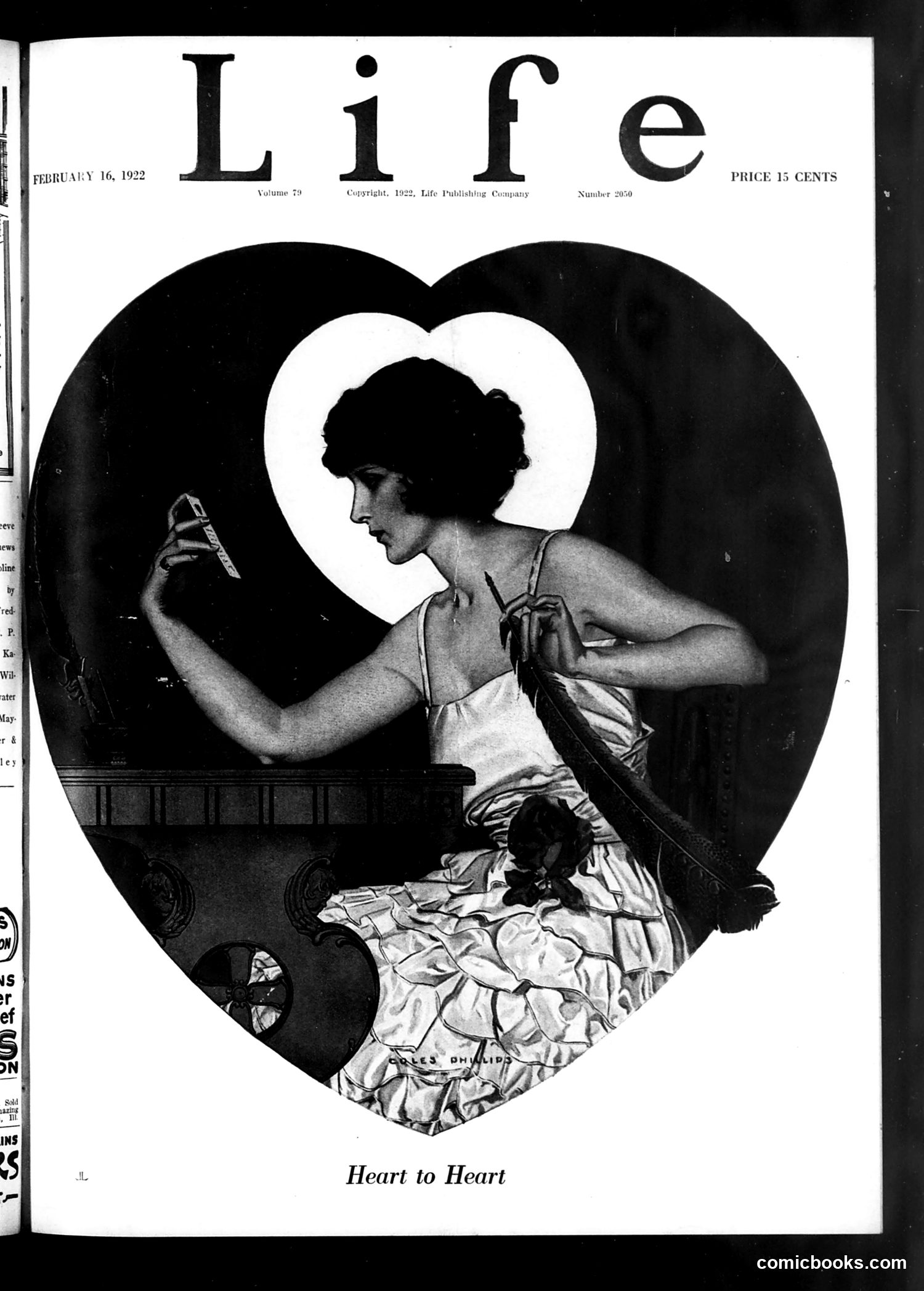
This cover illustration depicts a woman admiring herself in a mirror, with the title "Heart to Heart" below. The woman appears to be primping or checking her appearance—a common vanity theme in 1920s satire. The heart-shaped frame and romantic staging suggest this is commentary on feminine narcissism or self-absorption, likely poking fun at fashionable modern women of the Jazz Age era. The illustration's style is typical of Life's satirical covers from this period, which frequently mocked contemporary social behaviors and gender dynamics. Without additional OCR text from inside the magazine, the specific satirical target remains somewhat unclear, though it likely comments on women's vanity, self-regard, or romantic preoccupations during the 1920s.
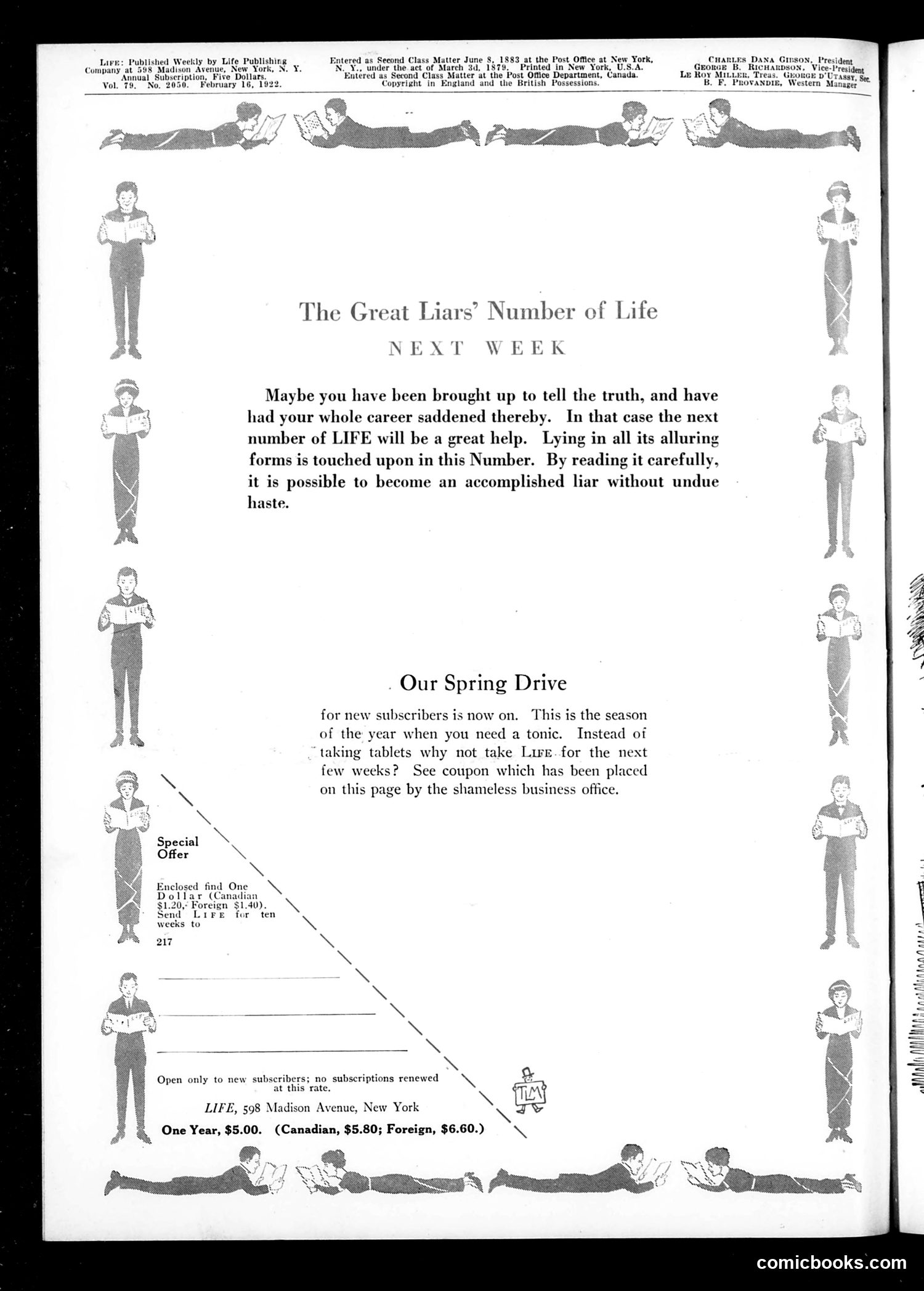
This page is primarily **advertising for Life magazine's upcoming issue**, not a political cartoon. The main content promotes next week's feature called "The Great Liars' Number," which will humorously teach readers "how to become an accomplished liar without undue haste." The page uses decorative border illustrations of people reading newspapers in various poses. Below, there's a "Spring Drive" subscription solicitation offering Life for new subscribers at $5/year (or $5.80 Canadian, $6.60 foreign). The satire is mild and self-referential—Life positioning itself as entertainment that playfully instructs on deception. The decorative figures suggest readers eagerly consuming content. This appears to be typical magazine promotion from the era, using humor to encourage subscriptions rather than commenting on current events.
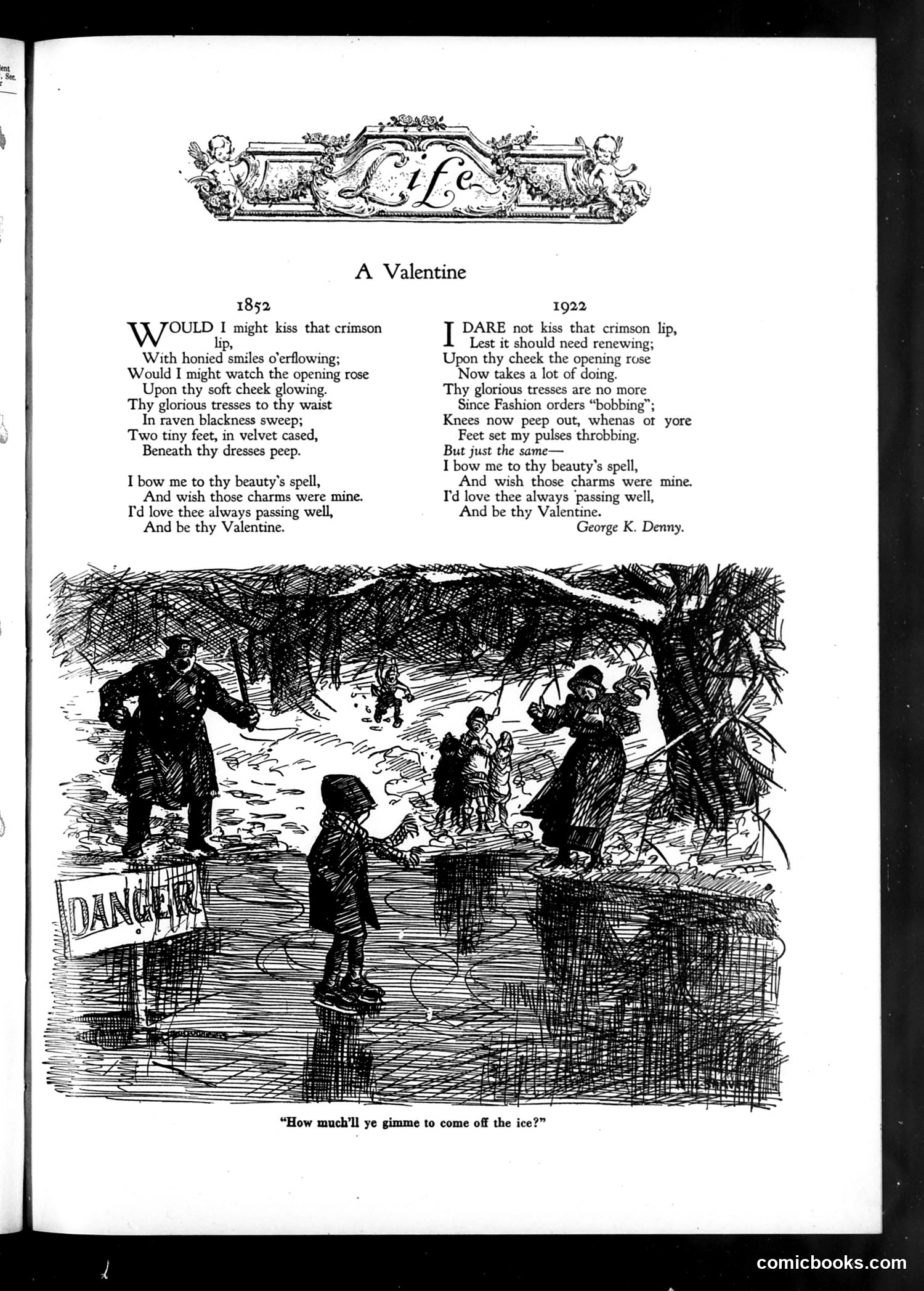
This page presents a poem titled "A Valentine" by George K. Denny, contrasting romantic ideals from 1852 versus 1922. The left stanza expresses Victorian sentimentality about a beloved's physical beauty and charm. The right stanza, dated seventy years later, satirizes how modern women have changed—"knees now peep out," fashion has abandoned modesty, and women are more athletic ("pulses throbbing"). The accompanying illustration shows people on frozen ice with a "DANGER" sign, depicting ice-skating. The caption "How much'll ye gimme to come off the ice?" suggests the cartoon mocks either the recklessness of modern youth or changing social norms around courtship and propriety. The satire critiques how dramatically women's fashion, behavior, and social roles had shifted in the early twentieth century.
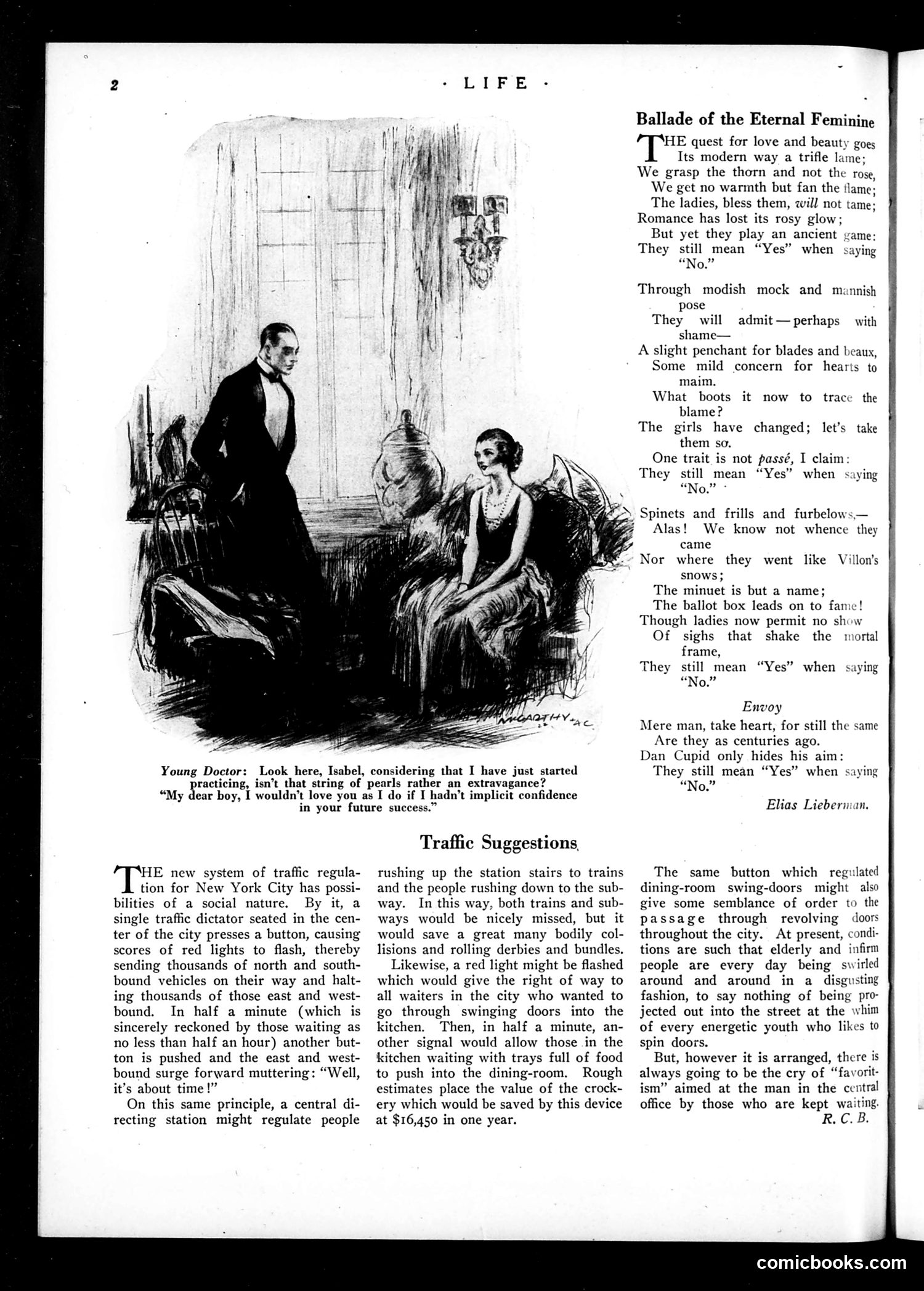
**The Cartoon:** The sketch depicts a young doctor speaking to a woman named Isabel, asking her to marry him despite his modest circumstances. The caption captures his nervous pitch: he's asking her to accept his proposal based on his future success rather than current wealth. **The Social Commentary:** This satirizes early 20th-century courtship conventions where a woman's acceptance of marriage depended heavily on a man's financial prospects. The young doctor represents the struggling professional trying to convince a woman to marry "on spec"—betting on his future earnings rather than present means. **The Poem & Article Below:** "Ballade of the Eternal Feminine" mocks women's persistent tendency to say "Yes" to marriage proposals despite changing times, while "Traffic Suggestions" proposes humorous urban traffic-control solutions for New York City.
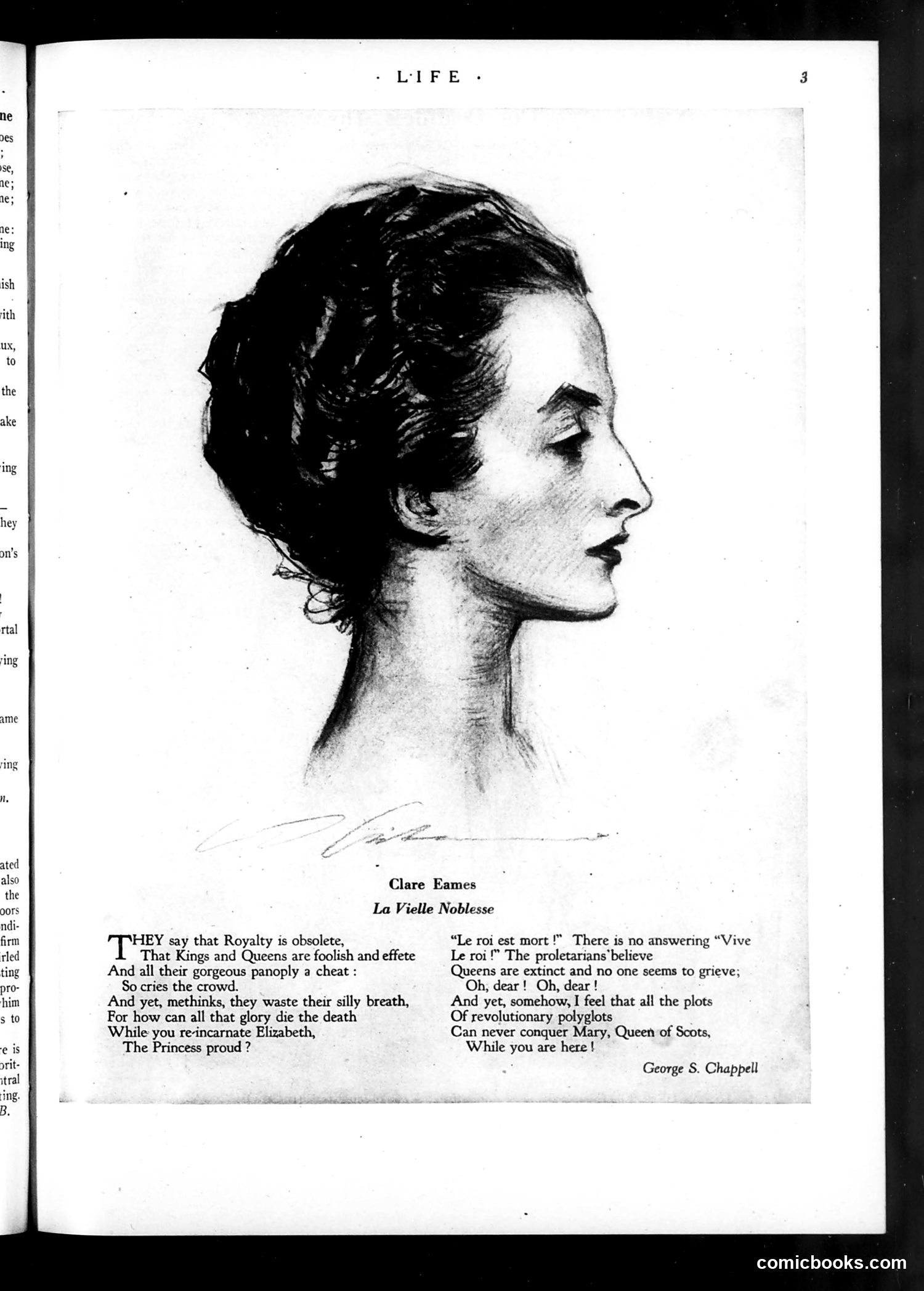
This page features a portrait of **Clare Eames**, labeled "La Vielle Noblesse" (The Old Nobility). Below is a poem by George S. Chappell critiquing the concept of royalty as "obsolete." The satire contrasts the elegant, classical profile drawing with a poem dismissing kings and queens as "foolish and effete," arguing their "glory die[s]" while they're reincarnated. The closing question—"The Princess proud?"—appears skeptical of aristocratic pretension. This likely reflects 1920s-era anti-monarchist sentiment following World War I and various European revolutions. The pairing of Eames's refined portrait with anti-royalty verse creates ironic tension, perhaps suggesting that even refined individuals cannot escape criticism of the outdated nobility system itself.
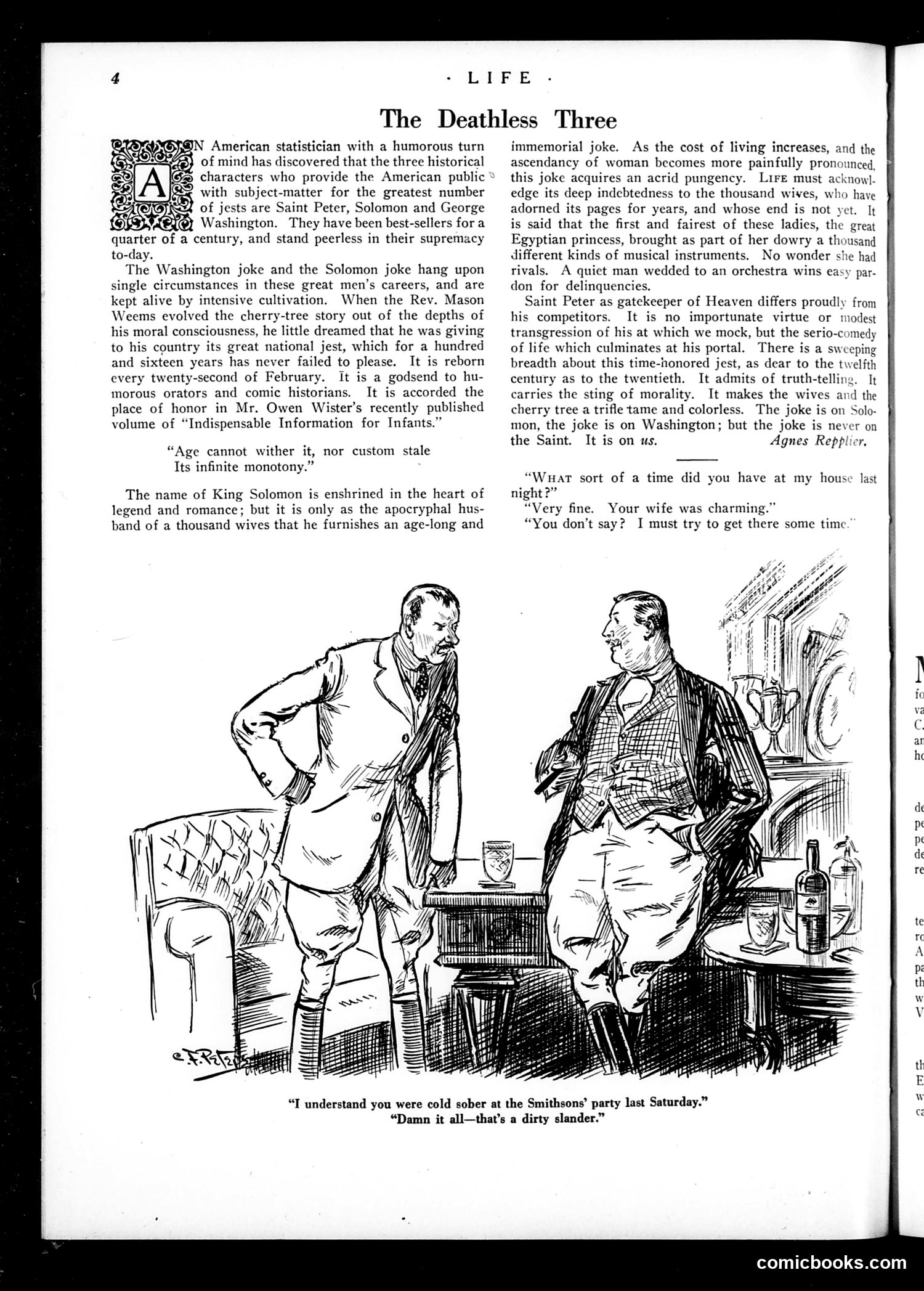
This page discusses three historical figures—Saint Peter, Solomon, and George Washington—whose associated jokes have endured for centuries. The text argues these men became cultural fixtures partly through apocryphal humor rather than historical accuracy. The cartoon illustrates a "Solomon joke"—a domestic scene where one man tells another he attended a party at "the Smithsons'" where the second man was "cold sober," prompting the reply "Damn it all—that's a dirty slander." The joke's structure relies on Solomon's legendary thousand wives; the implication is that the man gossips so persistently that even being sober—the opposite of the usual excuse for indiscretion—becomes scandalous. It's observational humor about social reputation and marital discord, demonstrating how these traditional jokes persist through relatable domestic situations.
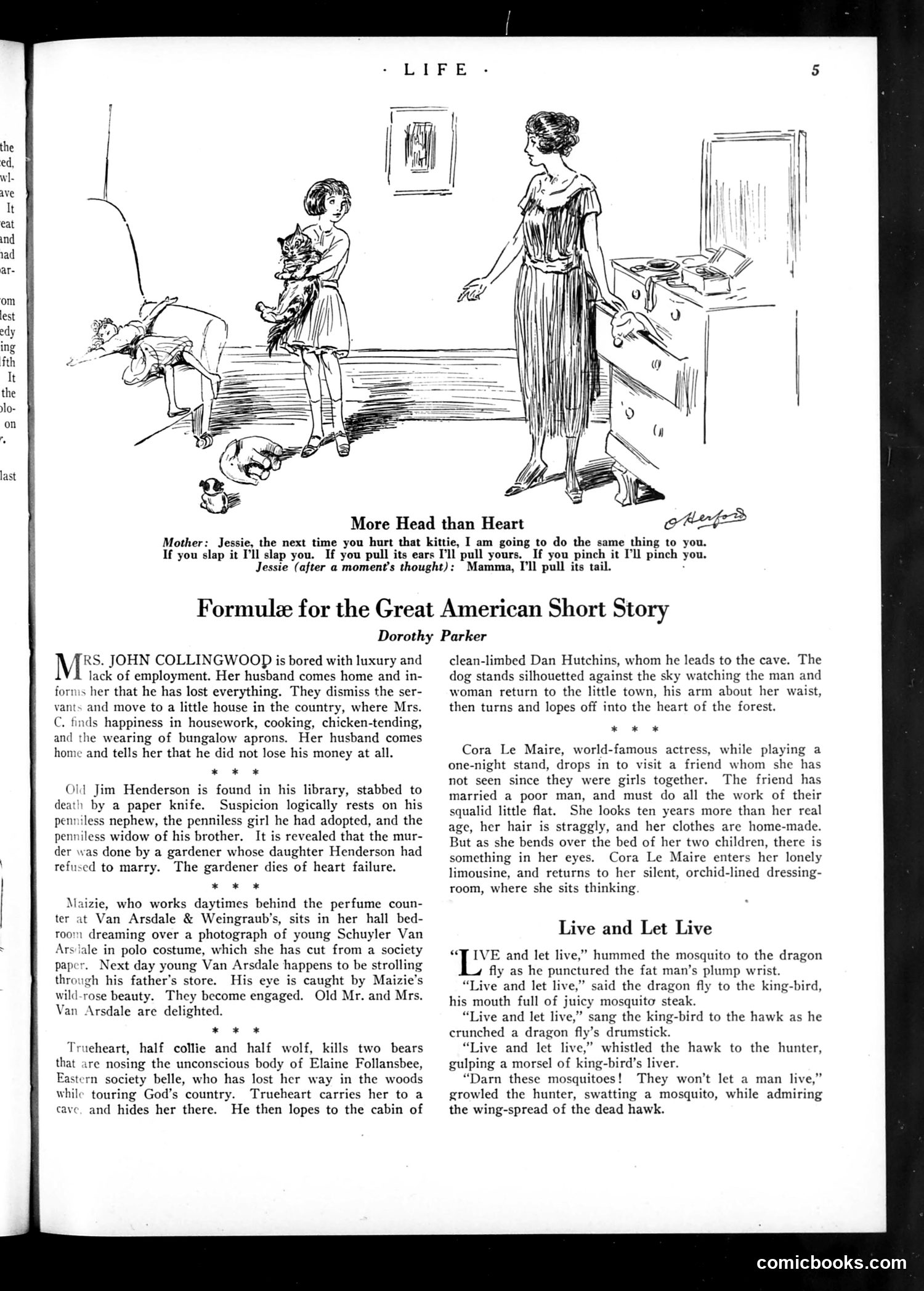
This cartoon satirizes harsh parenting through a domestic scene. A mother threatens her child with physical punishment ("I am going to do the same thing to you") after the child mistreats a kitten. The caption's title suggests the mother acts from intellect rather than compassion—she understands discipline but lacks warmth. The child's final thought—"I'll pull its tail"—indicates the punishment fails to teach empathy, only fear. This critiques a common parenting philosophy of the era: that physical discipline alone develops character without emotional understanding. Below, Dorothy Parker's article on "Formulas for the Great American Short Story" offers literary commentary, while "Live and Let Live" presents a fable about predatory nature, possibly commenting on similar themes of dominance and survival.
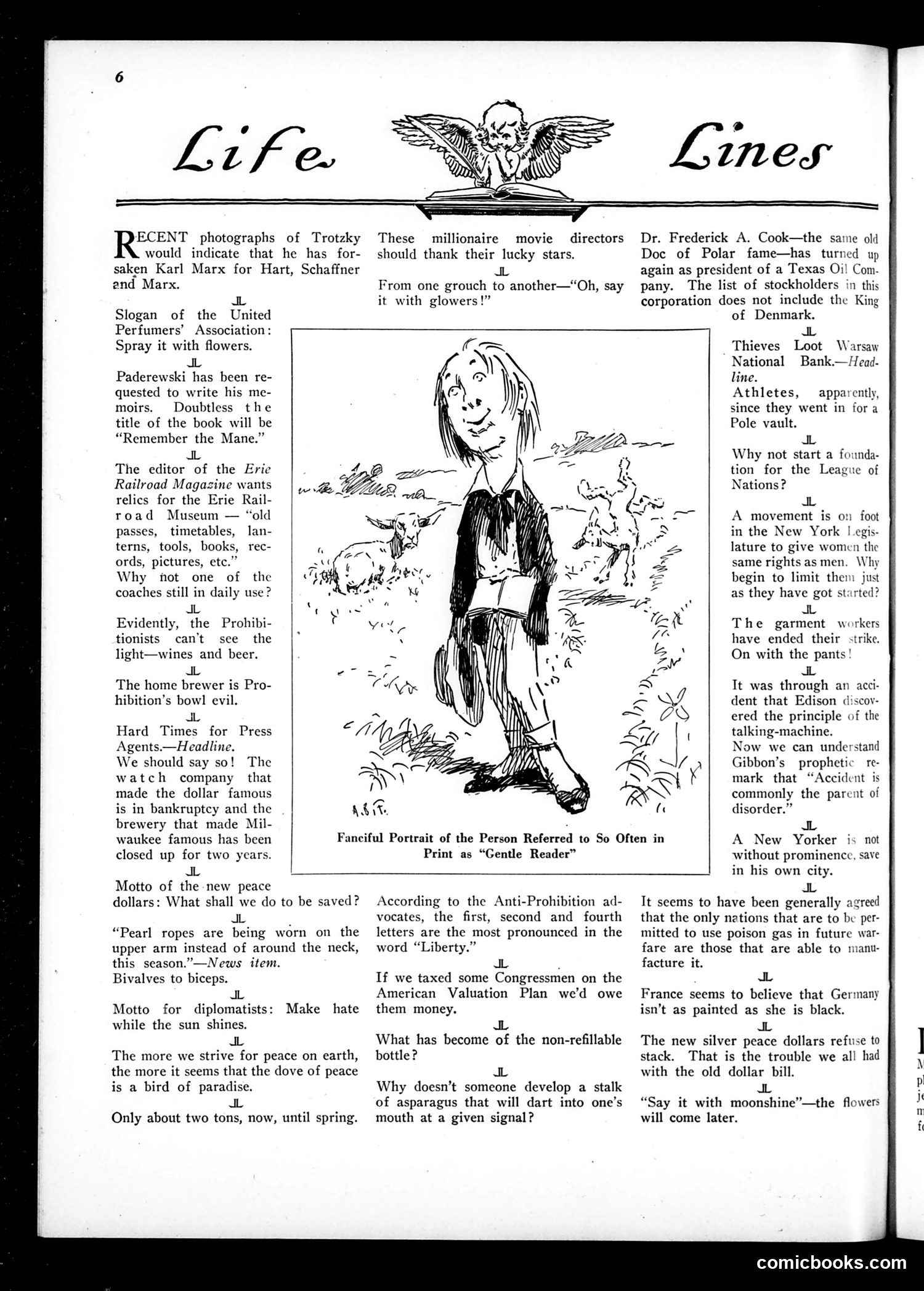
This page contains miscellaneous satirical observations and jokes rather than political cartoons. The central illustration shows a caricatured figure labeled "Fanciful Portrait of the Person Referred to So Often in Print as 'Gentle Reader'"—a humorous jab at the common journalistic phrase. The "Life Lines" section consists of brief witticisms on contemporary topics: Prohibition (mocking breweries and home brewers), women's rights movements, diplomatic relations, and wartime concerns about poison gas. References to Trotsky, Edison, and mentions of asparagus weapons appear as non-sequitur humor typical of the magazine's style. The overall tone mocks post-WWI politics, gender equality activism, and Prohibition-era hypocrisy through short, punchy observations rather than sustained narrative satire.
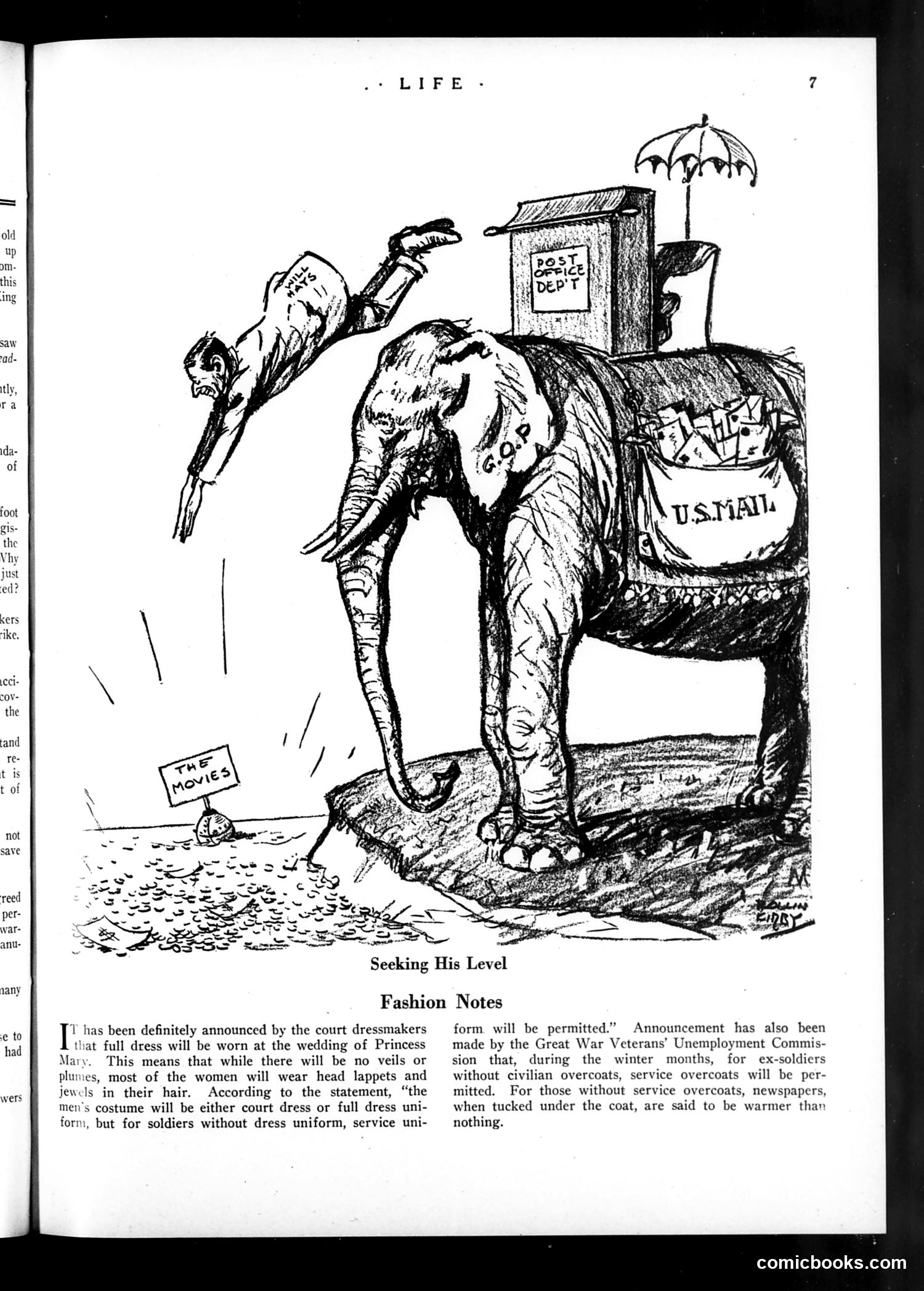
This political cartoon depicts an elephant labeled "G.O.P." (Republican Party) at a post office, appearing to mail something labeled "THE MOVIES" to "THE MOLES." A well-dressed figure (likely a politician) holds an umbrella nearby. The satire targets Republican involvement with or support for the movie industry, suggesting they're operating at a subterranean level—"the moles" being a derogatory reference, implying underhanded or secretive dealings. The phrase "seeking his level" suggests the GOP is descending to corrupt or disreputable practices. The accompanying "Fashion Notes" discusses Princess Mary's wedding attire and ex-soldier unemployment relief, topics likely contemporary to this issue.
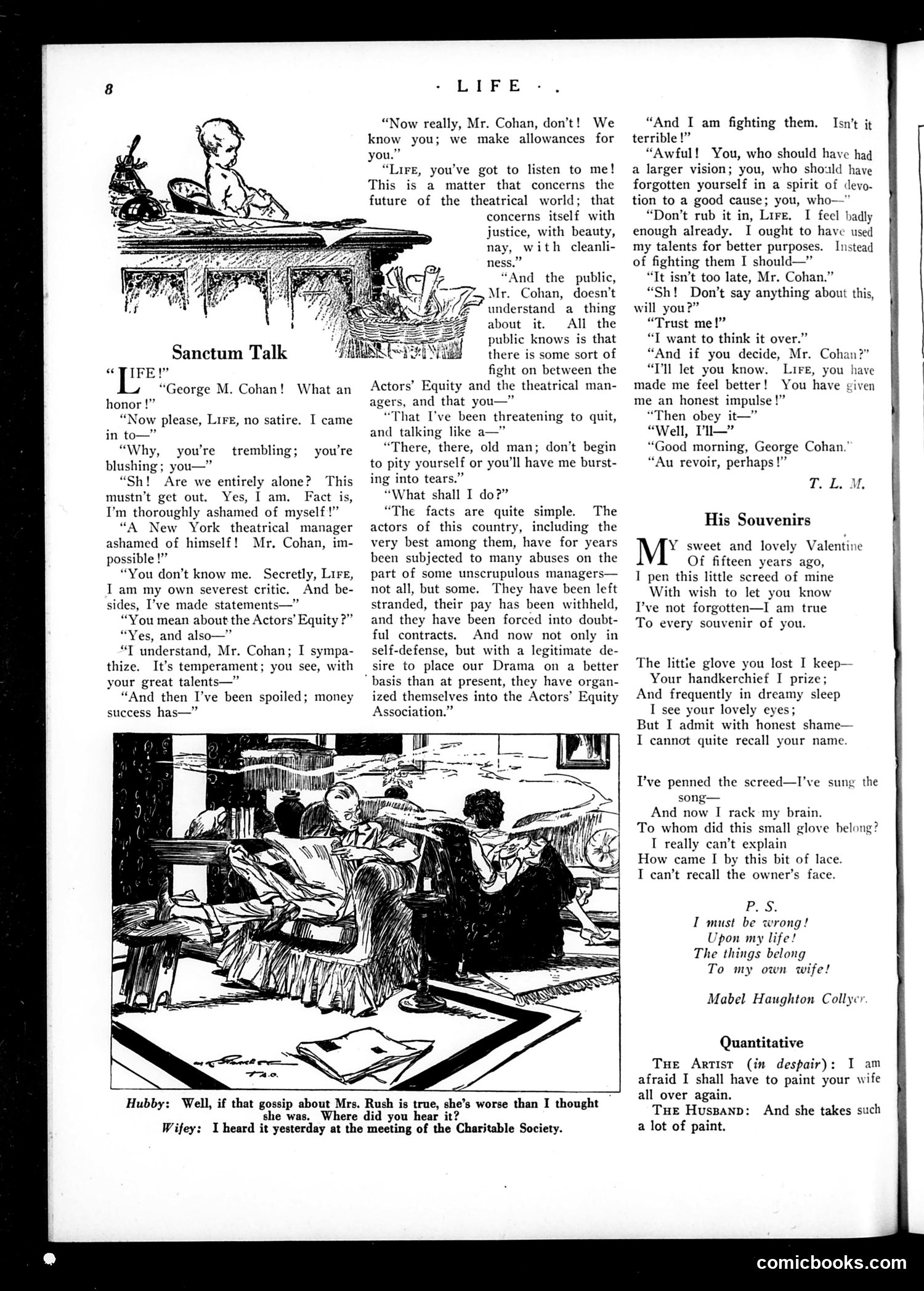
This page contains a dialogue between "Life" (the magazine's personified voice) and George M. Cohan, a prominent American actor and playwright of the early 20th century. Life confronts Cohan about his behavior regarding the Actors' Equity Association strike, accusing him of threatening to quit and questioning his commitment to theatrical reform. The cartoon below depicts two men gossiping, with the caption indicating they're discussing rumors about "Mrs. Rush" from a "Charitable Society" meeting—typical society-page gossip material. The right column features romantic poems titled "His Souvenirs," sentimental verses about lost love and forgotten memories, likely responding to reader submissions. The page combines satirical editorial commentary on theater industry conflicts with lighter humor and romantic sentiment.
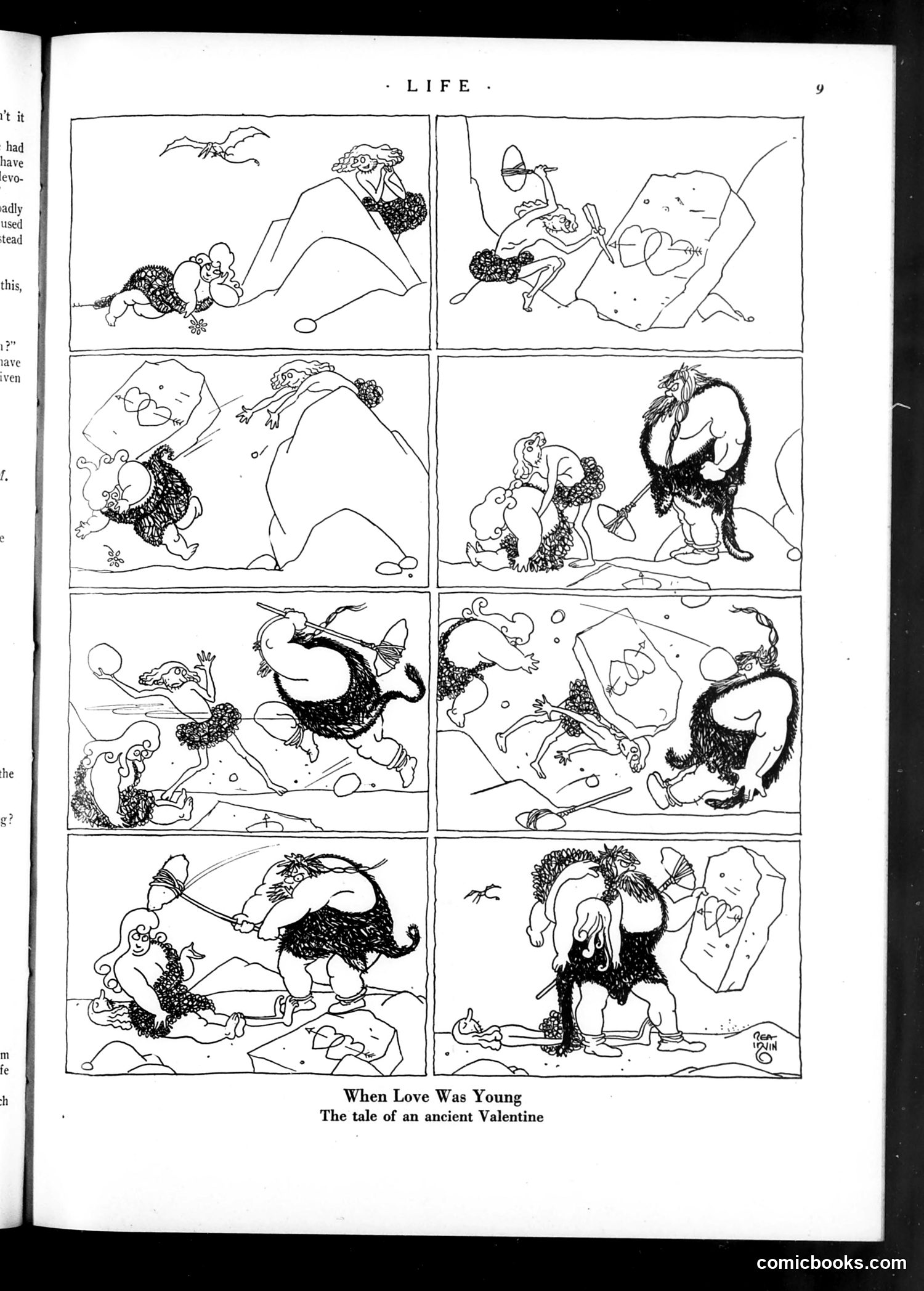
This is a humorous comic strip showing two primitive, hairy figures (appearing to represent early humans or cavemen) engaged in courtship rituals. The narrative progresses through eight panels depicting increasingly chaotic romantic gestures—from presenting flowers and hearts, through playful fighting, to more destructive behavior involving clubs and scattered debris. The satire appears to be commenting on the timeless, primal nature of romantic love and courtship, suggesting that despite civilization's progress, human romantic behavior remains fundamentally unchanged from our "caveman" ancestors. The joke is that elaborate Valentine's traditions are merely modern refinements of basic animal instinct—the fundamental messiness and chaos of love transcends all eras.
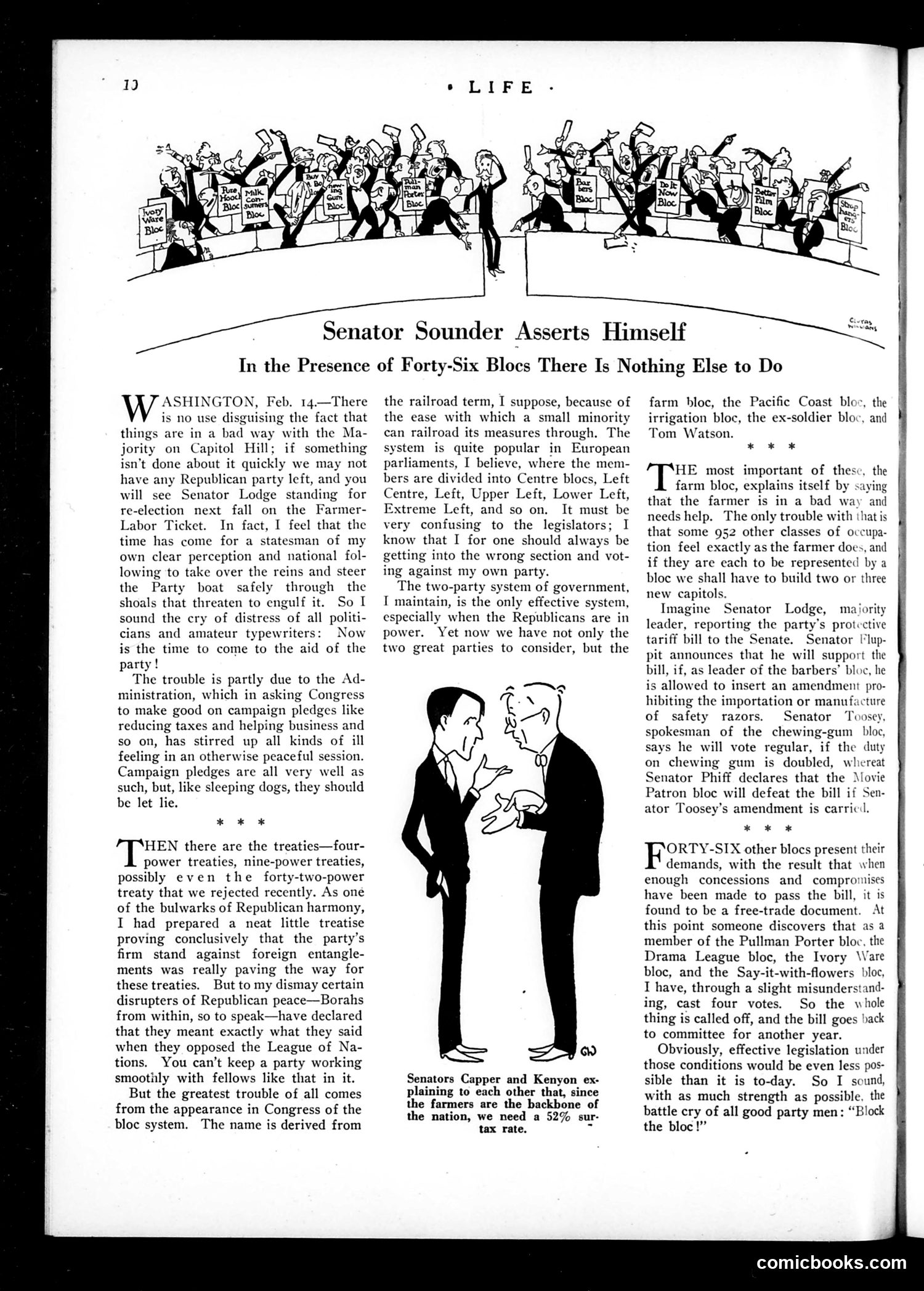
This Life magazine page satirizes Congressional gridlock caused by competing "blocs" — interest groups that fragment legislative action. Senator Sounder (a fictional character) argues that with 46 blocs present, meaningful governance is impossible. The cartoon depicts various bloc representatives (farmers, railroad interests, Pacific Coast irrigation advocates, etc.) holding signs, illustrating how fragmented special interests paralyze Congress. The lower illustration shows Senators Capper and Kenyon discussing how farmers form the "backbone" of the nation yet need protection through tariffs. The satire critiques the bloc system itself: while ostensibly representing constituencies, these organized groups actually prevent effective two-party governance and create a "free-trade" stalemate. The article argues that only strong two-party politics can function smoothly—bloc politics descends into perpetual compromise and gridlock.
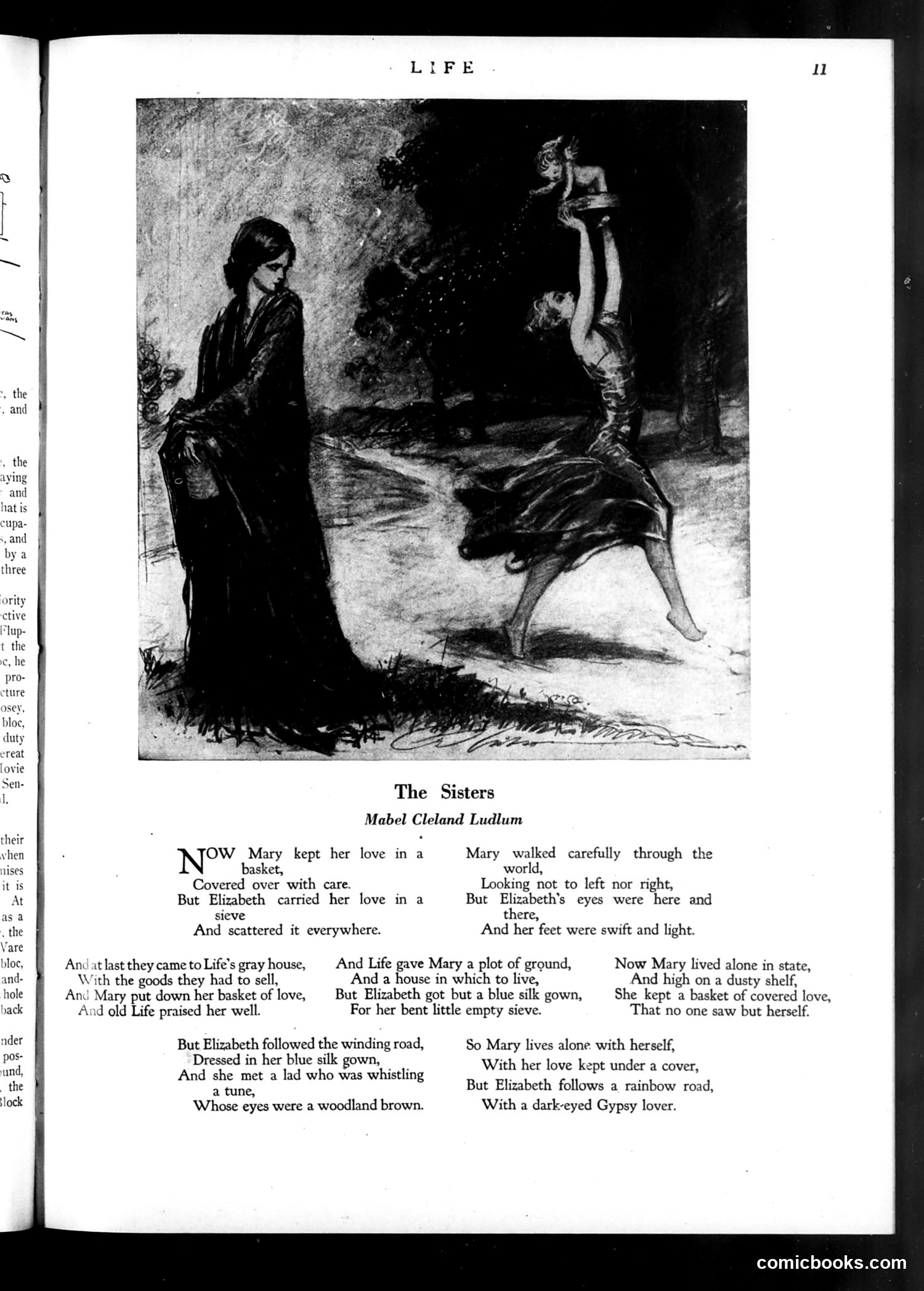
This is a poem illustrated with a dramatic sketch, not political satire. The image shows two contrasting female figures: one in dark clothing standing still and composed, the other in lighter dress with raised arm in an animated, expressive pose. The poem uses the sisters as a metaphor for different life philosophies. Mary "kept her love in a basket" (restrained, careful), while Elizabeth "scattered it everywhere" (freely given). Their divergent paths—Mary living alone with her "covered" love, Elizabeth following a "rainbow road" with passion—illustrate choices between emotional restraint and romantic abandon. This appears to be literary/philosophical commentary on female independence and emotional expression rather than political commentary.
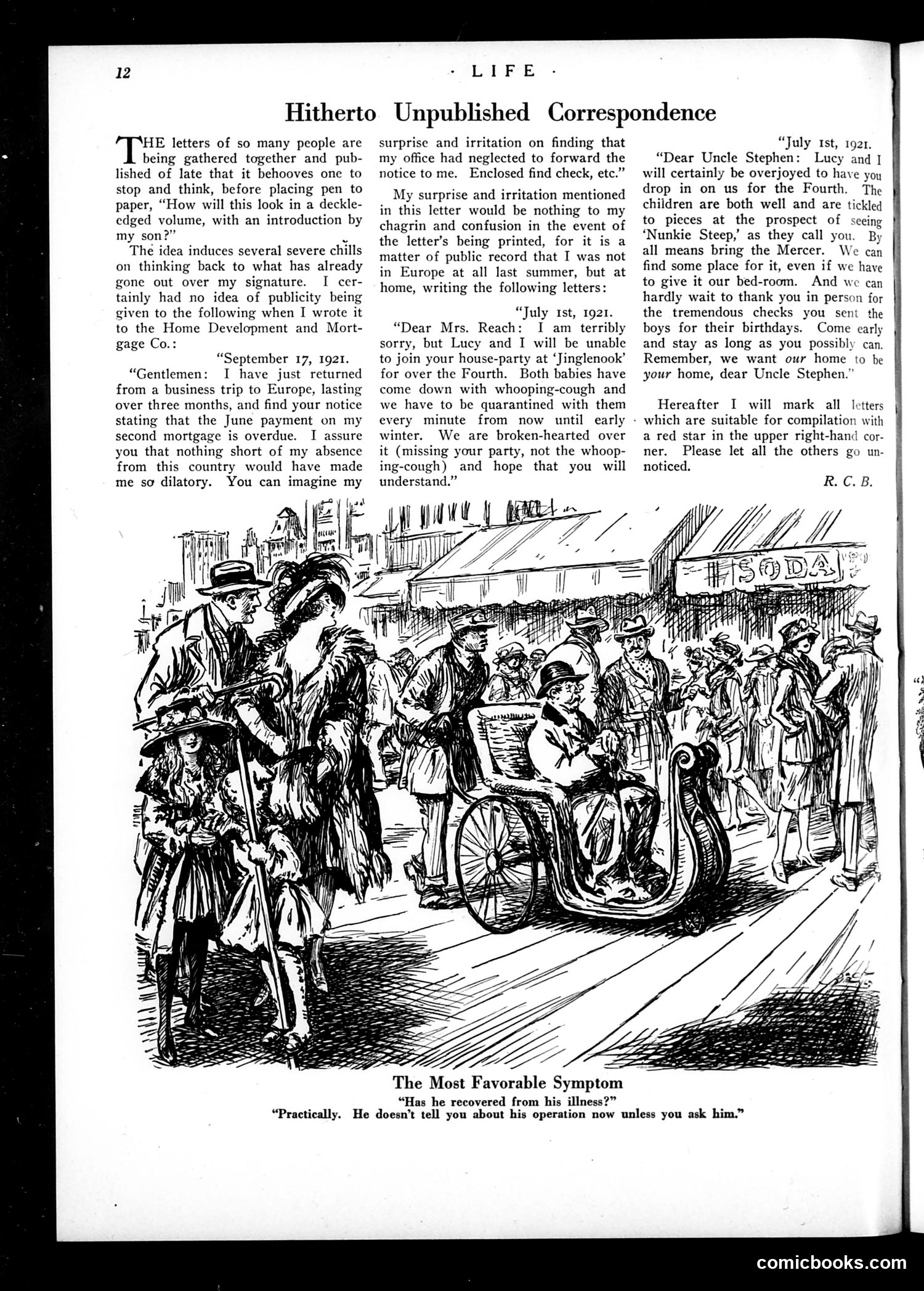
This cartoon satirizes people's reluctance to discuss their medical conditions or surgical procedures. The caption quotes a doctor saying a patient "has recovered from his illness" but "doesn't tell you about his operation now unless you ask him." The crowded street scene shows a man with a visible abdominal scar or bandage, surrounded by pedestrians. The joke critiques social embarrassment around bodily functions and medical matters—a patient may physically recover well but avoids mentioning surgery due to Victorian-era propriety and social discomfort with discussing health problems publicly. The "favorable symptom" is actually psychological: the patient's silence and apparent shame about his operation, rather than any physical improvement. It mocks both the patient's bashfulness and society's squeamishness about medical topics.
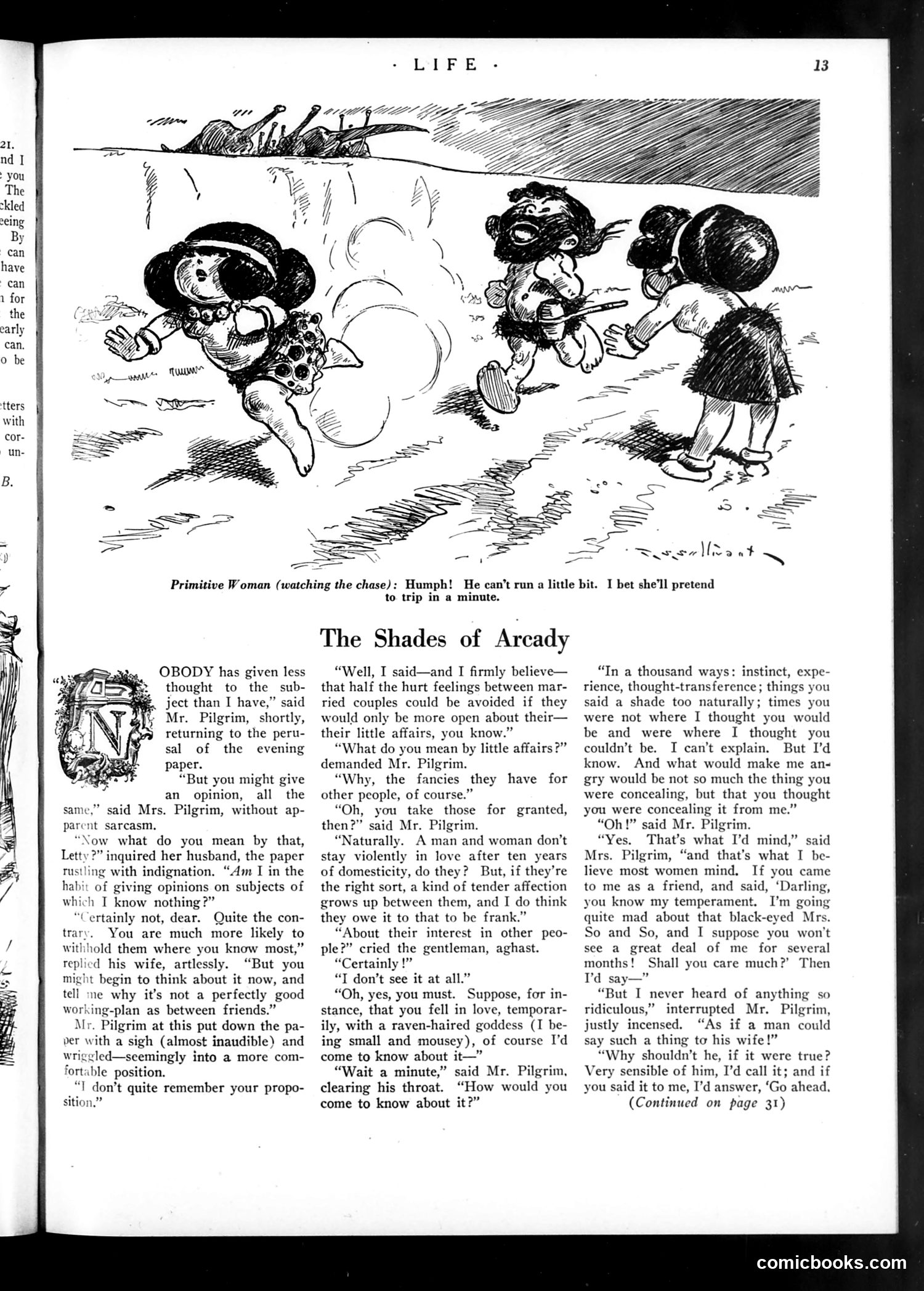
This page presents a satirical story about marriage and infidelity. The cartoon at top shows "Primitive Woman (watching the chase)" observing what appears to be children at play, with a comment about pretending to "trip in a minute." The main text, "The Shades of Arcady," is a dialogue between Mr. and Mrs. Pilgrim debating whether married couples can avoid affairs. Mrs. Pilgrim argues that "little affairs" between married people are inevitable and common. Mr. Pilgrim counters that such infidelity could be avoided through openness and honesty. The story satirizes contemporary attitudes toward marriage, fidelity, and gender relations—suggesting that early-20th-century society normalized marital infidelity as natural human behavior, while also questioning whether frank communication between spouses could prevent it.
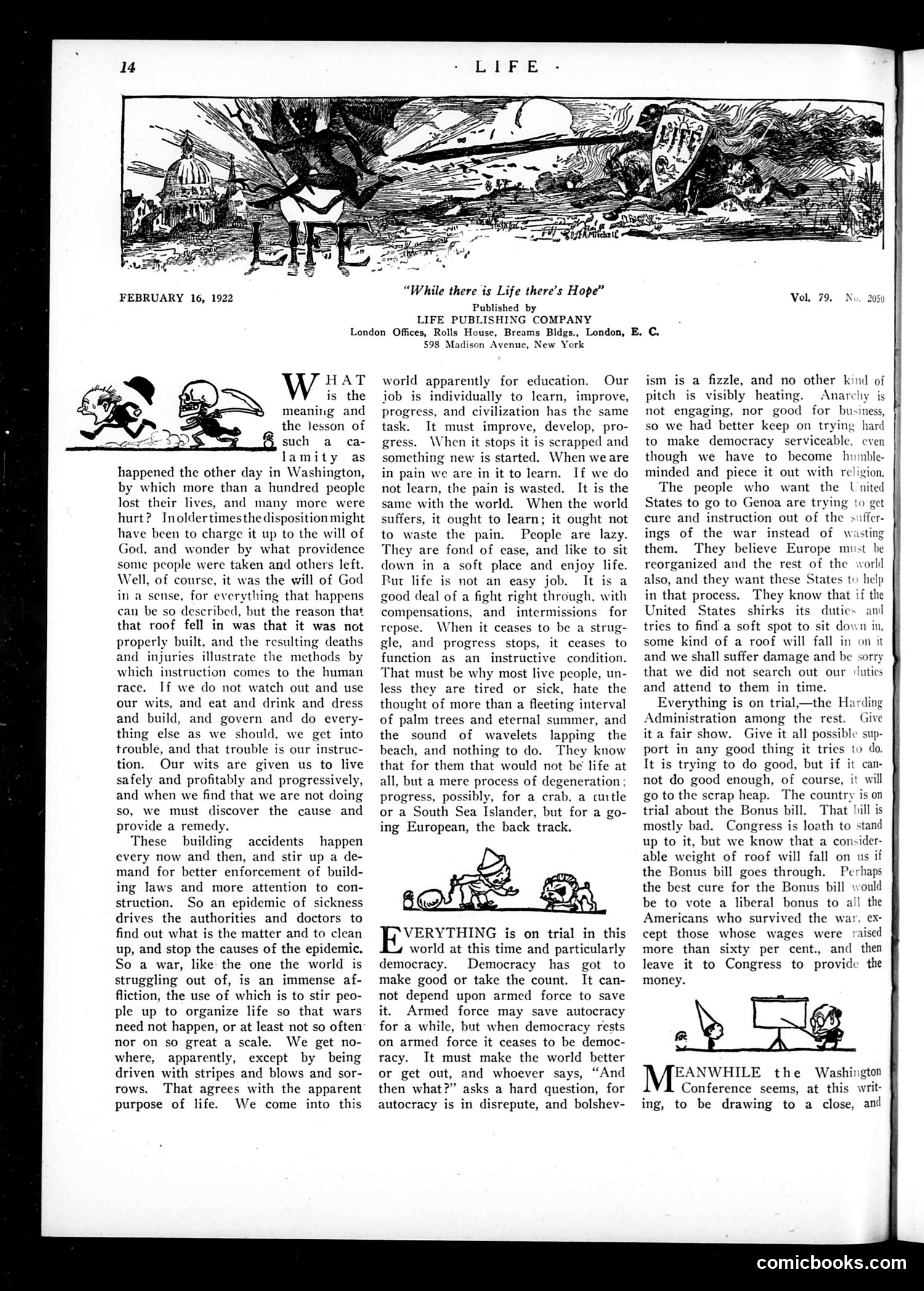
This editorial page discusses post-WWI reconstruction and American democracy. The main article criticizes both government inefficiency and anarchist ideology, arguing that "democracy has got to make good or take the count." It warns that armed force might temporarily save democracy but undermines it long-term. The small cartoon illustrations (appearing to show simple figures in conflict or distress) likely reinforce themes of social upheaval. The text references the Washington Conference (visible in "MEANWHILE" section), suggesting contemporary peace negotiations. The overall message: America faces a critical test between maintaining democratic institutions or risking authoritarian solutions—a common post-WWI anxiety about Bolshevism, labor unrest, and government legitimacy that dominated 1920s American discourse.
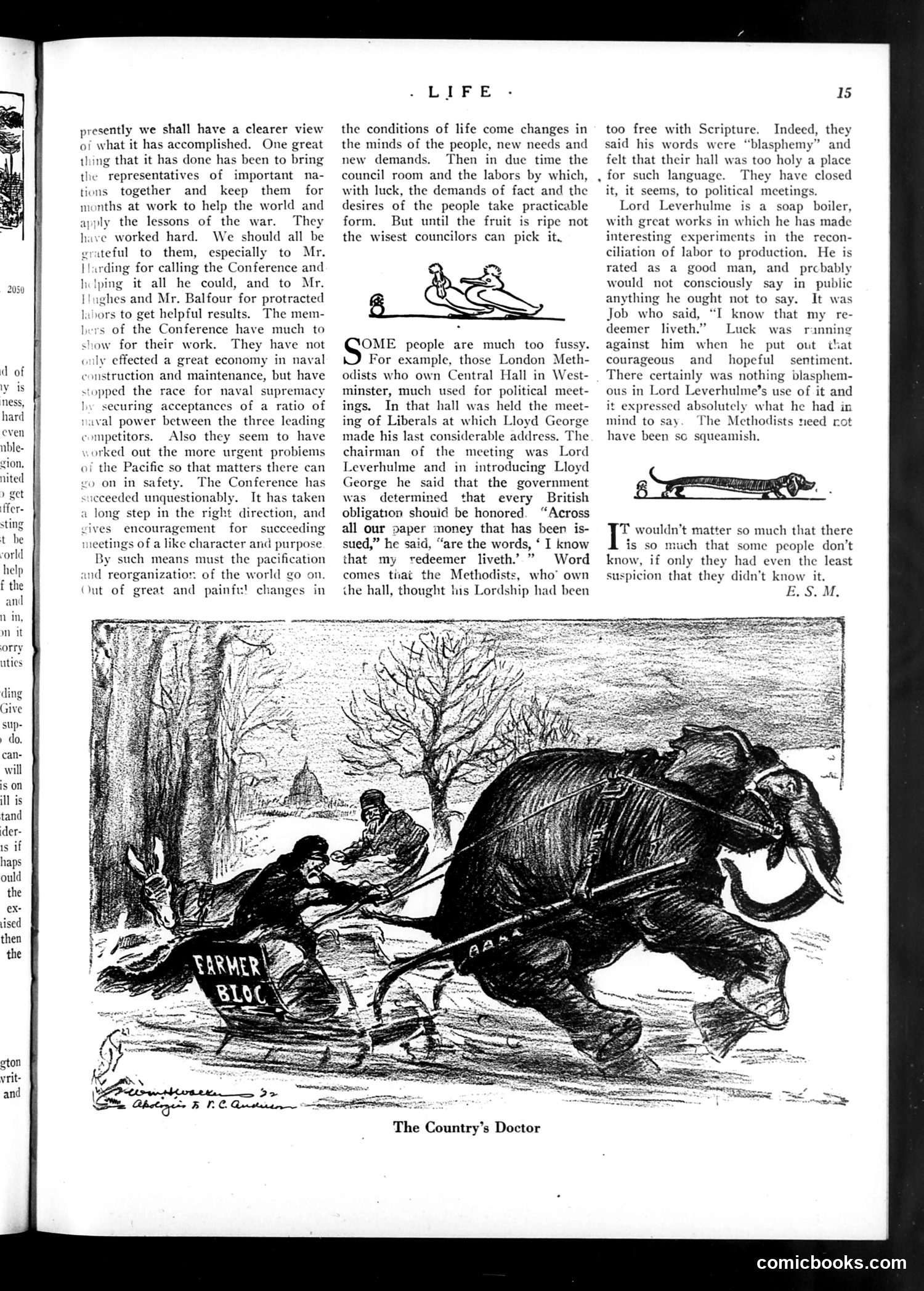
The large political cartoon depicts an elephant labeled "FARMER BLOC" being led or controlled by two figures—likely representing politicians or political factions pulling the agricultural vote in different directions. The elephant, a traditional Republican symbol, suggests the cartoon critiques how the farming constituency was being manipulated by competing political interests during the post-WWI era. The accompanying text discusses Lord Leverhulme, a British soap manufacturer and industrialist, who quoted Job 19:25 ("I know that my redeemer liveth") during a Liberal political meeting at a Methodist-owned hall in Westminster. Methodist leaders objected, calling the biblical reference "blasphemy" in a political context—apparently believing sacred Scripture shouldn't appear in partisan speeches. The satire mocks the Methodists' excessive sensitivity: the quotation is genuinely biblical and Leverhulme's sentiment was sincere, not irreverent. The broader point critiques rigid religious propriety that prevents legitimate speech.
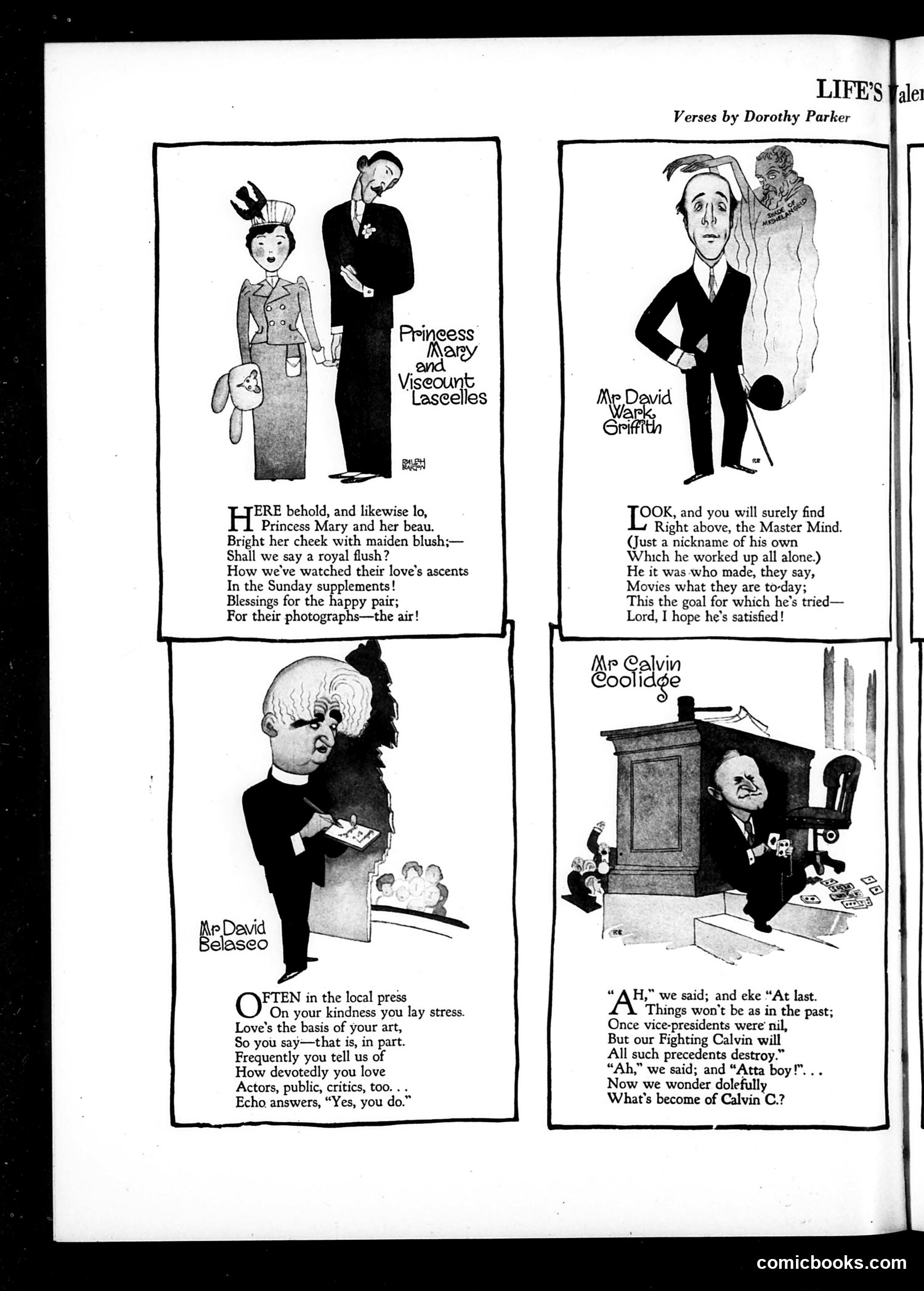
This page contains four Dorothy Parker verses mocking prominent figures of the era. The cartoons satirize: **Princess Mary and Viscount Lascelles**: Parker jokes about the royal couple's publicized romance, mocking media obsession with their "love's ascents" covered in Sunday supplements and photographs. **Mr. David Wark Griffith**: The film director, presented as the "Master Mind" behind modern cinema, is criticized for the grandiose self-regard of someone who "worked up" his own nickname and believes movies exist because of his efforts. **Mr. David Belasco**: A theater figure portrayed as sentimental about actors and critics, with Parker's verse suggesting his professed artistic devotion is somewhat hollow. **Mr. Calvin Coolidge**: The vice president (later president) is mocked for promising to destroy vice-presidential precedent—Parker sarcastically questions what became of this "Fighting Calvin," implying his impact was negligible or disappointing. The satire targets celebrity worship, artistic pretension, and political grandiosity typical of 1920s American culture.
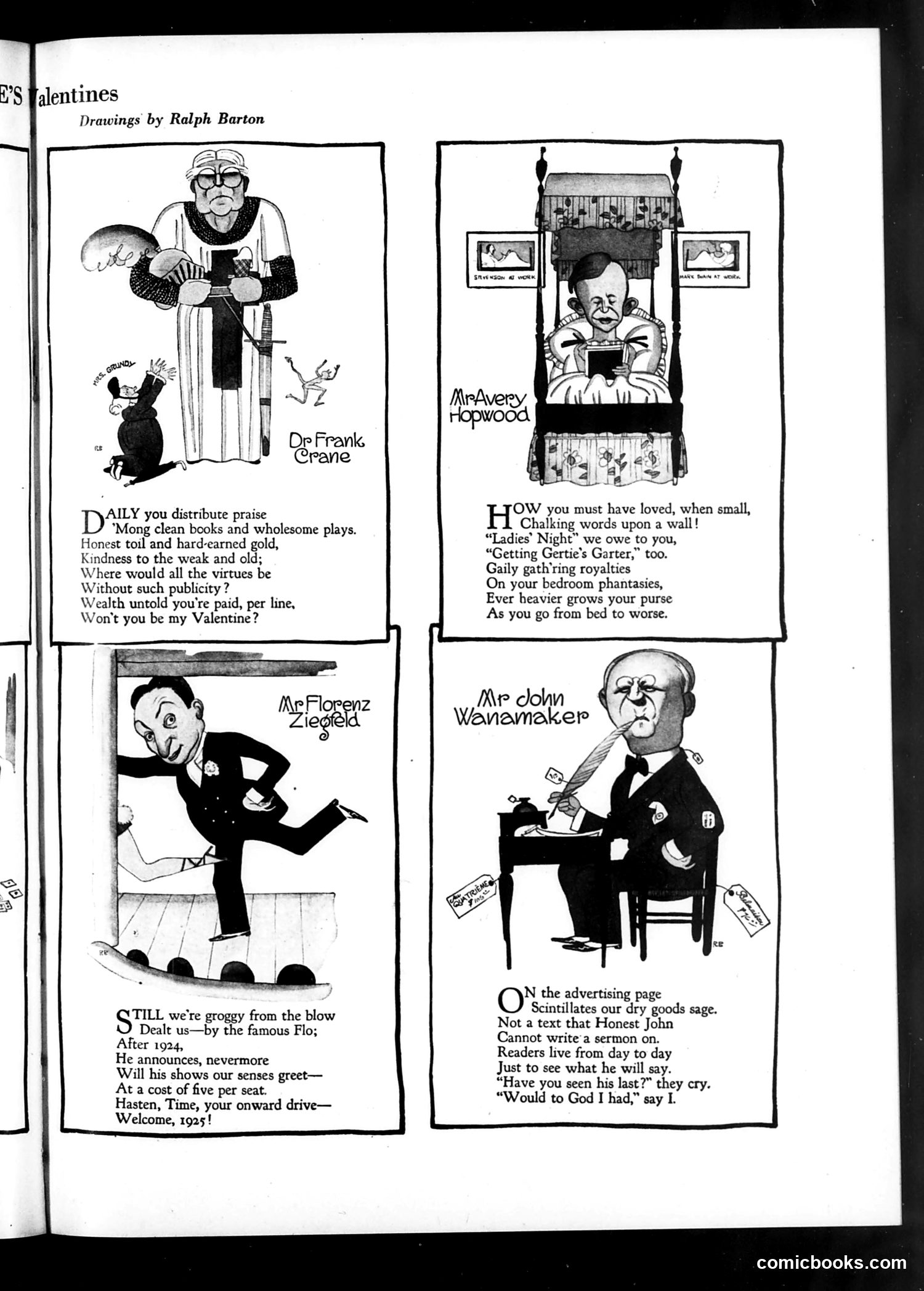
This page presents four satirical "valentines" mocking prominent figures of 1920s American culture, drawn by cartoonist Ralph Barton. **Dr. Frank Crane** receives praise for distributing moralistic content—the satire suggests his public virtue-mongering is motivated purely by financial gain ("Wealth untold you're paid, per line"). **Florenz Ziegfeld**, famous theatrical producer, is criticized for announcing he'll stop producing shows after 1924, with ticket prices at five dollars—portrayed as good riddance. **William Hopwood** (appears to be a playwright) is mocked for profiting from bedroom comedies like "Getting Gertie's Garter," with the joke being his "royalties" grow as content becomes progressively worse. **John Wanamaker**, the Philadelphia department store magnate and advertising pioneer, is ridiculed for his ubiquitous advertising copy and sermonizing tone—readers allegedly check his ads daily despite hoping to escape them ("Would to God I had"). The satire targets commercialism and self-promotion disguised as morality.
This page contains theater reviews from Life magazine's drama section, written in the publication's characteristic sardonic style. The reviews critique three Broadway productions: 1. **"The Voice from the Minaret"** — Marie Lohr imports this adaptation of Robert Hichens' prose work. The reviewer mocks it as stilted and old-fashioned, mockingly suggesting actors should deliver lines with exaggerated posture. Only Edmund Gwenn escapes criticism. The reviewer suggests the play smells of "camphor" (mothballs)—implying it's ancient and musty. 2. **"The Czarina"** — A costume drama about Catherine the Great, praised for freshness despite its melodramatic sword-slapping conventions. Doris Keane receives particular praise for bringing "comedy sense" to the role. 3. **"Marjolaine"** — A musical comedy praised for Hugo Felix's melodies and intelligent staging by Bert French. The reviewer notes it's wholesome entertainment requiring nothing intellectually demanding of audiences. The tone throughout is witty, dismissive of pretension, and focused on performance quality.
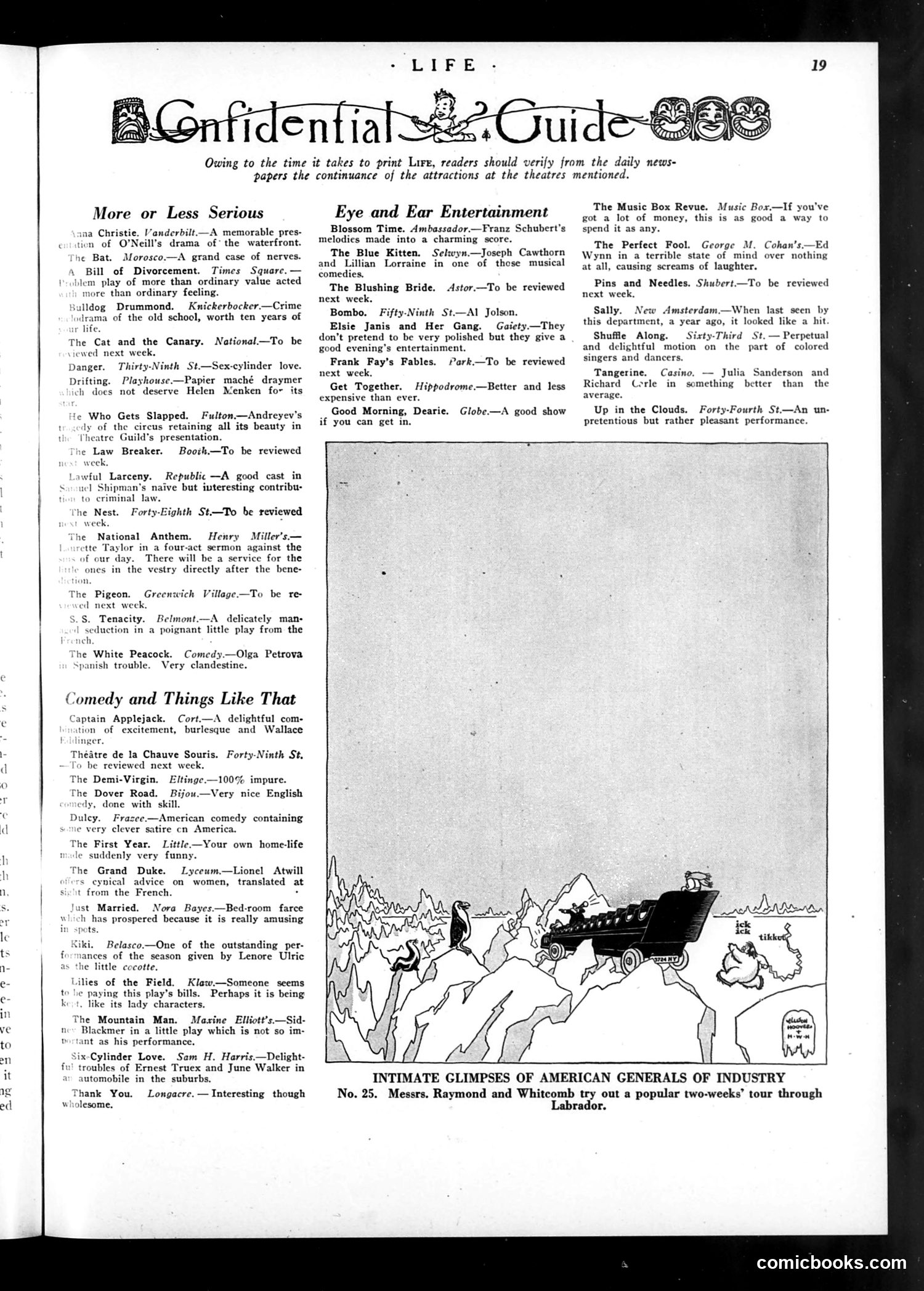
This page from *Life* magazine presents theater and entertainment reviews typical of early 1920s New York cultural criticism. The left column catalogs Broadway shows across categories: "More or Less Serious" (dramatic productions), "Comedy and Things Like That," and musical revues. The reviews are brief, witty assessments—some praising ("delightful"), others dismissive ("grand case of nerves"). Notable mentions include Al Jolson in *Bombo*, George M. Cohan's *The Perfect Fool*, and *Shuffle Along* (noted as featuring "colored singers"—reflecting period racial categorization). **The cartoon** (bottom right) titled "Intimate Glimpses of American Generals of Industry" shows two businessmen (Messrs. Raymond and Whitcomb) on a sightseeing tour through Labrador, depicted in rustic wilderness. This satirizes wealthy industrialists taking leisure tours, a marker of Gilded Age affluence. The page reflects *Life*'s role as arbiter of sophisticated urban entertainment and social commentary for educated, affluent readers.
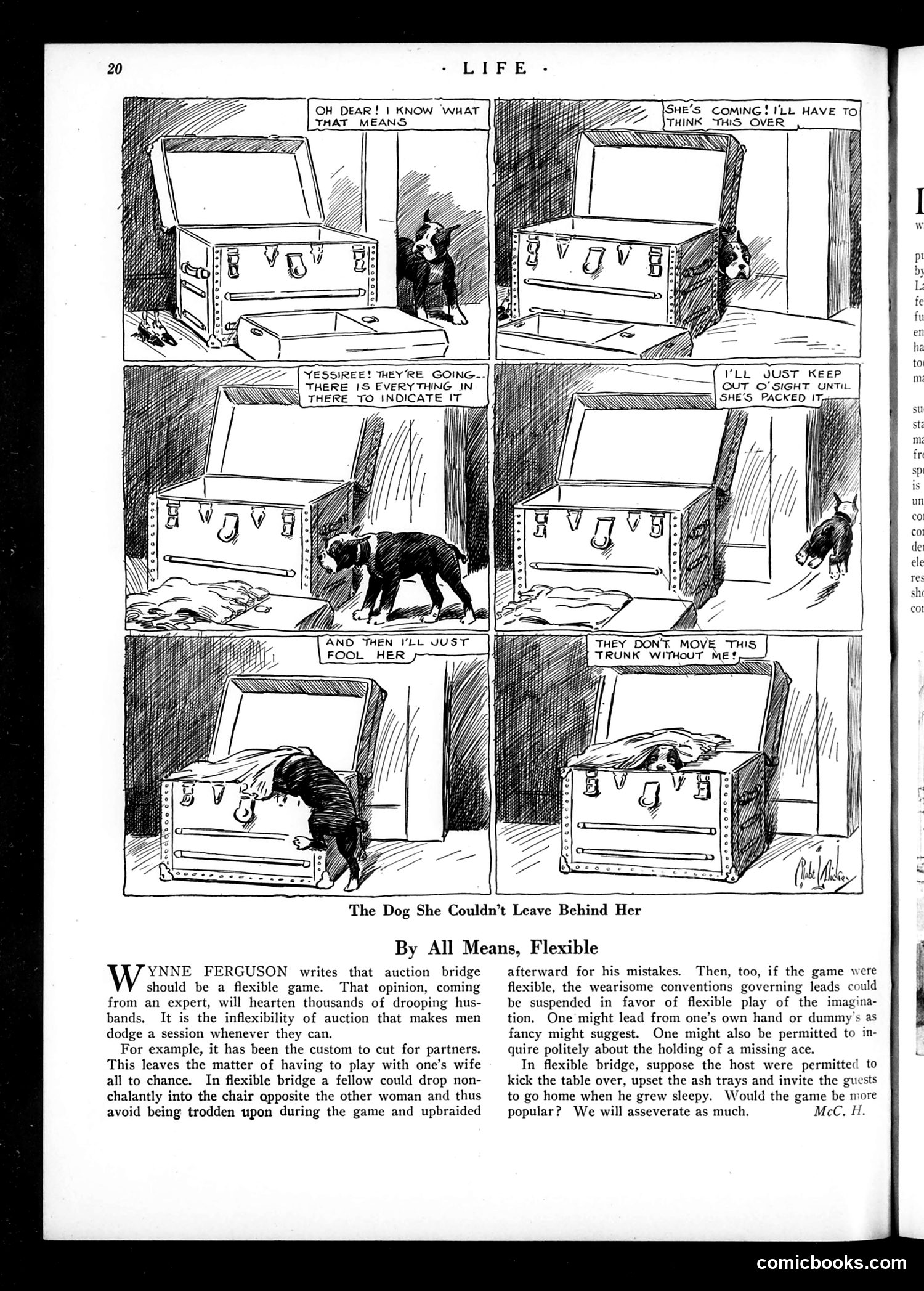
This comic depicts a dog's determination to stow away in a steamer trunk rather than be left behind when her owner travels. The humor escalates through six panels: the dog discovers luggage being packed, hides in the trunk, and ultimately refuses to budge—declaring "THEY DON'T MOVE THIS TRUNK WITHOUT ME!" The accompanying article by Wynne Ferguson satirizes inflexible auction bridge rules, arguing the game would be more popular if flexible. Ferguson humorously suggests allowing players to avoid their spouses as partners, suspend standard conventions, and even kick over tables when tired—advocating absurd flexibility as a solution to widespread male resistance to the card game. Together, the comic and article use comic exaggeration to comment on early 20th-century domestic life: both pet loyalty and married men's reluctance toward their wives' leisure activities.
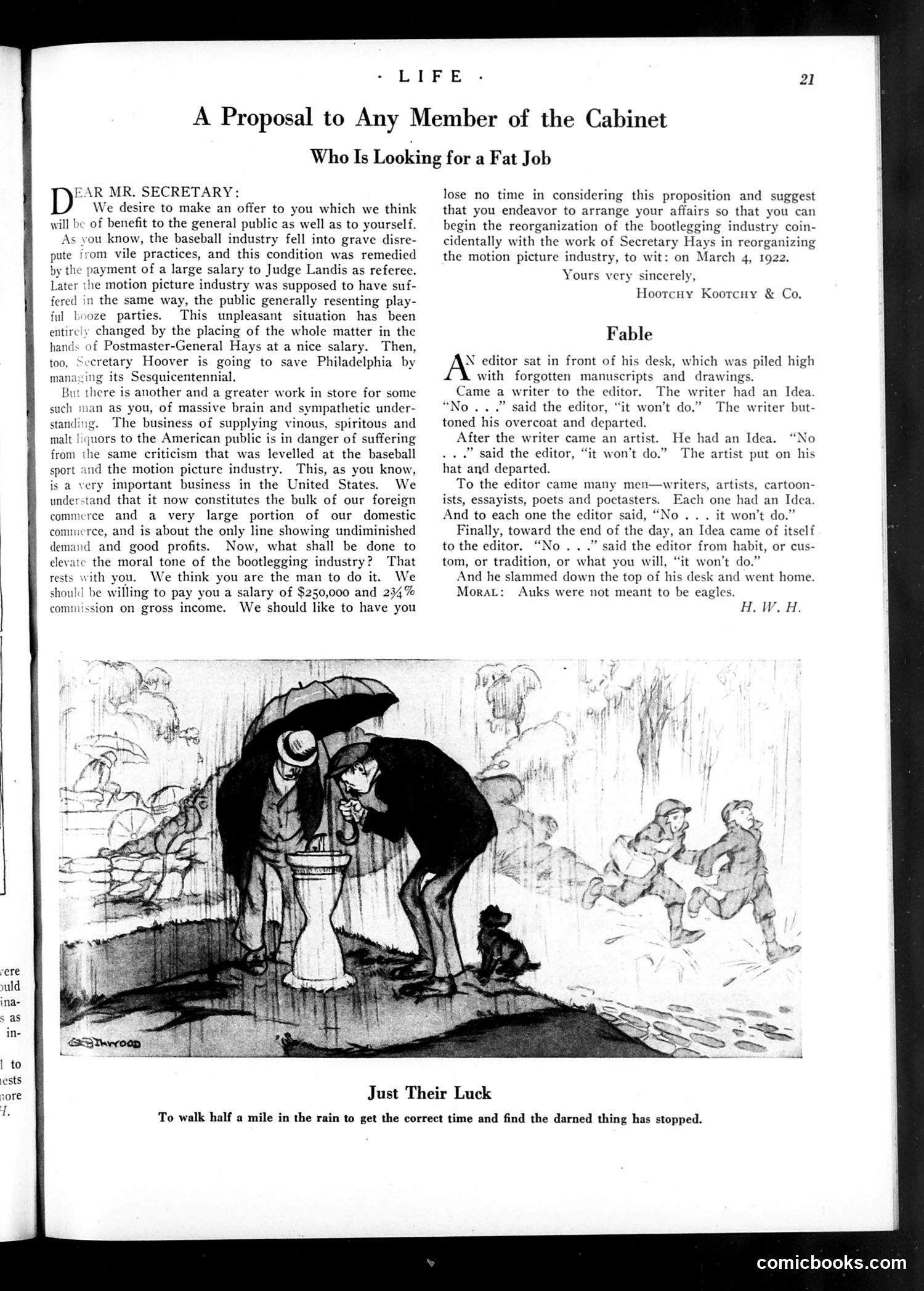
**Main Article:** "A Proposal to Any Member of the Cabinet" is a satirical open letter offering a cabinet member a lucrative salary ($250,000 plus commission) to "reorganize" the bootlegging industry during Prohibition. The satire mocks how the government has appointed czars to reform controversial industries (baseball's Judge Landis, motion pictures' Postmaster-General Hays). The joke: bootlegging—illegal alcohol distribution—is treated as a legitimate "business" needing moral rehabilitation, implying the lucrative illegal trade is effectively part of the economy. **"Fable":** A cynical short story about an editor who reflexively rejects every idea from writers and artists, then dismisses his own idea by habit before leaving. The moral ("Auks were not meant to be eagles") suggests accepting one's limitations—or critiques editorial gatekeeping's absurdity. **Cartoon ("Just Their Luck"):** Two figures walk in rain to check a clock's accuracy, only to find it stopped. Visual humor about Murphy's Law-style bad timing. The page satirizes Prohibition-era hypocrisy and editorial/institutional rigidity.
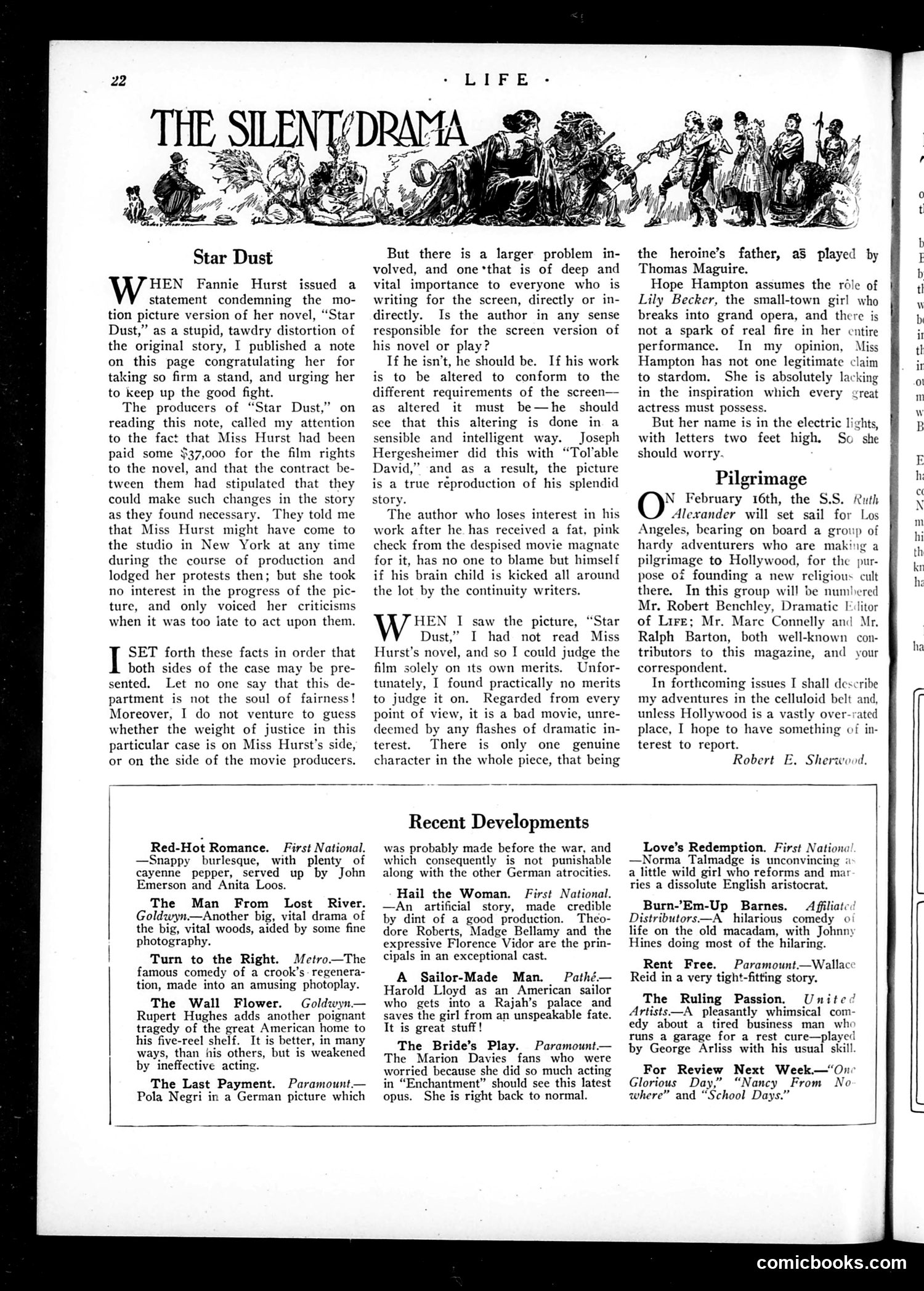
This page from *Life* magazine critiques both the adaptation of Fannie Hurst's novel "Star Dust" into a film and the broader issue of authorial control in Hollywood. The article argues that while producers paid Hurst $37,000 and held contractual rights to alter her work, authors like Hurst bear responsibility for disinterested abandonment of their projects during production. The piece specifically attacks actress Hope Hampton's performance as "absolutely lacking" in legitimate talent, sardonically noting she shouldn't worry since her name appears in lights. The satire targets Hollywood's commercial machinery—fat checks corrupting artists—and exposes the contradiction between Hurst's public condemnation and her financial complicity. The "Pilgrimage" announcement at page's end humorously frames a celebrity trip to Hollywood as religious pilgrimage, mocking the town's status as pilgrimage destination while previewing upcoming coverage by *Life* contributors including Robert Benchley and Robert E. Sherwood.
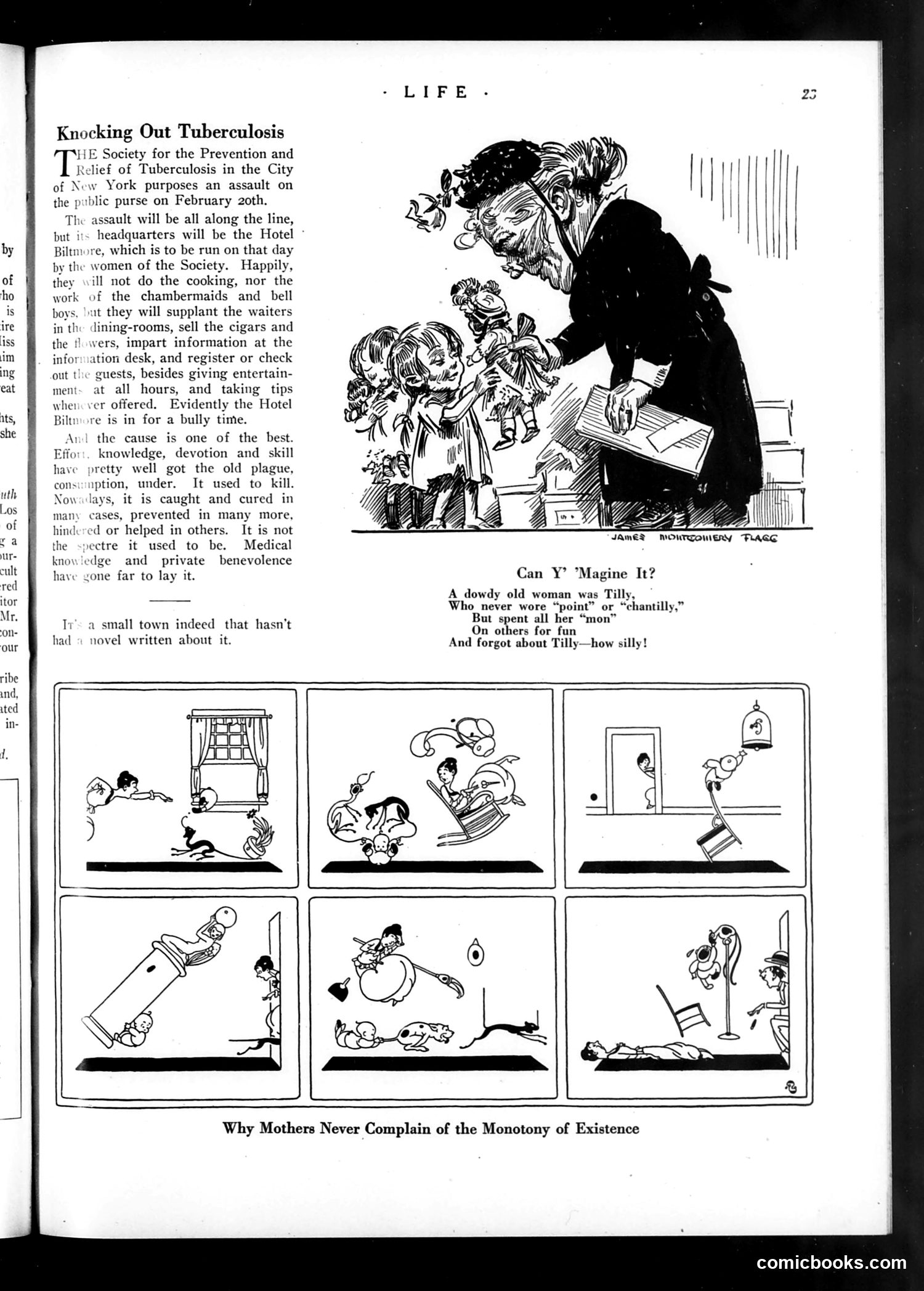
**Main Content:** The page features an article about the Society for the Prevention and Relief of Tuberculosis planning a fundraising event at the Hotel Biltmore on February 20th, where society women will volunteer as staff. **Top Illustration:** A caricatured old woman (likely personifying tuberculosis or disease) is shown being "knocked out" by younger figures, illustrating the article's metaphor about combating the disease through medical knowledge and private benevolence. **"Can Y' 'Magine It?" Poem & Illustration:** A satirical piece about "Tilly," an unfashionable dowdy woman who selflessly spends her money on others rather than herself, forgetting her own appearance. The joke critiques women who neglect self-care for generosity. **Bottom Comic Strip:** "Why Mothers Never Complain of the Monotony of Existence" shows six panels depicting mothers managing chaotic domestic situations—children causing destruction, mess, and mayhem. The satire suggests motherhood's constant activity and unpredictability actually prevents boredom, contradicting the era's notion that domestic life was monotonous.
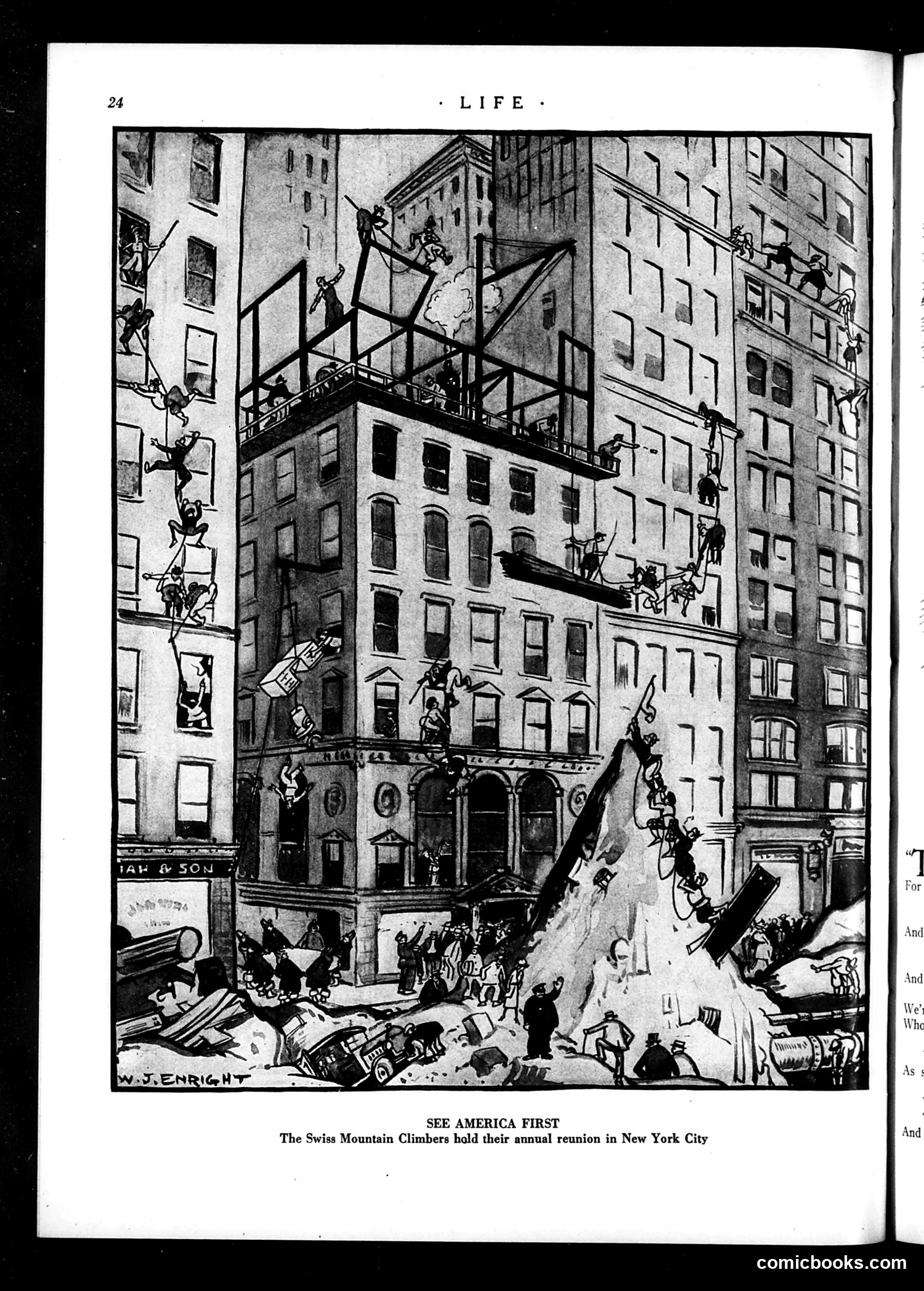
This W.J. Enright cartoon satirizes the "See America First" tourism campaign by depicting Swiss mountain climbers holding their annual reunion atop New York City's skyscrapers. The joke plays on the absurdity of treating urban architecture as equivalent to natural mountain peaks. The climbers scale the buildings using ropes and equipment, treating Manhattan's vertical landscape as mountaineering terrain. This mocks both the campaign's nationalist appeal (encouraging Americans to visit domestic sites) and the incongruity of applying Alpine climbing traditions to an urban environment. The cartoon appears to criticize either the campaign's overselling of American attractions or the humor in how immigrants adapted their cultural practices to American urban life. The signature "TAB & SON" appears on a storefront below, grounding the fantasy in recognizable New York street-level reality.
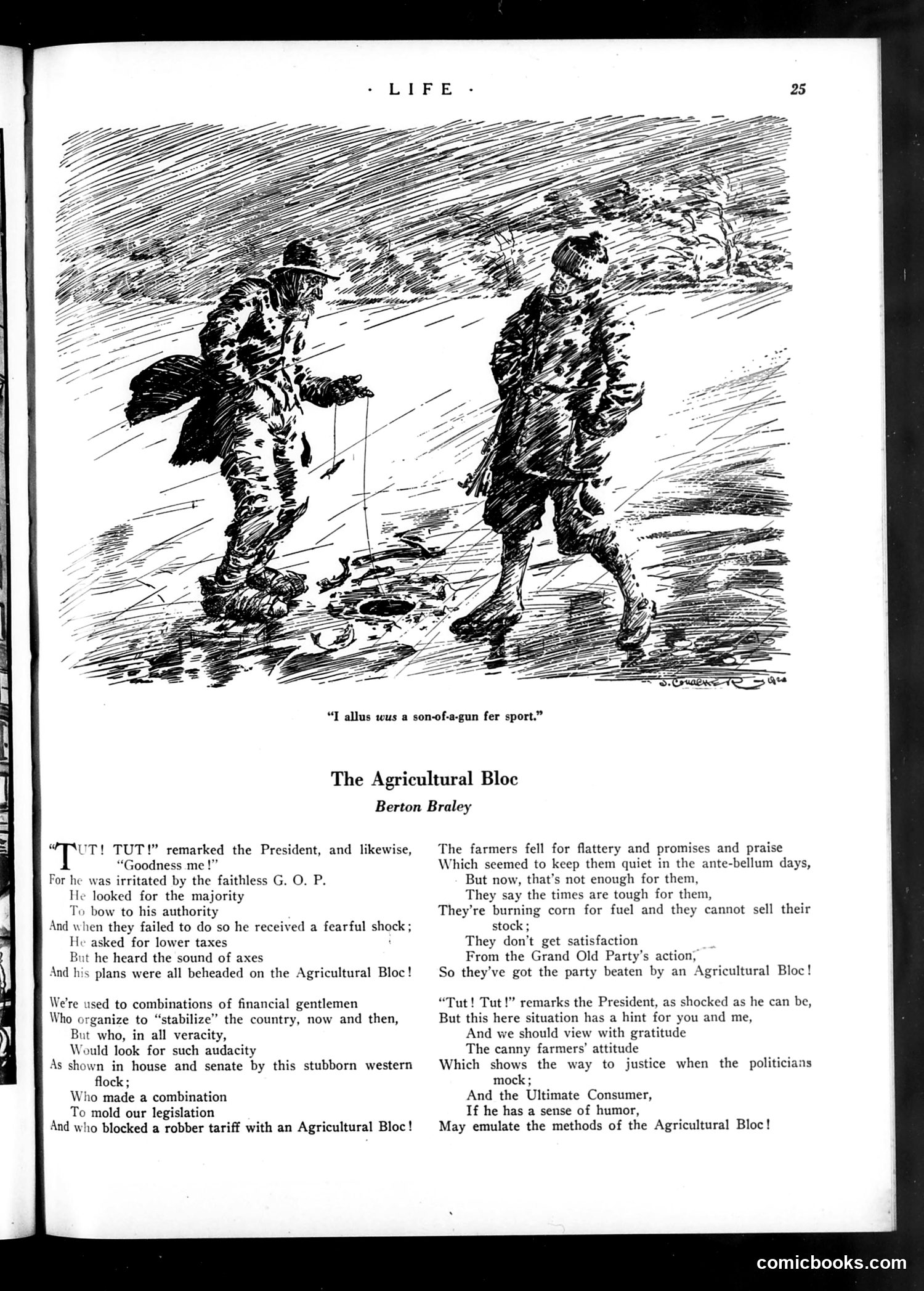
This poem by Berton Braley satirizes the emerging political power of American farmers in the early 1920s. The "Agricultural Bloc" refers to a coalition of farm-state congressmen who united to block legislation they opposed—specifically a protective tariff they viewed as harmful to agriculture. The satire mocks the President (likely Woodrow Wilson or Warren Harding) for expecting automatic Republican party loyalty, only to be thwarted by rebellious western farmers. Braley presents this as surprising audacity—politicians organizing independently rather than obeying party leadership. The poem's tone shifts sympathetically toward the farmers' plight: burning corn for fuel, unable to sell livestock, betrayed by broken promises. The final stanza praises their "canny" resistance as a model for consumers and ordinary citizens—suggesting that organized pressure from outside traditional power structures might actually achieve justice against corrupt politicians. The cartoon above shows two figures skiing through harsh conditions, captioning the contentious winter farmers faced.
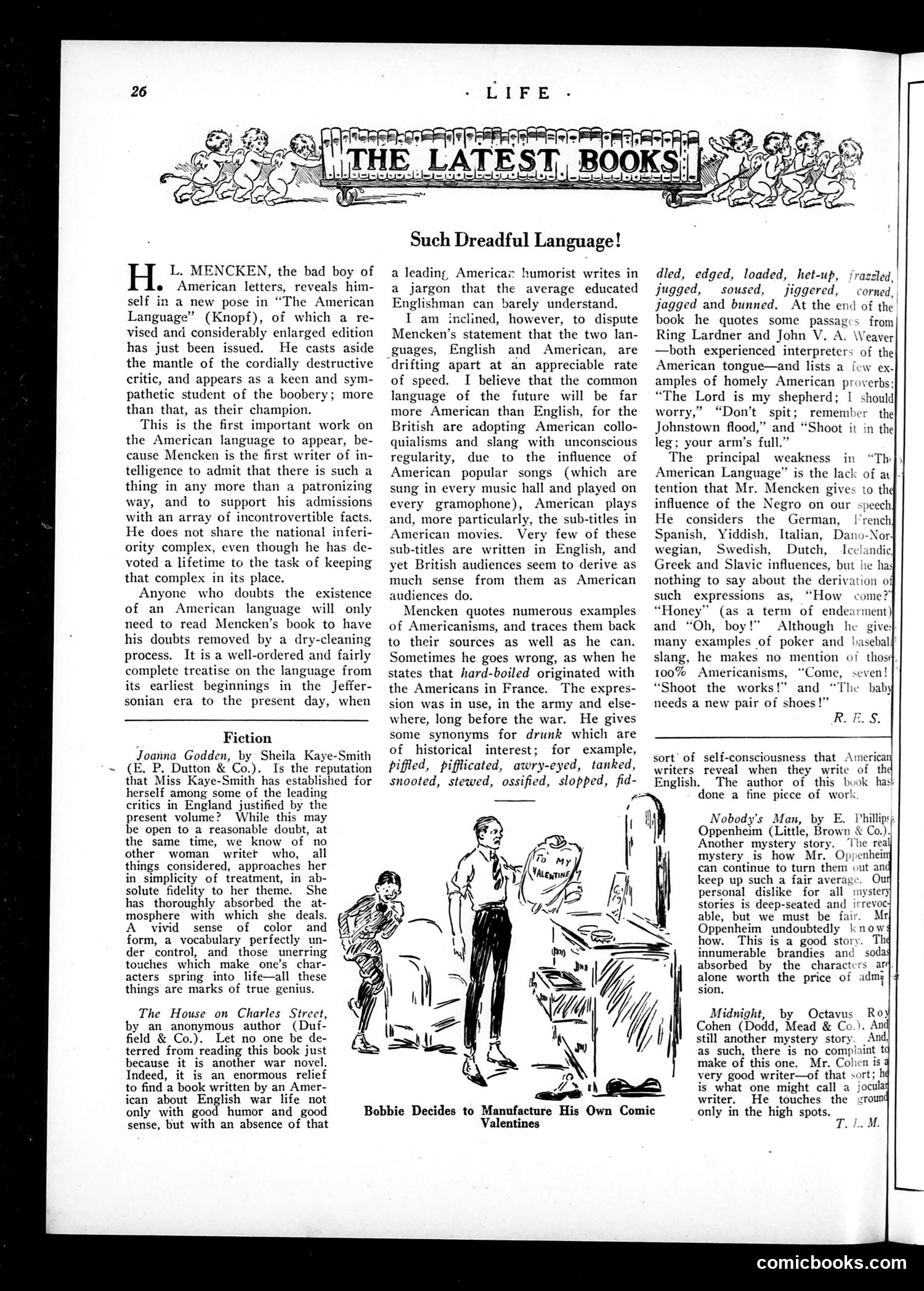
This page reviews H.L. Mencken's scholarly work on American English, presenting his argument that American and English are diverging languages. The reviewer disputes Mencken's claim, predicting American English will actually dominate the future due to American cultural exports—popular songs, theater, and especially cinema with English subtitles that British audiences readily understand. The cartoon shows a man manufacturing homemade valentines, illustrating the book review's lighthearted tone. The page also includes brief reviews of contemporary fiction. The satire here targets linguistic snobbery: Mencken is praised for treating American speech seriously rather than dismissively, while the reviewer notes the irony that British audiences absorb American expressions through entertainment without realizing it. This reflects early 20th-century anxiety about American cultural influence on British speech patterns—a concern that proved prescient.
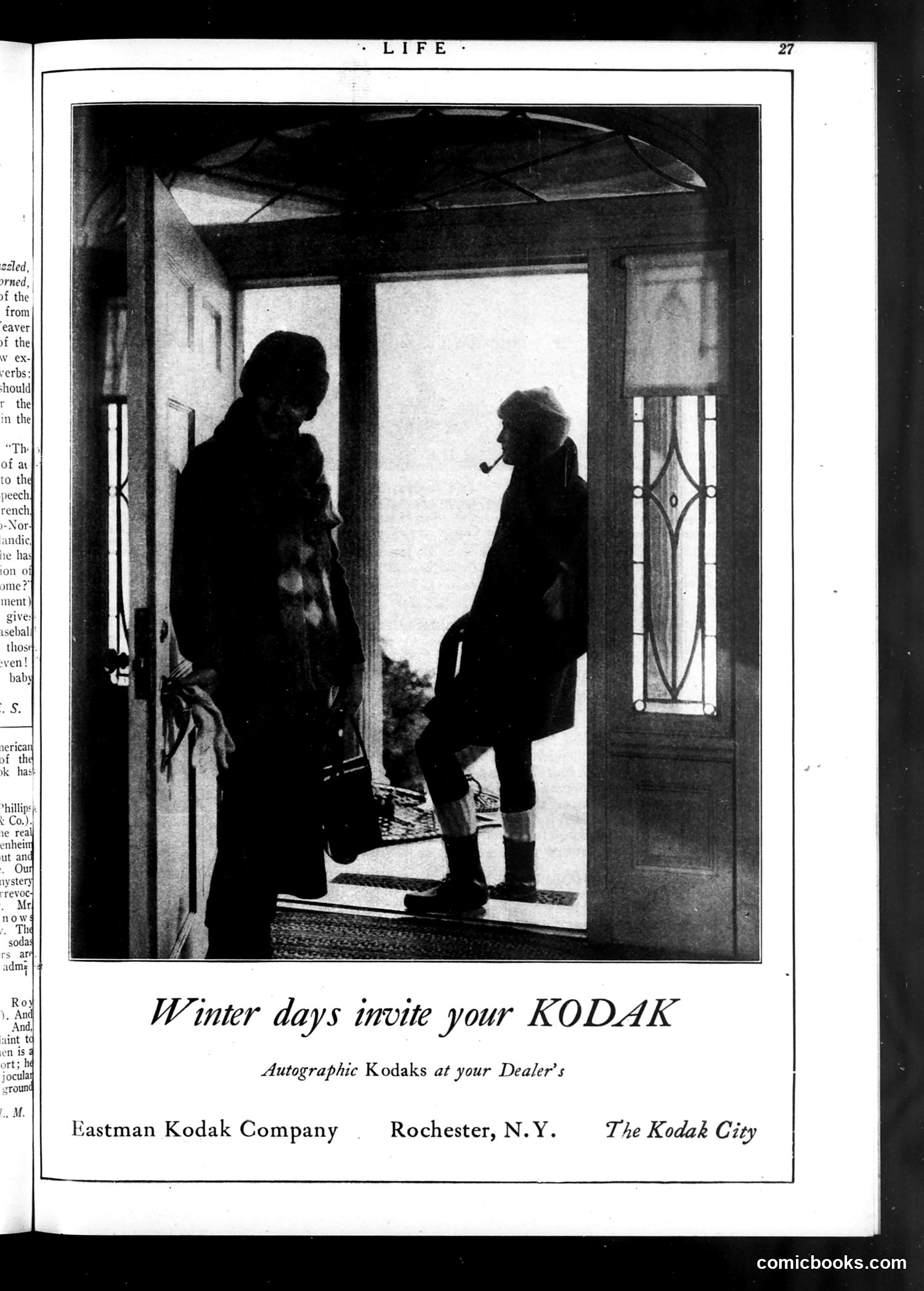
This is a **Kodak camera advertisement**, not a political cartoon or satire. The page shows two silhouetted figures in a doorway or window frame—one appearing to enter or greet the other during what seems to be winter conditions (visible through the bright window behind them). The ad copy reads "Winter days invite your KODAK," promoting Autographic Kodak cameras available at dealers. It's positioned as a lifestyle advertisement encouraging photography during winter months. The "Kodak City" tagline references Rochester, New York, home to Eastman Kodak Company's headquarters. This appears to be a straightforward commercial advertisement from an era when Life magazine carried such promotions alongside editorial content.
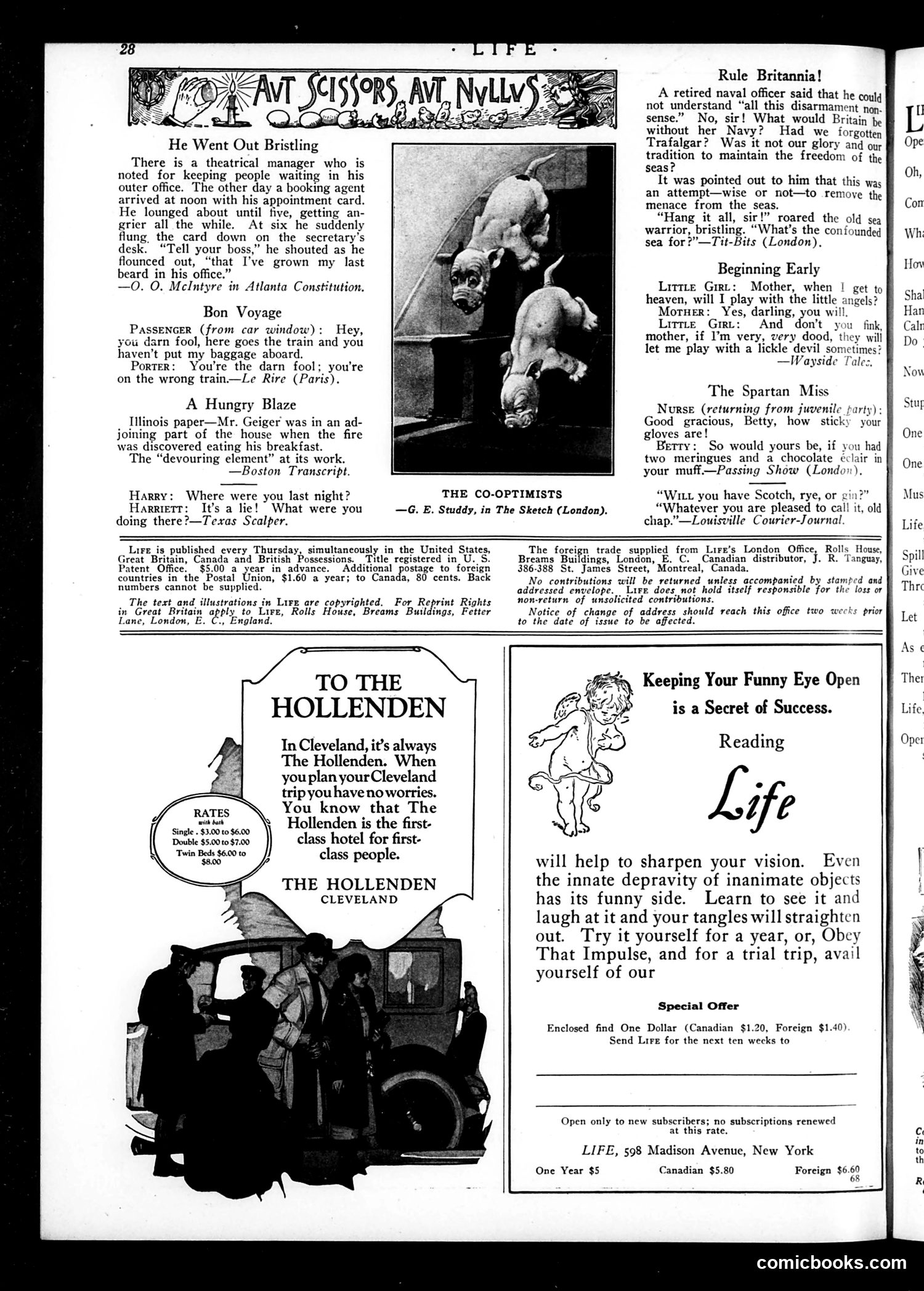
This page contains several brief satirical jokes and advertisements typical of early 20th-century Life magazine. The main cartoon content includes: **"Rule Britannia!"** - A retired British naval officer bristles at disarmament proposals, insisting Britain needs naval dominance. The satire targets those opposing weapons reduction, invoking naval tradition (Trafalgar) to resist modern peace efforts. **"He Went Out Bristling"** - A theatrical manager's appointment-seeking agent grows angry after waiting five hours, sarcastically telling the manager he's "grown his last beard in his office" — meaning he'll never return. Other brief jokes satirize everyday absurdities: a porter's sarcasm about luggage, a child's heaven expectations, and drinks served without proper labeling (calling liquor by false names). The page is largely **advertisements** for The Hollenden hotel in Cleveland and a subscription pitch for Life itself, emphasizing humor as beneficial to one's perspective. The content reflects early-1900s concerns: British naval politics and comedic observations of social pretension and domestic situations.
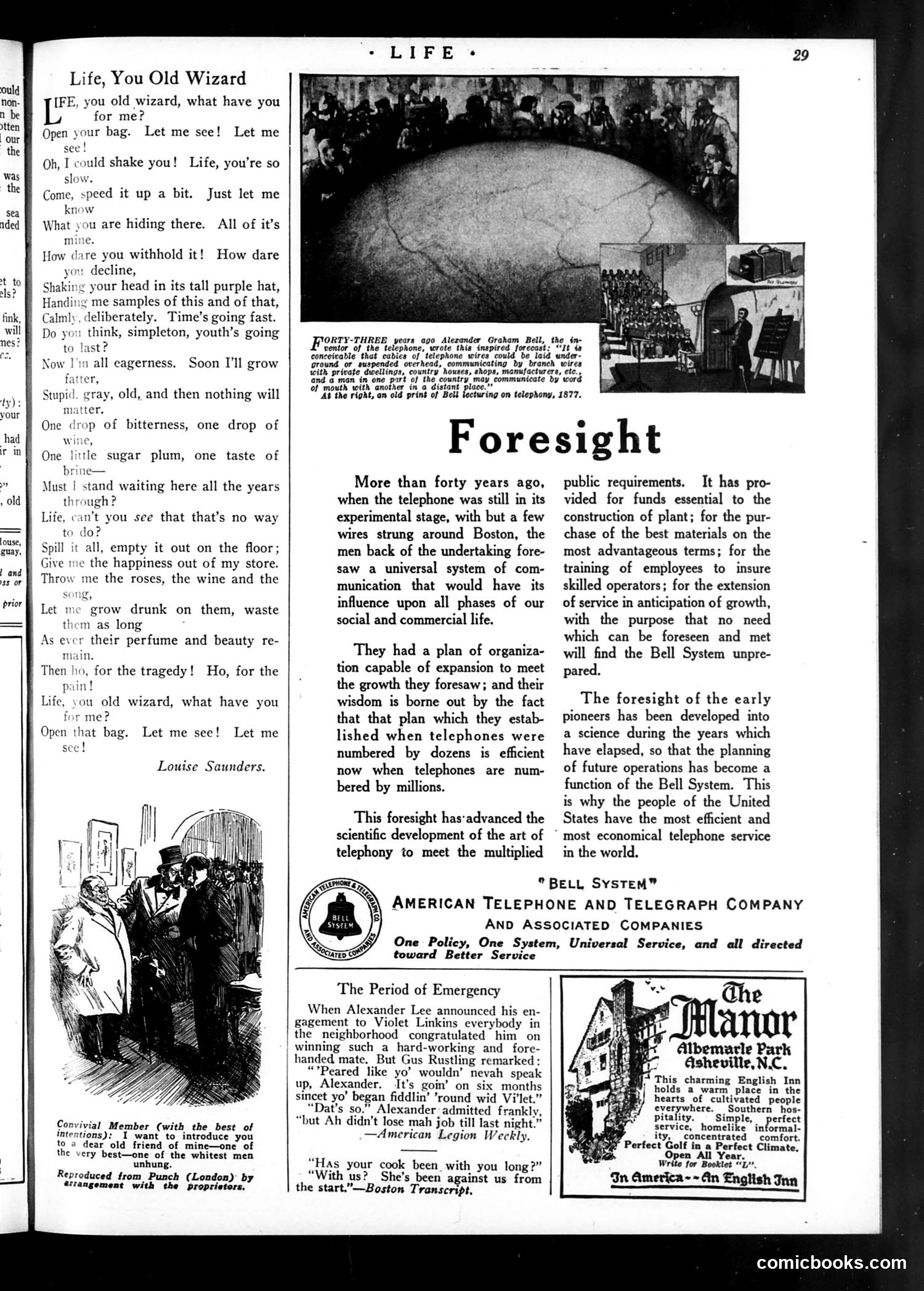
This page contains two distinct elements: **Left side - Poetry ("Life, You Old Wizard"):** A poem by Louise Saunders personifying Life as a reluctant wizard. A young person impatiently demands Life reveal its treasures immediately, complaining about waiting and wanting to "waste" happiness while youth lasts. The tone captures youthful impatience with life's gradual unfolding. Below it is a cartoon (reproduced from British *Punch*) showing convivial men introducing friends—likely satirizing how people vouch for questionable characters. **Right side - Advertisement:** The Bell Telephone System runs a corporate advertorial titled "Foresight," praising Alexander Graham Bell's 1877 vision that the telephone could create universal communication infrastructure. The ad argues Bell System's early planning enabled efficient modern service. This is essentially propaganda celebrating the company's expansion from dozens to millions of phones. **The satire:** The juxtaposition is ironic—the poem's impatient youth contrasts with Bell's patient, long-term planning. The ad subtly suggests corporate foresight is superior to human spontaneity.
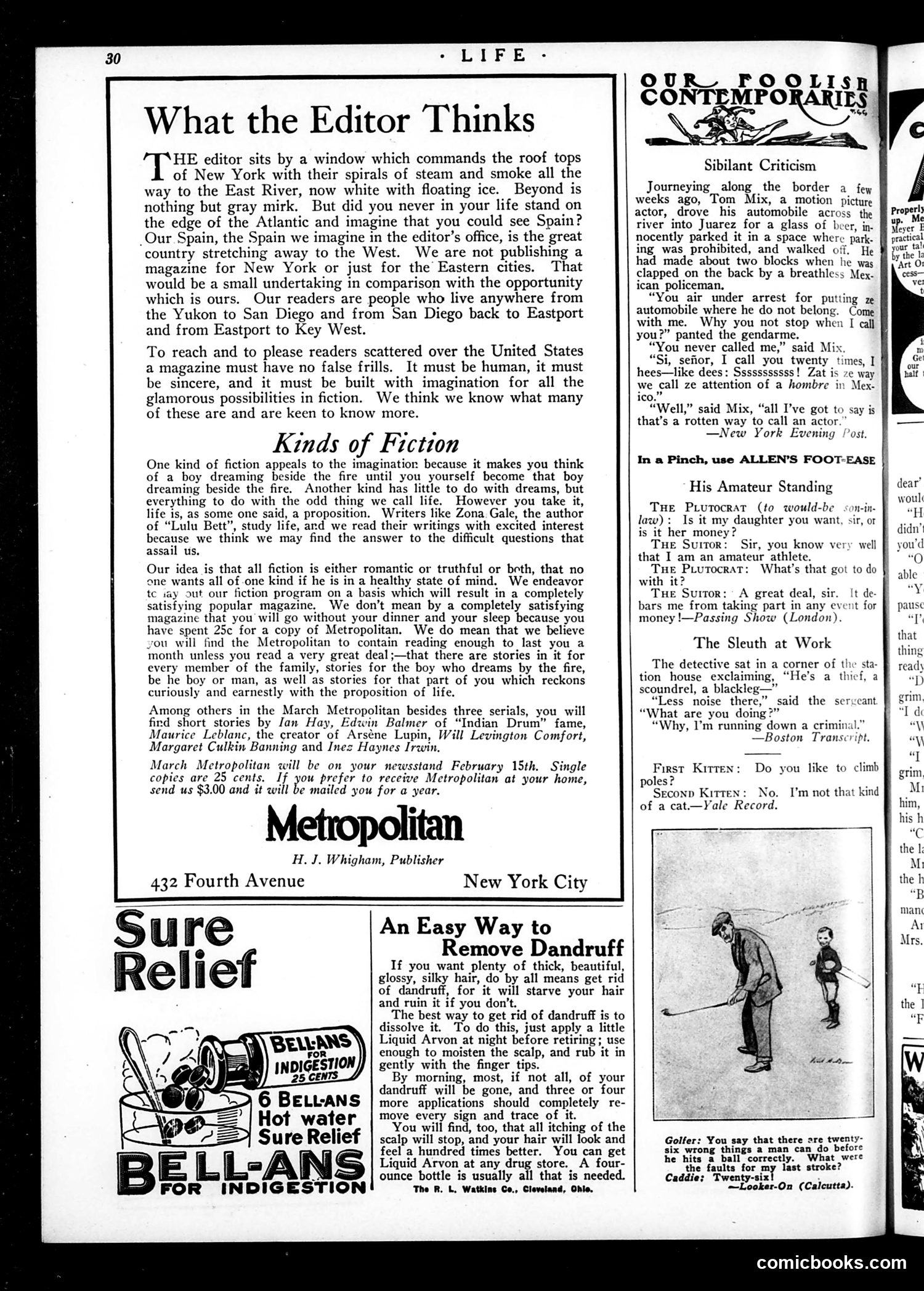
This is primarily an editorial and advertising page from Life magazine. The main content is the editor's manifesto about Life's ambitions: to serve readers nationwide (from "the Yukon to San Diego"), not just Eastern cities, by publishing sincere, human fiction appealing to diverse tastes—both romantic and realistic stories. The page includes a humorous anecdote about actor Tom Mix being arrested in Juarez, Mexico, for parking illegally. The joke relies on a stereotype of a Mexican policeman with exaggerated accent and speech patterns ("Sssssssssss! Zat is ze way...") who claims he called Mix but in a hissing sound only a snake would make—satirizing the miscommunication between American tourists and foreign authorities. The bottom half contains advertisements for Bellans indigestion remedy and Liquid Arvon dandruff treatment, typical period product marketing.
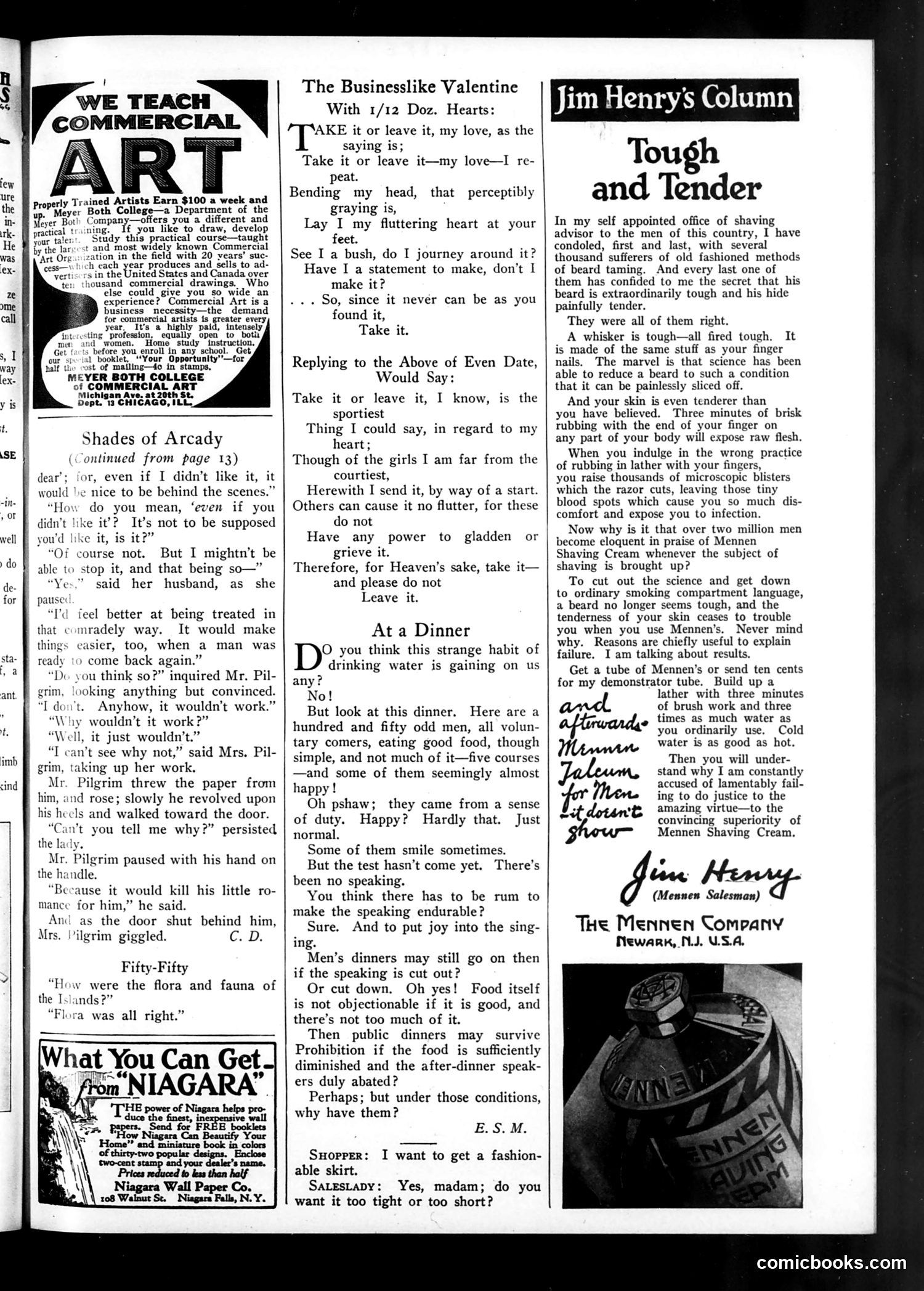
This page from *Life* magazine contains several distinct pieces of satirical and comedial content: **"The Businesslike Valentine"** presents a humorous critique of modern romance stripped of sentiment. The poem exchanges traditional romantic language for businesslike transactional rhetoric ("Take it or leave it"), mocking how contemporary efficiency culture was colonizing even intimate relationships. The reply maintains this deadpan tone, treating love as a practical matter rather than an emotional one. **"At a Dinner"** satirizes male social conventions, specifically the assumption that men's dinners require alcohol to be enjoyable. The dialogue questions whether dinners could function without drinking, suggesting contemporary anxieties about Prohibition-era restrictions on social gatherings. The page also includes commercial advertisements (Meyer Both College art instruction, Niagara wallpaper) typical of *Life*'s mixed editorial-advertising format. **"Shades of Arcady"** (continued story) and **"Fifty-Fifty"** appear to be lighter domestic humor pieces about marriage and relationships. The overall tone reflects early 20th-century satire targeting modern manners and changing social customs.
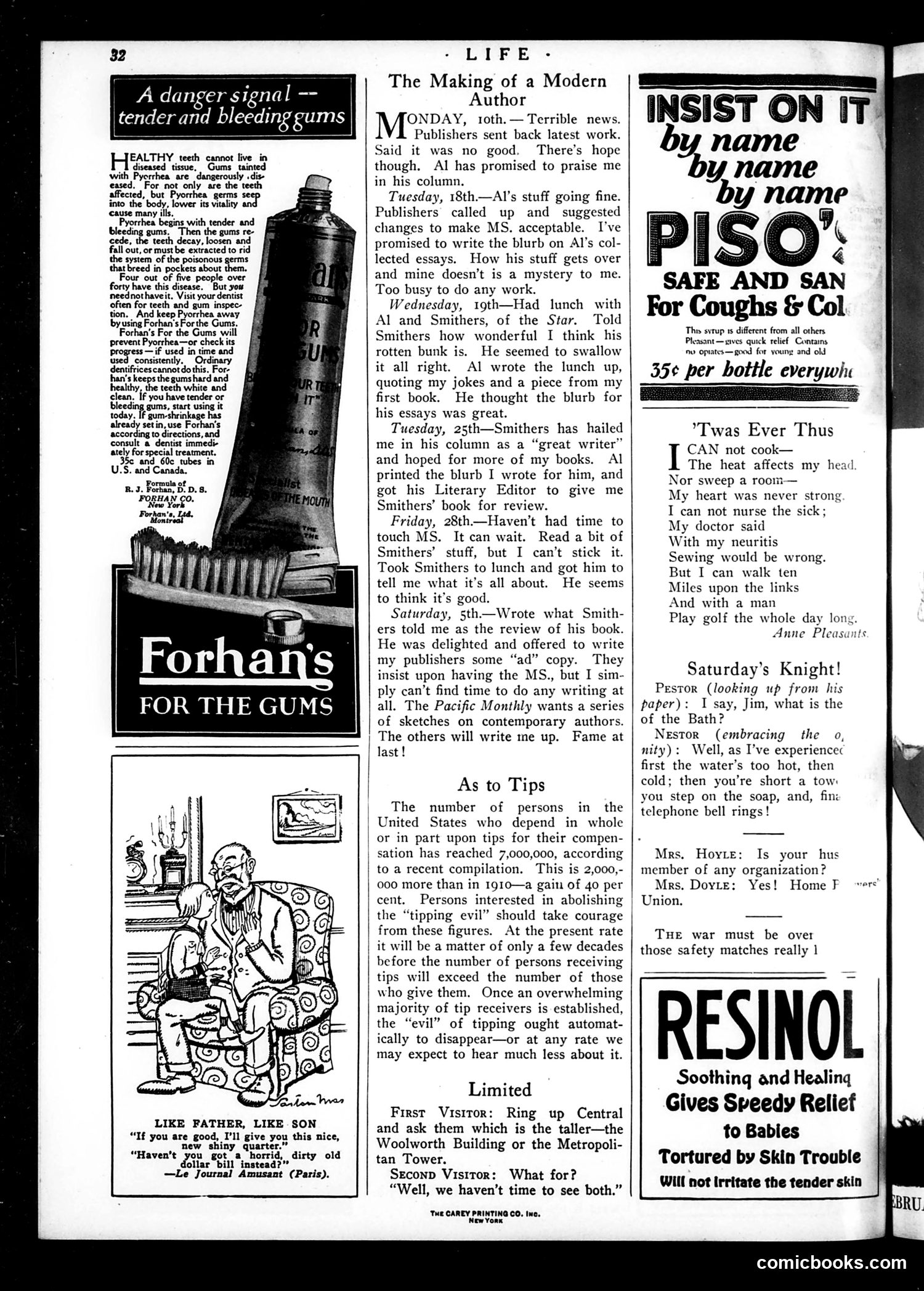
This satirical diary entry mocks the literary world's mutual back-scratching and networking culture. An unpublished author ("I") trades favors with a columnist ("Al") and a newspaper critic ("Smithers")—exchanging praise, positive reviews, and promotional blurbs regardless of actual literary merit. The author admits to writing a book review based entirely on secondhand information from Smithers himself, yet gains fame through this circular system of reciprocal endorsements. The joke: professional success depends not on writing quality but on cultivating relationships with influential media figures and trading flattery. The author abandons actual writing to network, yet receives promised publication and acclaim. This exposes how 1920s publishing relied on cronyism rather than genuine literary merit—a pointed critique of the publishing industry's superficiality.