
Life, 1922-02-16 · page 12 of 34
Life — February 16, 1922 — page 12: what you’re looking at
What you’re looking at
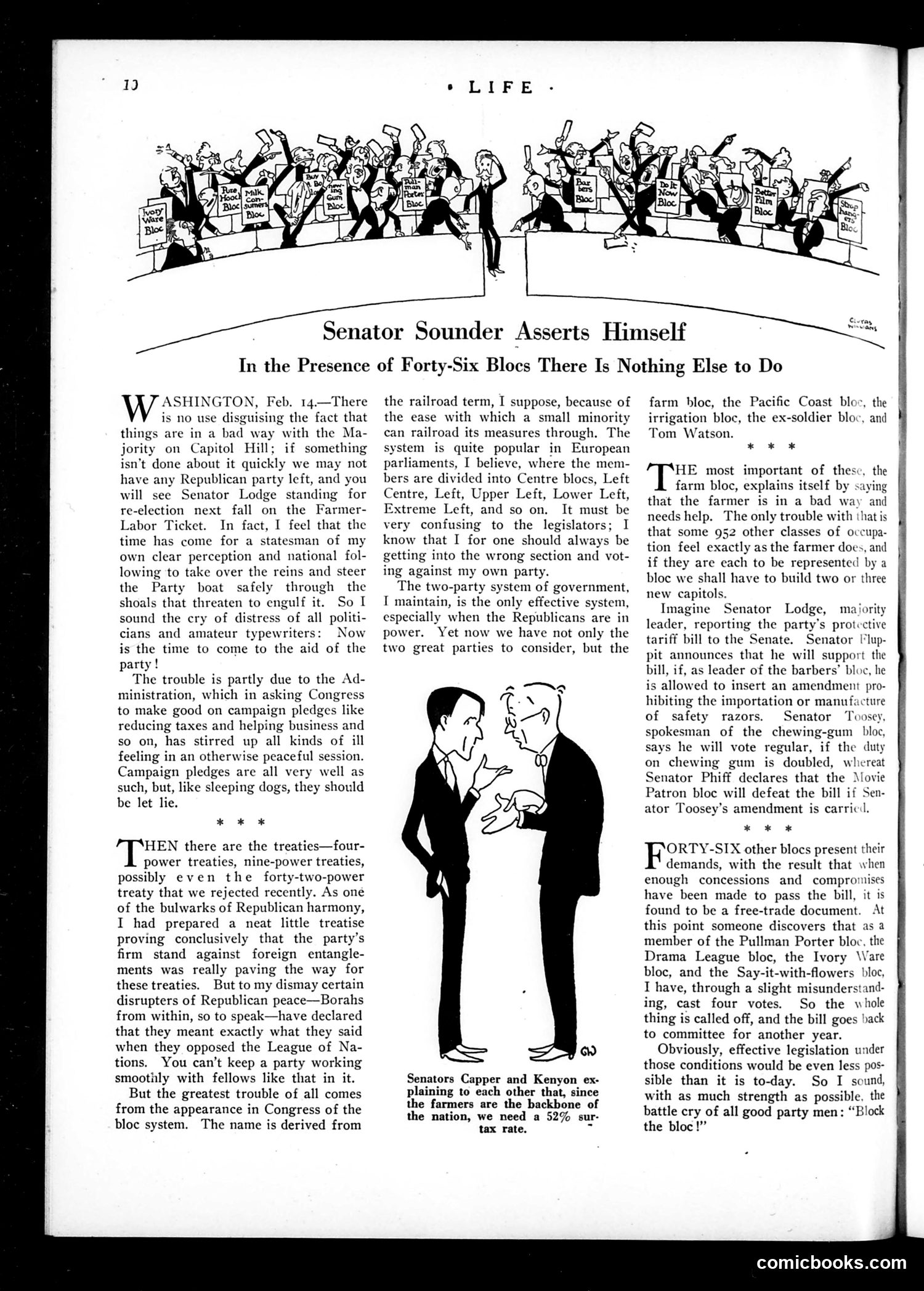
This Life magazine page satirizes Congressional gridlock caused by competing "blocs" — interest groups that fragment legislative action. Senator Sounder (a fictional character) argues that with 46 blocs present, meaningful governance is impossible. The cartoon depicts various bloc representatives (farmers, railroad interests, Pacific Coast irrigation advocates, etc.) holding signs, illustrating how fragmented special interests paralyze Congress. The lower illustration shows Senators Capper and Kenyon discussing how farmers form the "backbone" of the nation yet need protection through tariffs. The satire critiques the bloc system itself: while ostensibly representing constituencies, these organized groups actually prevent effective two-party governance and create a "free-trade" stalemate. The article argues that only strong two-party politics can function smoothly—bloc politics descends into perpetual compromise and gridlock.
📄 Transcribed text from this page (OCR, searchable)
Machine-transcribed from the original scan — historical spelling and the odd misread are preserved.
Senator Sounder Asserts Himself In the Presence of Forty-Six Blocs There Is Nothing Else to Do ASHINGTON, Feb. 14.—There is no use disguising the fact that things are in a bad way with the Ma- jority on Capitol Hill; if something isn’t done about it quickly we may not have any Republican party left, and you will see Senator Lodge standing for re-election next fall on the Farmer- Labor Ticket. In fact, I feel that the time has come for a statesman of my own clear perception and national fol- lowing to take over the reins and steer the Party boat safely through the shoals that threaten to engulf it. So I sound the cry of distress of all politi- cians and amateur typewriters: Now is the time to come to the aid of the party! The trouble is partly due to the Ad- ministration, which in asking Congress to make good on campaign pledges like reducing taxes and helping business and so on, has stirred up all kinds of ill feeling in an otherwise peaceful session. Campaign pledges are all very well as such, but, like sleeping dogs, they should be let lie. xk O* HEN there are the treaties—four- power treaties, nine-power treaties, possibly even the forty-two-power treaty that we rejected recently. As oné of the bulwarks of Republican harmony, I had prepared a neat little treatise proving conclusively that the party’s firm stand against foreign entangle- ments was really paving the way for these treaties. But to my dismay certain disrupters of Republican peace—Borahs from within, so to speak—have declared that they meant exactly what they said when they opposed the League of Na- tions. You can’t keep a party working smootiily with fellows like that in it. But the greatest trouble of all comes from the appearance in Congress of the bloc system. The name is derived from the railroad term, I suppose, because of the ease with which a small minority can railroad its measures through. The system is quite popular in European parliaments, I believe, where the mem- bers are divided into Centre blocs, Left Centre, Left, Upper Left, Lower Left, Extreme Left, and so on. It must be very confusing to the legislators; I know that I for one should always be getting into the wrong section and vot- ing against my own party. The two-party system of government, I maintain, is the only effective system, especially when the Republicans are in power. Yet now we have not only the two great parties to consider, but the Senators Capper and Kenyon ex- plaining to each other that, since the farmers are the backbone of the nation, we need a 52% sur- tax rate. - farm bloc, the Pacific Coast bloc, the irrigation bloc, the ex-soldier bloc, and Tom Watson. * * * HE most important of th farm bloc, explains itself b that the farmer is in a bad wa needs help. The only trouble with that is that some 952 other classes of occupa- tion feel exactly as the farmer does, and if they are each to be represented by a bloc we shall have to build two or three new capitols. Imagine Senator Lodge, majority leader, reporting the party's protective tariff bill to the Senate. Senator |"lup- pit announces that he will support the bill, if, as leader of the barbers’ bloc, he is allowed to insert an amendment pro- hibiting the importation or manufacture of safety razors. Senator Toosey, spokesman of the chewing-gum_ bloc, says he will vote regular, if the duty on chewing gum is doubled, whe Senator Phiff declares that the Patron bloc will defeat the bill if Sen- ator Toosey’s amendment is carrici. * * * ORTY-SIX other blocs present their demands, with the result that when enough concessions and compromises have been made to pass the bill, it is found to be a free-trade document. At this point someone discovers that as a member of the Pullman Porter bloc, the Drama League bloc, the Ivory \Vare bloc, and the Say-it-with-flowers bloc, I have, through a slight misunderstand- ing, cast four votes. So the whole thing is called off, and the bill goes back to committee for another year. Obviously, effective legislation under those conditions would be even less pos- sible than it is to-day. So I sound, with as much strength as possible, the battle cry of all good party men: “Block the bloc!” comicbooks.com