
Life, 1922-02-16 · page 17 of 34
Life — February 16, 1922 — page 17: what you’re looking at
What you’re looking at
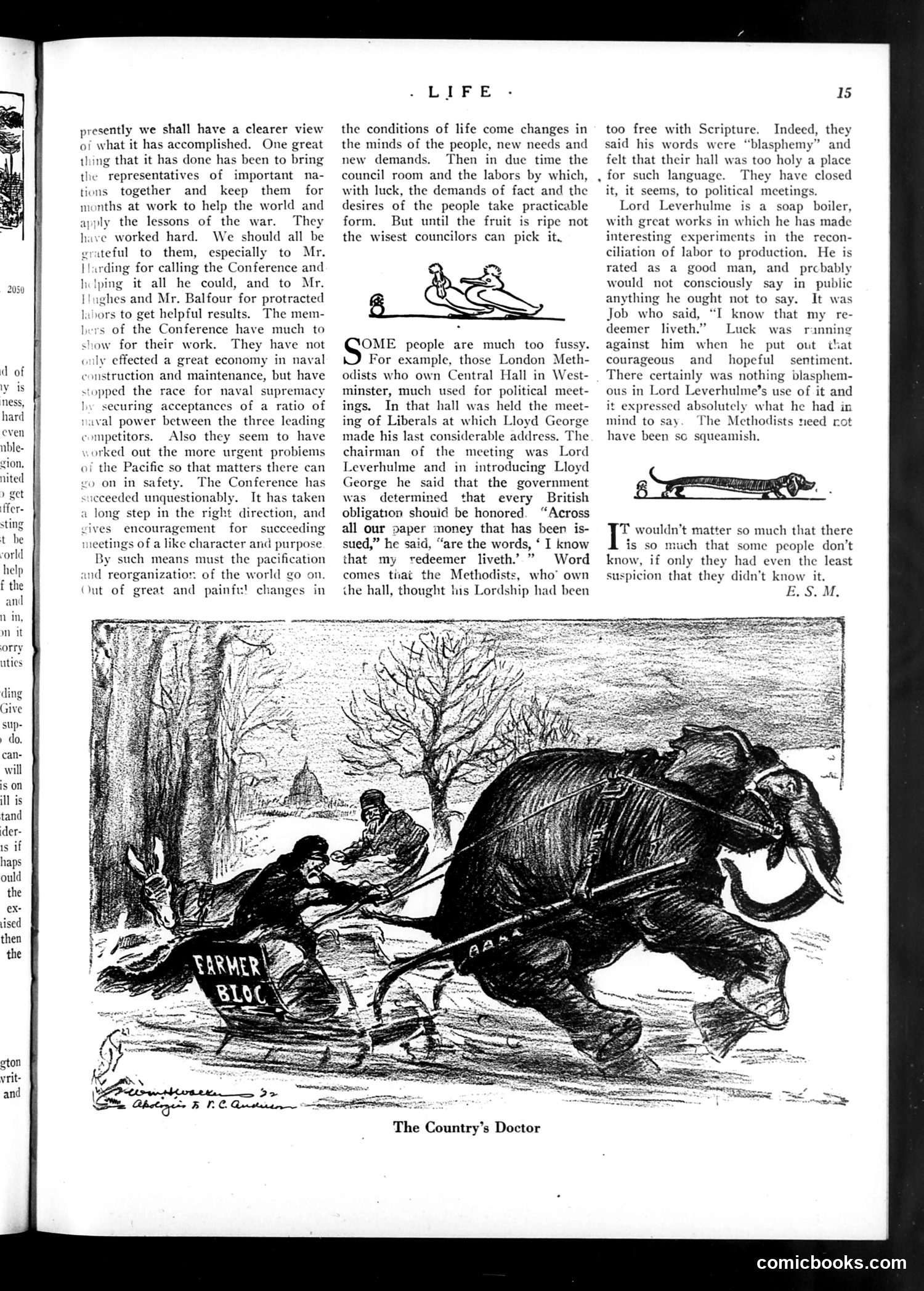
The large political cartoon depicts an elephant labeled "FARMER BLOC" being led or controlled by two figures—likely representing politicians or political factions pulling the agricultural vote in different directions. The elephant, a traditional Republican symbol, suggests the cartoon critiques how the farming constituency was being manipulated by competing political interests during the post-WWI era. The accompanying text discusses Lord Leverhulme, a British soap manufacturer and industrialist, who quoted Job 19:25 ("I know that my redeemer liveth") during a Liberal political meeting at a Methodist-owned hall in Westminster. Methodist leaders objected, calling the biblical reference "blasphemy" in a political context—apparently believing sacred Scripture shouldn't appear in partisan speeches. The satire mocks the Methodists' excessive sensitivity: the quotation is genuinely biblical and Leverhulme's sentiment was sincere, not irreverent. The broader point critiques rigid religious propriety that prevents legitimate speech.
📄 Transcribed text from this page (OCR, searchable)
Machine-transcribed from the original scan — historical spelling and the odd misread are preserved.
dof ly is ness, hard even nble- zion, nited » get ffer- sting t be orld help f the and n in, m it orry uties ill is tand der- is if haps ould presently we shall have a clearer view oi what it has accomplished. One great thing that it has done has been to bring the representatives of important na- tions together and keep them for months at work to help the world and apply the lessons of the war. They nuve worked hard. We should all be iteful to them, especially to Mr. wding for calling the Conference and lping it all he could, and to Mr. lughes and Mr. Balfour for protracted sors to get helpful results. The mem- s of the Conference have much to how for their work. They have not ly effected a great economy in naval mstruction and maintenance, but have topped the race for naval supremacy securing acceptances of a ratio of naval power between the three leading mmpetitors. Also they seem to have wrked out the more urgent probiems oi the Pacific so that matters there can » on in safety. The Conference has succeeded unquestionably. It has taken a long step in the right direction, and gives encouragement for succeeding 1eetings of a like character and purpose By such means must the pacification and reorganization. of the world go on Out of great and painfu! changes in LIFE .- the conditions of life come changes in the minds of the people, new needs and new demands. Then in due time the council room and the labors by which, with luck, the demands of fact and the desires of the people take practicable form. But until the fruit is ripe not the wisest councilors can pick it. a OME people are much too fussy. For example, those London Meth- odists who own Central Hall in West- minster, much used for political meet- ings. In that hall was held the meet- ing of Liberals at which Lloyd George made his last considerable address. The chairman of the meeting was Lord Leverhulme and in introducing Lloyd George he said that the government was determined that every British obligation should be honored. “Across all our paper money that has been is- sued,” he said, “are the words, ‘ I know that my redeemer liveth.” Word comes tiat the Methodists, who’ own the hall, thought ns Lordship had been The Country’s Doctor . for such language. 15 too free with Scripture. Indeed, they said his words were “blasphemy” and felt that their hall was too holy a place They have closed it, it seems, to political meetings. Lord Leverhulme is a soap boiler, with great works in which he has made interesting experiments in the recon- ciliation of labor to production, He is rated a good man, and prcbably would not consciously say in public anything he ought not to say. It was Job who said, “I know that my re- deemer liveth.” Luck was ranning against him when he put out chat courageous and hopeful sentiment. There certainly was nothing blasphem- ous in Lord Leverhulme’s use of it and it expressed absolutely what he had in mind to say. The Methodists need rot have been so squeamish, a ae T wouldn't matter so much that there is so much that some people don’t know, if only they had even the least suspicion that they didn’t know it. E. S. M. comicbooks.com