
Life, 1922-02-16 · page 6 of 34
Life — February 16, 1922 — page 6: what you’re looking at
What you’re looking at
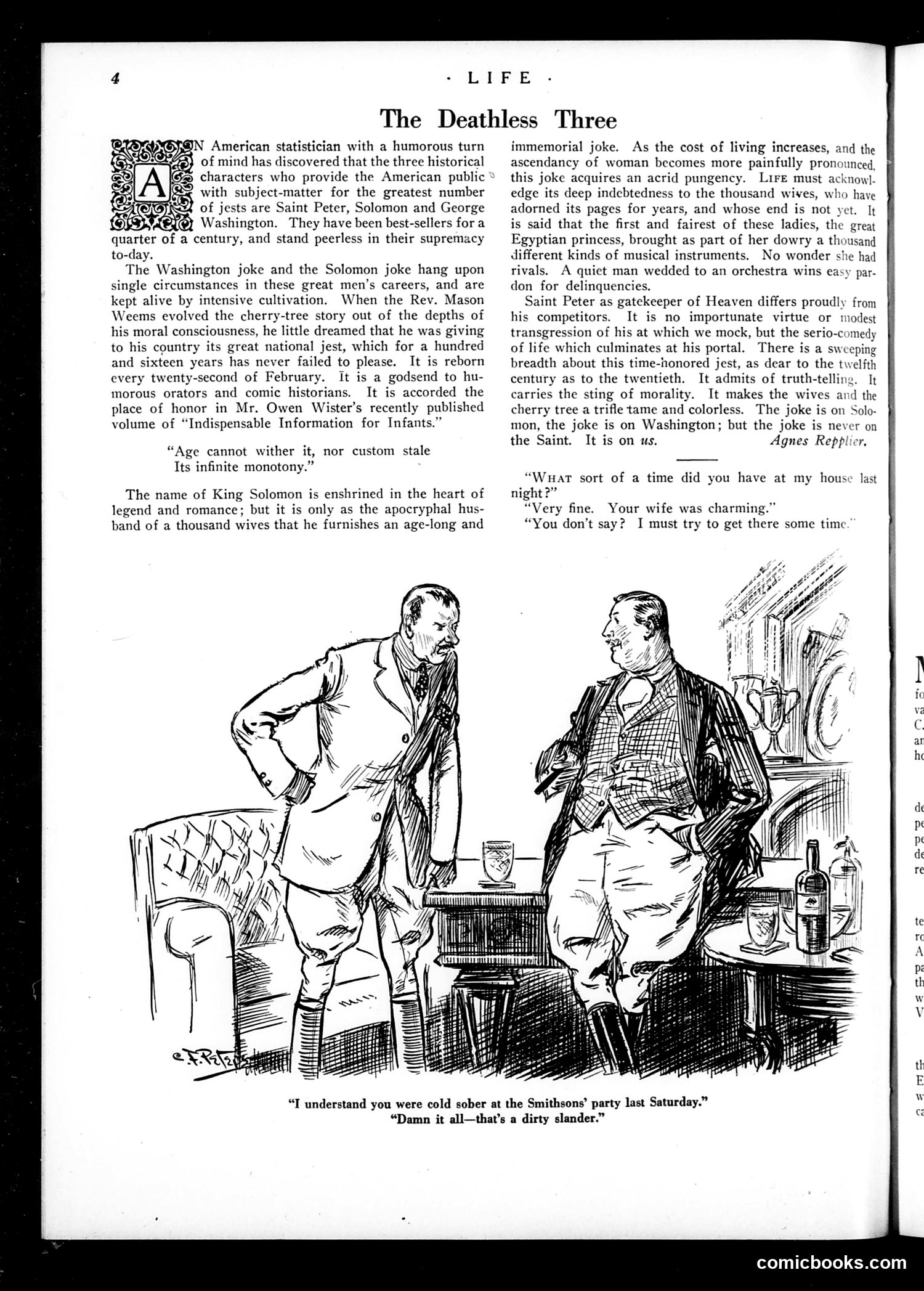
This page discusses three historical figures—Saint Peter, Solomon, and George Washington—whose associated jokes have endured for centuries. The text argues these men became cultural fixtures partly through apocryphal humor rather than historical accuracy. The cartoon illustrates a "Solomon joke"—a domestic scene where one man tells another he attended a party at "the Smithsons'" where the second man was "cold sober," prompting the reply "Damn it all—that's a dirty slander." The joke's structure relies on Solomon's legendary thousand wives; the implication is that the man gossips so persistently that even being sober—the opposite of the usual excuse for indiscretion—becomes scandalous. It's observational humor about social reputation and marital discord, demonstrating how these traditional jokes persist through relatable domestic situations.
📄 Transcribed text from this page (OCR, searchable)
Machine-transcribed from the original scan — historical spelling and the odd misread are preserved.
- LIFE The Deathless Three @N American statistician with a humorous turn of mind has discovered that the three historical characters who provide the American public with subject-matter for the greatest number of jests are Saint Peter, Solomon and George Washington. They have been best-sellers for a quarter of a century, and stand peerless in their supremacy to-day. The Washington joke and the Solomon joke hang upon single circumstances in these great men’s careers, and are kept alive by intensive cultivation. When the Rev. Mason Weems evolved the cherry-tree story out of the depths of his moral consciousness, he little dreamed that he was giving to his country its great national jest, which for a hundred and sixteen years has never failed to please. It is reborn every twenty-second of February. It is a godsend to hu- morous orators and comic historians. It is accorded the place of honor in Mr. Owen Wister’s recently published volume of “Indispensable Information for Infants.” “Age cannot wither it, nor custom stale Its infinite monotony.” The name of King Solomon is enshrined in the heart of legend and romance; but it is only as the apocryphal hus- band of a thousand wives that he furnishes an age-long and immemorial joke. As the cost of living increases, and the ascendancy of woman becomes more painfully pronounced, this joke acquires an acrid pungency. Lire must acknowl- edge its deep indebtedness to the thousand wives, who have adorned its pages for years, and whose end is not yet. It is said that the first and fairest of these ladies, the great Egyptian princess, brought as part of her dowry a thousand different kinds of musical instruments. No wonder she had rivals. A quict man wedded to an orchestra wins easy par- don for delinquencies. Saint Peter as gatekeeper of Heaven differs proudly from his competitors. It is no importunate virtue or modest transgression of his at which we mock, but the serio-comedy of life which culminates at his portal. There is a sweeping breadth about this time-honored jest, as dear to the twelfth century as to the twentieth. It admits of truth-telling. It carries the sting of morality. It makes the wives and the cherry tree a trifle tame and colorless. The joke is on Solo- mon, the joke is on Washington; but the joke is never on the Saint. It is on us. Agnes Repplier. “Wuar sort of a time did you have at my house last night?” “Very fine. Your wife was charming.” “You don’t say? I must try to get there some time. “I understand you were cold sober at the Smithsons’ party last Saturday.” “Damn it all—that’s a dirty slander.” comicbooks.com