
Life, 1922-02-16 · page 24 of 34
Life — February 16, 1922 — page 24: what you’re looking at
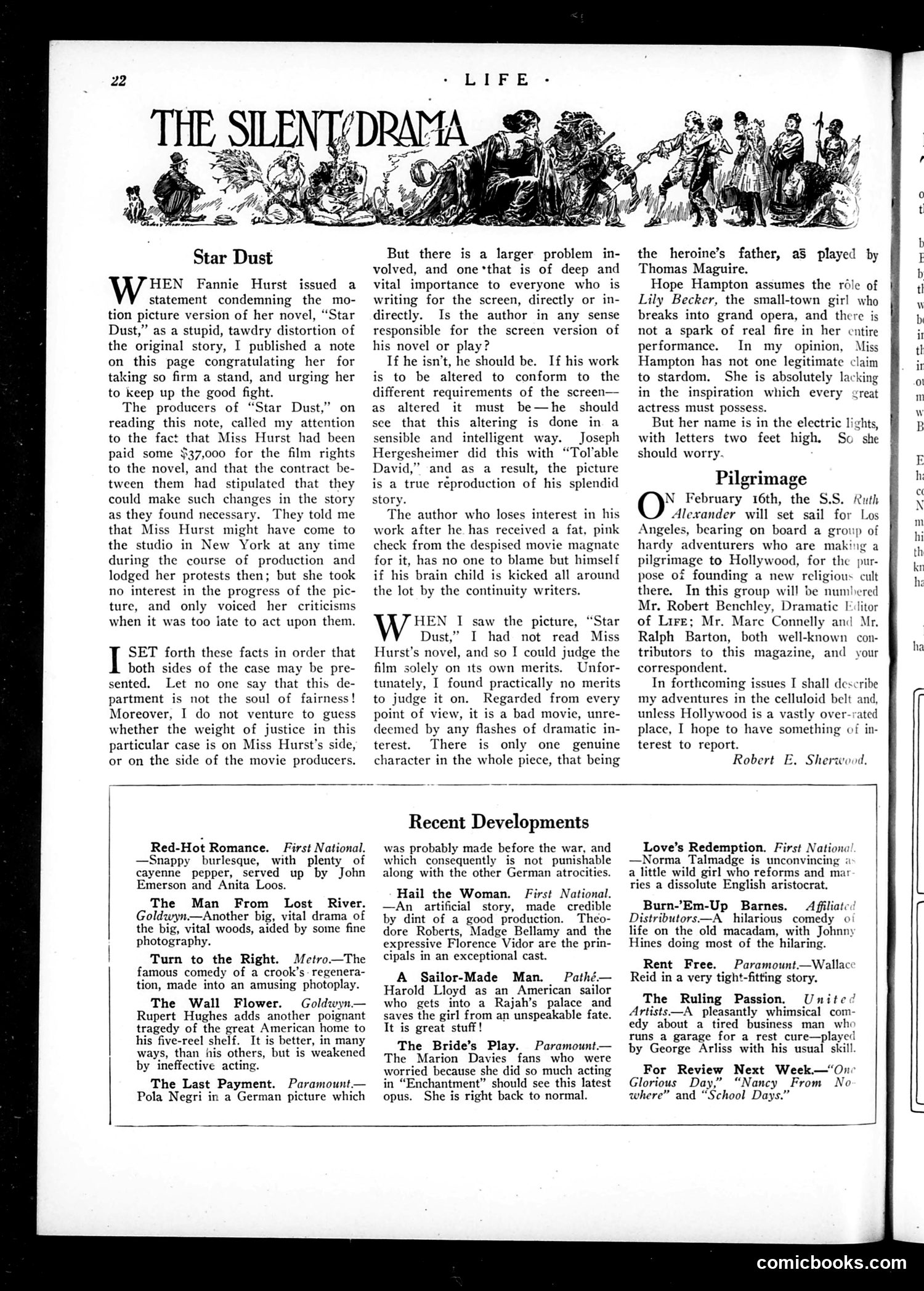
What you’re looking at
This page from *Life* magazine critiques both the adaptation of Fannie Hurst's novel "Star Dust" into a film and the broader issue of authorial control in Hollywood. The article argues that while producers paid Hurst $37,000 and held contractual rights to alter her work, authors like Hurst bear responsibility for disinterested abandonment of their projects during production. The piece specifically attacks actress Hope Hampton's performance as "absolutely lacking" in legitimate talent, sardonically noting she shouldn't worry since her name appears in lights. The satire targets Hollywood's commercial machinery—fat checks corrupting artists—and exposes the contradiction between Hurst's public condemnation and her financial complicity. The "Pilgrimage" announcement at page's end humorously frames a celebrity trip to Hollywood as religious pilgrimage, mocking the town's status as pilgrimage destination while previewing upcoming coverage by *Life* contributors including Robert Benchley and Robert E. Sherwood.
📄 Transcribed text from this page (OCR, searchable)
Machine-transcribed from the original scan — historical spelling and the odd misread are preserved.
Star Dust HEN Fannie Hurst issued a statement condemning the mo- tion picture version of her novel, “Star Dust,” as a stupid, tawdry distortion of the original story, I published a note on this page congratulating her for taking so firm a stand, and urging her to keep up the good fight. The producers of “Star Dust,” on reading this note, called my attention to the fact that Miss Hurst had been paid some $37,000 for the film rights to the novel, and that the contract be- tween them had stipulated that they could make such changes in the story as they found necessary. They told me that Miss Hurst might have come to the studio in New York at any time during the course of production and lodged her protests then; but she took no interest in the progress of the pic- ture, and only voiced her criticisms when it was too iate to act upon them. SET forth these facts in order that both sides of the case may be pre- sented. Let no one say that this de- partment is not the soul of fairness! Moreover, I do not venture to guess whether the weight of justice in this particular case is on Miss Hurst's side, or on the side of the movie producers. But there is a larger problem in- volved, and one*that is of deep and vital importance to everyone who is writing for the screen, directly or in- directly. Is the author in any sense responsible for the screen version of his novel or play? If he isn’t, he should be. If his work is to be altered to conform to the different requirements of the screen— as altered it must be—he should see that this altering is done in a sensible and intelligent way. Joseph Hergesheimer did this with “Tol’able David,” and as a result, the picture is a true reproduction of his splendid story. The author who loses interest in his work after he has received a fat, pink check from the despised movie magnate for it, has no one to blame but himself if his brain child is kicked all around the lot by the continuity writers. HEN I saw the picture, “Star Dust,” I had not read Miss Hurst's novel, and so I could judge the film solely on its own merits. Unfor- tunately, I found practically no merits to judge it on. Regarded from every point of view, it is a bad movie, unre- deemed by any flashes of dramatic in- terest. There is only one genuine character in the whole piece, that being the heroine’s father, aS played by Thomas Maguire. Hope Hampton assumes the role of Lily Becker, the small-town girl who breaks into grand opera, and there is not a spark of real fire in her entire performance. In my opinion, Miss Hampton has not one legitimate claim to stardom. She is absolutely lacking in the inspiration which every great actress must possess. But her name is in the electric lights, with letters two feet high, So she should worry, Pilgrimage N February 16th, the S.S. Ruth Alexander will set sail for Los Angeles, bearing on board a group of hardy adventurers who are making a pilgrimage to Hollywood, for the pur- pose of founding a new religious cult there. In this group will be numbered Mr. Robert Benchley, Dramatic [itor of Lire; Mr. Mare Connelly and Mr. Ralph Barton, both well-known con- tributors to this magazine, and your correspondent. In forthcoming issues I shall describe my adventures in the celluloid belt and, unless Hollywood is a vastly over-rated place, I hope to have something of in- terest to report. Robert E. Sherwood. Red-Hot Romance. First National. —Snappy burlesque, with plenty of cayenne pepper, served up by John Emerson and Anita Loos. The Man From Lost River. Goldwyn.—Another big, vital drama of the big, vital woods, aided by some fine photography. Turn to the Right. Metro—The famous comedy of a crook’s- regenera- tion, made into an amusing photoplay. The Wall Flower. Goldwyn— Rupert Hughes adds another poignant tragedy of the great American home to his five-reel shelf. It is better, in many ways, than his others, but is weakened by ineffective acting. The Last Payment. Paramount— Pola Negri in a German picture which Recent Developments was probably made before the war, and which consequently is not punishable along with the other German atrocities. Hail the Woman. First National. —An artificial story, made credible by dint of a good production. Theo- dore Roberts, Madge Bellamy and the expressive Florence Vidor are the prin- cipals in an exceptional cast. A Sailor-Made Man. Pathé— Harold Lloyd as an American sailor who gets into a Rajah’s palace and saves the girl from an unspeakable fate. It is great stuff! The Bride’s Play. Paramount.— The Marion Davies fans who were worried because she did so much acting in “Enchantment” should see this latest opus. She is right back to normal. Love’s Redemption. First Nationa —Norma_ Talmadge is unconvincing a a little wild girl who reforms and mar ries a dissolute English aristocrat. Burn-’Em-Up Barnes. 4 ffiliat Distributors—A hilarious comedy o life on the old macadam, with Johnny Hines doing most of the hilaring. Rent Free. Paramount.—Wallac Reid in a very tight-fitting story. The Ruling Passion. United Artists—A pleasantly whimsical com- edy about a tired business man who runs a garage for a rest cure—played by George Arliss with his usual skill. For Review Next Week—“On: Glorious Day,’ “Nancy From No where” and “School Days.” \ comicbooks.com