
Life, 1922-02-16 · page 4 of 34
Life — February 16, 1922 — page 4: what you’re looking at
What you’re looking at
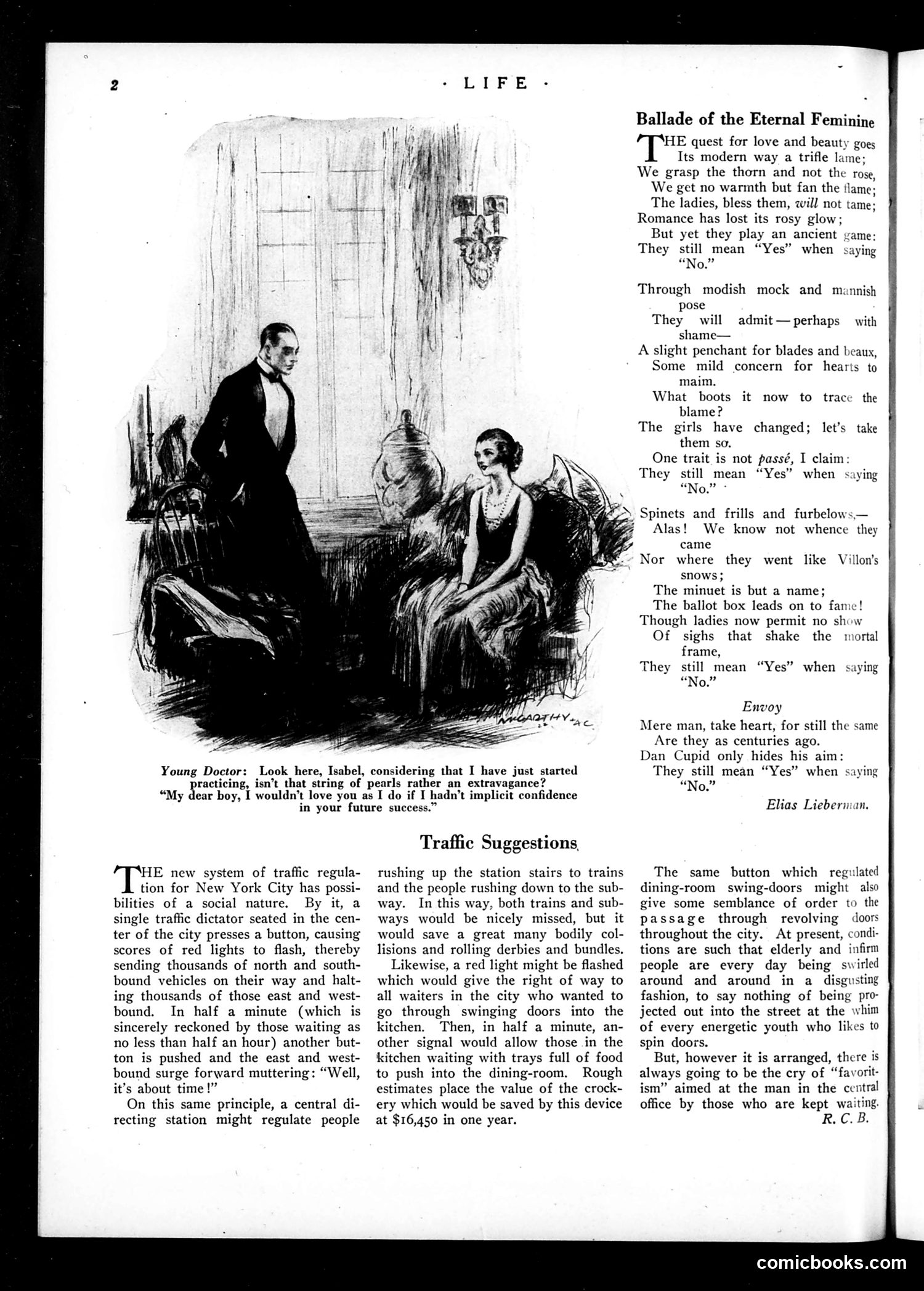
**The Cartoon:** The sketch depicts a young doctor speaking to a woman named Isabel, asking her to marry him despite his modest circumstances. The caption captures his nervous pitch: he's asking her to accept his proposal based on his future success rather than current wealth. **The Social Commentary:** This satirizes early 20th-century courtship conventions where a woman's acceptance of marriage depended heavily on a man's financial prospects. The young doctor represents the struggling professional trying to convince a woman to marry "on spec"—betting on his future earnings rather than present means. **The Poem & Article Below:** "Ballade of the Eternal Feminine" mocks women's persistent tendency to say "Yes" to marriage proposals despite changing times, while "Traffic Suggestions" proposes humorous urban traffic-control solutions for New York City.
📄 Transcribed text from this page (OCR, searchable)
Machine-transcribed from the original scan — historical spelling and the odd misread are preserved.
Young Doctor: Look here, Isabel, considering that I have just started practicing, isn’t that string of pearls rather an extravagance? “My dear boy, I wouldn’t love you as I do if I hadn’t implicit confidence in your future success.” ‘HE new system of traffic regula- ion for New York City has possi- bilities of a social nature. By it, a single traffic dictator seated in the cen- ter of the city presses a button, causing scores of red lights to flash, thereby sending thousands of north and south- bound vehicles on their way and halt- ing thousands of those east and west- bound. In half a minute (which is sincerely reckoned by those waiting as no less than half an hour) another but- ton is pushed and the east and west- bound surge forward muttering: “Well, it’s about time!” On this same principle, a central di- recting station might regulate people Traffic Suggestions, rushing up the station stairs to trains and the people rushing down to the sub- way. In this way, both trains and sub- ways would be nicely missed, but it would save a great many bodily col- lisions and rolling derbies and bundles. Likewise, a red light might be flashed which would give the right of way to all waiters in the city who wanted to go through swinging doors into the kitchen. Then, in half a minute, an- other signal would allow those in the kitchen waiting with trays full of food to push into the dining-room. Rough estimates place the value of the crock- ery which would be saved by this device at $16,450 in one year. Ballade of the Eternal Feminine ‘HE quest for love and beauty goes Its modern way a trifle lame; We grasp the thorn and not the rose, We get no warmth but fan the flame; The ladies, bless them, will not tame; Romance has lost its rosy glow; But yet they play an ancient vame: They still mean “Yes” when saying “No.” Through modish mock and mannish pose They will shame— A slight penchant for blades and beaux, Some mild concern for hearts to maim. What boots it blame? The girls have changed; let’s take them so. One trait is not passé, I claim: They still mean “Yes” when saying “No.” * admit — perhaps with now to trace the Spinets and frills and furbelows,— Alas!) We know not whence they came Nor where they went like Villon’s snows}; The minuet is but a name; The ballot box leads on to fame! Though ladies now permit no show Of sighs that shake the mortal frame, They still mean “Yes” when saying “No.” Envoy Mere man, take heart, for still the same Are they as centuries ago. Dan Cupid only hides his aim: They still mean “Yes” when saying “No.” Elias Lieberman. The same button which regulated dining-room swing-doors might also give some semblance of order to the passage through revolving doors throughout the city. At present, condi- tions are such that elderly and infirm people are every day being swirled around and around in a disgusting fashion, to say nothing of being pro- jected out into the street at the whim of every energetic youth who likes to spin doors. But, however it is arranged, there is always going to be the cry of “favorit- ism” aimed at the man in the central office by those who are kept waiting. R.C. B. comicbooks.com