
Life, 1922-02-16 · page 16 of 34
Life — February 16, 1922 — page 16: what you’re looking at
What you’re looking at
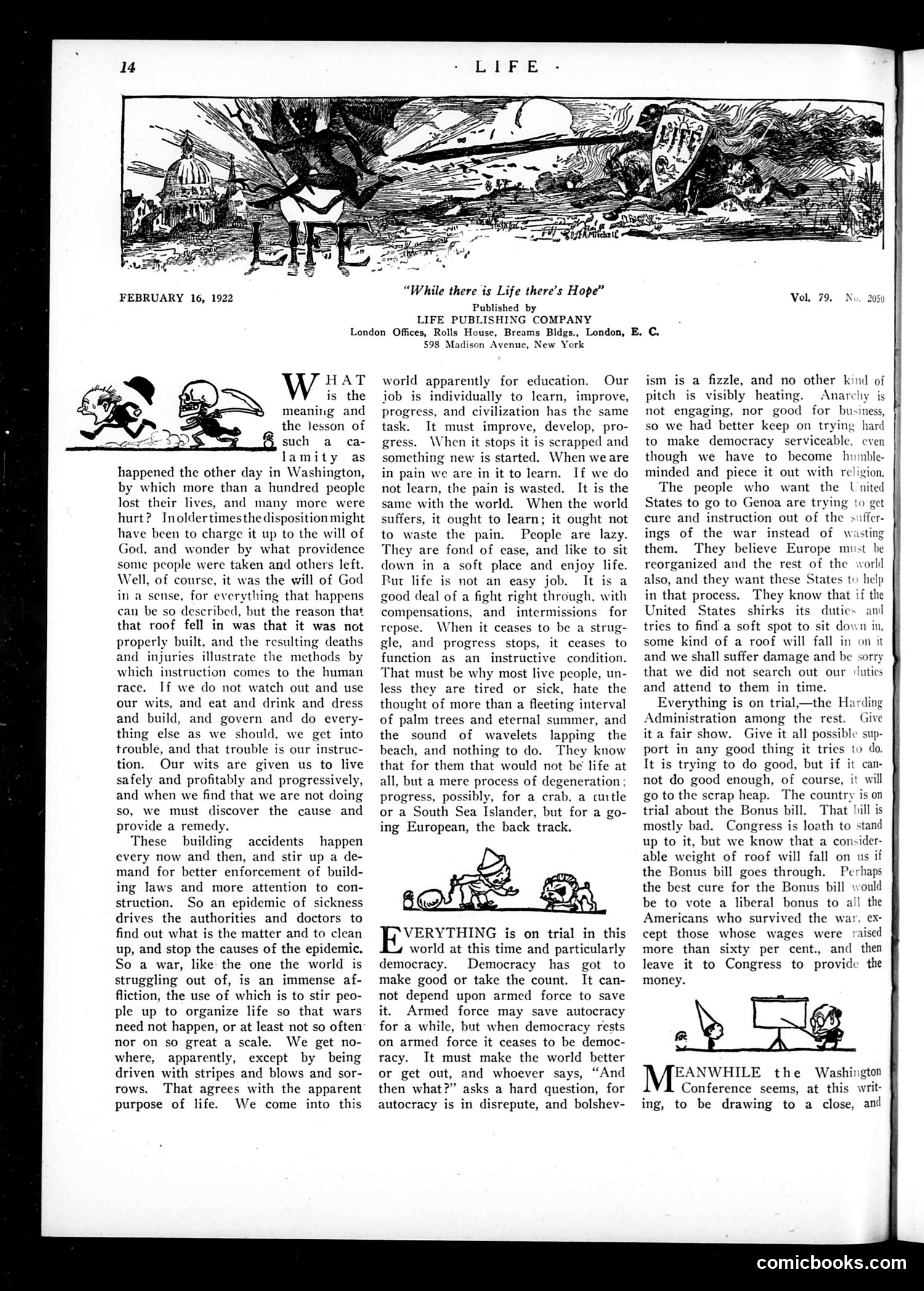
This editorial page discusses post-WWI reconstruction and American democracy. The main article criticizes both government inefficiency and anarchist ideology, arguing that "democracy has got to make good or take the count." It warns that armed force might temporarily save democracy but undermines it long-term. The small cartoon illustrations (appearing to show simple figures in conflict or distress) likely reinforce themes of social upheaval. The text references the Washington Conference (visible in "MEANWHILE" section), suggesting contemporary peace negotiations. The overall message: America faces a critical test between maintaining democratic institutions or risking authoritarian solutions—a common post-WWI anxiety about Bolshevism, labor unrest, and government legitimacy that dominated 1920s American discourse.
📄 Transcribed text from this page (OCR, searchable)
Machine-transcribed from the original scan — historical spelling and the odd misread are preserved.
FEBRUARY 16, 1922 “While there is Life there’s Hope” Published by LIFE PUBLISHING COMPANY No. 2050 London Offices, Rolls House, Breams Bidgs., London, E. C. HAT is the meaning and the lesson of such a ca- lamity as happened the other day in Washington, by which more than a hundred people lost their lives, and many more were hurt? Inoldertimesthe disposition might have been to charge it up to the will of God, and wonder by what providence some people were taken and others left. Well, of course, it was the will of God in a sense, for everything that happens can be so described, but the reason that that roof fell in was that it was not properly built, and the resulting deaths and injuries illustrate the methods by which instruction comes to the human race. If we do not watch out and use our wits, and eat and drink and dress and build, and govern and do every- thing else as we should, we get into trouble, and that trouble is our instruc- tion. Our wits are given us to live safely and profitably and progressively, and when we find that we are not doing so, we must discover the cause and provide a remedy. These building accidents happen every now and then, and stir up a de- mand for better enforcement of build- ing laws and more attention to con- struction. So an epidemic of sickness drives the authorities and doctors to find out what is the matter and to clean up, and stop the causes of the epidemic. So a war, like the one the world is struggling out of, is an immense af- fliction, the use of which is to stir peo- ple up to organize life so that wars need not happen, or at least not so often nor on so great a scale. We get no- where, apparently, except by being driven with stripes and blows and sor- rows. That agrees with the apparent purpose of life. We come into this 598 Madison Avenue, New York world apparently for education. Our job is individually to learn, improve, progress, and civilization has the same It must improve, develop, pro- s. When it stops it is scrapped and something new is started. When we are in pain we are in it to learn. If we do not learn, the pain is wasted. It is the same with the world. When the world suffers, it ought to learn; it ought not to waste the pain. People are lazy. They are fond of case, and like to sit down in a soft place and enjoy life. Put life is not an easy job. It is a good deal of a fight right through, with compensations, and intermissions for repose. When it ceases to be a strug- gle, and progress stops, it ceases to function as an instructive condition. That must be why most live people, un- less they are tired or sick, hate the thought of more than a fleeting interval of palm trees and eternal summer, and the sound of wavelets lapping the beach, and nothing to do. They know that for them that would not be life at all, but a mere process of degeneration ; progress, possibly, for a crab, a curtle or a South Sea Islander, but for a go- ing European, the back track. peers is on trial in this world at this time and particularly democracy. Democracy has got to make good or take the count. It can- not depend upon armed force to save it. Armed force may save autocracy for a while, but when democracy rests on armed force it ceases to be democ- racy. It must make the world better or get out, and whoever says, “And then what?” asks a hard question, for autocracy is in disrepute, and bolshev- ism is a fizzle, and no other kind of pitch is visibly heating. Anarc not engaging, nor good for business, so we had better keep on trying hard to make democracy serviceable, even though we have to become humble- minded and piece it out with religion. The people who want the United States to go to Genoa are trying to get cure and instruction out of the suffer- ings of the war instead of wasting them. They believe Europe must be reorganized and the rest of the world also, and they want these States to help in that process. They know that if the United States shirks its dutics and tries to find a soft spot to sit down in, some kind of a roof will fall in on it and we shall suffer damage and be sorry that we did not search out our «luties and attend to them in time. Everything is on trial—the Harding Administration among the rest. Give it a fair show. Give it all possible sup- port in any good thing it tries to do. It is trying to do good, but if it can- not do good enough, of course, it will go to the scrap heap. The country is on trial about the Bonus bill. That Dill is mostly bad. Congress is loath to stand up to it, but we know that a consider- able weight of roof will fall on us if the Bonus bill goes through. Perhaps the best cure for the Bonus bill would be to vote a liberal bonus to all the Americans who survived the war, ex- cept those whose wages were raised more than sixty per cent., and then leave it to Congress to provide the money. R EANWHILE the Washington Conference seems, at this writ- ing, to be drawing to a close, and comicbooks.com