
Life, 1922-02-16 · page 28 of 34
Life — February 16, 1922 — page 28: what you’re looking at
What you’re looking at
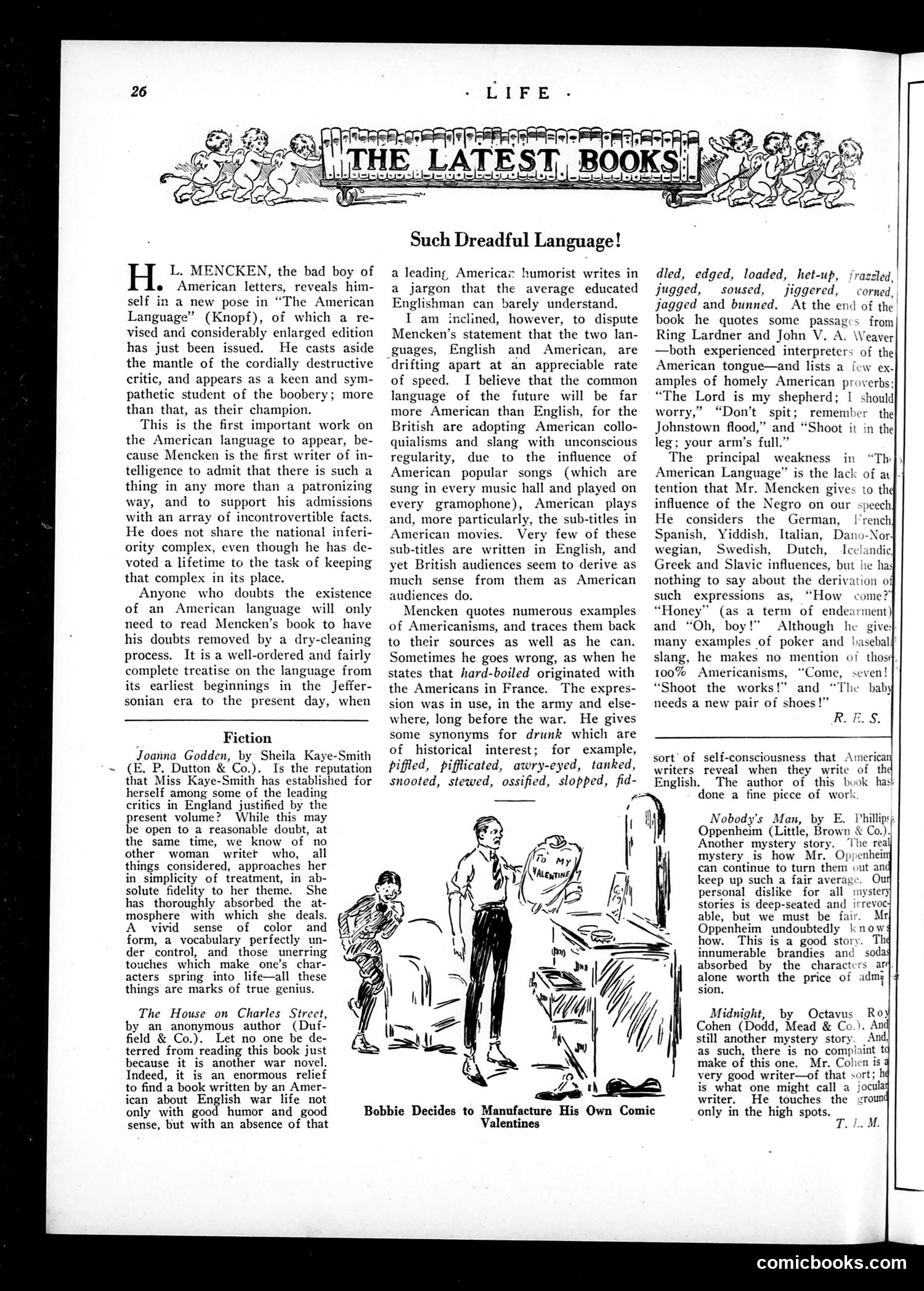
This page reviews H.L. Mencken's scholarly work on American English, presenting his argument that American and English are diverging languages. The reviewer disputes Mencken's claim, predicting American English will actually dominate the future due to American cultural exports—popular songs, theater, and especially cinema with English subtitles that British audiences readily understand. The cartoon shows a man manufacturing homemade valentines, illustrating the book review's lighthearted tone. The page also includes brief reviews of contemporary fiction. The satire here targets linguistic snobbery: Mencken is praised for treating American speech seriously rather than dismissively, while the reviewer notes the irony that British audiences absorb American expressions through entertainment without realizing it. This reflects early 20th-century anxiety about American cultural influence on British speech patterns—a concern that proved prescient.
📄 Transcribed text from this page (OCR, searchable)
Machine-transcribed from the original scan — historical spelling and the odd misread are preserved.
L. MENCKEN, the bad boy of e American letters, reveals him- self in a new pose in “The American Language” (Knopf), of which a re- vised and considerably enlarged edition has just been issued. He casts aside the mantle of the cordially destructive critic, and appears as a keen and sym- pathetic student of the boobery; more than that, as their champion. This is the first important work on the American language to appear, be- cause Mencken is the first writer of in- telligence to admit that there is such a thing in any more than a patronizing way, and to support his admissions with an array of incontrovertible facts. He does not share the national inferi- ority complex, even though he has de- voted a lifetime to the task of keeping that complex in its place. Anyone who doubts the existence of an American language will only need to read Mencken’s book to have his doubts removed by a dry-cleaning process. It is a well-ordered and fairly complete treatise on the language from its earliest beginnings in the Jeffer- sonian era to the present day, when Fiction Joanna Godden, by Sheila Kaye-Smith (E. P. Dutton & Co.). Is the reputation that Miss Kaye-Smith has established for herself among some of the leading critics in England justified by the present volume? While this may be open to a reasonable doubt, at the same time, we know of no other woman writet who, all things considered, approaches her in simplicity of treatment, in ab- solute fidelity to her theme. She has thoroughly absorbed the at- mosphere with which she deals. A vivid sense of color and form, a vocabulary perfectly un- der control, and those unerring touches which make one’s char- acters spring into life—all these things are marks of true genius. The House on Charles Street, by an anonymous author (Duf- field & Co.). Let no one be de- terred from reading this book just because it is another war novel. Indeed, it is an enormous relief to find a book written by an Amer- ican about English war life not only with good humor and good sense, but with an absence of that guages, Such Dreadful Language! a leading America: humorist writes in a jargon that the average educated Englishman can barely understand. I am inclined, however, to dispute Mencken’s statement that the two lan- English and American, are drifting apart at an appreciable rate of speed. I believe that the common language of the future will be far more American than English, for the British are adopting American collo- quialisms and slang with unconscious regularity, due to the influence of American popular songs (which are sung in every music hall and played on every gramophone), American plays and, more particularly, the sub-titles in American movies. Very few of these sub-titles are written in English, and yet British audiences seem to derive as much sense from them as American audiences do. Mencken quotes numerous examples of Americanisms, and traces them back to their sources as well as he can. Sometimes he goes wrong, as when he states that hard-boiled originated with the Americans in France. The expres- sion was in use, in the army and else- where, long before the war. He gives some synonyms for drunk which are of historical interest; for example, piffled, pifflicated, awry-eyed, tanked, snooted, stewed, ossified, slopped, fid- e cs > G Valentines English. The author of this book has! done a fine piece of work ih Nobody's Man, by E. Phillips Oppenheim (Little, Brown & Co.). Another mystery story. ‘The real Wa a i Bobbie Decides to Manufacture His Own Comic H mystery can continue to turn them out and keep up such a fair average. Ow personal dislike for all mystery dled, edged, loaded, het-up, jrazsled, jugged, soused, jiggered, corned, jagged and bunned. At the end of the book he quotes some passagcs from Ring Lardner and John V. A. \Veaver —both experienced interpreters of the American tongue—and lists a few ex- amples of homely American proverbs; “The Lord is my shepherd; I should| worry,” “Don’t spit; remember the| Johnstown flood,” and “Shoot it in the| leg; your arm’s full.” The principal weakness in “Th+}) American Language” is the lack of at tention that Mr. Mencken gives to thd influence of the Negro on our speech. He considers the German, |'rench Spanish, Yiddish, Italian, Dano-Nor. wegian, Swedish, Dutch, Icelandic] Greek and Slavic influences, but he hag nothing to say about the derivation of such expressions as, “How come?’ “Honey” (as a term of endearment) and “Oh, boy!" Although he gives many examples of poker and lbasebal slang, he makes no mention of thos¢. 100% Americanisms, “Come, seven! “Shoot the works!" and “The baby needs a new pair of shoes!” R. E..S. mericar ite of the sort’ of self-consciousness that writers reveal when they w is how Mr. Oppenheim stories is deep-seated and irrevoc able, but we must be fair. Mr Oppenheim undoubtedly know how. This is a good story. Th innumerable brandies and soday ma absorbed by the characters are alone worth the price of admy sion. Midnight, by Octavus Roy Cohen (Dodd, Mead & Co.). And still another mystery story And, as such, there is no complaint t make of this one. Mr. Colien is very good writer—of that sort; h is what one might call a jocula! writer. He touches the groum only in the high spots. T u comicbooks.com