
Life, 1922-02-16 · page 10 of 34
Life — February 16, 1922 — page 10: what you’re looking at
What you’re looking at
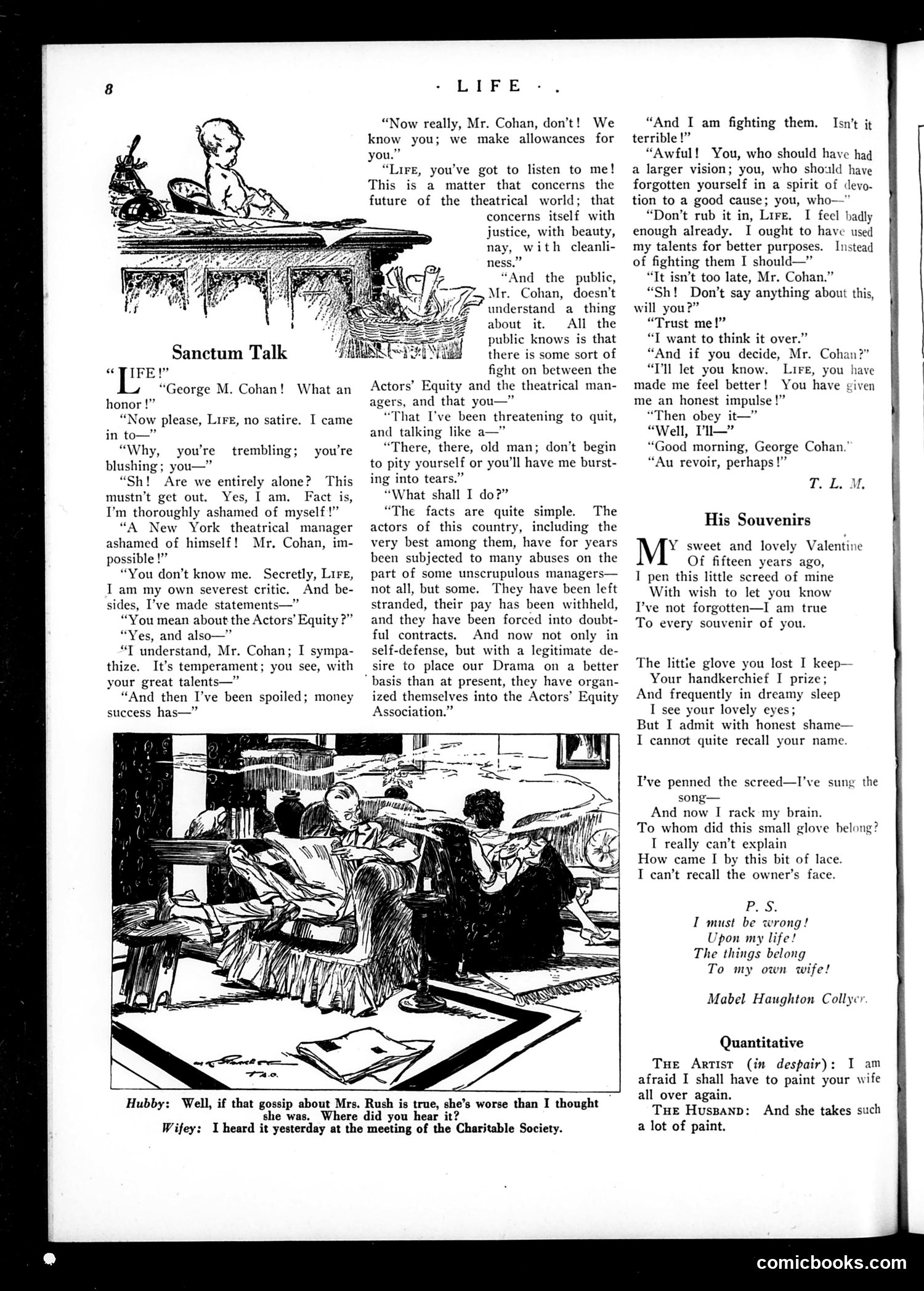
This page contains a dialogue between "Life" (the magazine's personified voice) and George M. Cohan, a prominent American actor and playwright of the early 20th century. Life confronts Cohan about his behavior regarding the Actors' Equity Association strike, accusing him of threatening to quit and questioning his commitment to theatrical reform. The cartoon below depicts two men gossiping, with the caption indicating they're discussing rumors about "Mrs. Rush" from a "Charitable Society" meeting—typical society-page gossip material. The right column features romantic poems titled "His Souvenirs," sentimental verses about lost love and forgotten memories, likely responding to reader submissions. The page combines satirical editorial commentary on theater industry conflicts with lighter humor and romantic sentiment.
📄 Transcribed text from this page (OCR, searchable)
Machine-transcribed from the original scan — historical spelling and the odd misread are preserved.
Sanctum Talk “TIFE!” “George M. Cohan! honor !” “Now please, Lire, no satire. I came in to—” “Why, you're blushing; you—” “Sh! Are we entirely alone? This mustn’t get out. Yes, I am. Fact is, I’m thoroughly ashamed of myself!” “A New York theatrical manager ashamed of himself! Mr. Cohan, im- possible!” “You don’t know me. Secretly, Lire, I am my own severest critic. And be- sides, I’ve made statements—” “You mean about the Actors’ Equity ?” “Yes, and also—” “T understand, Mr. Cohan; I sympa- thize. It’s temperament; you see, with your great talents—” “And then I've been spoiled; money success has—” What an trembling; you're LIFE “Now really, Mr. Cohan, don’t! We know you; we make allowances for you.” “LirE, you’ve got to listen to me! This is a matter that concerns the future of the theatrical world; that concerns itself with justice, with beauty, nay, with cleanli- ness.” “And the public, Mr. Cohan, doesn’t understand a thing about it. All the public knows is that there is some sort of fight on between the Actors’ Equity and the theatrical man- agers, and that you—” That I've been threatening to quit, and talking like a—” “There, there, old man; don’t begin to pity yourself or you'll have me burst- ing into tears.” “What shall I do?” “The facts are quite simple. The actors of this country, including the very best among them, have for years been subjected to many abuses on the part of some unscrupulous managers— not all, but some. They have been left stranded, their pay has been withheld, and they have been forced into doubt- ful contracts. And now not only in self-defense, but with a legitimate de- sire to place our Drama on a better “basis than at present, they have organ- ized themselves into the Actors’ Equity Association.” Hubby: Well, if that gossip about Mrs. Rush is true, she’s worse than I thought she was. Where did you hear it? Wifey: I heard it yesterday at the meeting of the Charitable Society. “And I am fighting them. terrible!” “Awful! You, who should have had a larger vision; you, who shold have forgotten yourself in a spirit of devo- tion to a good cause; you, who—” “Don’t rub it in, Lire. I feel badly enough already. I ought to have used my talents for better purposes. Instead of fighting them I should—” “Tt isn’t too late, Mr. Cohan.” “Sh! Don’t say anything about this, will you?” “Trust me!” “I want to think it over.” “And if you decide, Mr. Cohan?” “Tl let you know. Lire, you have made me feel better! You have given me an honest impulse!” “Then obey it—” “Well, I’ll—” “Good morning, George Cohan.’ “Au revoir, perhaps !” Isn’t it T. L. M. His Souvenirs Y sweet and lovely Valentine Of fifteen years ago, I pen this little screed of mine With wish to let you know I’ve not forgotten—I am true To every souvenir of you. The littie glove you lost I keep— Your handkerchief I prize; And frequently in dreamy sleep I see your lovely eyes; But I admit with honest shame— I cannot quite recall your name. I’ve penned the screed—I’ve sung the song— And now I rack my brain. To whom did this small glove belong? I really can’t explain How came I by this bit of lace. I can’t recall the owner’s face. P.S. I must be wrong! Upon my life! The things belong To my own wife! Mabel Haughton Collyer Quantitative Tue Artist (in despair): I am afraid I shall have to paint your wife all over again. Tue Huspanp: a lot of paint. And she takes such comicbooks.com