
Life, 1922-02-16 · page 20 of 34
Life — February 16, 1922 — page 20: what you’re looking at
What you’re looking at
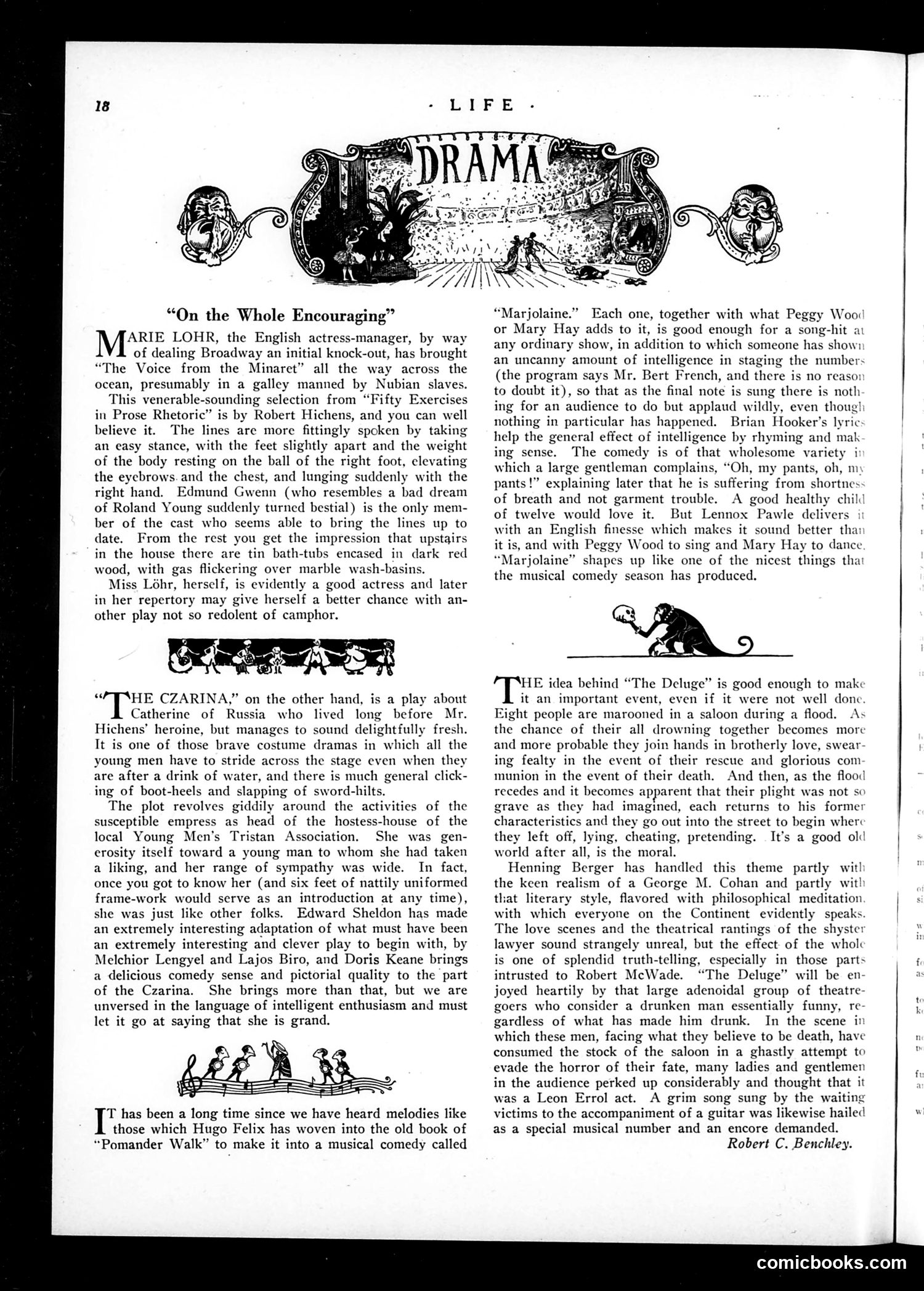
This page contains theater reviews from Life magazine's drama section, written in the publication's characteristic sardonic style. The reviews critique three Broadway productions: 1. **"The Voice from the Minaret"** — Marie Lohr imports this adaptation of Robert Hichens' prose work. The reviewer mocks it as stilted and old-fashioned, mockingly suggesting actors should deliver lines with exaggerated posture. Only Edmund Gwenn escapes criticism. The reviewer suggests the play smells of "camphor" (mothballs)—implying it's ancient and musty. 2. **"The Czarina"** — A costume drama about Catherine the Great, praised for freshness despite its melodramatic sword-slapping conventions. Doris Keane receives particular praise for bringing "comedy sense" to the role. 3. **"Marjolaine"** — A musical comedy praised for Hugo Felix's melodies and intelligent staging by Bert French. The reviewer notes it's wholesome entertainment requiring nothing intellectually demanding of audiences. The tone throughout is witty, dismissive of pretension, and focused on performance quality.
📄 Transcribed text from this page (OCR, searchable)
Machine-transcribed from the original scan — historical spelling and the odd misread are preserved.
“On the Whole Encouraging” ARIE LOHR, the English actress-manager, by way of dealing Broadway an initial knock-out, has brought “The Voice from the Minaret” all the way across the ocean, presumably in a galley manned by Nubian slaves. This venerable-sounding selection from “Fifty Exercises in Prose Rhetoric” is by Robert Hichens, and you can well believe it. The lines are more fittingly spoken by taking an easy stance, with the feet slightly apart and the weight of the body resting on the ball of the right foot, elevating the eyebrows. and the chest, and lunging suddenly with the right hand. Edmund Gwenn (who resembles a bad dream of Roland Young suddenly turned bestial) is the only mem- ber of the cast who seems able to bring the lines up to date. From the rest you get the impression that upstairs in the house there are tin bath-tubs encased in dark red wood, with gas flickering over marble wash-basins. Miss Lohr, herself, is evidently a good actress and later in her repertory may give herself a better chance with an- other play not so redolent of camphor. a HE CZARINA,” on the other hand, is a play about Catherine of Russia who lived long before Mr. Hichens’ heroine, but manages to sound delightfully fresh. It is one of those brave costume dramas in which all the young men have to stride across the stage even when they are after a drink of water, and there is much general click- ing of boot-heels and slapping of sword-hilts. The plot revolves giddily around the activities of the susceptible empress as head of the hostess-house of the local Young Men’s Tristan Association. She was gen- erosity itself toward a young man to whom she had taken a liking, and her range of sympathy was wide. In fact, once you got to know her (and six feet of nattily uniformed frame-work would serve as an introduction at any time), she was just like other folks. Edward Sheldon has made an extremely interesting adaptation of what must have been an extremely interesting and clever play to begin with, by Melchior Lengyel and Lajos Biro, and Doris Keane brings a delicious comedy sense and pictorial quality to the part of the Czarina. She brings more than that, but we are unversed in the language of intelligent enthusiasm and must let it go at saying that she is grand. T has been a long time since we have heard melodies like those which Hugo Felix has woven into the old book of “Pomander Walk” to make it into a musical comedy called “Marjolaine.” Each one, together with what Peggy Woo: or Mary Hay adds to it, is good enough for a song-hit a any ordinary show, in addition to which someone has show: an uncanny amount of intelligence in staging the numbers (the program says Mr. Bert French, and there is no reasor to doubt it), so that as the final note is sung there is noth ing for an audience to do but applaud wildly, even thoug! nothing in particular has happened. Brian Hooker's lyric help the general effect of intelligence by rhyming and mak ing sense. The comedy is of that wholesome variety i which a large gentleman complains, “Oh, my pants, oh, m pants!” explaining later that he is suffering from shortnes of breath and not garment trouble. A good healthy chil of twelve would love it. But Lennox Pawle delivers with an English finesse which makes it sound better tha: it is, and with Peggy Wood to sing and Mary Hay to dance. “Marjolaine” shapes up like one of the nicest things that the musical comedy season has produced. HE idea behind “The Deluge” is good enough to make it an important event, even if it were not well done. Eight people are marooned in a saloon during a flood. As the chance of their all drowning together becomes more and more probable they join hands in brotherly love, swear- ing fealty in the event of their rescue and glorious com munion in the event of their death. And then, as the flood recedes and it becomes apparent that their plight was not so grave as they had imagined, each returns to his former characteristics and they go out into the street to begin wher: they left off, lying, cheating, pretending. It’s a good ol world after all, is the moral. Henning Berger has handled this theme partly wit! the keen realism of a George M. Cohan and partly wit! that literary style, flavored with philosophical meditation with which everyone on the Continent evidently speaks The love scenes and the theatrical rantings of the s| lawyer sound strangely unreal, but the effect of the whol is one of splendid truth-telling, especially in those parts intrusted to Robert McWade. “The Deluge” will be en joyed heartily by that large adenoidal group of theatre- goers who consider a drunken man essentially funny, re- gardless of what has made him drunk. In the scene in which these men, facing what they believe to be death, have consumed the stock of the saloon in a ghastly attempt to evade the horror of their fate, many ladies and gentlemen in the audience perked up considerably and thought that it was a Leon Errol act. A grim song sung by the waiting victims to the accompaniment of a guitar was likewise hailed as a special musical number and an encore demanded. Robert C. Benchley. comicbooks.com