A complete issue · 34 pages · 1922
Life — January 26, 1922
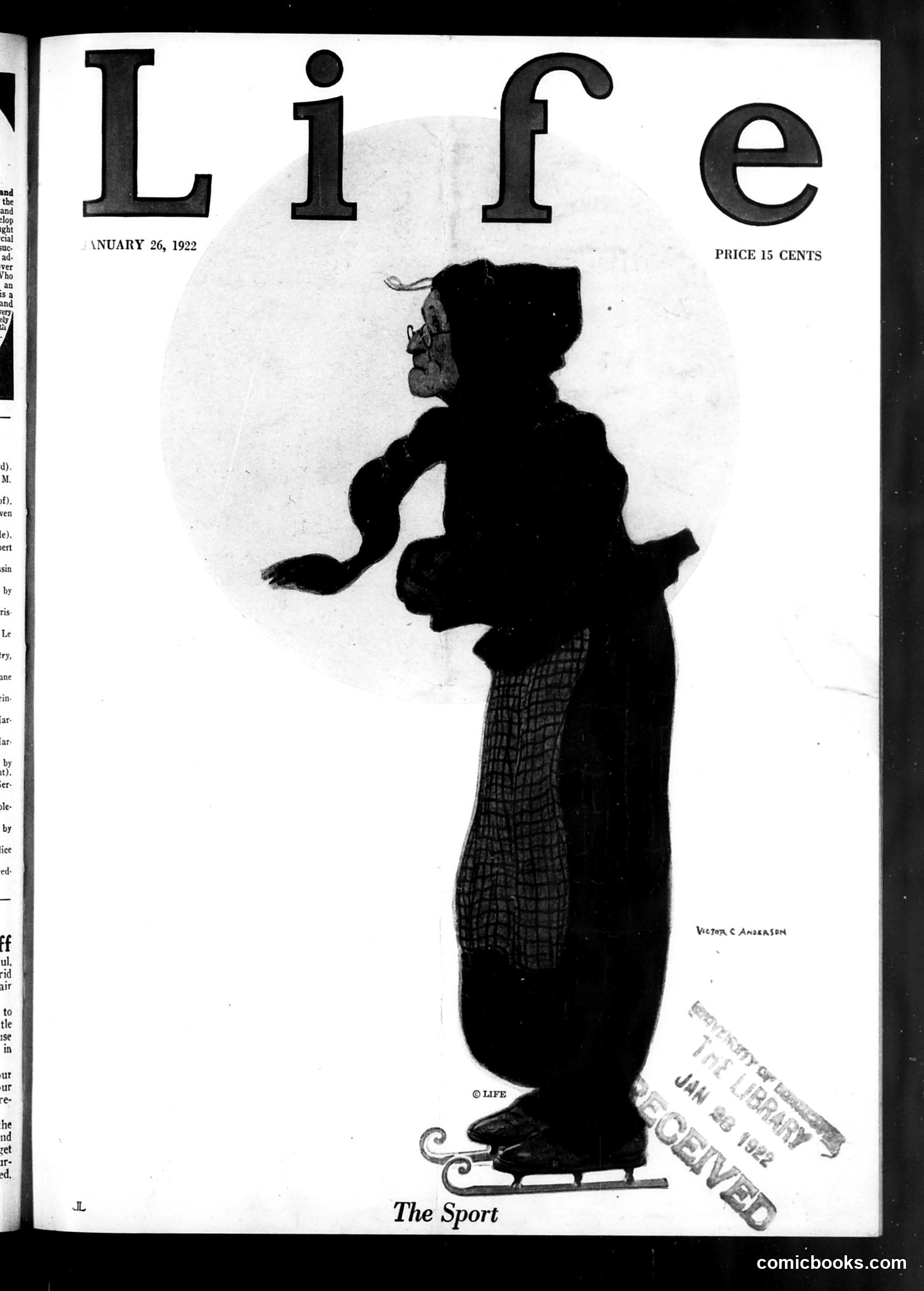
This cover illustration by Weyburn Anderson depicts a silhouetted figure ice skating, shown in dynamic motion with arms outstretched. The figure appears to be a woman based on the costume detail visible (a patterned skirt), and the artistic style suggests this celebrates ice skating as a fashionable winter sport. The title "The Sport" indicates this likely promotes ice skating as a contemporary recreational activity popular among the leisure class. Given the 1922 date, this reflects the growing popularity of winter sports and outdoor recreation during the post-World War I era. The figure's elegant pose and silhouette treatment suggest ice skating was considered both athletically impressive and socially prestigious among American audiences at this time.
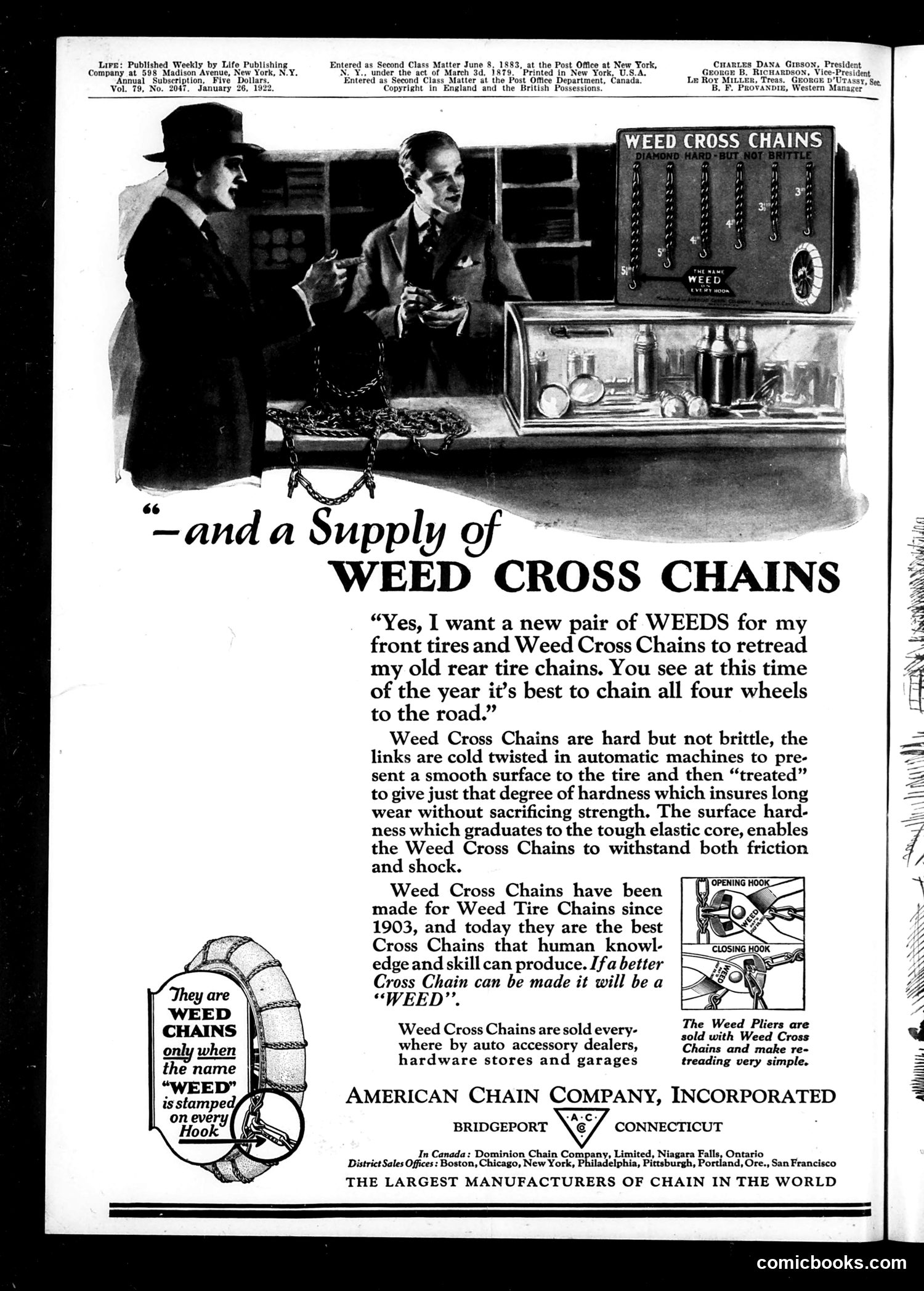
This page is primarily **advertising, not satire or political commentary**. It's a 1922 product advertisement for Weed Cross Chains—tire chains used for winter driving traction. The illustration shows two men in business attire examining chains at what appears to be an auto shop counter, with a display board of products behind them. The ad's narrative depicts a customer purchasing winter tire chains, emphasizing their quality and durability since 1903. The only "cartoon" element is a small illustrated tire in the left margin with text saying "They are WEED CHAINS only when the name 'WEED' is stamped on every Hook." This is straightforward commercial messaging aimed at automobile owners, reflecting early 1920s winter driving concerns. There is no political satire or social commentary to decode.
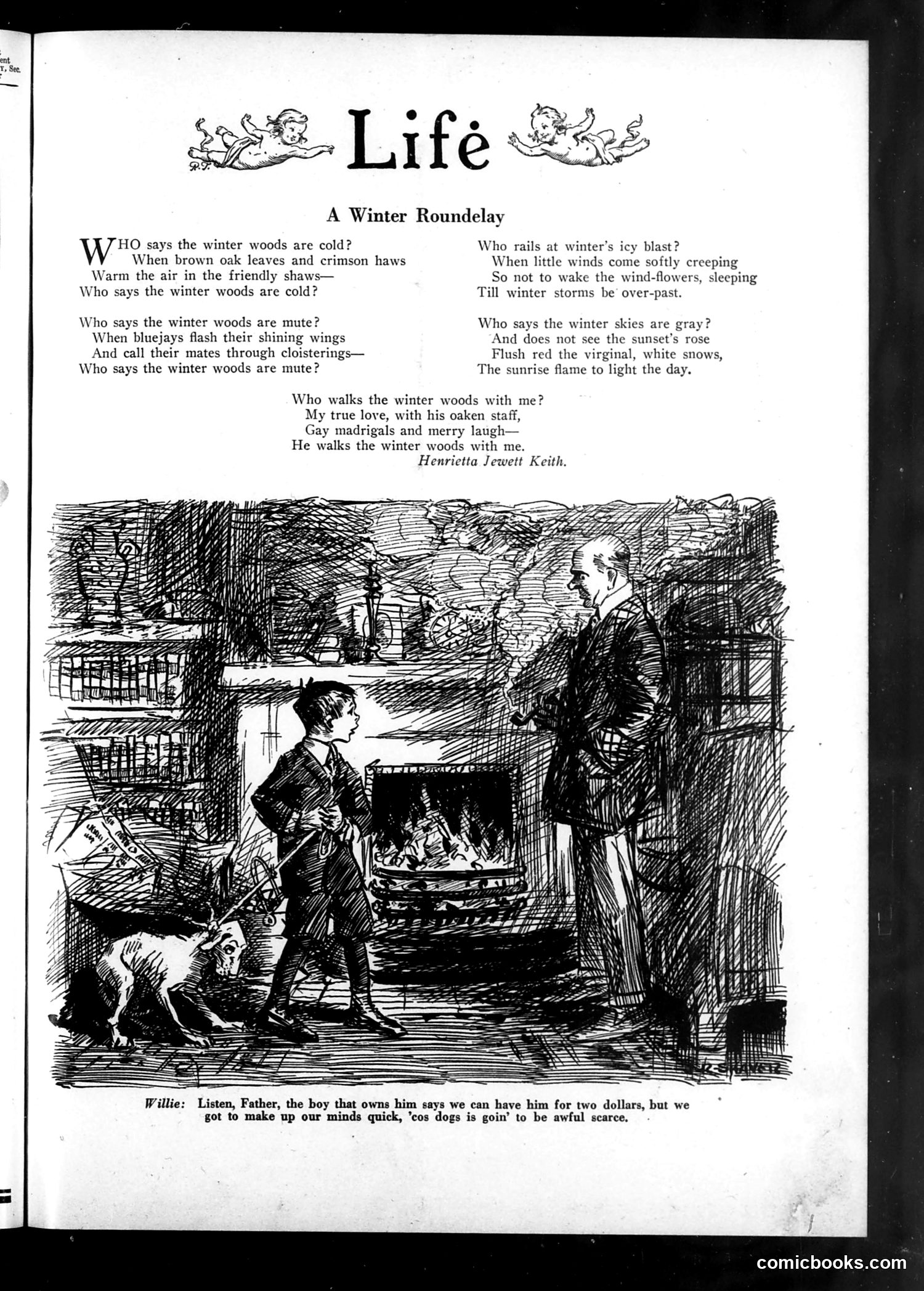
This page features a romantic poem by Henrietta Jewett Keith celebrating winter woods and nature, attributed to the genteel literary tradition of the era. The accompanying illustration depicts a domestic scene where a boy approaches his father with a dog, likely seeking permission to keep it. The caption records Willie's negotiation: the dog's owner will sell it for two dollars, but Willie must convince his father the animal won't be a nuisance—dogs will cause "awful scare." This is gentle domestic humor typical of Life's family content, contrasting the sentimental poetry above with the mundane realities of childhood persuasion. The cartoon satirizes neither politics nor social issues, but rather the universal father-son dynamic around pet acquisition, presented with affectionate irony.
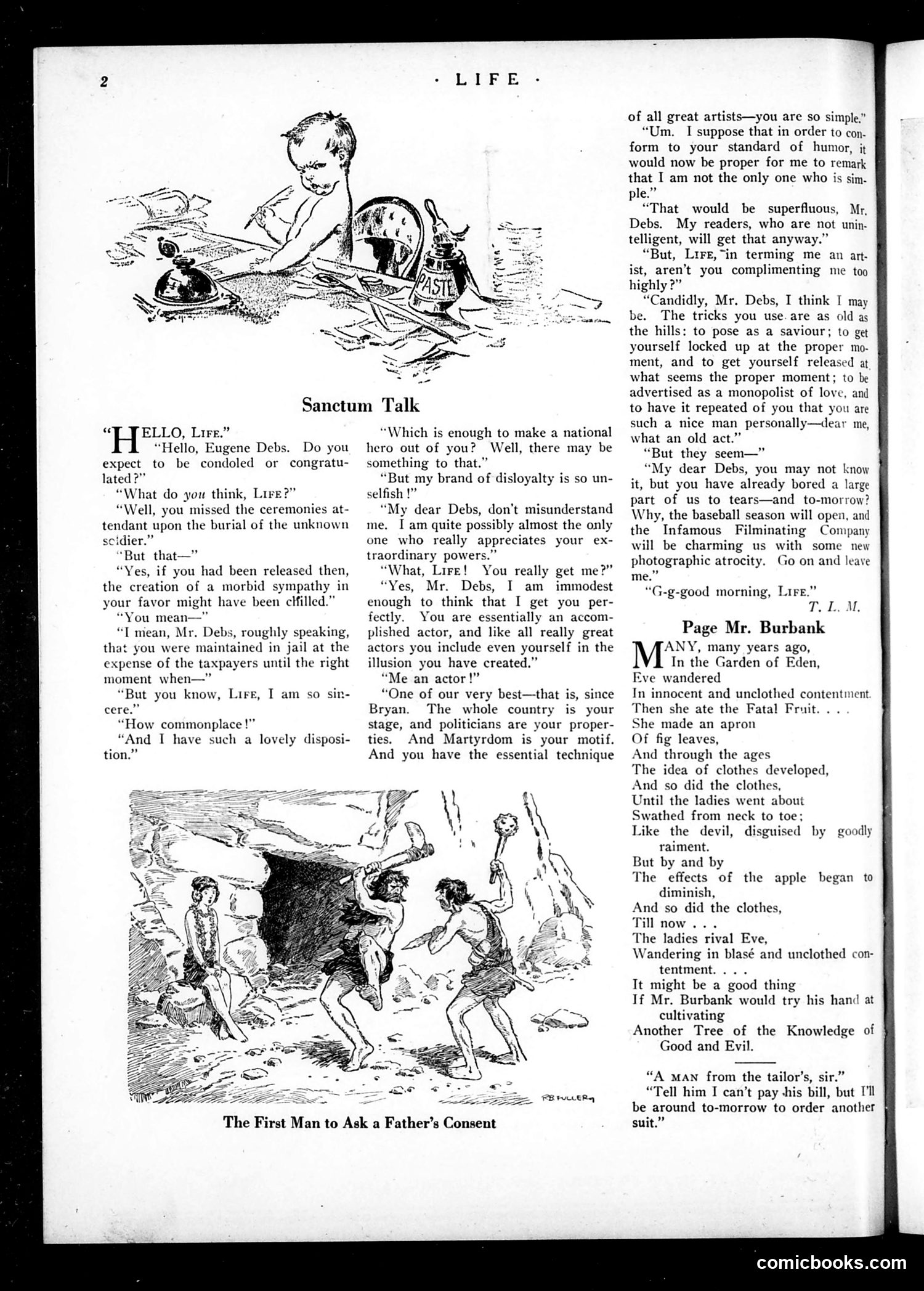
This page contains two satirical pieces: **"Sanctum Talk"** is a humorous dialogue between "Life" (the magazine personified) and Eugene Debs, likely referencing the socialist politician. Life teases Debs about his failed presidential campaigns and morbid public sympathy, while Debs counters that Life itself is a "monopolist of love" with repetitive content. The satire mocks both political idealism and magazine formulas. **"Page Mr. Burbank"** is verse satirizing Luther Burbank, the famous botanist and plant breeder. It humorously traces how women's clothing evolved from Eve's fig leaf through history, suggesting Burbank should cultivate "Another Tree of Knowledge" to reverse this "progress"—implying modern women's scanty fashion represents moral decline. The satire attacks both fashion trends and Burbank's scientific pretensions.
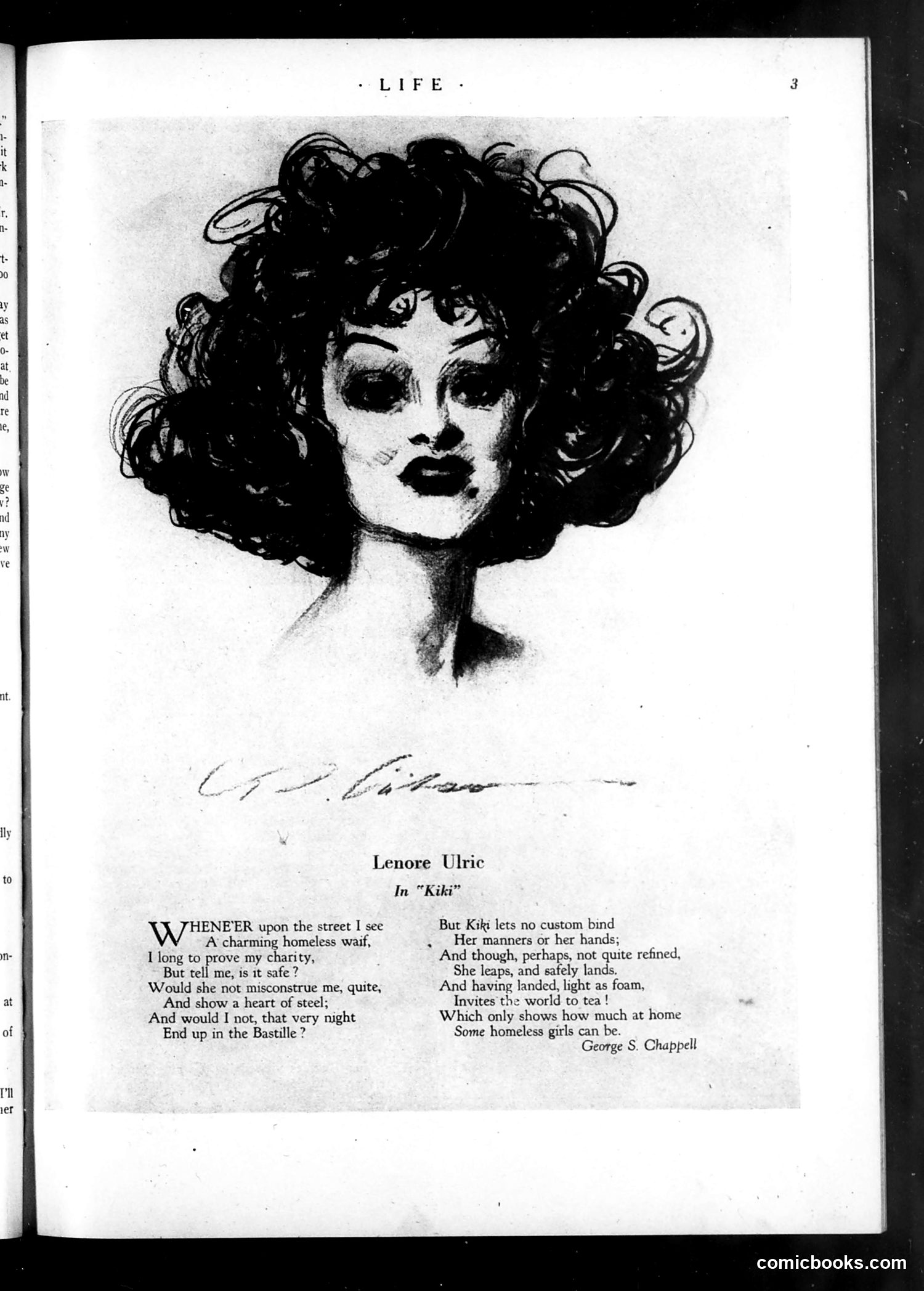
This page features **Lenore Ulric**, an actress, illustrated in a portrait with 1920s-style bobbed hair and makeup. Below is a poem titled "In 'Kiki'" attributed to George S. Chappell. The poem appears to satirize attitudes toward homeless girls and social charity. The speaker expresses moral concern about homeless waifs, worrying they might "end up in the Bastille" (jail), yet the poem suggests hypocrisy—these concerns may mask judgment rather than genuine compassion. The reference to "Kiki" likely alludes to the 1926 film or contemporary theatrical production, using that cultural reference to comment on how society romanticizes or moralizes about disadvantaged women while failing to provide meaningful support. The satire targets the gap between professed charitable impulses and actual indifference.
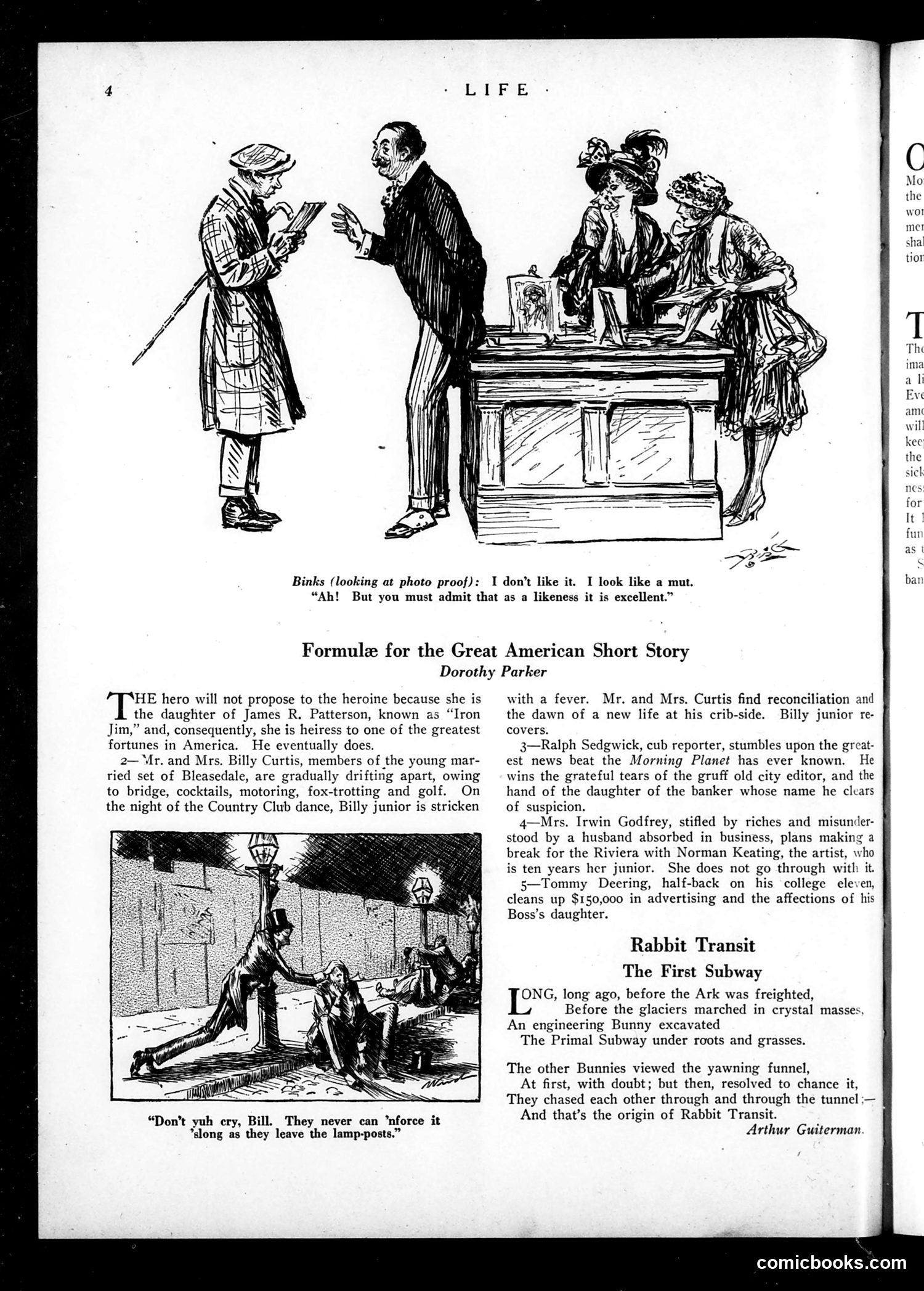
**Top Cartoon**: A man named Binks receives a photo proof from a photographer. Binks complains it makes him look like "a mut" (mutt), yet admits the likeness is excellent. This satirizes the common social tension between vanity and accuracy—people wanting flattering rather than truthful representations of themselves. **Main Article**: Dorothy Parker's "Formule for the Great American Short Story" satirizes predictable fiction formulas by listing numbered plot devices (affairs, reconciliation, business success, etc.). The numbered examples mock how interchangeable and formulaic popular short stories had become. **Bottom Section**: "Rabbit Transit: The First Subway" is a whimsical poem by Arthur Guiterman imagining rabbits creating the first subway by chasing each other underground—a playful origin myth.
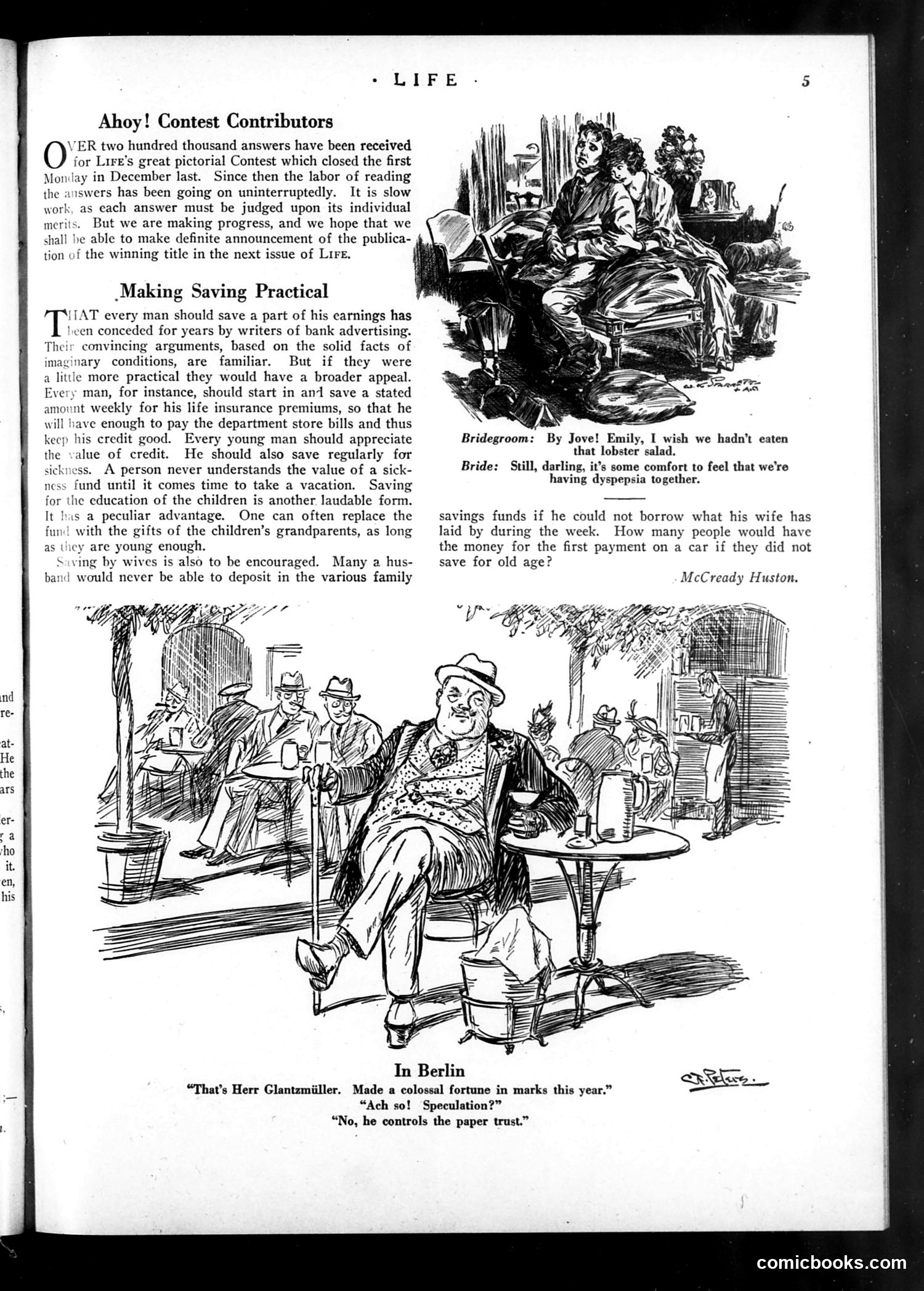
This cartoon satirizes **Herr Glanztmiller**, a Berlin financier who made enormous profits (in marks) through speculation. The joke's setup suggests he profited through shrewd market speculation, but the punchline reveals the real source: he "controls the paper trust"—meaning he monopolizes paper production. The satire targets **monopolistic business practices** and suggests that wealth accumulation isn't always based on legitimate market skill but rather on controlling essential commodities (paper). The cartoon implies that Glanztmiller's fortune comes from controlling supply rather than fair competition. This reflects 1920s-era concerns about **economic trusts and monopolies**, particularly relevant during post-WWI inflation in Germany, when speculation and commodity control created vast fortunes amid economic instability.
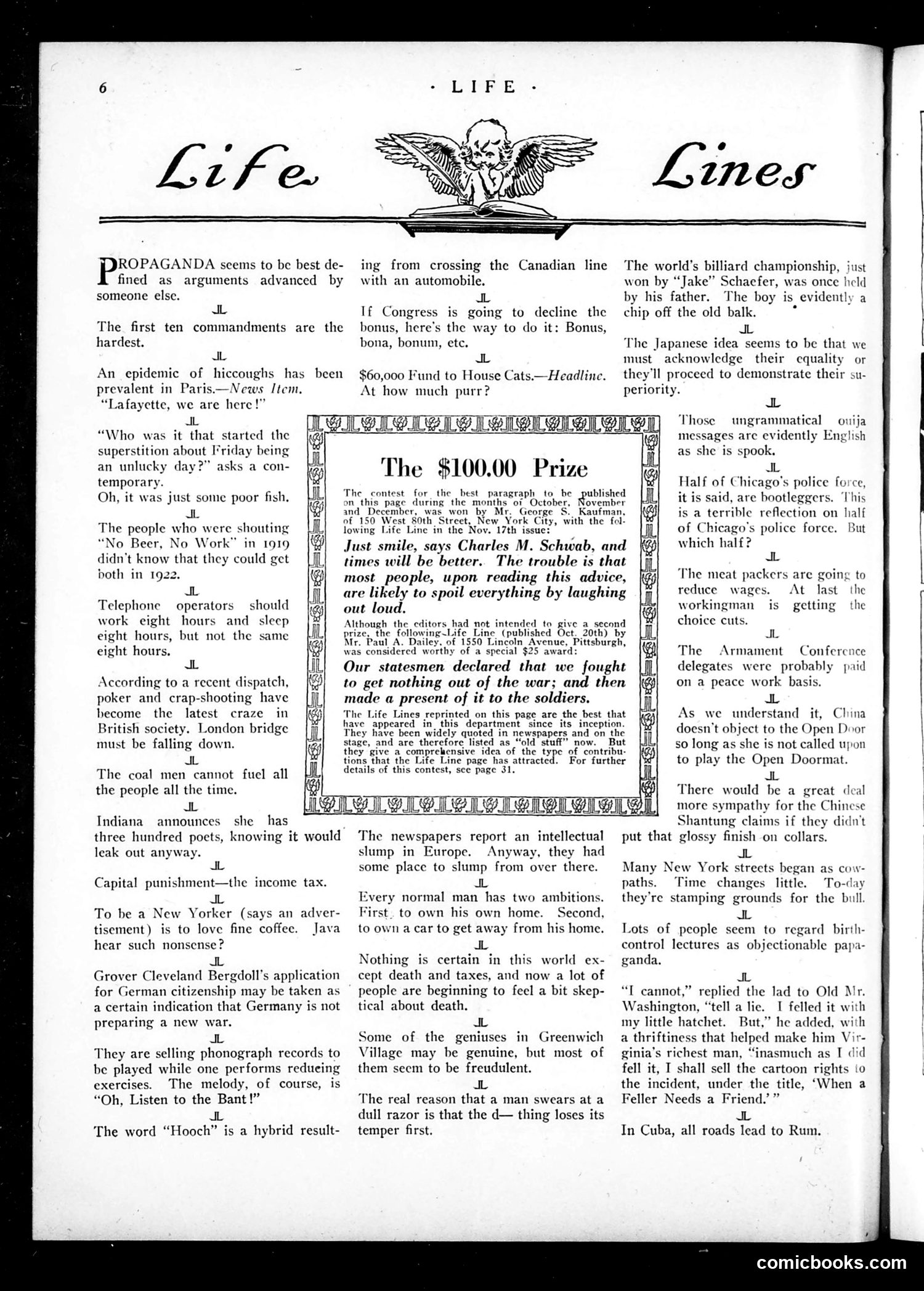
This page is primarily a collection of short satirical observations and jokes rather than a political cartoon. The main visual element is "The $100.00 Prize" box, which announces a writing contest for the best paragraph about life, won by George S. Kaufman. The brief commentaries mock various targets: hiccoughs in Paris, Friday the 13th superstitions, Prohibition's failure (people could still get beer in 1922), telephone operators' work hours, poker's popularity in British society, and German citizenship applications (suggesting Germany wasn't preparing for war). Other quips target New York coffee culture, birth control lectures, Cuba's political situation, and various social hypocrisies. The tone is characteristic of *Life*'s satirical approach—witty, observational humor about contemporary American life and politics.
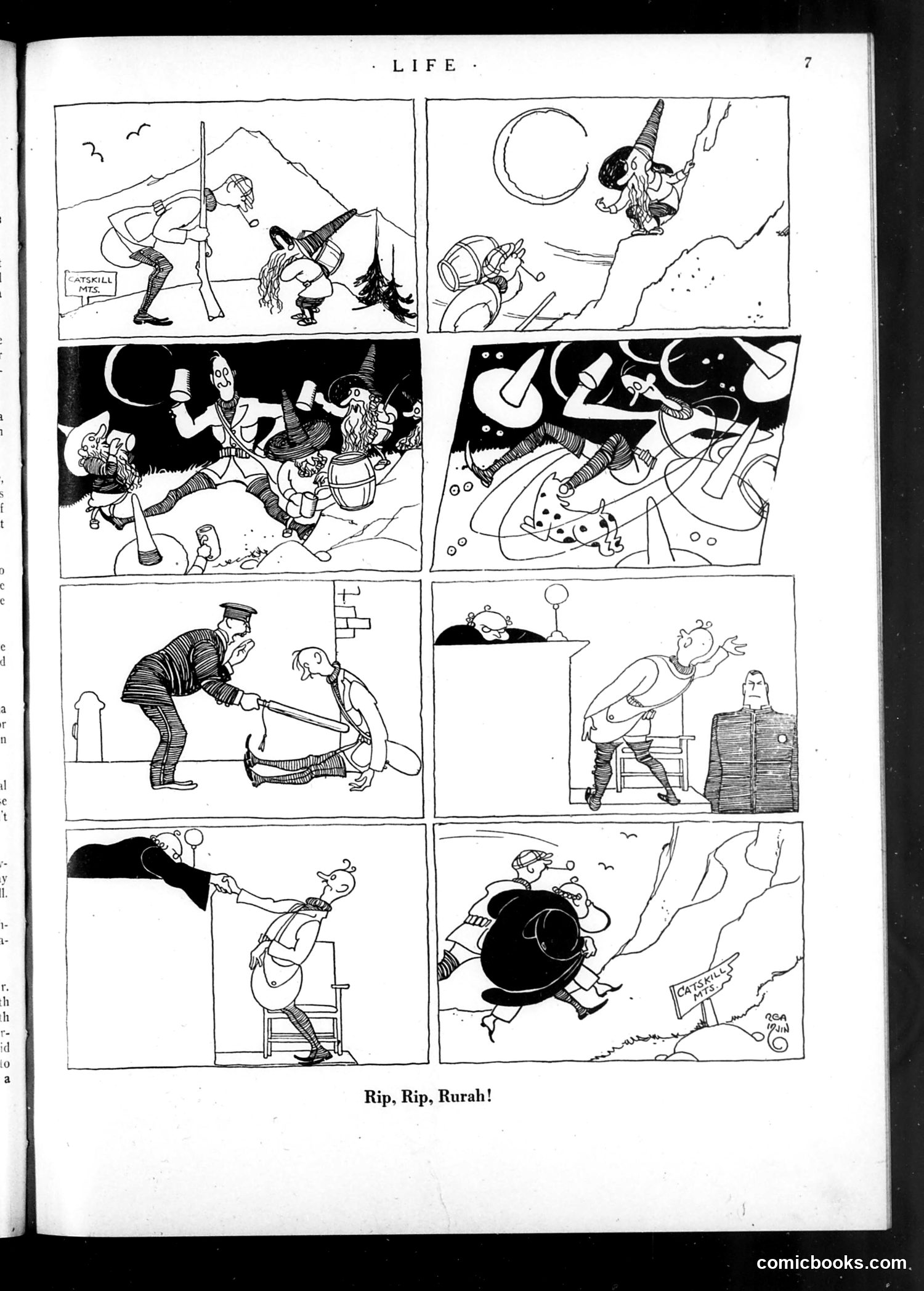
This is a sequential comic strip satirizing political or military leadership through slapstick humor. The narrative shows: 1. **Top panels**: Figures (appearing to be military or political leaders, identifiable by their distinctive hats and formal dress) engage in absurd activities—fishing, acrobatics, and celebration. 2. **Middle/lower panels**: The action escalates into chaos—figures are struck, tumble, and fall in increasingly undignified ways. 3. **Final panels**: A large spherical object (possibly representing a bomb or consequence) chases fleeing figures toward disaster. The title "Rip, Rip, Rurah!" suggests mockery of authority figures facing inevitable comeuppance. Without clearer context or visible dates, the specific political targets remain unclear, but the cartoon clearly ridicules incompetent or frivolous leadership facing serious consequences.
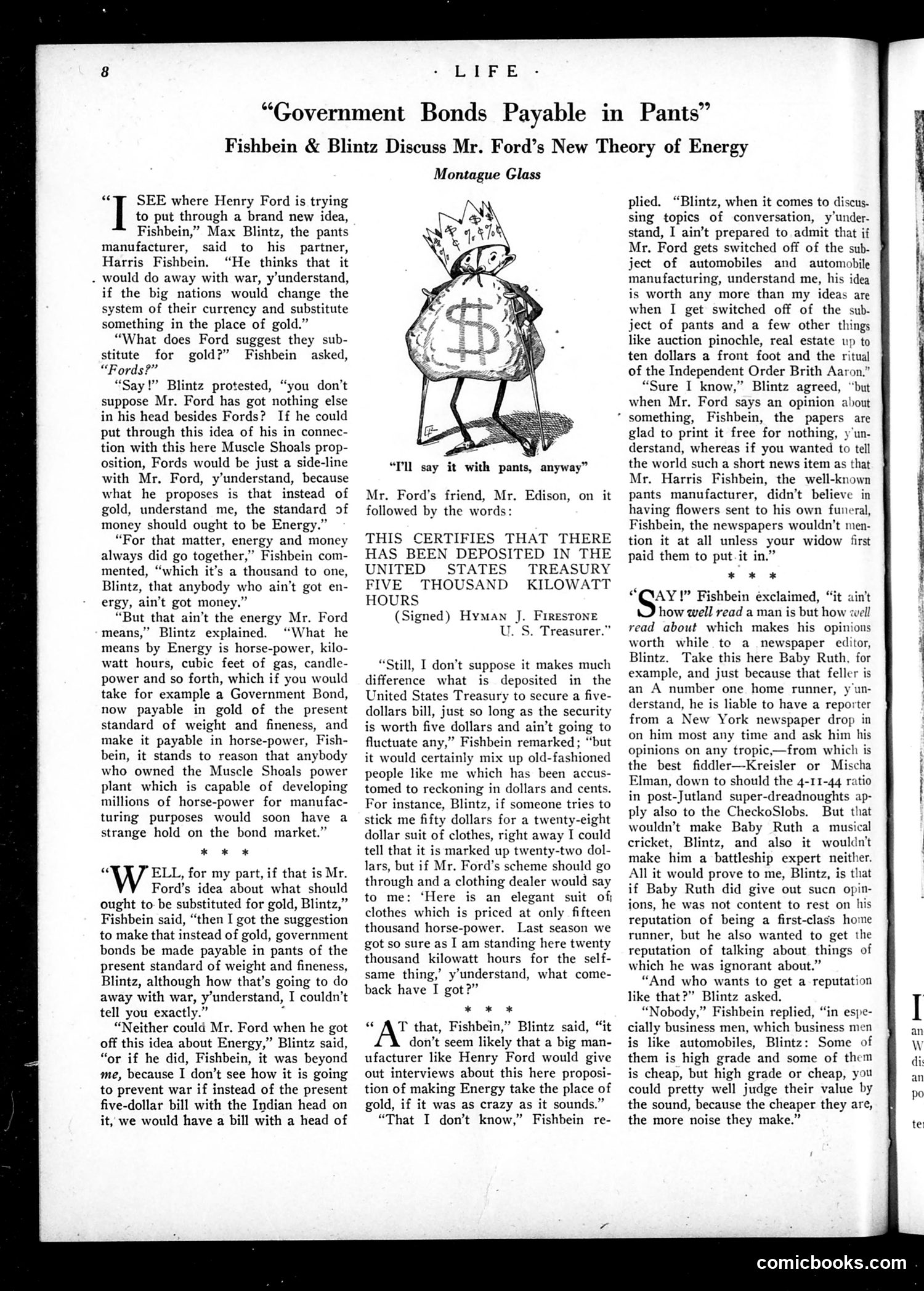
This 1920s *Life* magazine article satirizes Henry Ford's proposal to replace the gold standard with an energy-based currency system. The cartoon shows a money bag labeled with a dollar sign, illustrating the absurdist concept. The dialogue between **Fishbein** (pants manufacturer) and **Blintz** mocks Ford's idea by imagining government bonds "payable in pants" instead of gold—a reductio ad absurdum. The satire suggests that substituting any commodity (pants, horspower, kilowatt hours) for gold as monetary backing is equally ridiculous. The accompanying Treasury certificate (signed by "Hyman J. Firestone") reinforces the joke by treating the absurd concept as official policy. The piece lampoons Ford's unconventional economic thinking and his influence over public discourse.
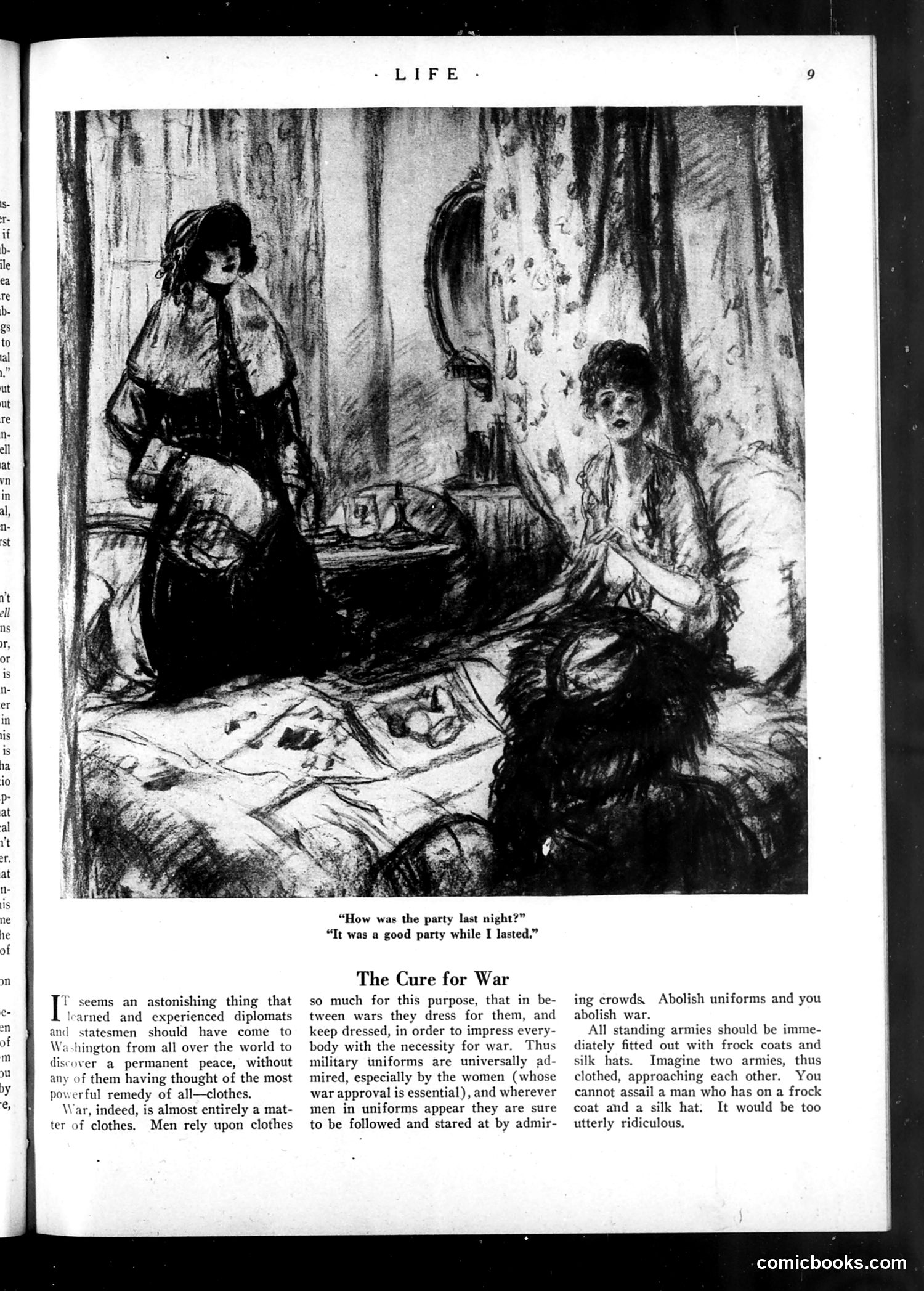
The illustration depicts three women in what appears to be a modest interior, with a caption suggesting they're discussing a recent party. Below this is an article titled "The Cure for War" arguing that war is fundamentally a matter of clothing and uniforms. The author proposes that if all armies wore identical frock coats and silk hats instead of military dress, war would become impossible—soldiers couldn't identify enemies or be motivated to fight. The piece sarcastically suggests that abolishing distinctive military uniforms would abolish war itself, since uniforms inspire admiration and martial spirit. This is satire on the absurdity of jingoism and militarism—mocking how superficial trappings of war (uniforms, pageantry) drive nations toward conflict, while suggesting the remedy is equally absurd.
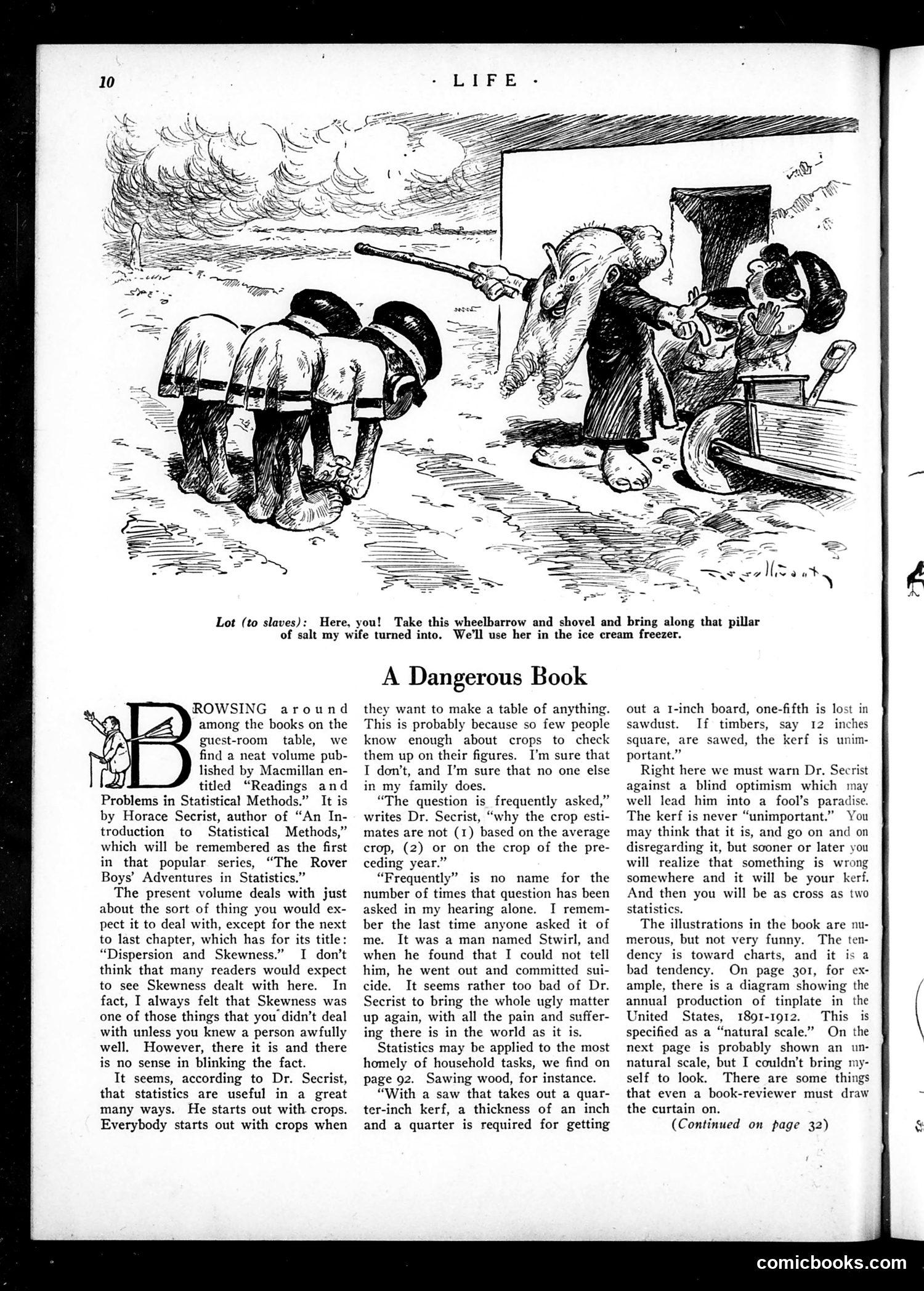
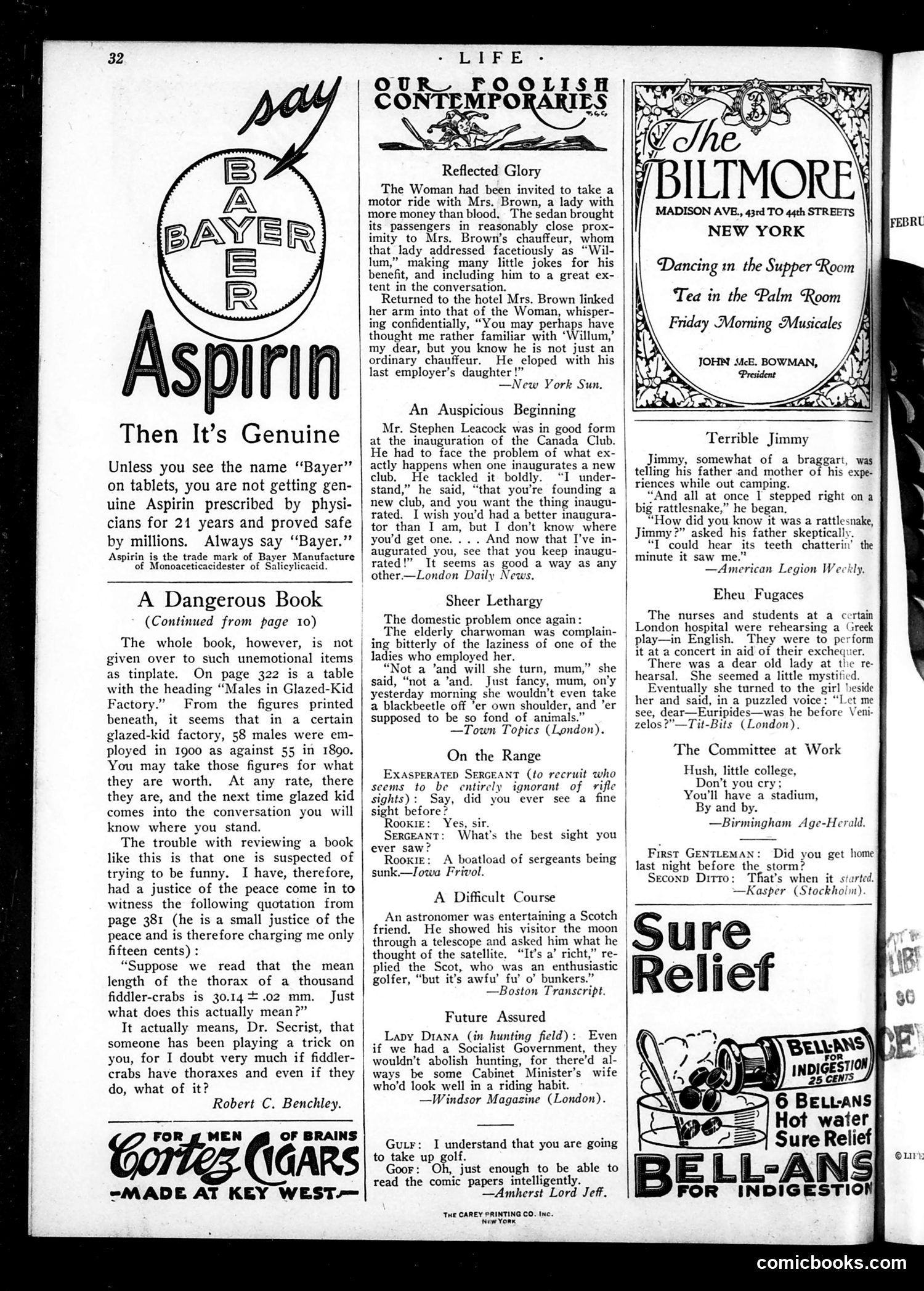
**The Cartoon:** Shows a figure labeled "Lot" commanding enslaved people to fetch tools, threatening to use "my wife turned into" (a pillar of salt, referencing the Biblical story of Lot's wife) in an ice cream freezer. This is grotesque dark humor. **The Article:** Reviews Horace Secrist's statistical book "Reading and Problems in Statistical Methods." The reviewer critiques Secrist's blind optimism about statistics' usefulness, arguing that statistics can mislead when applied carelessly to real-world problems—exemplified by agricultural crop estimates that ignore actual conditions. **The Satire:** The cartoon's absurdist cruelty mirrors the article's point: just as Lot misapplies a Biblical reference for sinister purposes, people misapply statistics to justify poor decisions. Statistics are "dangerous" when wielded without wisdom.
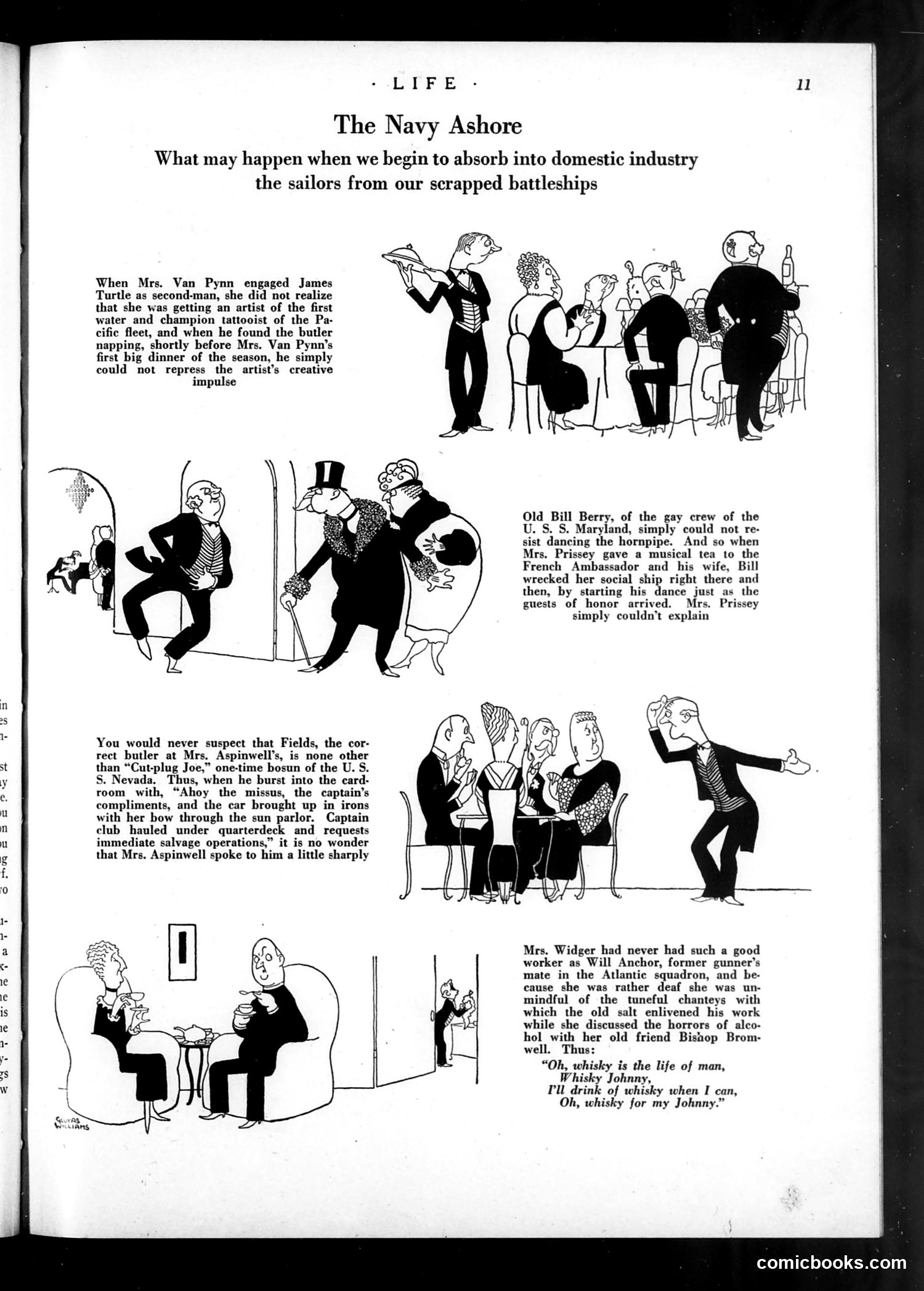
This page satirizes how former Navy sailors, upon discharge after World War I, are transitioning into civilian life with mixed results. The humor focuses on the culture clash: sailors trained in naval discipline and maritime culture struggle to adapt to domestic settings and social conventions. The specific anecdotes ridicule various types: James Turtle, an artist whose creative impulses can't be suppressed (he paints during dinner); Old Bill Berry, a dancer who cannot restrain himself from performing at formal occasions; and Fields, a butler who uses nautical language and naval habits (mentioning "the captain") in civilian households. The final panel references alcohol and masculine nostalgia, with the character Will Anchor mourning naval life through drink. The satire gently mocks the difficulty these working-class men face adjusting to peacetime civilian employment.
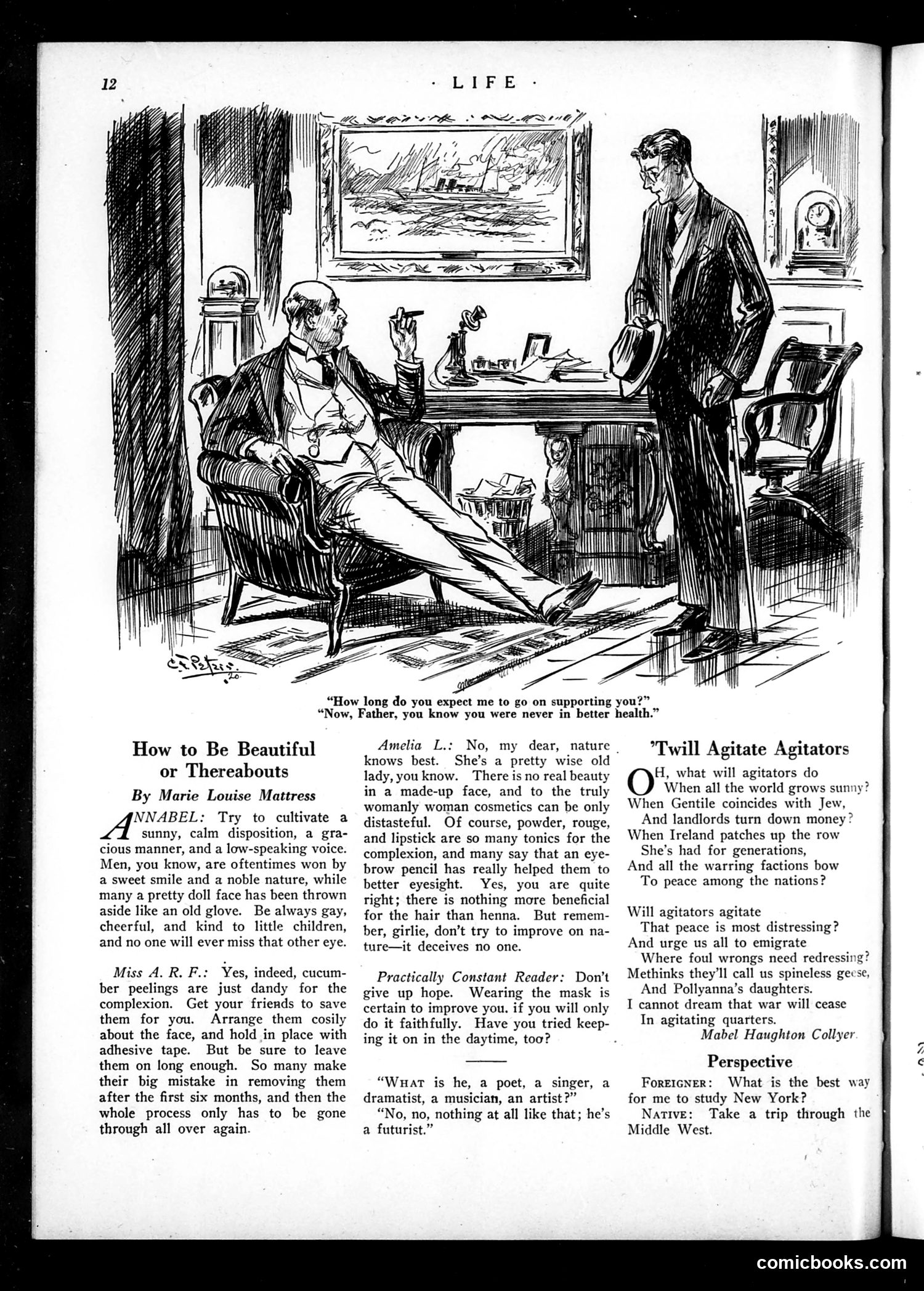
The main cartoon depicts two men in an office: one reclining in a chair, one standing. The seated man asks, "How long do you expect me to go on supporting you?" The standing man replies, "Now, Father, you know you were never in better health." **The satire**: This is a commentary on adult children's financial dependence on aging parents. The joke inverts typical concern—the father worries about supporting his son indefinitely, while the son reassures him by noting the father's good health (implying he'll live long enough to keep providing money). It satirizes entitled adult children who exploit parental responsibility rather than achieving independence, a social anxiety particularly relevant in early 20th-century America during periods of economic uncertainty. The page also contains unrelated advice columns on beauty and poetry.
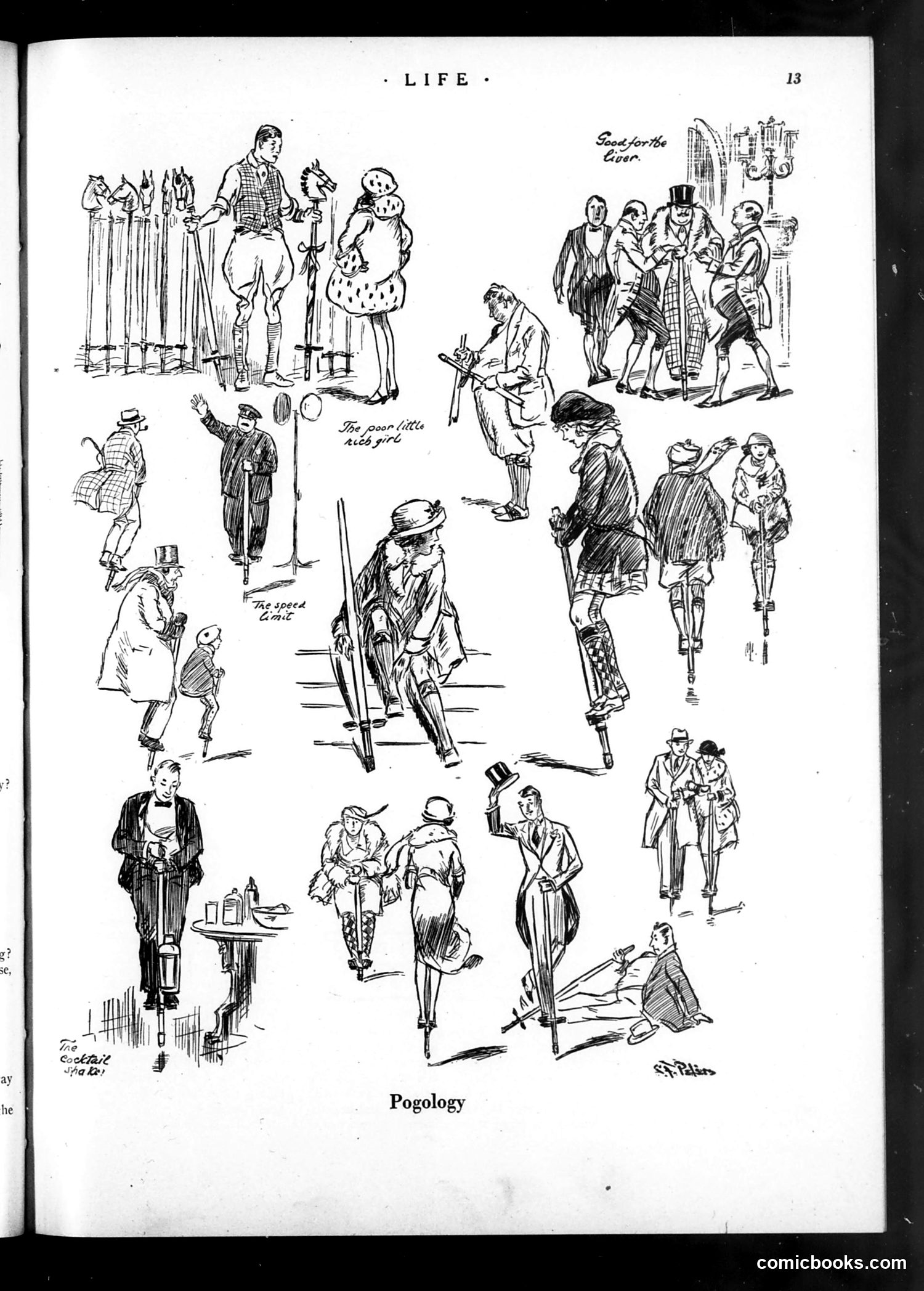
This page illustrates various scenes of people riding unicycles—a popular fad activity of the early 20th century. The sketches depict different social classes and scenarios engaging with this novelty transportation method: wealthy individuals at formal events ("Best for the Vicar"), a poor girl learning to ride, people in urban settings, and various humorous mishaps and pratfalls. The satire appears to mock how this absurd one-wheeled contraption briefly captured public fascination across all social strata. The title "Pogology" suggests treating unicycling with mock-serious academic interest, poking fun at the craze's temporary nature and the ridiculous spectacle of dignified people attempting to balance on single wheels. It's essentially social commentary on fad culture and human susceptibility to novelty entertainment.
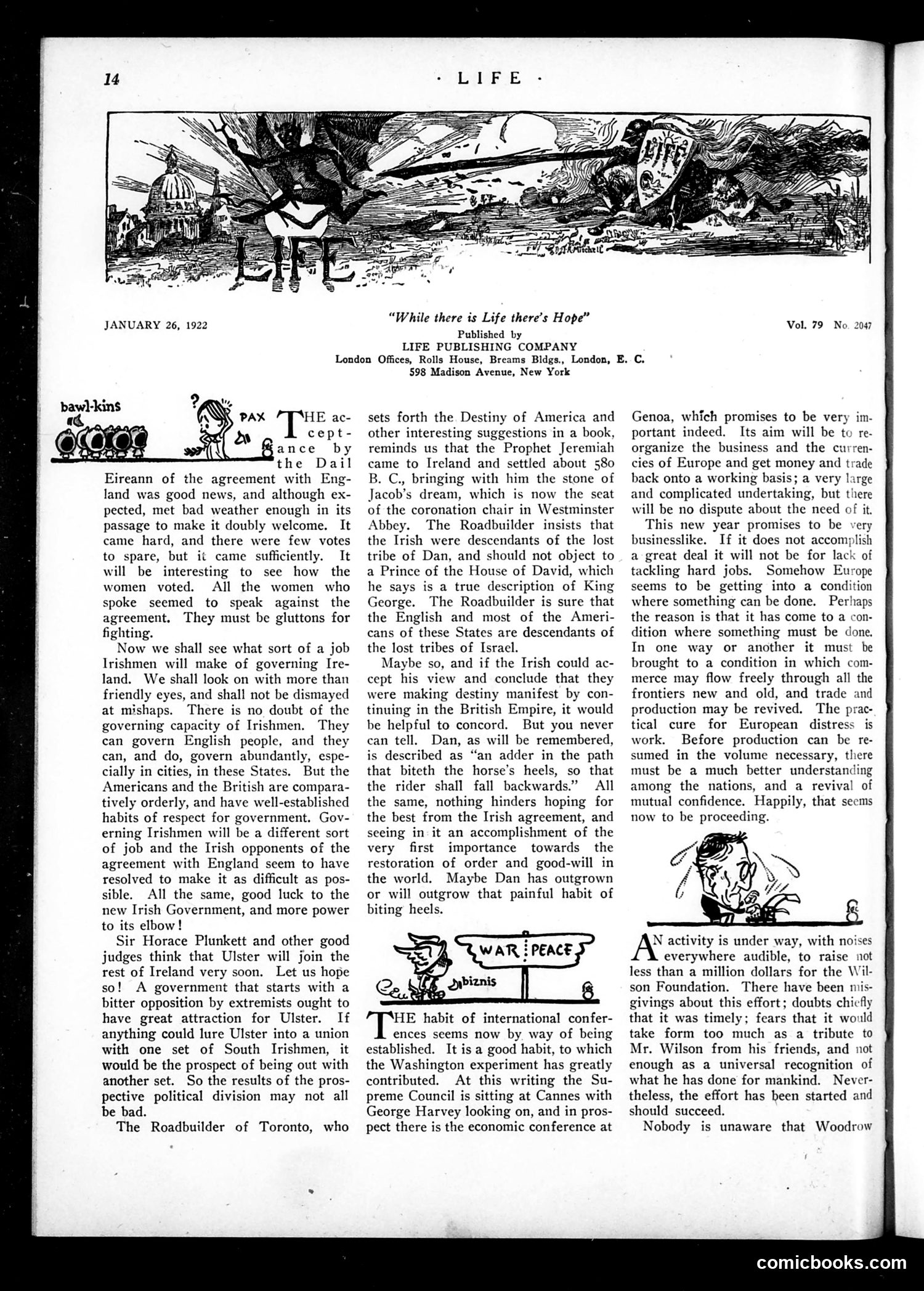
This page contains satirical articles about Irish independence and international peace efforts. The main text discusses the Irish Free State agreement and governance prospects, questioning whether Irish leaders can effectively govern themselves—a common British/unionist skepticism about Irish self-rule. The accompanying cartoons appear to reference: - **"War" and "Peace"** imagery, likely commenting on post-WWI diplomacy - References to Dan (unclear which specific figure), described as having a habit of "biting heels"—seemingly mocking Irish political leaders' combative tactics A secondary article discusses the Wilson Foundation fundraising effort and the Supreme Council meeting at Cannes, reflecting contemporary international peace-building efforts following World War I. The overall tone is skeptical about both Irish governance capability and optimistic international peace initiatives.
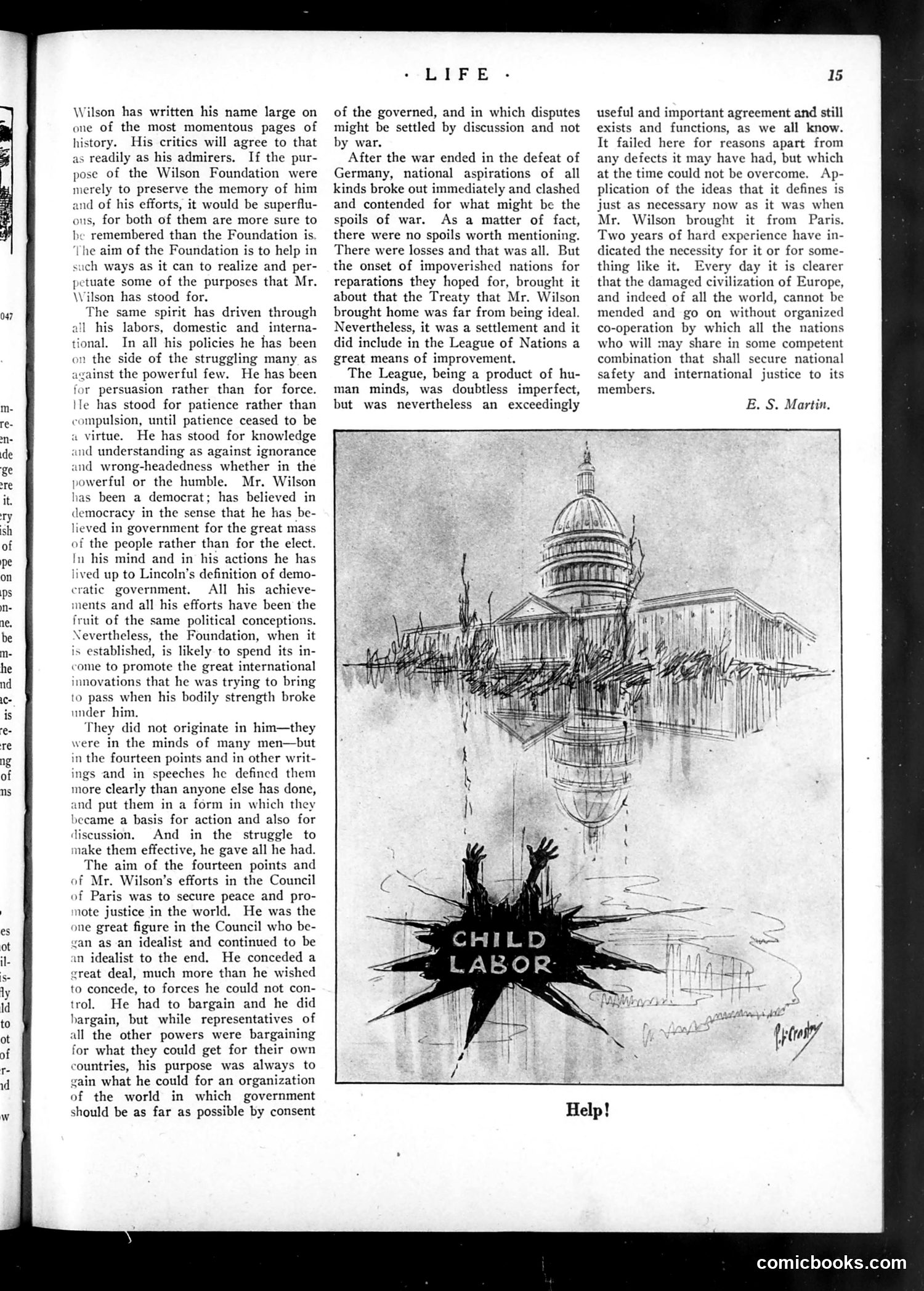
This page commemorates Woodrow Wilson's political philosophy and the Wilson Foundation, established to advance his internationalist ideals. The accompanying illustration satirizes the gap between Wilson's democratic principles and harsh American realities. The cartoon depicts the U.S. Capitol building with "CHILD LABOR" emblazoned below in an explosive burst, with two children's hands reaching upward in distress. The stark image contrasts sharply with the text's celebration of Wilson as champion of "the struggling many" against "the powerful few." The satire's point: Wilson advocated globally for justice and democratic governance through the League of Nations, yet America—his own nation—permitted widespread child labor exploitation. The cartoon suggests hypocrisy in promoting international idealism while domestic social injustices persisted uncorrected. It's a pointed critique of the disconnect between lofty political rhetoric and lived American suffering, particularly affecting society's most vulnerable members.
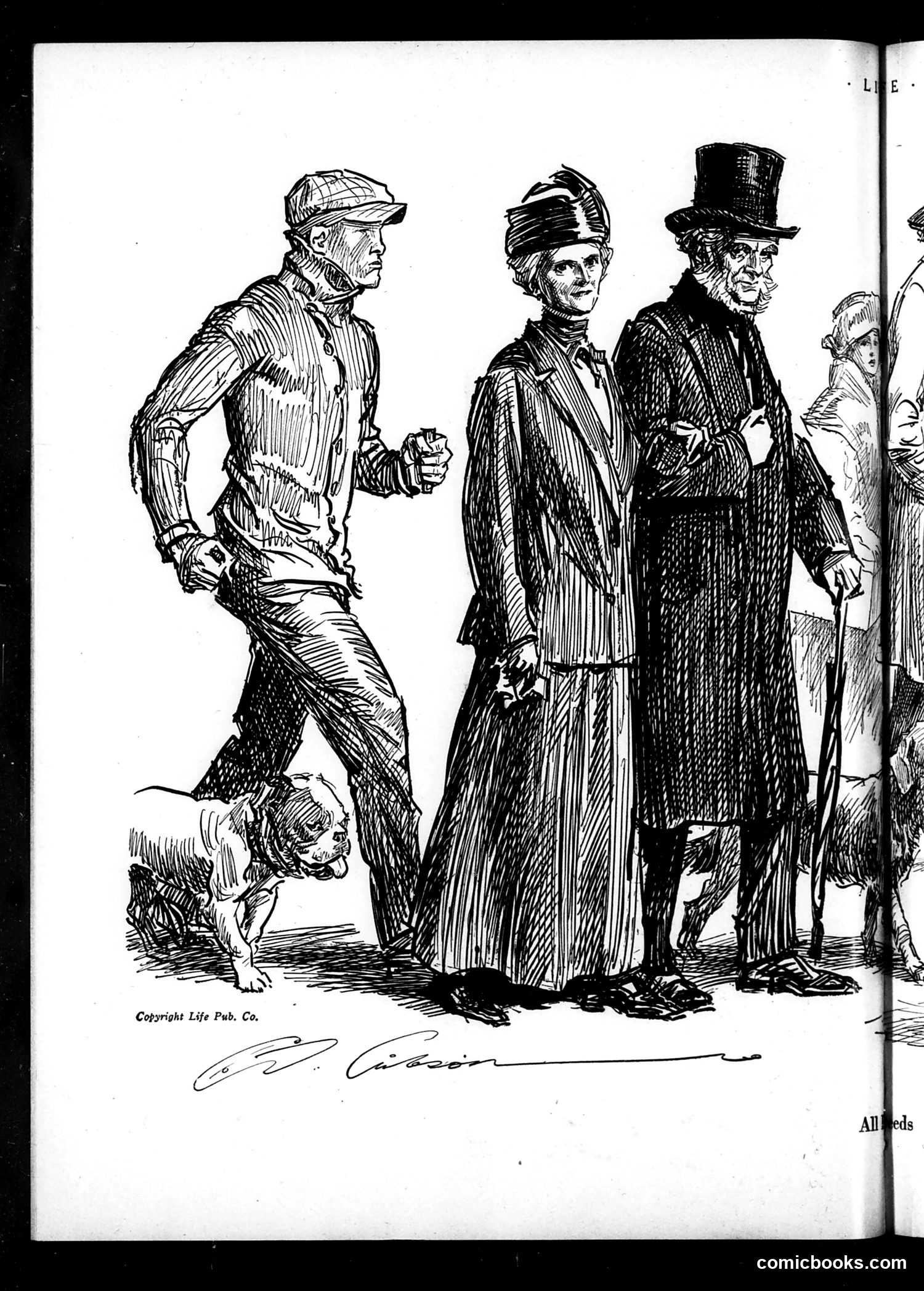
This is a pen-and-ink illustration signed by what appears to be the artist's signature (bottom left). The image shows three figures in early 20th-century dress: a working-class man in a flat cap on the left, a woman in middle-class attire with a feathered hat in the center, and a gentleman in a top hat on the right. A small dog accompanies them. The OCR text is corrupted and unreadable, making it impossible to determine the specific satirical point. Based solely on the visual composition, this appears to be social commentary on class distinctions or urban society—the contrasting dress and apparent social positioning of the three figures suggests satire about class interactions or social hierarchies. However, without legible accompanying text or caption, the precise subject and message remain unclear.
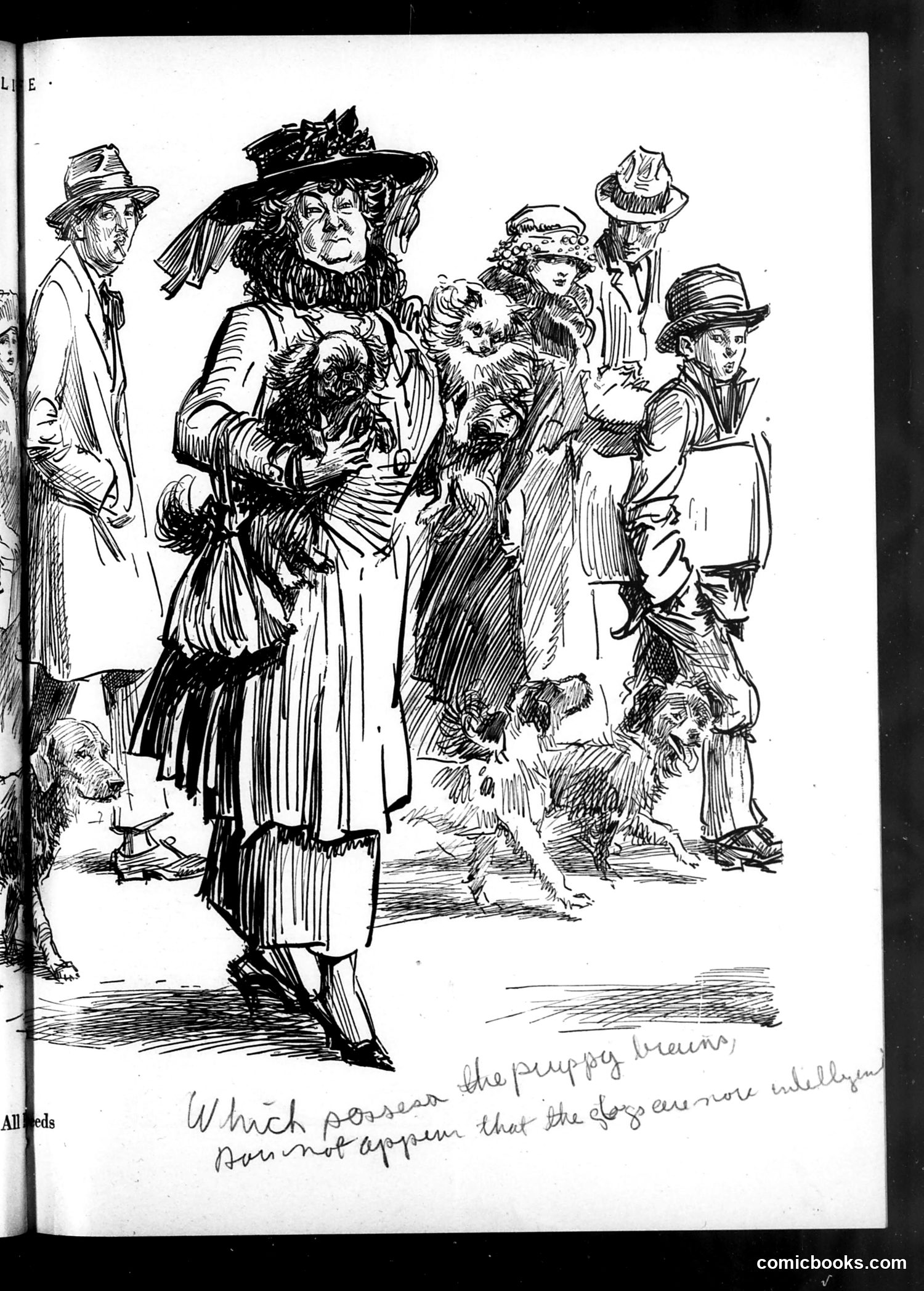
This appears to be a satirical illustration from *Life* magazine featuring a group of women and small dogs. The handwritten caption reads: "Which possess the puppys brains Cannot appear that the dogs are more intelligent." The cartoon satirizes wealthy society women of the period, suggesting they possess no more intelligence than their lap dogs. The elaborate hats, fashionable coats, and pampered small dogs mark these as affluent urban women—likely targets of the magazine's mockery of upper-class pretension and frivolity. The joke relies on a common era stereotype: that society women were vain, empty-headed, and preoccupied with fashion and pets rather than substantive matters. The comparison between the women's intellect and their dogs' is deliberately insulting satire, reflecting period attitudes about women's roles and capabilities.
This page reviews three Broadway plays from around 1921. The "Deep Stuff" section critiques *Lawful Larceny*, praising its philosophical premise ("What difference does it make what one does, so long as one does it?") while noting the irony that protagonist Shipman embodies this relativism. The reviewer highlights the play's gender-justice question: why punish a woman for stealing jewels but not for stealing a husband's affections? The second review mocks *The S.S. Tenacity*, a French translation, but uses it mainly to satirize disruptive audience members—specifically young men who make crude remarks ("Oh, boys!") during romantic scenes, noted as 93% male. The final section reviews *Drifting*, praising designer Brady's new set pieces for the Chinese-locale play while sardonically comparing his spending habits to "the proverbial drunken sailor." The page contains no political cartoons—it's entirely theatrical criticism with period-appropriate wit and social observation about audience behavior.
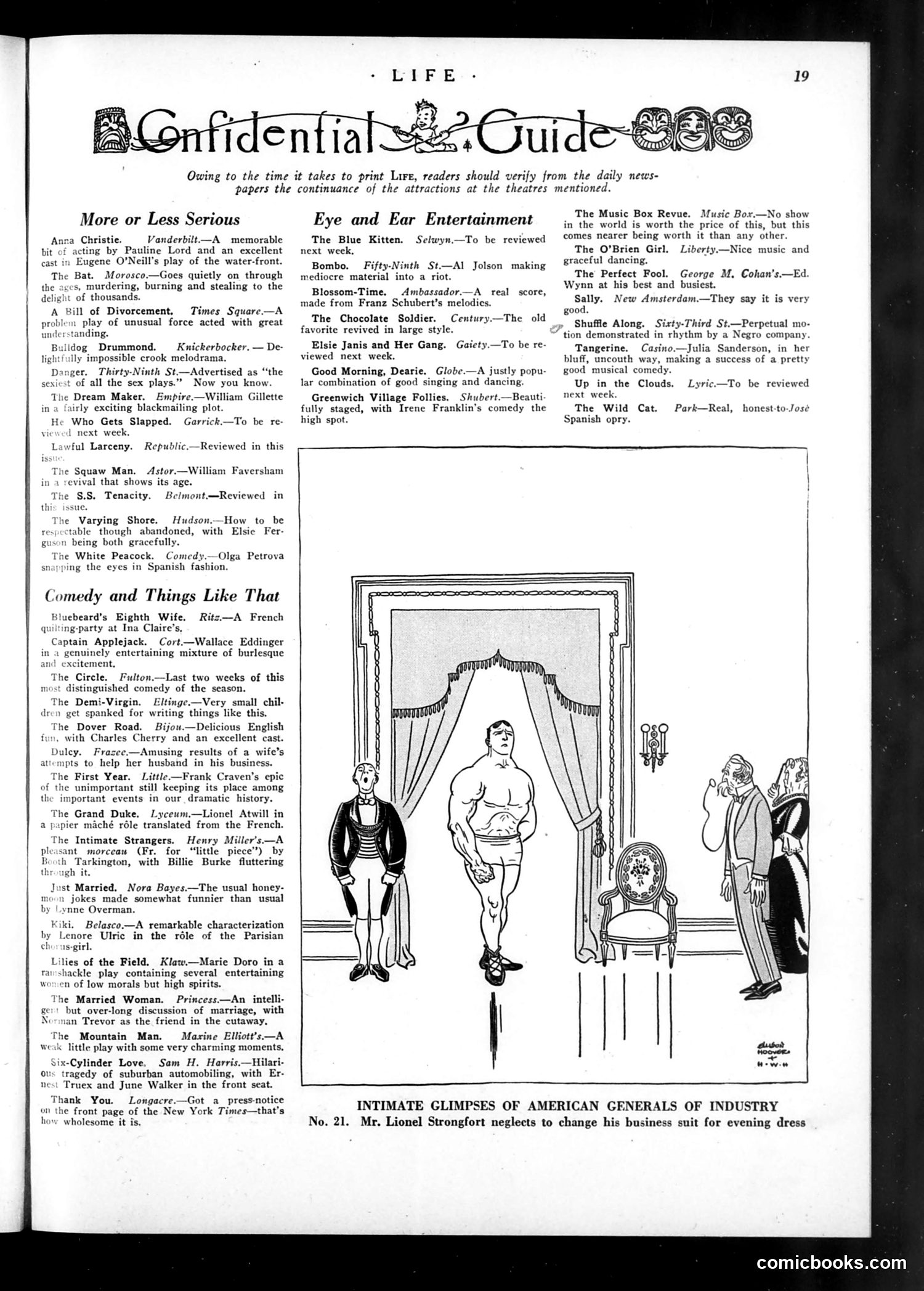
This is a theater review page from *Life* magazine featuring a satirical cartoon captioned "Intimate Glimpses of American Generals of Industry, No. 21: Mr. Lionel Strongfort neglects to change his business suit for evening dress." The cartoon mocks Lionel Strongfort, a real early-20th-century bodybuilder and physical culture entrepreneur famous for promoting muscular development. The humor lies in depicting him at what appears to be a formal evening event (note the elegantly dressed guests and formal setting) while he remains shirtless, displaying his physique—suggesting his obsessive focus on his muscles overrides social conventions about proper formal attire. The satire targets both Strongfort's narcissism and the broader early-1920s trend of wealthy industrialists being portrayed as culturally uncouth or absurdly self-absorbed. The page's theater reviews above provide context for *Life's* role as a general-interest publication commenting on American society beyond just entertainment.
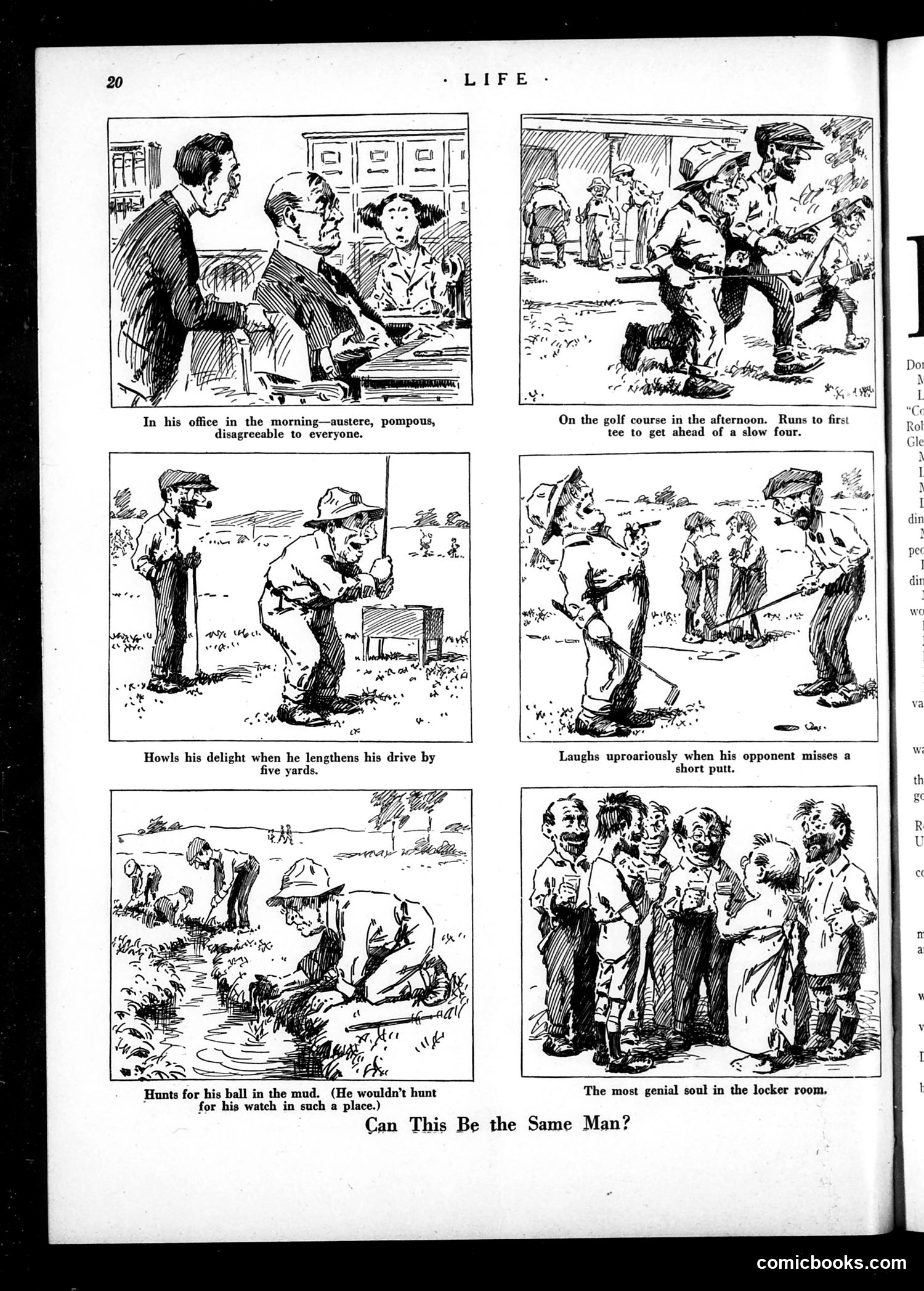
This satirical comic contrasts a businessman's public and private personas. The same man appears in six panels: **Morning office**: Austere, pompous, disagreeable. **Afternoon golf course**: Frantically competitive, rushing ahead of slower players. **On the course**: Obsessively boastful about minor improvements; cruel when opponents fail. **In the mud**: Willing to get dirty hunting for his golf ball—yet supposedly too dignified to search for his own watch elsewhere. **Locker room**: Suddenly genial and friendly. The joke satirizes hypocrisy and the dual nature of men in early 20th-century business culture: stern, disagreeable authority figures at work transform into petty, competitive, then charming versions of themselves depending on context. Golf reveals their true character—competitive and undignified—contradicting their cultivated professional personas. The title poses the central question: which version is the "real" man?
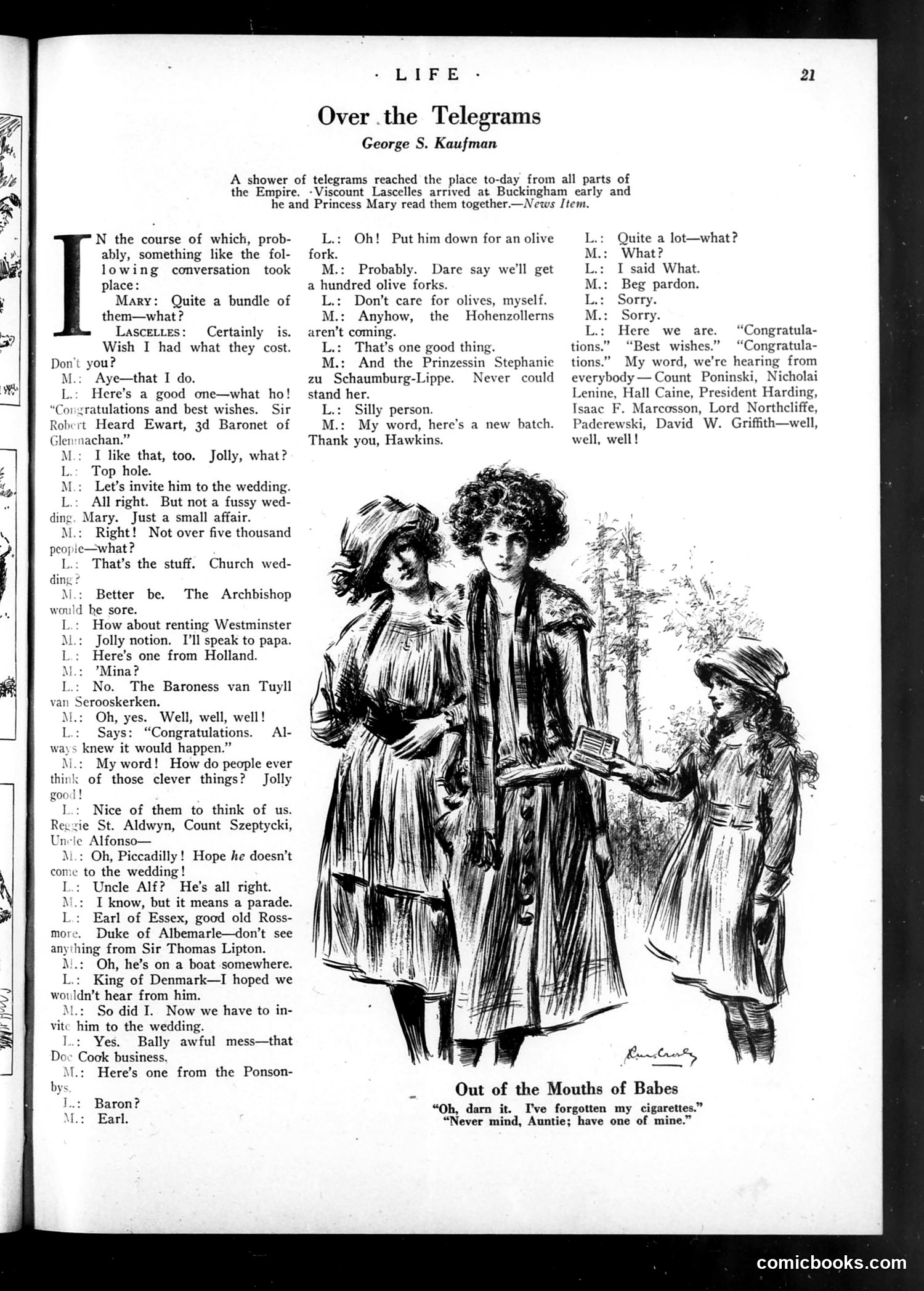
This piece by George S. Kaufman satirizes the 1922 wedding of Princess Mary to Viscount Lascelles. The dialogue mocks the scale and social implications of a royal event receiving congratulations from an absurdly broad spectrum of figures—from European nobility (King of Denmark, Hohenzollerns) to contemporary celebrities (President Harding, filmmaker David W. Griffith, author Hall Caine). The humor lies in the couple's cavalier attitude toward logistics: casually deciding to invite thousands despite wanting "a small affair," renting Westminster Abbey, and feeling obligated to invite dignitaries simply because they sent telegrams. The guest list's mix—ranging from genuinely important figures to obscure baronets—highlights the pretension and chaos of royal protocol. The accompanying illustration and caption about a child offering cigarettes suggests broader social commentary on changing manners and propriety in the post-WWI era.
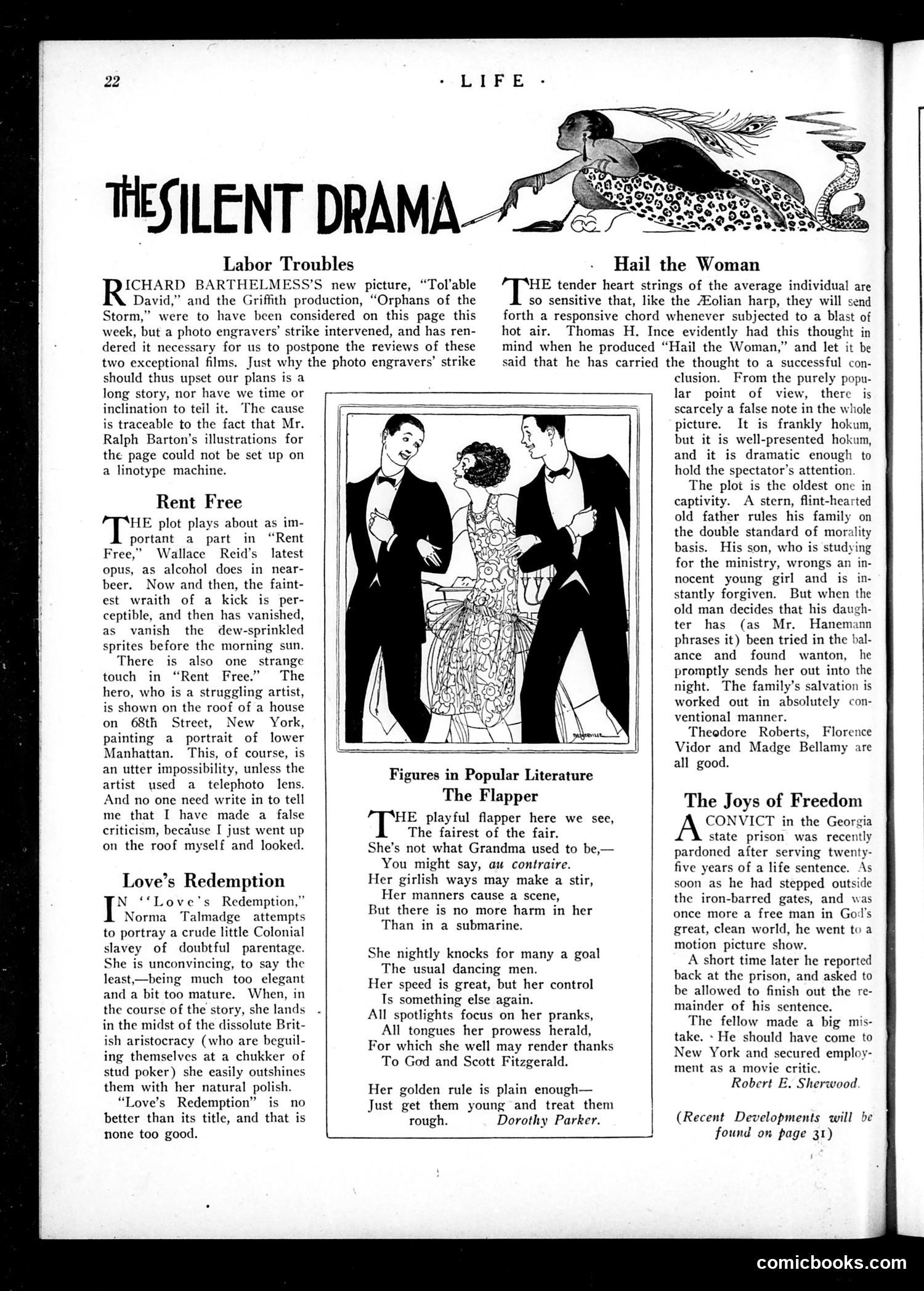
This page reviews recent silent films while commenting on contemporary issues. The main content includes: **Film Reviews**: Critical assessments of movies by Richard Barthelmess, Wallace Reid, and Norma Talmadge. Notably, the editors postpone reviewing two films because a **photo engravers' strike** prevented illustrations by Ralph Barton from being set on a linotype machine—revealing labor tensions in the printing industry. **"The Flapper" Illustration**: A satirical poem and figure contrasting modern young women with their grandmothers. The flapper's "girlish ways" may cause scenes, but she's deemed harmless—"no more harm in her / Than in a submarine." This captures 1920s moral panic about liberated youth while suggesting their rebelliousness is overblown. **"The Joys of Freedom"**: A brief, darkly humorous anecdote about a Georgia convict released after 25 years who immediately returns to prison—implying institutionalization or that freedom itself is unbearable. The page captures post-WWI American concerns: labor unrest, generational anxiety about changing morality, and the trauma of incarceration.
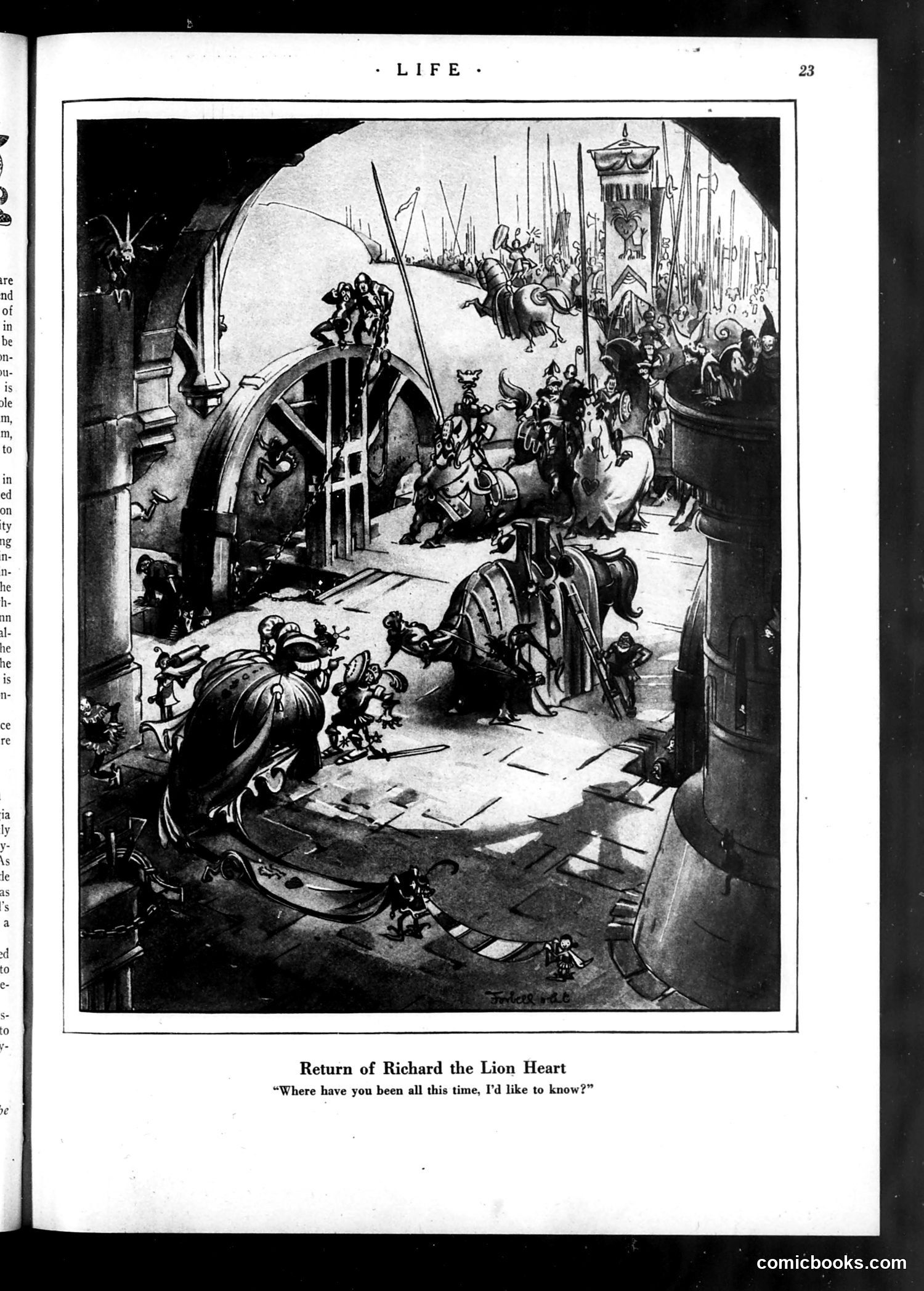
This illustration depicts a medieval scene titled "Return of Richard the Lion Heart" with the caption "Where have you been all this time, I'd like to know?" The cartoon appears to be a satirical take on the famous Crusader king Richard I's prolonged absence during his reign. The elaborate castle setting, armed soldiers, and gathered court suggest Richard's return after extended time away (historically, the Crusades and captivity). The caption's exasperated tone implies criticism—likely satirizing a contemporary political figure's unexplained absence or neglect of duties, using Richard as an historical parallel. The "Lion Heart" reference plays on Richard's legendary courage, perhaps ironically questioning where that courage went during his absence. Without additional context about *Life* magazine's publication date, the specific political target remains unclear, though this appears to mock a leader's accountability to constituents or court.
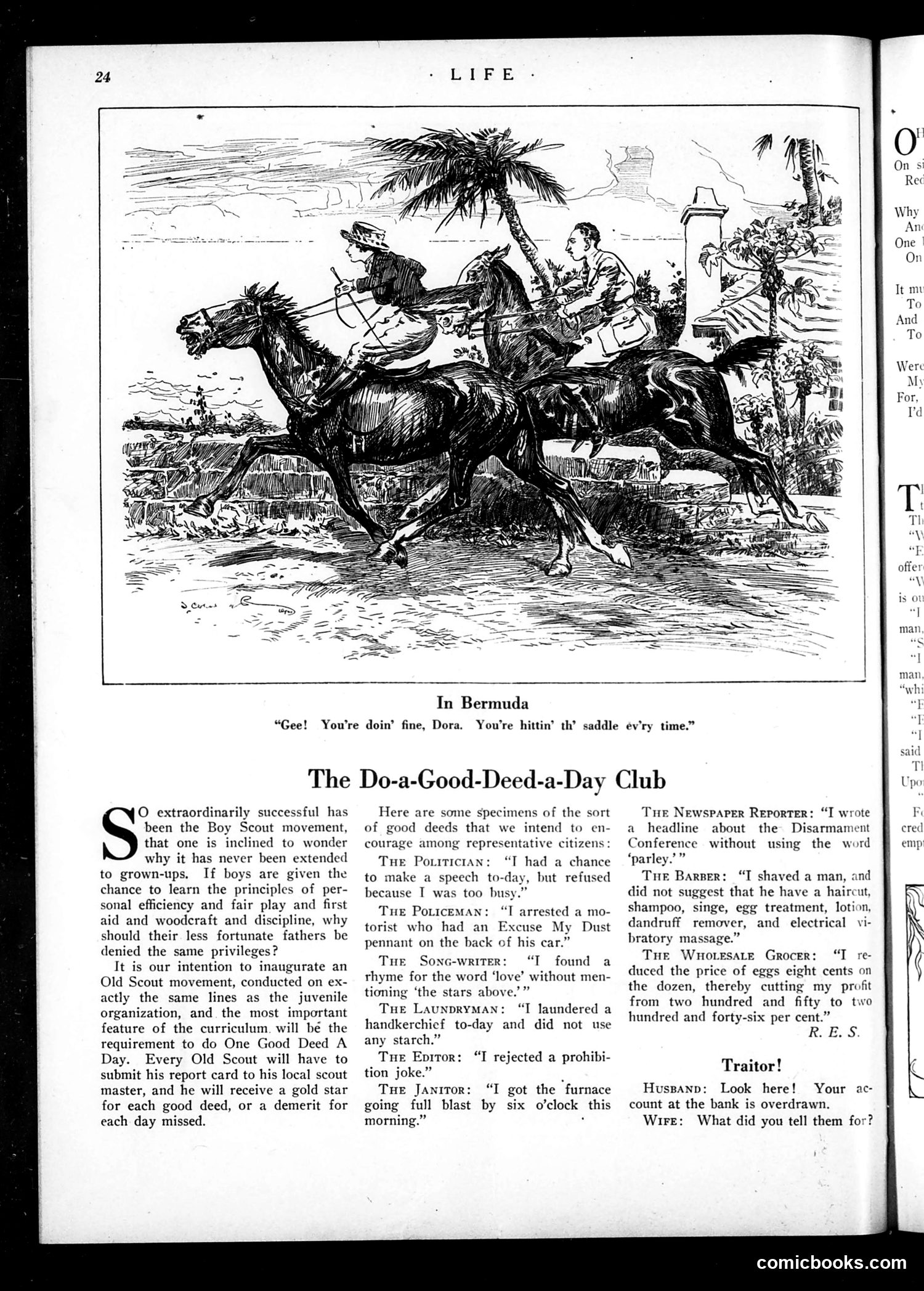
This satire proposes extending the Boy Scout movement to adults through an "Old Scout" organization requiring one good deed daily. The humor lies in the specimen "good deeds" listed, which are actually *avoidances of normal professional behavior*—revealing contemporary frustrations with various professions. Examples include: a politician refusing to make speeches (implying politicians talk too much), a barber not upselling unnecessary treatments, a grocer reducing egg prices despite cutting profits, and a journalist avoiding clichéd language like "parley" in disarmament coverage. The cartoon above depicts horseback riding in Bermuda, illustrating leisure activities. The final joke—a wife angry her husband disclosed their overdrawn bank account—suggests even honesty (normally virtuous) can be inappropriate. The satire critiques professional cynicism: true "good deeds" would be remarkable reversals of expected behavior, implying widespread dishonesty, overselling, and self-interest were endemic to early-20th-century American life.
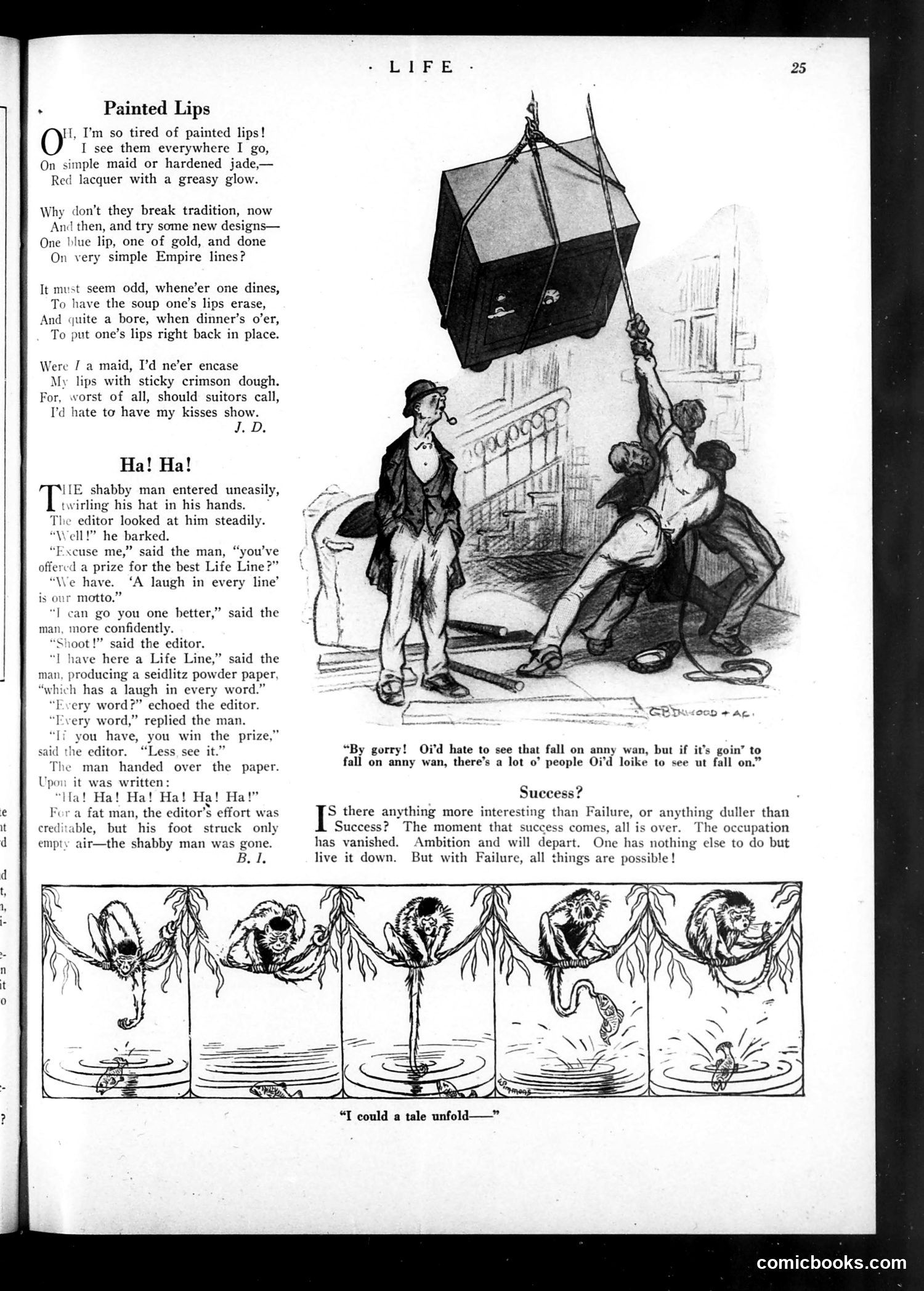
This page contains three satirical pieces typical of early 20th-century American humor: **"Painted Lips"** critiques the fashion trend of women wearing red lipstick, mocking both the ubiquity and impracticality of cosmetics—lipstick smudges during meals, requires reapplication, and leaves evidence of kisses. **"Ha! Ha!"** is a con-artist joke: a shabby man tricks a *Life* magazine editor by submitting a "Life Line" (a pun on the magazine's name and the fortune-telling concept) consisting only of laughter—technically fulfilling the motto "A laugh in every line" while being worthless. **"Success?"** presents a philosophical meditation arguing that failure is more interesting than success because success ends ambition, whereas failure offers possibilities. The bottom panel shows a serial cartoon about a character suspended over water by vines, captioned "I could a tale unfold"—a Shakespearean reference suggesting dramatic peril ahead. The humor relies on wordplay, irony, and social observation typical of *Life*'s satirical approach.
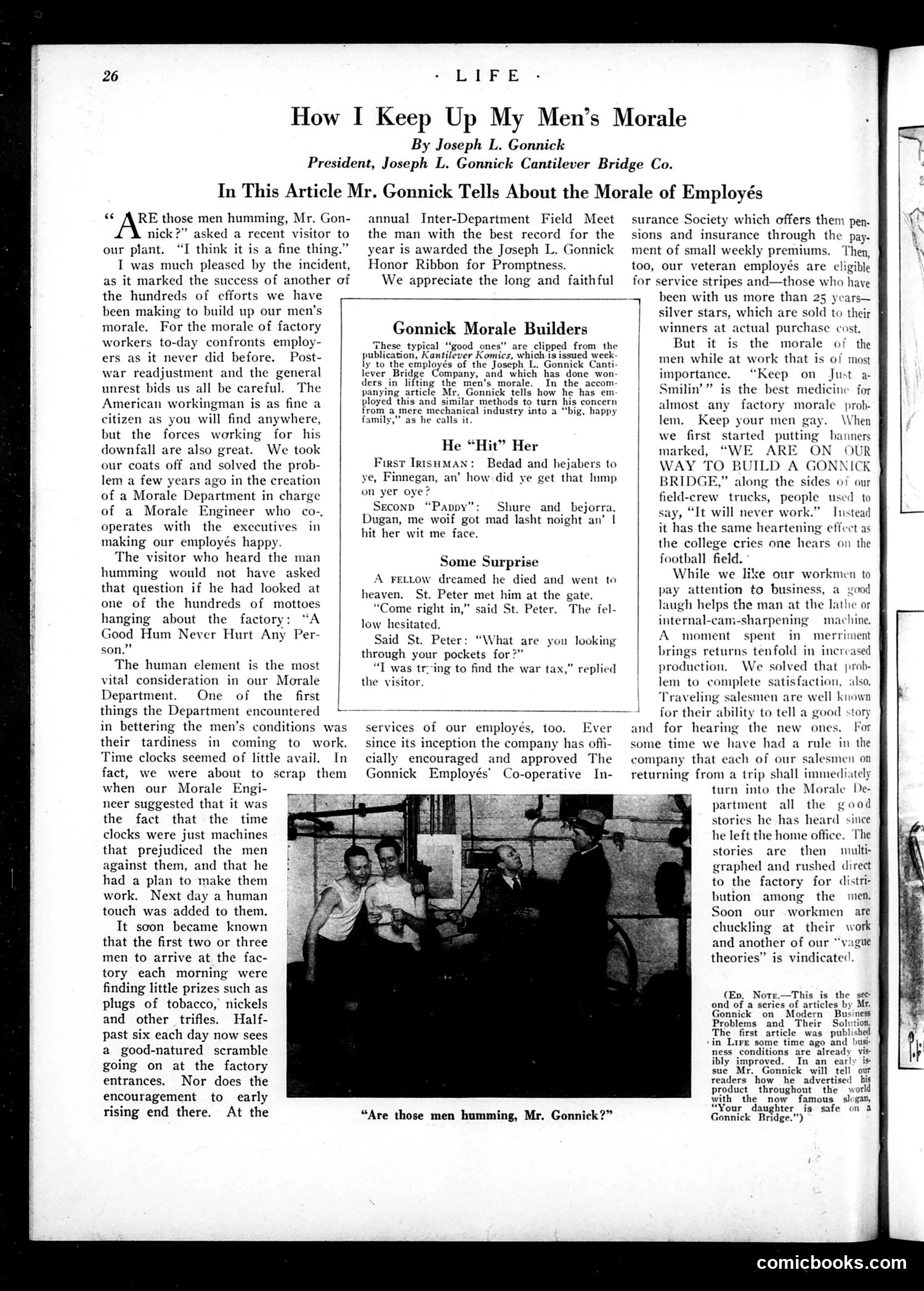
This is a management-propaganda article by Joseph L. Gonnick, president of a bridge company, boasting about his "Morale Department"—essentially an early corporate welfare scheme designed to boost worker productivity and loyalty. The article describes paternalistic tactics: time-clock prizes to encourage punctuality, an in-house humor magazine ("Kantilever Komics"), motivational mottoes, and employee insurance. The accompanying photograph shows what appears to be factory workers in a casual setting, illustrating the "happy family" workplace Gonnick claims to have created. The three jokes inset ("Morale Builders") are typical early-20th-century ethnic humor and sight gags, meant to entertain factory workers. The satirical point isn't explicit in the text itself, but Life magazine's inclusion of this self-congratulatory article—with its earnest claims about solving worker morale through trinkets and jokes—likely invites readers to question whether small prizes and humor magazines genuinely address workers' real concerns: wages, hours, and working conditions.
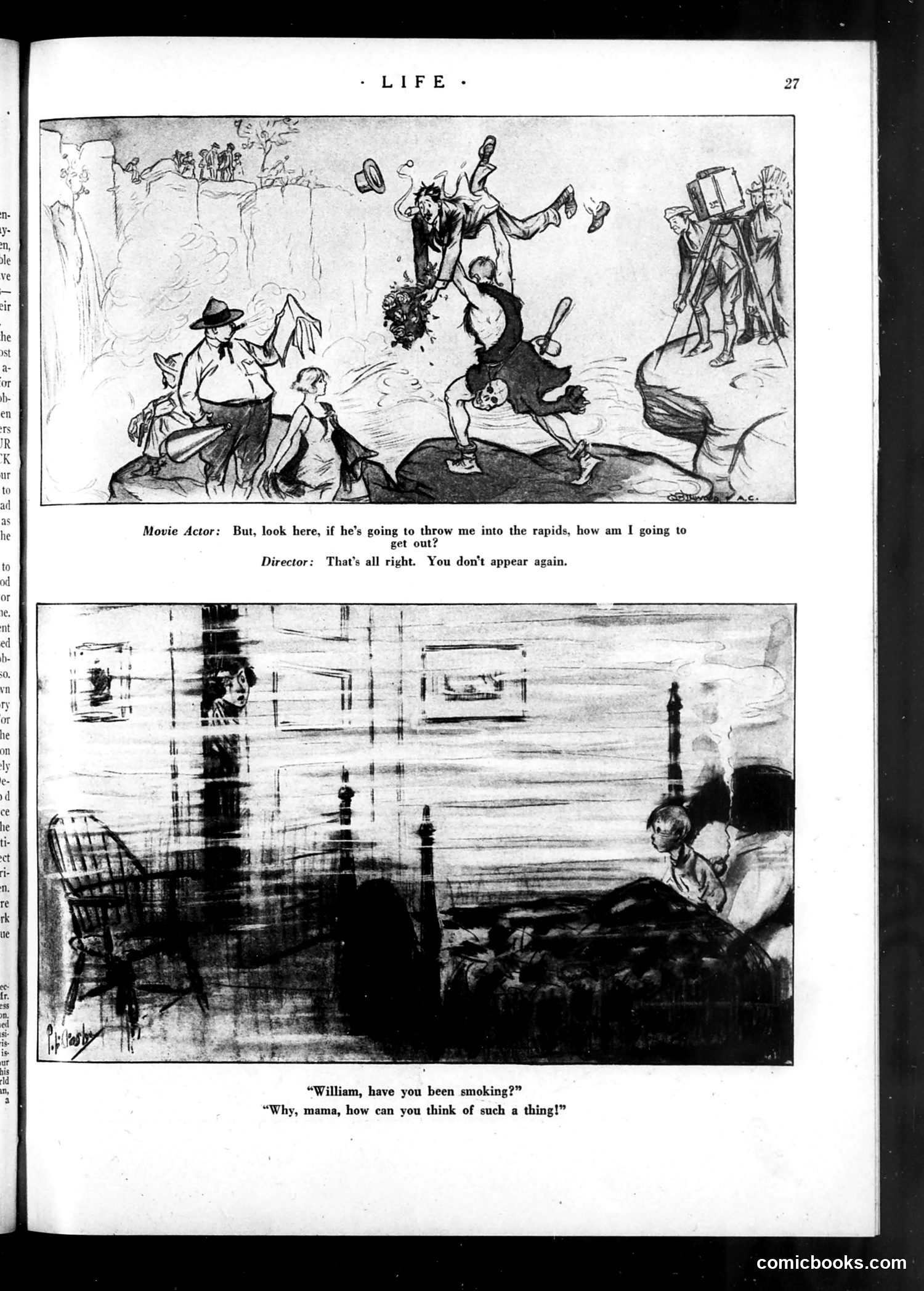
**Top cartoon:** Mocks silent-film movie production. A director dismisses an actor's safety concerns about being thrown into rapids, callously stating he won't appear again in the film—implying the actor might actually drown. This satirizes the era's dangerous stunt work and directors' disregard for performer safety. **Bottom cartoon:** A domestic humor piece showing a mother confronting her son "William" about smoking. The boy denies it unconvincingly. The humor relies on the contrast between his obvious guilt (visible smoke in the background) and his transparent lie—a timeless parental scenario played for gentle comedy about childhood deception. Both cartoons use exaggeration and visual comedy typical of early-20th-century Life magazine satire.
This page is a book review section from an American satirical magazine, featuring literary criticism and commentary. The main content includes: **"How Long?"** — A humorous essay critiquing popular "wolf-pack literature," likely adventure novels set in the frozen North featuring muscular heroes, beautiful heroines, villains with grinding teeth, and dramatic sledge-dog pursuits. The author satirizes these formulaic plots' predictability and excess melodrama. **"The Girls" rhymed review** — A verse review of Edna Ferber's novel, celebrating its feminist theme: three generations of women (Charlotte, Lottie, Charley Kemp) progressing from constrained by family duty to rejecting those constraints. The reviewer frames this as "Freedom's fight" against "Mrs. Grundy's rule" (Victorian social conventions). The bottom decorative illustration shows cherubs or putti in a whimsical scene unrelated to the text. This represents typical early 20th-century American literary satire—mocking both overwrought popular fiction and celebrating progressive social values, particularly women's independence.
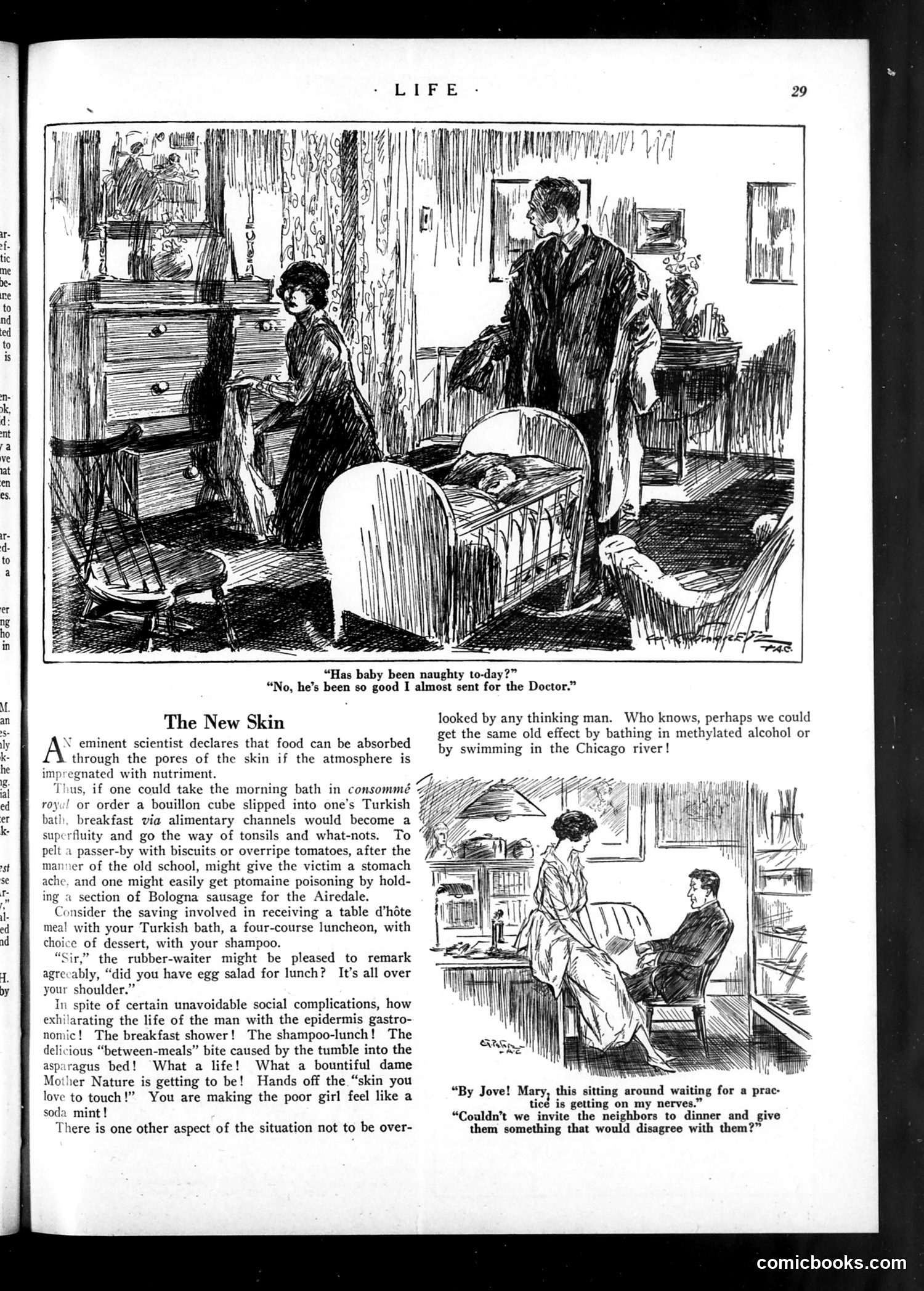
This page satirizes a pseudo-scientific claim that food can be absorbed through skin pores if the air contains nutrients. The article humorously extrapolates this absurd premise to ridiculous conclusions: bathing in consommé instead of eating breakfast, receiving meals during Turkish baths, or feeding dogs Bologna sausage by proximity. The satire mocks both the credulous acceptance of dubious scientific claims and the era's obsession with efficiency and labor-saving innovations. By imagining a world where eating becomes unnecessary and food absorption occurs accidentally (falling into asparagus beds, getting egg salad on your shoulder), the author ridicules how far people will go to avoid traditional domestic routines. The smaller cartoon reinforces this theme: a bored woman suggests inviting neighbors to dinner specifically to poison them—implying even social gatherings become suspect when efficiency-obsessed thinking dominates.
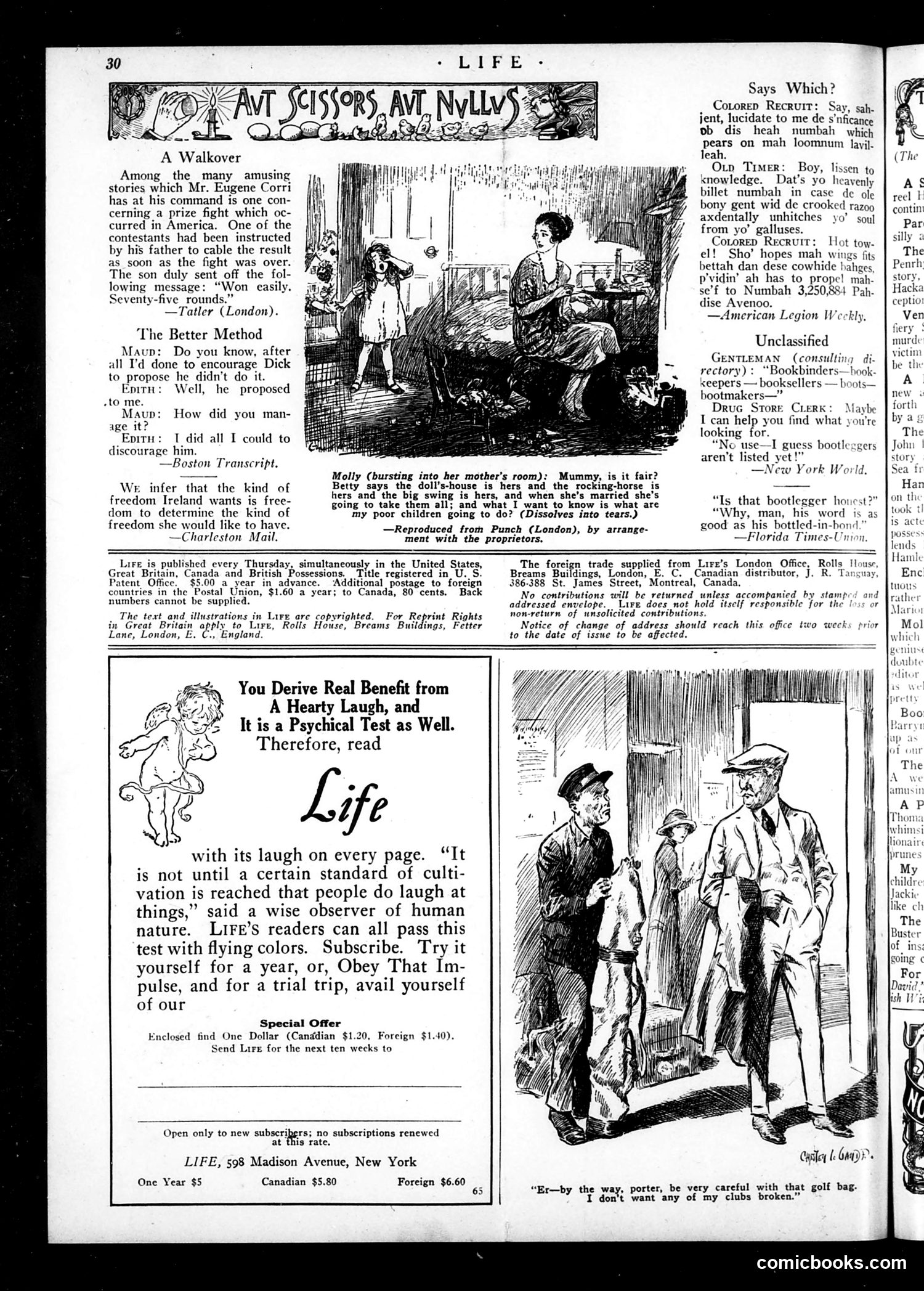
This page contains several humorous anecdotes and advertisements rather than political cartoons. The main content includes: **"A Walkover"**: A joke about a prize fight where a father received a cable saying "Won easily. Seventy-five rounds"—absurd because seventy-five rounds wouldn't constitute an easy victory. **"The Better Method"**: A brief dialogue suggesting a man discouraged his girlfriend from accepting his proposal, yet she married him anyway—reversing expected courtship dynamics for comedic effect. **"Says Which?"**: Dialect humor featuring a "Colored Recruit" (using racist vernacular typical of early 20th-century American comedy) discussing military uniform numbers and equipment with an older soldier. **Bottom cartoon**: Shows men discussing a golf bag with a porter, making a joke about breaking golf clubs. The page is primarily a **humor magazine** promoting subscriptions. The dialect jokes reflect period racial attitudes, while other humor targets universal human situations—courtship, military life, sports—aimed at middle-class readers seeking "cultivated" entertainment.
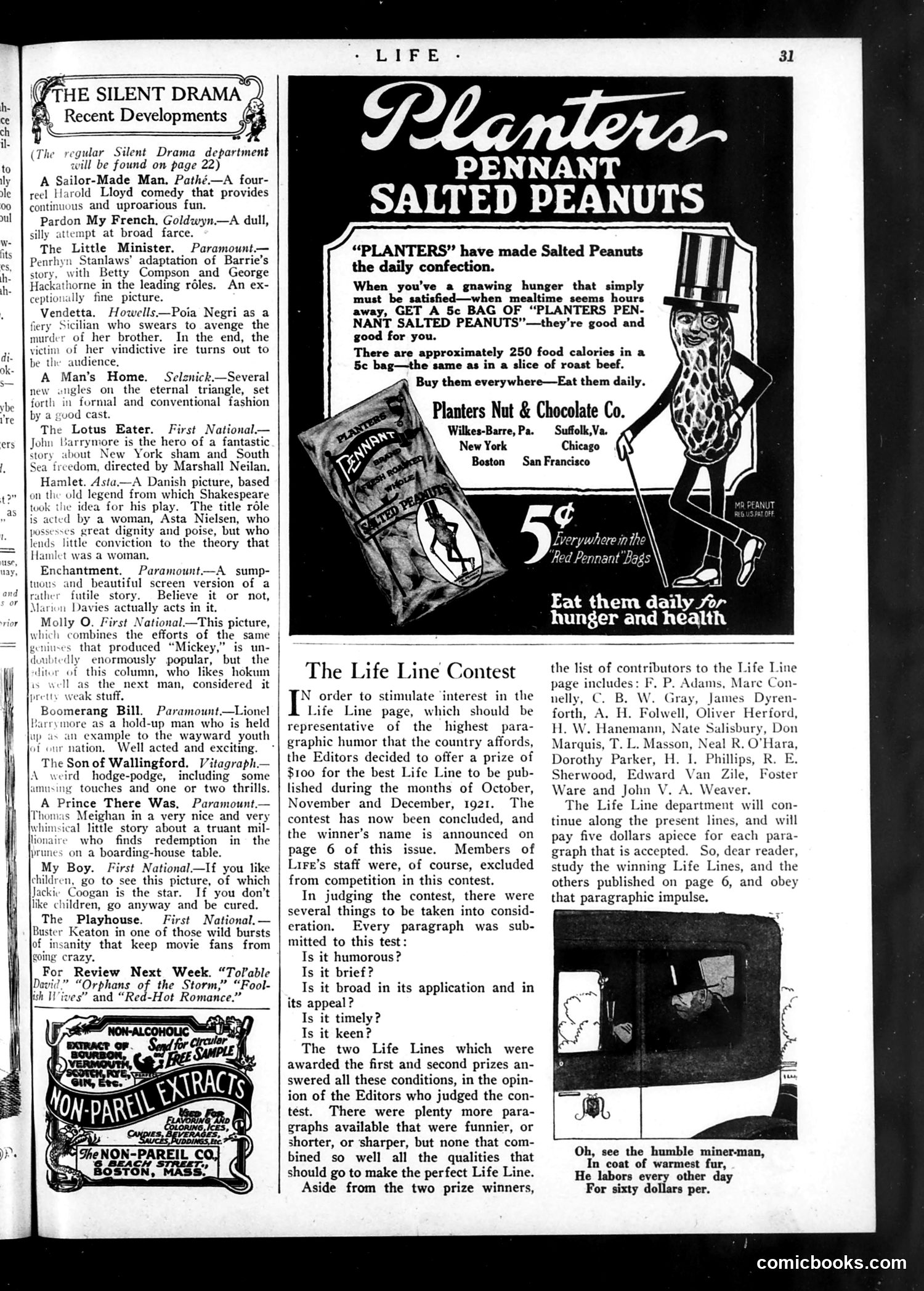
This page is primarily **advertising and entertainment content** from Life magazine (circa 1921), not political satire. **Main Content:** - **Left side**: Movie reviews of silent films, critiquing productions featuring stars like Harold Lloyd, Buster Keaton, and John Barrymore. The tone is sarcastic—praising some ("exquisitely fine picture") while mocking others as "dull" or "silly." - **Right side**: Large advertisement for Planters Pennant Salted Peanuts, featuring the iconic Mr. Peanut mascot (a anthropomorphized peanut in top hat and monocle). The ad claims the 5¢ bag contains 250 calories, equivalent to roast beef. - **Bottom**: Announcement of a "Life Line Contest" where readers submitted humorous paragraphs; winners received $100. **Historical context**: This reflects 1920s consumer culture and the magazine's dual role as both satirical commentary and advertising vehicle. The Mr. Peanut character (debuted 1916) was already well-established branding by this date.