
Life, 1922-01-26 · page 24 of 34
Life — January 26, 1922 — page 24: what you’re looking at
What you’re looking at
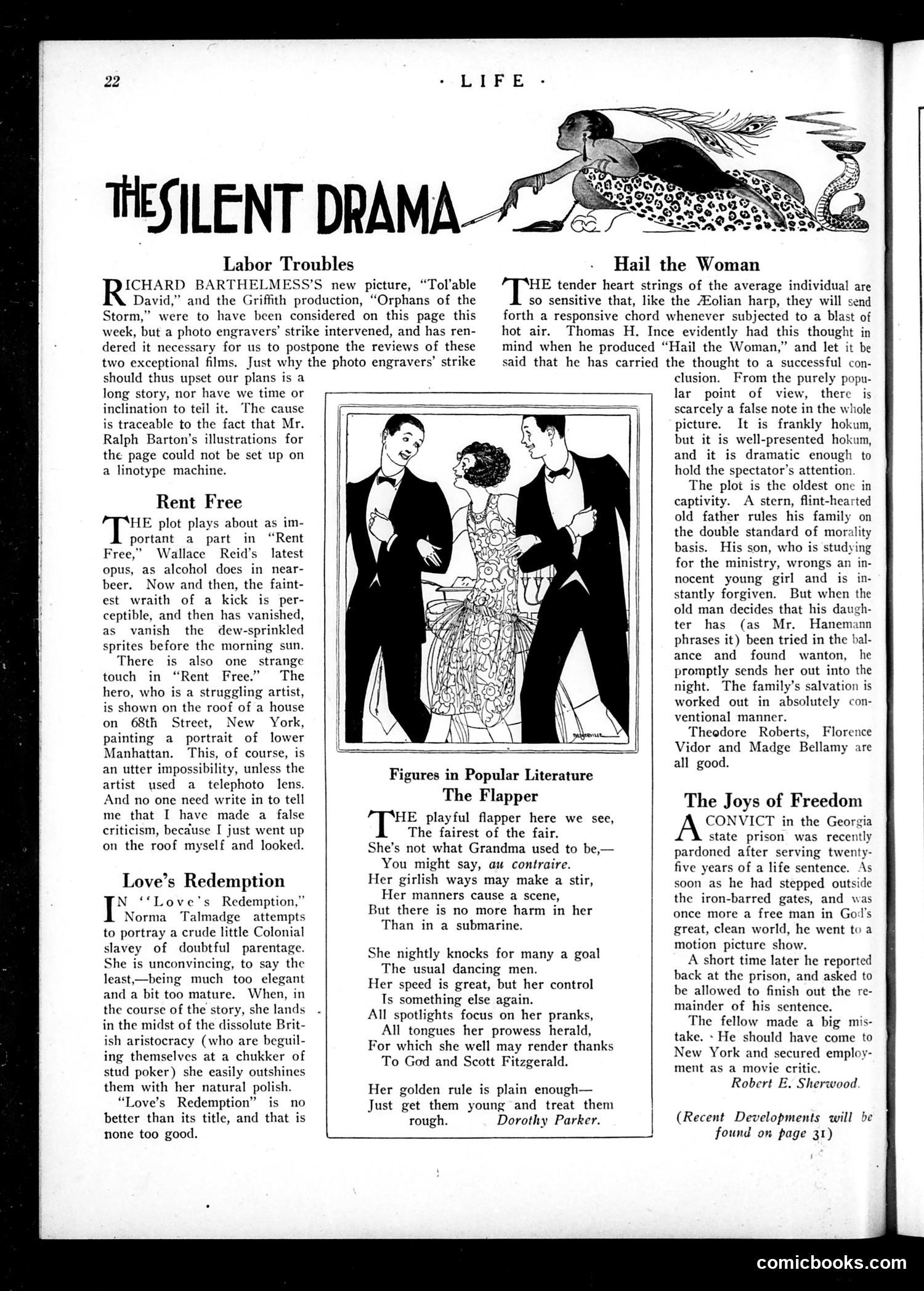
This page reviews recent silent films while commenting on contemporary issues. The main content includes: **Film Reviews**: Critical assessments of movies by Richard Barthelmess, Wallace Reid, and Norma Talmadge. Notably, the editors postpone reviewing two films because a **photo engravers' strike** prevented illustrations by Ralph Barton from being set on a linotype machine—revealing labor tensions in the printing industry. **"The Flapper" Illustration**: A satirical poem and figure contrasting modern young women with their grandmothers. The flapper's "girlish ways" may cause scenes, but she's deemed harmless—"no more harm in her / Than in a submarine." This captures 1920s moral panic about liberated youth while suggesting their rebelliousness is overblown. **"The Joys of Freedom"**: A brief, darkly humorous anecdote about a Georgia convict released after 25 years who immediately returns to prison—implying institutionalization or that freedom itself is unbearable. The page captures post-WWI American concerns: labor unrest, generational anxiety about changing morality, and the trauma of incarceration.
📄 Transcribed text from this page (OCR, searchable)
Machine-transcribed from the original scan — historical spelling and the odd misread are preserved.
TESILENT DRAMA Labor Troubles Hail the Woman ICHARD BARTHELMESS’S new picture, “Tol’able ‘HE tender heart strings of the average individual are David,” and the Griffith production, “Orphans of the so sensitive that, like the Zolian harp, they will send Storm,” were to have been considered on this page this forth a responsive chord whenever subjected to a blast of week, but a photo engravers’ strike intervened, and has ren- _— hot air. Thomas H. Ince evidently had this thought in dered it necessary for us to postpone the reviews of these mind when he produced “Hail the Woman,” and let it be two exceptional films. Just why the photo engravers’ strike said that he has carried the thought to a successful con- should thus upset our plans is a long story, nor have we time or inclination to teil it. The cause is traceable to the fact that Mr. Ralph Barton's illustrations for the page could not be set up on a linotype machine. Rent Free HE plot plays about as im- portant a part in “Rent Free,” Wallace Reid’s _ latest opus, as alcohol does in near- beer. Now and then, the faint- est wraith of a kick is per- ceptible, and then has vanished, as vanish the dew-sprinkled sprites before the morning sun. There is also one strange touch in “Rent Free.” The hero, who is a struggling artist, is shown on the roof of a house on 68th Street, New York, painting a portrait of lower Manhattan. This, of course, is an utter impossibility, unless the artist used a telephoto lens. And no one need write in to tell me that I have made a false criticism, because I just went up on the roof myself and looked. Love’s Redemption N ‘‘Love’s Redemption,” Norma Talmadge attempts to portray a crude little Colonial slavey of doubtful parentage. She is unconvincing, to say the least,—being much too elegant and a bit too mature. When, in the course of the story, she lands in the midst of the dissolute Brit- ish aristocracy (who are beguil- ing themselves at a chukker of stud poker) she easily outshines them with her natural polish. “Love’s Redemption” is no better than its title, and that is none too good. clusion. From the purely popu- lar point of view, there is scarcely a false note in the whole picture. It is frankly hokum, but it is well-presented hokum, and it is dramatic enough to hold the spectator’s attention The plot is the oldest one in captivity. A stern, flint-hearted old father rules his family on the double standard of morality basis. His son, who is studying for the ministry, wrongs an in- nocent young girl and is in- stantly forgiven. But when the old man decides that his daugh- ter has (as Mr. Hanemann phrases it) been tried in the bal- ance and found wanton, he promptly sends her out into the night. The family’s salvation is worked out in absolutely con- ventional manner. Theodore Roberts, Florence Vidor and Madge Bellamy are . . all good. Figures in Popular Literature B The Flapper The Joys of Freedom HE playful flapper here we see, CONVICT in the Georgia ron The fairest of the fair. state prison was recently She's not what Grandma used to be,— pardoned after serving twenty- You might say, au contraire. five years of a life sentence. As Her girlish ways may make a stir, soon as he had stepped outside Her manners cause a scene, the iron-barred gates, and was But there is no more harm in her once more a free man in God's Than in a submarine. great, clean world, he went to a motion picture show. A short time later he reported back at the prison, and asked to be allowed to finish out the re- mainder of his sentence. The fellow made a big mis- take. He should have come to New York and secured employ- ment as a movie critic. Robert E. Sherwood. She nightly knocks for many a goal The usual dancing men. Her speed is great, but her control Is something else again. All spotlights focus on her pranks, All tongues her prowess herald, For which she well may render thanks To God and Scott Fitzgerald. Her golden rule is plain enough— Just get them young and treat them rough. Dorothy Parker. (Recent Developments will be found on page 31) comicbooks.com