
Life, 1922-01-26 · page 16 of 34
Life — January 26, 1922 — page 16: what you’re looking at
What you’re looking at
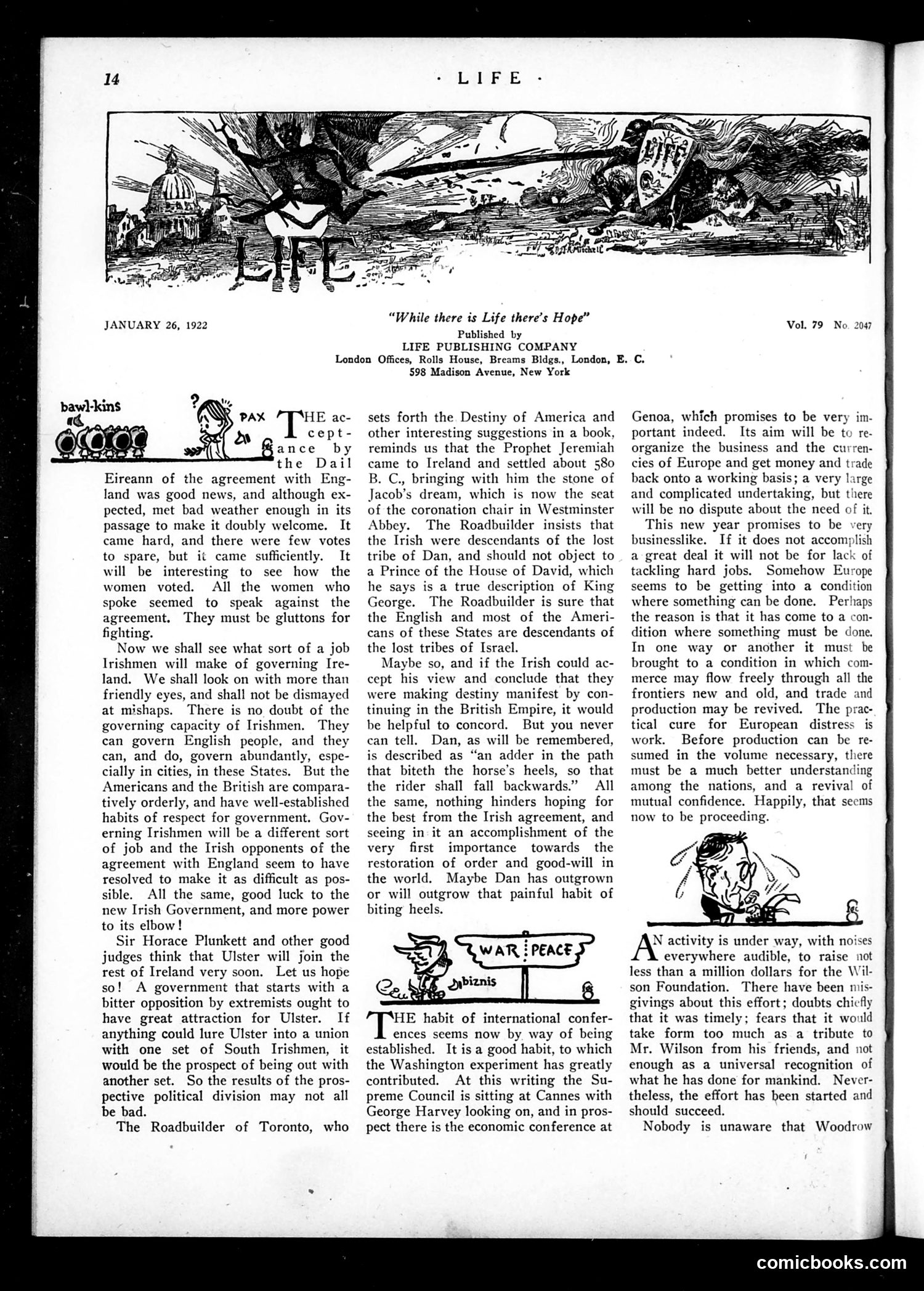
This page contains satirical articles about Irish independence and international peace efforts. The main text discusses the Irish Free State agreement and governance prospects, questioning whether Irish leaders can effectively govern themselves—a common British/unionist skepticism about Irish self-rule. The accompanying cartoons appear to reference: - **"War" and "Peace"** imagery, likely commenting on post-WWI diplomacy - References to Dan (unclear which specific figure), described as having a habit of "biting heels"—seemingly mocking Irish political leaders' combative tactics A secondary article discusses the Wilson Foundation fundraising effort and the Supreme Council meeting at Cannes, reflecting contemporary international peace-building efforts following World War I. The overall tone is skeptical about both Irish governance capability and optimistic international peace initiatives.
📄 Transcribed text from this page (OCR, searchable)
Machine-transcribed from the original scan — historical spelling and the odd misread are preserved.
“While there is Life there’s Hope” Published by LIFE PUBLISHING COMPANY Vol. 79 No. 2047 London Offices, Rolls House, Breams Bldgs., London, E. C. PAX HE ac- cept- Eireann of the agreement with Eng- land was good news, and although ex- pected, met bad weather enough in its passage to make it doubly welcome. It came hard, and there were few votes to spare, but it came sufficiently. It will be interesting to see how the women voted. All the women who spoke seemed to speak against the agreement, They must be gluttons for fighting. Now we shall see what sort of a job Irishmen will make of governing Ire- land. We shall look on with more than friendly eyes, and shall not be dismayed at mishaps. There is no doubt of the governing capacity of Irishmen. They can govern English people, and they can, and do, govern abundantly, espe- cially in cities, in these States. But the Americans and the British are compara- tively orderly, and have well-established habits of respect for government. Gov- erning Irishmen will be a different sort of job and the Irish opponents of the agreement with England seem to have resolved to make it as difficult as pos- sible. All the same, good luck to the new Irish Government, and more power to its elbow! Sir Horace Plunkett and other good judges think that Ulster will join the rest of Ireland very soon. Let us hope so! A government that starts with a bitter opposition by extremists ought to have great attraction for Ulster. If anything could lure Ulster into a union with one set of South Irishmen, it would be the prospect of being out with another set. So the results of the pros- pective political division may not all be bad. The Roadbuilder of Toronto, who 598 Madison Avenue, New York sets forth the Destiny of America and other interesting suggestions in a book, reminds us that the Prophet Jeremiah came to Ireland and settled about 580 B. C., bringing with him the stone of Jacob’s dream, which is now the seat of the coronation chair in Westminster Abbey. The Roadbuilder insists that the Irish were descendants of the lost tribe of Dan, and should not object to a Prince of the House of David, which he says is a true description of King George. The Roadbuilder is sure that the English and most of the Ameri- cans of these States are descendants of the lost tribes of Israel. Maybe so, and if the Irish could ac- cept his view and conclude that they were making destiny manifest by con- tinuing in the British Empire, it would be helpful to concord. But you never can tell. Dan, as will be remembered, is described as “an adder in the path that biteth the horse’s heels, so that the rider shall fall backwards.” All the same, nothing hinders hoping for the best from the Irish agreement, and seeing in it an accomplishment of the very first importance towards the restoration of order and good-will in the world. Maybe Dan has outgrown or will outgrow that painful habit of biting heels. ‘HE habit of international confer- ences seems now by way of being established. It is a good habit, to which the Washington experiment has greatly contributed. At this writing the Su- preme Council is sitting at Cannes with George Harvey looking on, and in pros- pect there is the economic conference at Genoa, which promises to be very im- portant indeed. Its aim will be to re- organize the business and the curren- cies of Europe and get money and trade back onto a working basis; a very large and complicated undertaking, but there will be no dispute about the need of it. This new year promises to be very businesslike. If it does not accomplish a great deal it will not be for lack of tackling hard jobs. Somehow Europe seems to be getting into a condition where something can be done. Perhaps the reason is that it has come to a con- dition where something must be done. In one way or another it must be brought to a condition in which com- merce may flow freely through all the frontiers new and old, and trade and production may be revived. The prac- tical cure for European distress is work. Before production can be re- sumed in the volume necessary, there must be a much better understanding among the nations, and a revival of mutual confidence. Happily, that seems now to be proceeding. activity is under way, with noises everywhere audible, to raise not less than a million dollars for the Wil- son Foundation. There have been niis- givings about this effort; doubts chiefly that it was timely; fears that it would take form too much as a tribute to Mr. Wilson from his friends, and not enough as a universal recognition of what he has done for mankind. Never- theless, the effort has been started and should succeed. Nobody is unaware that Woodrow comicbooks.com