
Life, 1922-01-26 · page 28 of 34
Life — January 26, 1922 — page 28: what you’re looking at
What you’re looking at
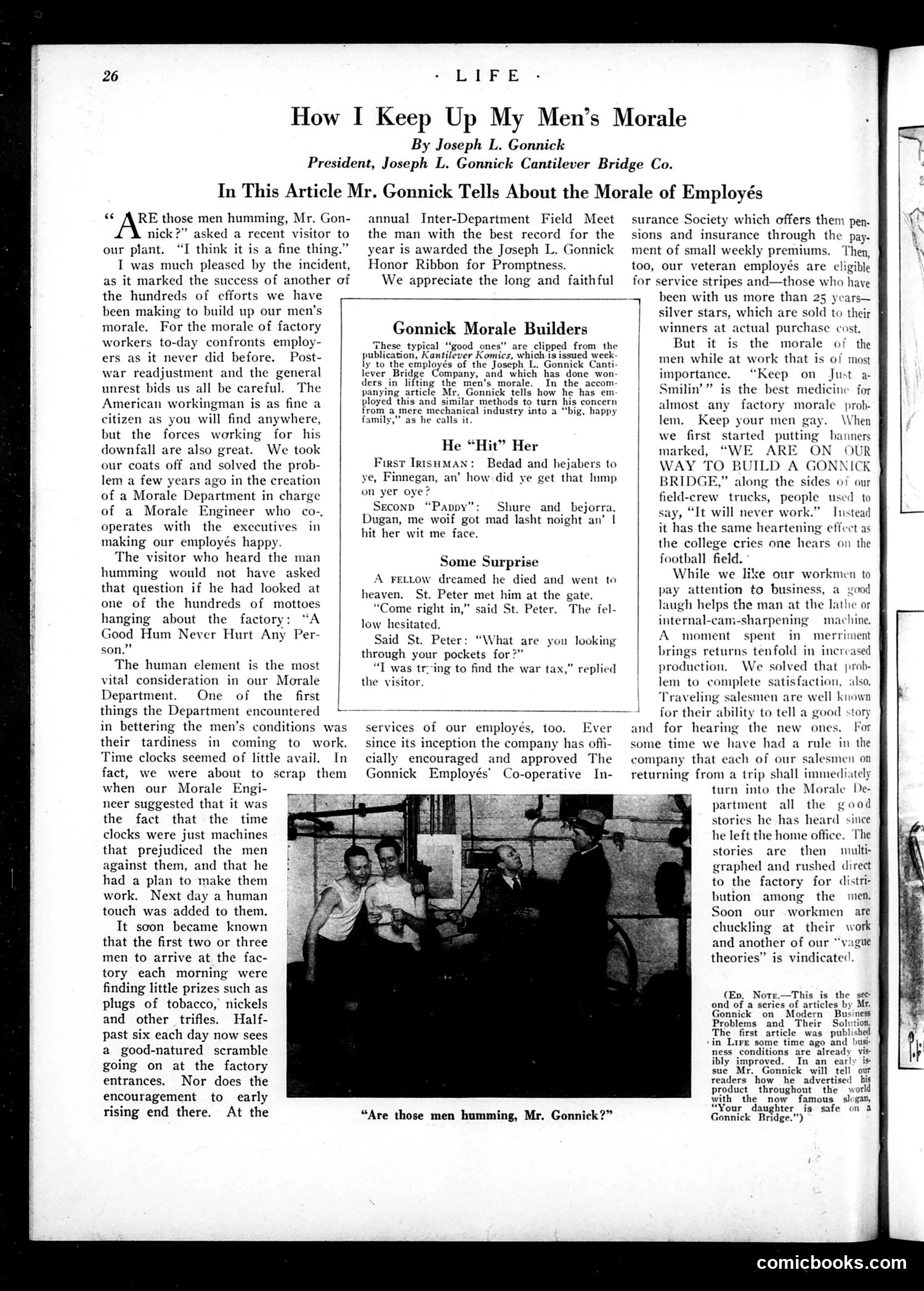
This is a management-propaganda article by Joseph L. Gonnick, president of a bridge company, boasting about his "Morale Department"—essentially an early corporate welfare scheme designed to boost worker productivity and loyalty. The article describes paternalistic tactics: time-clock prizes to encourage punctuality, an in-house humor magazine ("Kantilever Komics"), motivational mottoes, and employee insurance. The accompanying photograph shows what appears to be factory workers in a casual setting, illustrating the "happy family" workplace Gonnick claims to have created. The three jokes inset ("Morale Builders") are typical early-20th-century ethnic humor and sight gags, meant to entertain factory workers. The satirical point isn't explicit in the text itself, but Life magazine's inclusion of this self-congratulatory article—with its earnest claims about solving worker morale through trinkets and jokes—likely invites readers to question whether small prizes and humor magazines genuinely address workers' real concerns: wages, hours, and working conditions.
📄 Transcribed text from this page (OCR, searchable)
Machine-transcribed from the original scan — historical spelling and the odd misread are preserved.
ERE ° How I Keep Up My Men’s Morale By Joseph L. Gonnick President, Joseph L. Gonnick Cantilever Bridge Co. In This Article Mr. Gonnick Tells About the Morale of Employés RE those men humming, Mr. Gon- nick?” asked a recent visitor to our plant. “I think it is a fine thing.” I was much pleased by the incident, as it marked the success of another of the hundreds of efforts we have annual Inter-Department Field Meet the man with the best record for the year is awarded the Joseph L. Gonnick Honor Ribbon for Promptness. We appreciate the long and faithful been making to build up our men’s morale. For the morale of factory workers to-day confronts employ- ers as it never did before. Post- war readjustment and the general unrest bids us all be careful. The American workingman is as fine a citizen as you will find anywhere, but the forces working for his downfall are also great. We took our coats off and solved the prob- lem a few years ago in the creation of a Morale Department in charge of a Morale Engineer who co-, operates with the executives in making our employés happy. The visitor who heard the man humming would not have asked that question if he had looked at one of the hundreds of mottoes hanging about the factory: “A Good Hum Never Hurt Any Per- son,” The human element is the most vital consideration in our Morale Department. One of the first things the Department encountered =‘ in bettering the men’s conditions was their tardiness in coming to work. Time clocks seemed of little avail. In fact, we were about to scrap them when our Morale Engi- neer suggested that it was the fact that the time clocks were just machines that prejudiced the men against them, and that he had a plan to make them work. Next day a human touch was added to them. It soon became known that the first two or three men to arrive at the fac- tory each morning were finding little prizes such as plugs of tobacco, nickels and other trifles. Half- past six each day now sees a good-natured scramble going on at the factory entrances. Nor does the encouragement to early rising end there. At the Gonnick Morale Builders These typical “good ones” are clipped from the publication, Kantilever Komics, whichis issued week ly to the employés of the Joseph L. Gonnick Canti lever Bridge Company, and which has done won ders in lifting the men’s morale. In the accom panying article Mr. Gonnick tells how he has em ployed this and similar methods to turn his concern from a mere mechanical industry into a “big, happy family,” as he calls it. He “Hit” Her First IrRtisHMAN: Bedad and hejabers to ye, Finnegan, an’ how did ye get that lump on yer oye? Seconp “Pappy”: Shure and_bejorra, Dugan, me woif got mad lasht noight an’ | hit her wit me face. Some Surprise A FELLOW dreamed he died and went to heaven, St. Peter met him at the gate. “Come right in,” said St. Peter. The fel- low hesitated. Said St. Peter: “What 2 through your pockets for “T was trring to find the war tax,” the visitor, e you looking replied services of our employés, too. Ever since its inception the company has offi- cially encouraged and approved The Gonnick Employés’ Co-operative In- “Are those men humming, Mr. Gonnick?” surance Society which offers them pen- sions and insurance through the pay- ment of small weekly premiums. Then, too, our veteran employés are eligible for service stripes and—those who have 4 been with us more than 25 years— silver stars, which are sold to their winners at actual purchase cost, But it is the morale of the men while at work that is of most importance. “Keep on Just a- Smilin’” is the best medicine for almost any factory morale prob- lem. Keep your men gay. hen we first started putting banners marked, “WE ARE ON OUR WAY TO BUILD A GONNICK BRIDGE,” along the sides of our field-crew tru people used to say, “It will never work.” Instead it has the same heartening effect as the college cries one hears on the football field. While we like our workmen to pay attention to business, a good laugh helps the man at the lathe or internal-cam-sharpening — machine. A moment spent in merriment brings returns tenfold in increased production. We solved that prob- lem to complete satisfaction, also. raveling salesmen are well known for their ability to tell a good story and for hearing the new ones. For some time we have had a rule in the company that each of our salesmen on returning from a trip shall immediately turn into the Morale De- partment all the good stories he has heard since he left the home office. The stories are then multi- graphed and rushed direct to the factory for distri- bution among the men Soon our workmen are chuckling at their work and another of our “vague theories” is vindicated. ond of a series of articles b: Gonnick on Modern Bu: Problems and Their Solut The first article was published sin Lire some time ago and bus: ss conditions are already vis improved. In an early is sue Mr. Gonnick will tell our readers how he advertised his product throughout the world with the now famous slogan, “Your daughter is safe on a Gonnick Bridge.”) — comicbooks.com