
Life, 1922-01-26 · page 30 of 34
Life — January 26, 1922 — page 30: what you’re looking at
What you’re looking at
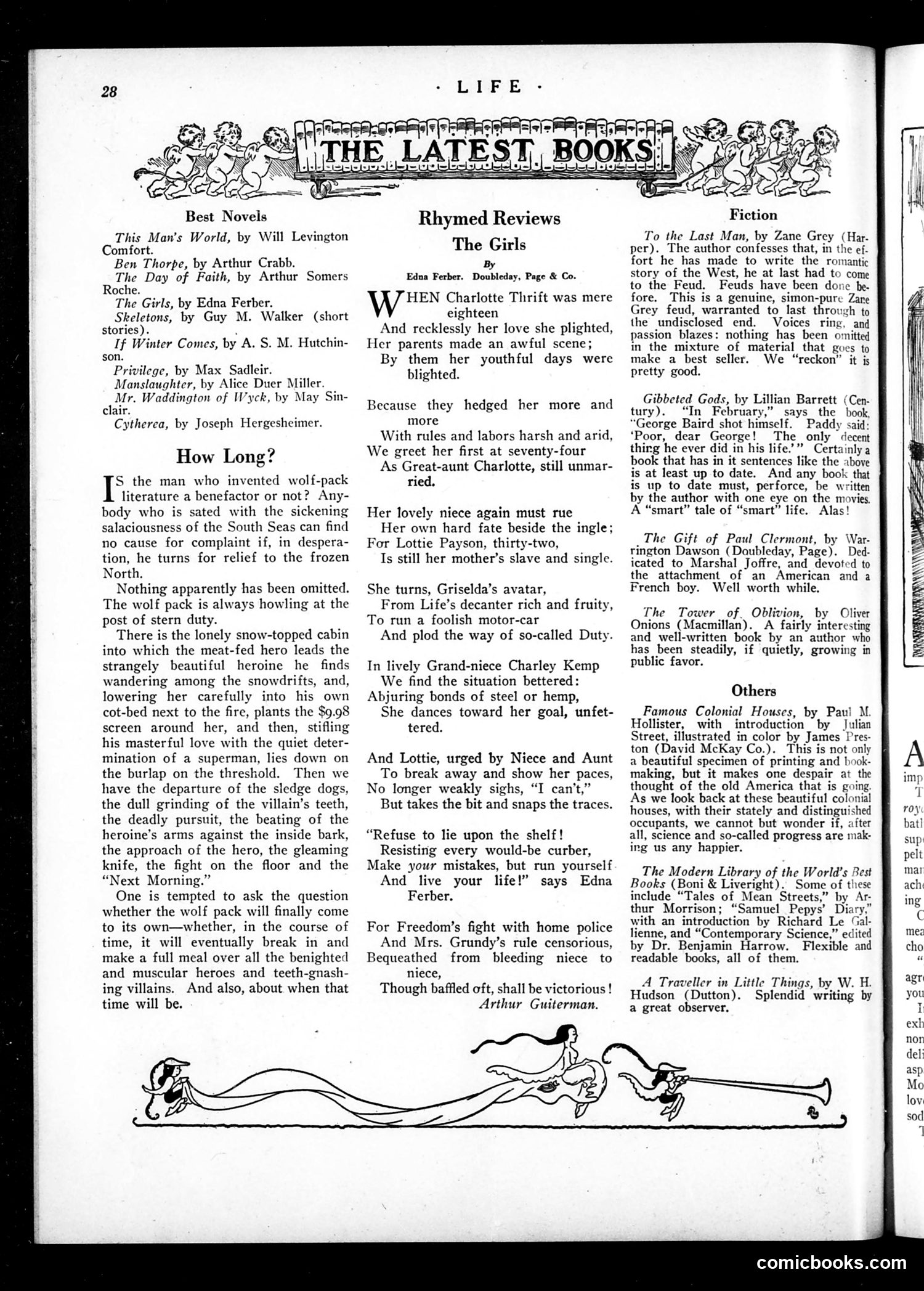
This page is a book review section from an American satirical magazine, featuring literary criticism and commentary. The main content includes: **"How Long?"** — A humorous essay critiquing popular "wolf-pack literature," likely adventure novels set in the frozen North featuring muscular heroes, beautiful heroines, villains with grinding teeth, and dramatic sledge-dog pursuits. The author satirizes these formulaic plots' predictability and excess melodrama. **"The Girls" rhymed review** — A verse review of Edna Ferber's novel, celebrating its feminist theme: three generations of women (Charlotte, Lottie, Charley Kemp) progressing from constrained by family duty to rejecting those constraints. The reviewer frames this as "Freedom's fight" against "Mrs. Grundy's rule" (Victorian social conventions). The bottom decorative illustration shows cherubs or putti in a whimsical scene unrelated to the text. This represents typical early 20th-century American literary satire—mocking both overwrought popular fiction and celebrating progressive social values, particularly women's independence.
📄 Transcribed text from this page (OCR, searchable)
Machine-transcribed from the original scan — historical spelling and the odd misread are preserved.
Best Novels This Man’s World, by Will Levington Comfort. Ben Thorpe, by Arthur Crabb. The Day of Faith, by Arthur Somers Roche. The Girls, by Edna Ferber. Skeletons, by Guy M. Walker (short stories). If Winter Comes, by A. S. M. Hutchin- son. Privilege, by Max Sadleir. Manslaughter, by Alice Duer Miller. ee Waddington of Wyck, by May Sin- clair, Cytherea, by Joseph Hergesheimer. How Long? S the man who invented wolf-pack literature a benefactor or not? Any- body who is sated with the sickening salaciousness of the South Seas can find no cause for complaint if, in despera- tion, he turns for relief to the frozen North. Nothing apparently has been omitted. The wolf pack is always howling at the post of stern duty. There is the lonely snow-topped cabin into which the meat-fed hero leads the strangely beautiful heroine he finds wandering among the snowdrifts, and, lowering her carefully into his own cot-bed next to the fire, plants the $9.98 screen around her, and then, stifling his masterful love with the quiet deter- mination of a superman, lies down on the burlap on the threshold. Then we have the departure of the sledge dogs, the dull grinding of the villain’s teeth, the deadly pursuit, the beating of the heroine’s arms against the inside bark, the approach of the hero, the gleaming knife, the fight on the floor and the “Next Morning.” One is tempted to ask the question whether the wolf pack will finally come to its own—whether, in the course of time, it will eventually break in and make a full meal over all the benighted and muscular heroes and teeth-gnash- ing villains. And also, about when that time will be. Rhymed Reviews The Girls By Edna Ferber. Doubleday, Page & Co. HEN Charlotte Thrift was mere eighteen And recklessly her love she plighted, Her parents made an awful scene; By them her youthful days were blighted. Because they hedged her more and more With rules and labors harsh and arid, We greet her first at seventy-four As Great-aunt Charlotte, still unmar- ried. Her lovely niece again must rue Her own hard fate beside the ingle; For Lottie Payson, thirty-two, Is still her mother’s slave and single. She turns, Griselda’s avatar, From Life’s decanter rich and fruity, To run a foolish motor-car And plod the way of so-called Duty. In lively Grand-niece Charley Kemp We find the situation bettered: Abjuring bonds of steel or hemp, She dances toward her goal, unfet- tered. And Lottie, urged by Niece and Aunt To break away and show her paces, No longer weakly sighs, “I can't,” But takes the bit and snaps the traces. “Refuse to lie upon the shelf! Resisting every would-be curber, Make your mistakes, but run yourself And live your life!” says Edna Ferber. For Freedom’s fight with home police And Mrs. Grundy’s rule censorious, Bequeathed from bleeding niece to niece, Though baffled oft, shall be victorious ! Arthur Guiterman. Fiction To the Last Man, by Zane Grey (Har- per). The author confesses that, in the ef- fort he has made to write the romantic story of the West, he at last had to come to the Feud. Feuds have been done be- fore. This is a genuine, simon-pure Zane Grey feud, warranted to last through to the undisclosed end. Voices ring, and passion blazes: nothing has been omitted in the mixture of material that goes to make a best seller. We “reckon” it is pretty good. Gibbeted Gods, by Lillian Barrett (Cen- tury). “In February,” says the book, “George Baird shot himself. Paddy said: ‘Poor, dear George! The only ‘decent thirg he ever did in his life’” Certainly a book that has in it sentences like the above is at least up to date. And any book that is up to date must, perforce, be wri itten by the author with one eye on the movies, A “smart” tale of “smart” life. Alas! The Gift of Paul Clermont, by War- rington Dawson (Doubleday, Page). Ded- icated to Marshal Joffre, and devoted to the attachment of an American and a French boy. Well worth while. The Tower of. Oblivion, by Oliver Onions (Macmillan). A fairly interesting and well-written book by an author who has been steadily, if quietly, growing in public favor. Others Famous Colonial Houses, by Paul M. Hollister, with introduction by Julian Street, illustrated in color by James Pres- ton (David McKay Co.). This is not only a beautiful specimen of printing and book- making, but it makes one despair at the thought of the old America that is going. As we look back at these beautiful colonial houses, with their stately and distinguished occupants, we cannot but wonder if, after all, science and so-called progress are mak- ing us any happier. The Modern Library of the World’s Best Books (Boni & Liveright). Some of these include “Tales of Mean Streets,” by Ar. thur Morrison; “Samuel Pepys’ Diary, with an introduction by Richard Le Gal- lienne, and “Contemporary Science,” edited by Dr. Benjamin Harrow. Flexible and readable books, all of them. A Traveller in Little Things, by W. H. Hudson (Dutton). Splendid writing by a great observer. imp T roy bat! sup pelt mat ach ing C mea cho agr you I exh non del: asp Mo lov sod 7 comicbooks.com