
Life, 1922-01-26 · page 20 of 34
Life — January 26, 1922 — page 20: what you’re looking at
What you’re looking at
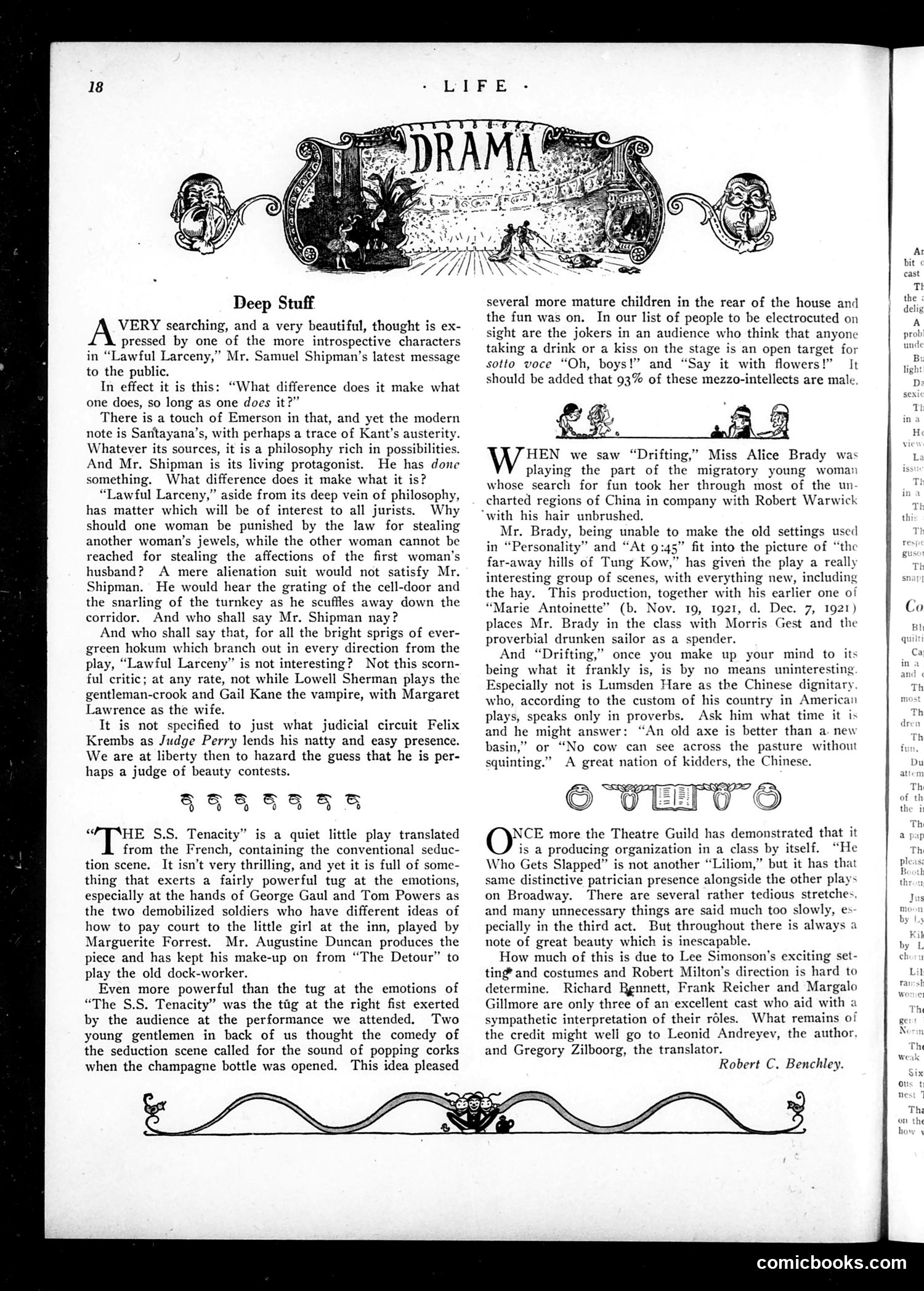
This page reviews three Broadway plays from around 1921. The "Deep Stuff" section critiques *Lawful Larceny*, praising its philosophical premise ("What difference does it make what one does, so long as one does it?") while noting the irony that protagonist Shipman embodies this relativism. The reviewer highlights the play's gender-justice question: why punish a woman for stealing jewels but not for stealing a husband's affections? The second review mocks *The S.S. Tenacity*, a French translation, but uses it mainly to satirize disruptive audience members—specifically young men who make crude remarks ("Oh, boys!") during romantic scenes, noted as 93% male. The final section reviews *Drifting*, praising designer Brady's new set pieces for the Chinese-locale play while sardonically comparing his spending habits to "the proverbial drunken sailor." The page contains no political cartoons—it's entirely theatrical criticism with period-appropriate wit and social observation about audience behavior.
📄 Transcribed text from this page (OCR, searchable)
Machine-transcribed from the original scan — historical spelling and the odd misread are preserved.
Deep Stuff VERY searching, and a very beautiful, thought is ex- pressed by one of the more introspective characters in “Lawful Larceny,” Mr. Samuel Shipman’s latest message to the public. In effect it is this: “What difference does it make what one does, so long as one does it?” There is a touch of Emerson in that, and yet the modern note is Saritayana’s, with perhaps a trace of Kant’s austerity. Whatever its sources, it is a philosophy rich in possibilities. And Mr. Shipman is its living protagonist. He has done something. What difference does it make what it is? “Lawful Larceny,” aside from its deep vein of philosophy, has matter which will be of interest to all jurists. Why should one woman be punished by the law for stealing another woman’s jewels, while the other woman cannot be reached for stealing the affections of the first woman's husband? A mere alienation suit would not satisfy Mr. Shipman. He would hear the grating of the cell-door and the snarling of the turnkey as he scuffles away down the corridor. And who shall say Mr. Shipman nay? And who shall say that, for all the bright sprigs of ever- green hokum which branch out in every direction from the play, “Lawful Larceny” is not interesting? Not this scorn- ful critic; at any rate, not while Lowell Sherman plays the gentleman-crook and Gail Kane the vampire, with Margaret Lawrence as the wife. It is not specified to just what judicial circuit Felix Krembs as Judge Perry lends his natty and easy presence. We are at liberty then to hazard the guess that he is per- haps a judge of beauty contests. EFETEHS ac HE S.S. Tenacity” is a quiet little play translated from the French, containing the conventional seduc- tion scene, It isn’t very thrilling, and yet it is full of some- thing that exerts a fairly powerful tug at the emotions, especially at the hands of George Gaul and Tom Powers as the two demobilized soldiers who have different ideas of how to pay court to the little girl at the inn, played by Marguerite Forrest. Mr. Augustine Duncan produces the piece and has kept his make-up on from “The Detour” to play the old dock-worker. Even more powerful than the tug at the emotions of “The S.S. Tenacity” was the tig at the right fist exerted by the audience at the performance we attended. Two young gentlemen in back of us thought the comedy of the seduction scene called for the sound of popping corks when the champagne bottle was opened. This idea pleased several more mature children in the rear of the house and the fun was on. In our list of people to be electrocuted on sight are the jokers in an audience who think that anyone taking a drink or a kiss on the stage is an open target for sotto voce “Oh, boys!” and “Say it with flowers!” It should be added that 93% of these mezzo-intellects are male. HEN we saw “Drifting,” Miss Alice Brady was playing the part of the migratory young woman whose search for fun took her through most of the un charted regions of China in company with Robert Warwick “with his hair unbrushed. Mr. Brady, being unable to make the old settings used in “Personality” and “At 9:45” fit into the picture of “the far-away hills of Tung Kow,” has given the play a really interesting group of scenes, with everything new, including the hay. This production, together with his earlier one of “Marie Antoinette” (b. Nov. 19, 1921, d. Dec. 7, 1921) places Mr. Brady in the class with Morris Gest and the proverbial drunken sailor as a spender. And “Drifting,” once you make up your mind to its being what it frankly is, is by no means uninteresting Especially not is Lumsden Hare as the Chinese dignitary who, according to the custom of his country in American plays, speaks only in proverbs. Ask him what time it is and he might answer: “An old axe is better than a. new basin,” or “No cow can see across the pasture without squinting.” A great nation of kidders, the Chinese. “ETO NCE more the Theatre Guild has demonstrated that it is a producing organization in a class by itself. “He Who Gets Slapped” is not another “Liliom,” but it has that same distinctive patrician presence alongside the other plays on Broadway. There are several rather tedious stretches. and many unnecessary things are said much too slowly, es- pecially in the third act. But throughout there is always a note of great beauty which is inescapable. How much of this is due to Lee Simonson’s exciting set- ting and costumes and Robert Milton’s direction is hard to determine. Richard Rennett, Frank Reicher and Margalo Gillmore are only three of an excellent cast who aid with a sympathetic interpretation of their réles. What remains of the credit might well go to Leonid Andreyev, the author, and Gregory Zilboorg, the translator. Robert C. Benchley. comicbooks.com