
Life, 1922-01-26 · page 17 of 34
Life — January 26, 1922 — page 17: what you’re looking at
What you’re looking at
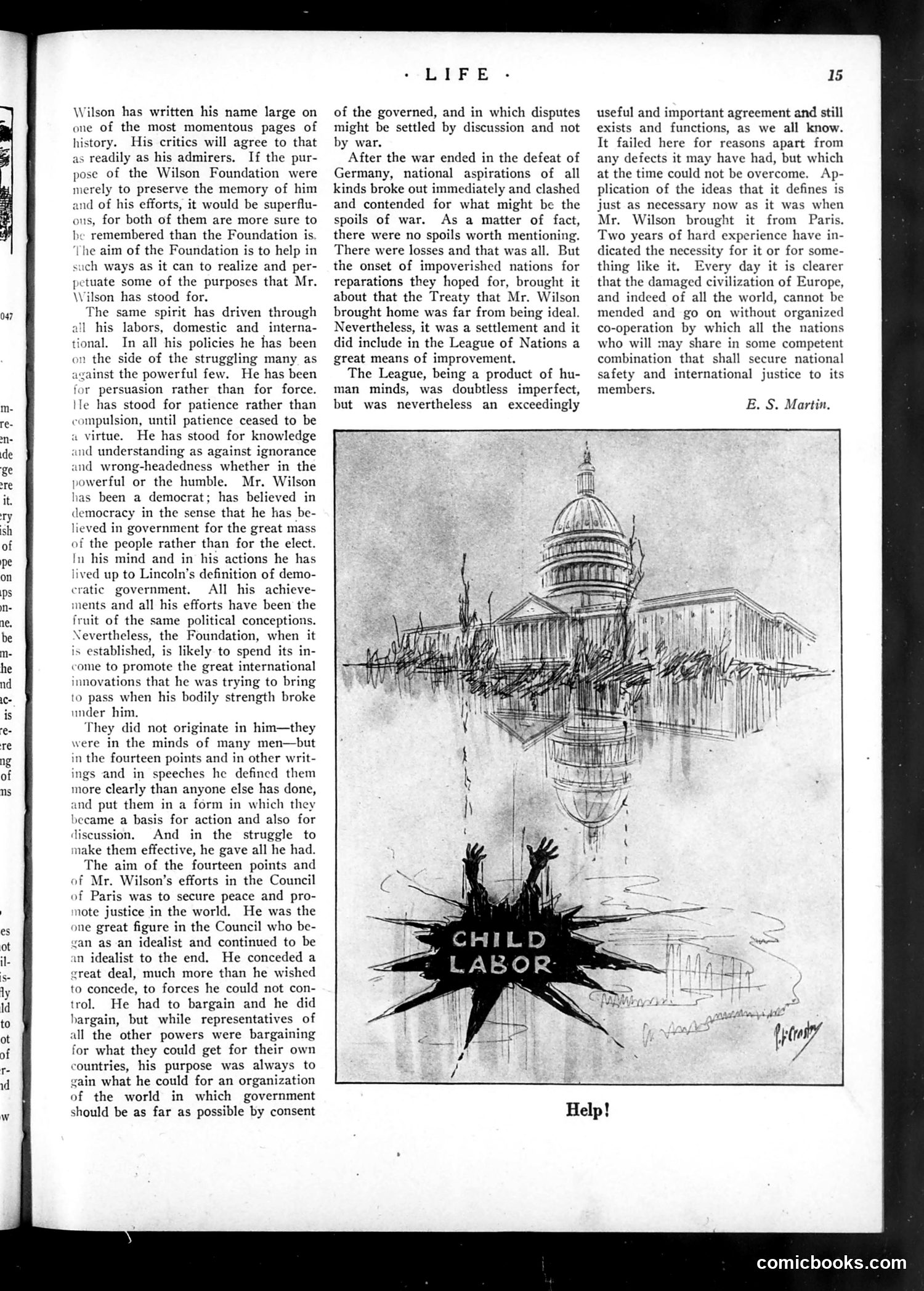
This page commemorates Woodrow Wilson's political philosophy and the Wilson Foundation, established to advance his internationalist ideals. The accompanying illustration satirizes the gap between Wilson's democratic principles and harsh American realities. The cartoon depicts the U.S. Capitol building with "CHILD LABOR" emblazoned below in an explosive burst, with two children's hands reaching upward in distress. The stark image contrasts sharply with the text's celebration of Wilson as champion of "the struggling many" against "the powerful few." The satire's point: Wilson advocated globally for justice and democratic governance through the League of Nations, yet America—his own nation—permitted widespread child labor exploitation. The cartoon suggests hypocrisy in promoting international idealism while domestic social injustices persisted uncorrected. It's a pointed critique of the disconnect between lofty political rhetoric and lived American suffering, particularly affecting society's most vulnerable members.
📄 Transcribed text from this page (OCR, searchable)
Machine-transcribed from the original scan — historical spelling and the odd misread are preserved.
Wilson has written his name large on one of the most momentous pages of history. His critics will agree to that as readily as his admirers. If the pur- pose of the Wilson Foundation were merely to preserve the memory of him and of his efforts, it would be superflu- ous, for both of them are more sure to be remembered than the Foundation is he aim of the Foundation is to help in such ways as it can to realize and per- petuate some of the purposes that Mr. \Vilson has stood for. The same spirit has driven through all his labors, domestic and interna- tional. In all his policies he has been on the side of the struggling many as inst the powerful few. He has been for persuasion rather than for force. lle has stood for patience rather than compulsion, until patience ceased to be « virtue. He has stood for knowledge and understanding as against ignorance and wrong-headedness whether in the powerful or the humble. Mr. Wilson has been a democrat; has believed in lemocracy in the sense that he has be- lieved in government for the great mass of the people rather than for the elect. !n his mind and in his actions he has lived up to Lincoln’s definition of demo- cratic government. All his achieve- ments and all his efforts have been the fruit of the same political conceptions. Nevertheless, the Foundation, when it is established, is likely to spend its in- come to promote the great international innovations that he was trying to bring to pass when his bodily strength broke under him. They did not originate in him—they were in the minds of many men—but in the fourteen points and in other writ- ings and in speeches he defined them more clearly than anyone else has done, and put them in a form in which they scame a basis for action and also for ion. And in the struggle to nake them effective, he gave all he had. The aim of the fourteen points and of Mr. Wilson’s efforts in the Council of Paris was to secure peace and pro- note justice in the world. He was the one great figure in the Council who be- yan as an idealist and continued to be in idealist to the end. He conceded a great deal, much more than he wished to concede, to forces he could not con- trol. He had to bargain and he did bargain, but while representatives of all the other powers were bargaining for what they could get for their own countries, his purpose was alw to gain what he could for an organization of the world in which government should be as far as possible by consent + DACRE: - of the governed, and in which disputes might be settled by discussion and not by war. After the war ended in the defeat of Germany, national aspirations of all kinds broke out immediately and clashed and contended for what might be the spoils of war. As a matter of fact, there were no spoils worth mentioning. There were losses and that was all. But the onset of impoverished nations for reparations they hoped for, brought it about that the Treaty that Mr. Wilson brought home was far from being ideal. Nevertheless, it was a settlement and it did include in the League of Nations a great means of improvement. The League, being a product of hu- man minds, was doubtless imperfect, but was nevertheless an exceedingly useful and important agreement and still exists and functions, as we all know. It failed here for reasons apart from any defects it may have had, but which at the time could not be overcome. Ap- plication of the ideas that it defines is just as necessary now as it was when Mr. Wilson brought it from Paris. Two years of hard experience have in- dicated the necessity for it or for some- thing like it. Every day it is clearer that the damaged civilization of Europe, and indeed of all the world, cannot be mended and go on without organized co-operation by which all the nations who will may share in some competent combination that shall secure national safety and international justice to its members. E. S. Martin. fey, 4 rai comicbooks.com