
Life, 1922-01-26 · page 12 of 34
Life — January 26, 1922 — page 12: what you’re looking at
What you’re looking at
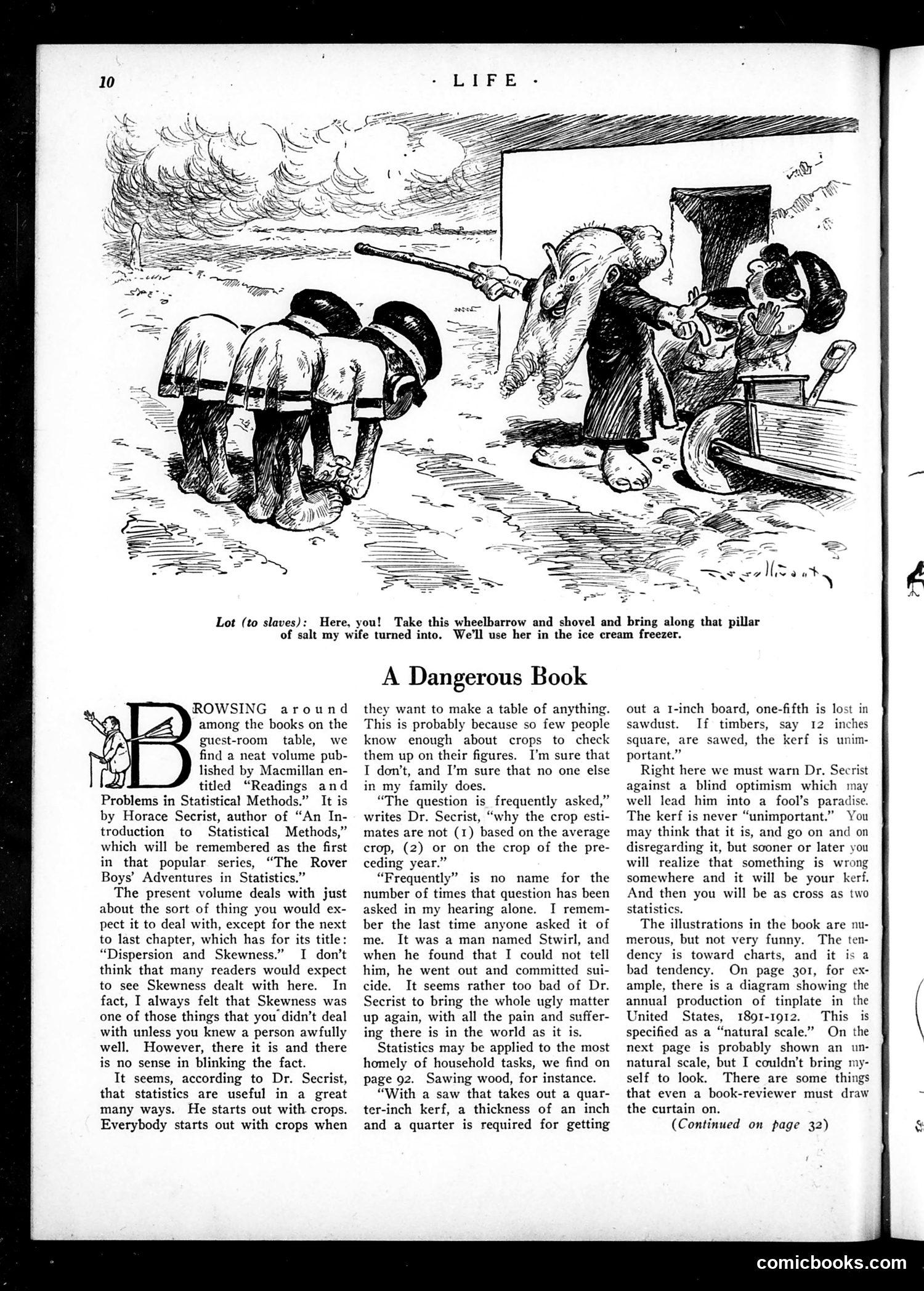
**The Cartoon:** Shows a figure labeled "Lot" commanding enslaved people to fetch tools, threatening to use "my wife turned into" (a pillar of salt, referencing the Biblical story of Lot's wife) in an ice cream freezer. This is grotesque dark humor. **The Article:** Reviews Horace Secrist's statistical book "Reading and Problems in Statistical Methods." The reviewer critiques Secrist's blind optimism about statistics' usefulness, arguing that statistics can mislead when applied carelessly to real-world problems—exemplified by agricultural crop estimates that ignore actual conditions. **The Satire:** The cartoon's absurdist cruelty mirrors the article's point: just as Lot misapplies a Biblical reference for sinister purposes, people misapply statistics to justify poor decisions. Statistics are "dangerous" when wielded without wisdom.
📄 Transcribed text from this page (OCR, searchable)
Machine-transcribed from the original scan — historical spelling and the odd misread are preserved.
Lot (to slaves): Here, you! Take this wheelbarrow and shovel and bring along that pillar of salt my wife turned into. We'll use her in the ice cream freezer. ROWSING around among the books on the guest-room table, we find a neat volume pub- lished by Macmillan en- titled “Readings and Problems in Statistical Methods.” It is by Horace Secrist, author of “An In- troduction to Statistical Methods,” which will be remembered as the first in that popular series, “The Rover Boys’ Adventures in Statistics.” The present volume deals with just about the sort of thing you would ex- pect it to deal with, except for the next to last chapter, which has for its title: “Dispersion and Skewness.” I don’t think that many readers would expect to see Skewness dealt with here. In fact, I always felt that Skewness was one of those things that you didn’t deal with unless you knew a person awfully well. However, there it is and there is no sense in blinking the fact. It seems, according to Dr. Secrist, that statistics are useful in a great many ways. He starts out with crops. Everybody starts out with crops when A Dangerous Book they want to make a table of anything. This is probably because so few people know enough about crops to check them up on their figures. I’m sure that I don’t, and I’m sure that no one else in my family does. “The question is frequently asked,” writes Dr. Secrist, “why the crop esti- mates are not (1) based on the average crop, (2) or on the crop of the pre- ceding year.” “Frequently” is no name for the number of times that question has been asked in my hearing alone. I remem- ber the last time anyone asked it of me. It was a man named Stwirl, and when he found that I could not tell him, he went out and committed sui- cide. It seems rather too bad of Dr. Secrist to bring the whole ugly matter up again, with all the pain and suffer- ing there is in the world as it is. Statistics may be applied to the most homely of household tasks, we find on page 92. Sawing wood, for instance. “With a saw that takes out a quar- ter-inch kerf, a thickness of an inch and a quarter is required for getting out a I-inch board, one-fifth is lost in sawdust. If timbers, say 12 inches square, are sawed, the kerf is unim- portant.” Right here we must warn Dr. Secrist against a blind optimism which may well lead him into a fool’s paradise. The kerf is never “unimportant.” You may think that it is, and go on and on disregarding it, but sooner or later you will realize that something is wrong somewhere and it will be your kerf. And then you will be as cross as two statistics. The illustrations in the book are nu- merous, but not very funny. The ten- dency is toward charts, and it is a bad tendency. On page 301, for ex- ample, there is a diagram showing the annual production of tinplate in the United States, 1891-1912. This is specified as a “natural scale.” On the next page is probably shown an un- natural scale, but I couldn't bring 1 self to look. There are some things that even a book-reviewer must draw the curtain on. (Continued on page 32) comicbooks.com to