
Life, 1922-01-26 · page 10 of 34
Life — January 26, 1922 — page 10: what you’re looking at
What you’re looking at
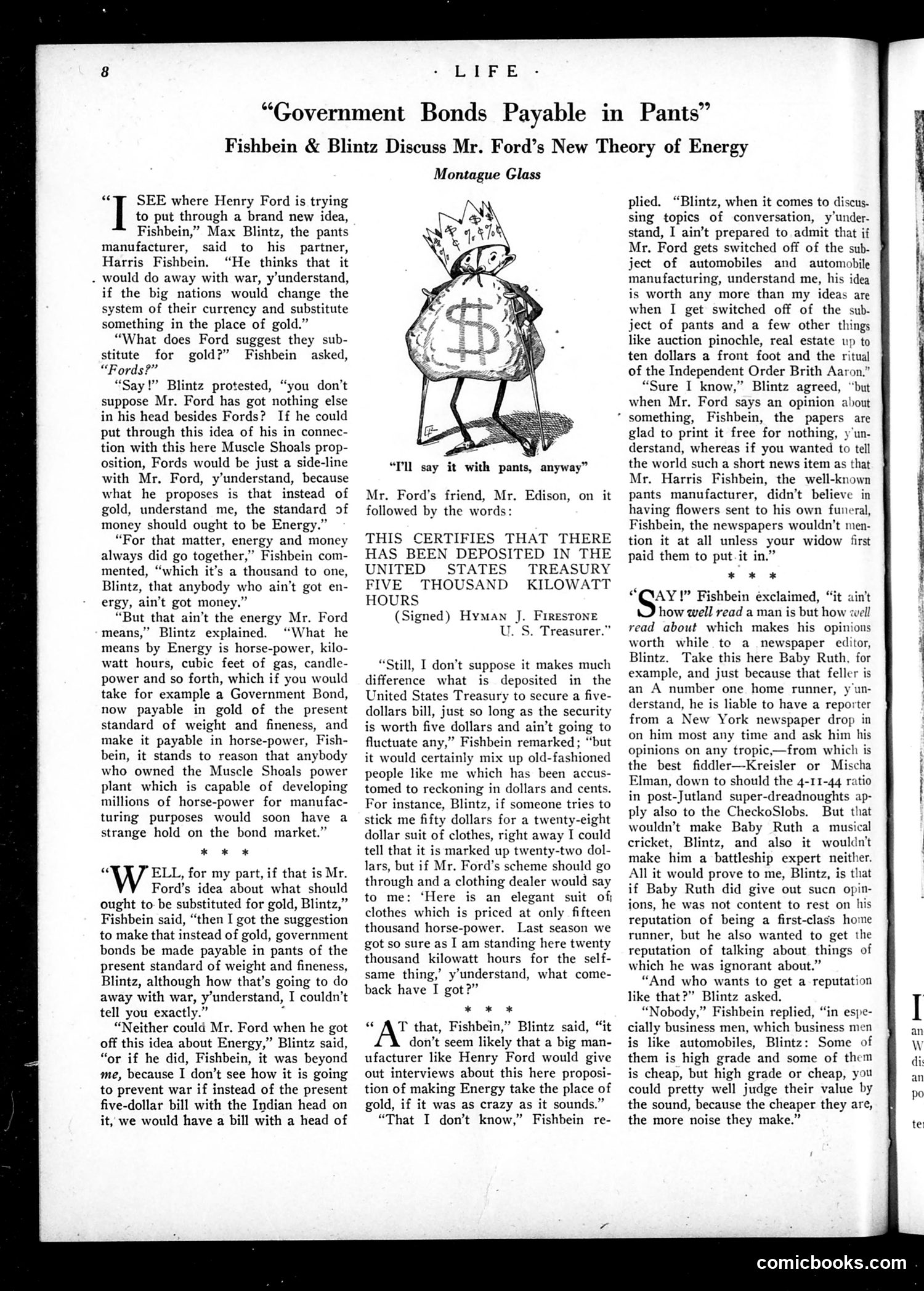
This 1920s *Life* magazine article satirizes Henry Ford's proposal to replace the gold standard with an energy-based currency system. The cartoon shows a money bag labeled with a dollar sign, illustrating the absurdist concept. The dialogue between **Fishbein** (pants manufacturer) and **Blintz** mocks Ford's idea by imagining government bonds "payable in pants" instead of gold—a reductio ad absurdum. The satire suggests that substituting any commodity (pants, horspower, kilowatt hours) for gold as monetary backing is equally ridiculous. The accompanying Treasury certificate (signed by "Hyman J. Firestone") reinforces the joke by treating the absurd concept as official policy. The piece lampoons Ford's unconventional economic thinking and his influence over public discourse.
📄 Transcribed text from this page (OCR, searchable)
Machine-transcribed from the original scan — historical spelling and the odd misread are preserved.
LYFE “Government Bonds Payable in Pants” Fishbein & Blintz Discuss Mr. Ford’s New Theory of Energy to put through a brand new idea, Fishbein,” Max Blintz, the pants manufacturer, said to his partner, Harris Fishbein. “He thinks that it . would do away with war, y’understand, if the big nations would change the system of their currency and substitute something in the place of gold.” “What does Ford suggest they sub- stitute for gold?” Fishbein asked, “Fords?” “Say!” Blintz protested, “you don’t suppose Mr. Ford has got nothing else in his head besides Fords? If he could put through this idea of his in connec- tion with this here Muscle Shoals prop- osition, Fords would be just a side-line with Mr. Ford, y’understand, because what he proposes is that instead of gold, understand me, the standard of money should ought to be Energy.” “For that matter, energy and money always did go together,” Fishbein com- mented, “which it’s a thousand to one, Blintz, that anybody who ain't got en- ergy, ain’t got money.” “But that ain’t the energy Mr. Ford means,” Blintz explained. ‘What he means by Energy is horse-power, kilo- watt hours, cubic feet of gas, candle- power and so forth, which if you would take for example a Government Bond, now payable in gold of the present standard of weight and fineness, and make it payable in horse-power, Fish- bein, it stands to reason that anybody who owned the Muscle Shoals power plant which is capable of developing millions of horse-power for manufac- turing purposes would soon have a strange hold on the bond market.” ek Ok & ELL, for my part, if that is Mr. Ford’s idea about what should ought to be substituted for gold, Blintz,” Fishbein said, “then I got the suggestion to make that instead of gold, government bonds be made payable in pants of the present standard of weight and fineness, Blintz, although how that’s going to do away with war, y’understand, I couldn’t tell you exactly.” ° “Neither could Mr. Ford when he got off this idea about Energy,” Blintz said, “or if he did, Fishbein, it was beyond me, because I don’t see how it is going to prevent war if instead of the present five-dollar bill with the Indian head on it, we would have a bill with a head of ‘Tl SEE where Henry Ford is trying Montague Glass “ll say it with pants, anyway” Mr. Ford’s friend, Mr. Edison, on it followed by the words: THIS CERTIFIES THAT THERE HAS BEEN DEPOSITED IN THE UNITED STATES TREASURY FIVE THOUSAND KILOWATT HOURS (Signed) Hyman J. Firestone U. S. Treasurer.” “Still, I don't suppose it makes much difference what is deposited in the United States Treasury to secure a five- dollars bill, just so long as the security is worth five dollars and ain’t going to fluctuate any,” Fishbein remarked; “but it would certainly mix up old-fashioned people like me which has been accus- tomed to reckoning in dollars and cents. For instance, Blintz, if someone tries to stick me fifty dollars for a twenty-eight dollar suit of clothes, right away I could tell that it is marked up twenty-two dol- lars, but if Mr. Ford’s scheme should go through and a clothing dealer would say to me: ‘Here is an elegant suit off clothes which is priced at only fifteen thousand horse-power. Last season we got so sure as I am standing here twenty thousand kilowatt hours for the self- same thing,’ y’understand, what come- back have I got?” * * * “AT that, Fishbein,” Blintz said, “it don’t seem likely that a big man- ufacturer like Henry Ford would give out interviews about this here proposi- tion of making Energy take the place of gold, if it was as crazy as it sounds.” “That I don’t know,” Fishbein re- * something, plied. “Blintz, when it comes to discus- sing topics of conversation, y’under- stand, I ain’t prepared to admit that if Mr. Ford gets switched off of the sub- ject of automobiles and automobile manufacturing, understand me, his idea is worth any more than my ideas are when I get switched off of the sub- ject of pants and a few other things like auction pinochle, real estate up to ten dollars a front foot and the ritual of the Independent Order Brith Aaron.” “Sure I know,” Blintz agreed, “but when Mr, Ford says an opinion about Fishbein, the papers are glad to print it free for nothing, y'un- derstand, whereas if you wanted to tell the world such a short news item as that Mr. Harris Fishbein, the well-known pants manufacturer, didn’t believe in having flowers sent to his own funeral, Fishbein, the newspapers wouldn’t men- tion it at all unless your widow first paid them to put.it in.” + He “QAY!” Fishbein exclaimed, “it ain't how well read a man is but how well read about which makes his opinions worth while to a newspaper editor, Blintz. Take this here Baby Ruth, for example, and just because that feller is an A number one home runner, yun- derstand, he is liable to have a reporter from a New York newspaper drop in on him most any time and ask him his opinions on any tropic—from which is the best fiddler—Kreisler or Mischa Elman, down to should the 4-11-44 ratio in post-Jutland super-dreadnoughts ap- ply also to the CheckoSlobs. But that wouldn’t make Baby Ruth a musical cricket, Blintz, and also it wouldn't make him a battleship expert neither. All it would prove to me, Blintz, is that if Baby Ruth did give out sucn opin- ions, he was not content to rest on his reputation of being a first-class home runner, but he also wanted to get the reputation of talking about things of which he was ignorant about.” “And who wants to get a reputation like that?” Blintz asked. “Nobody,” Fishbein replied, “in espe- cially business men, which business men is like automobiles, Blintz: Some of them is high grade and some of them is cheap, but high grade or cheap, you could pretty well judge their value by the sound, because the cheaper they are, the more noise they make.” comicbooks.com