
A complete issue · 34 pages · 1922
Life — January 12, 1922
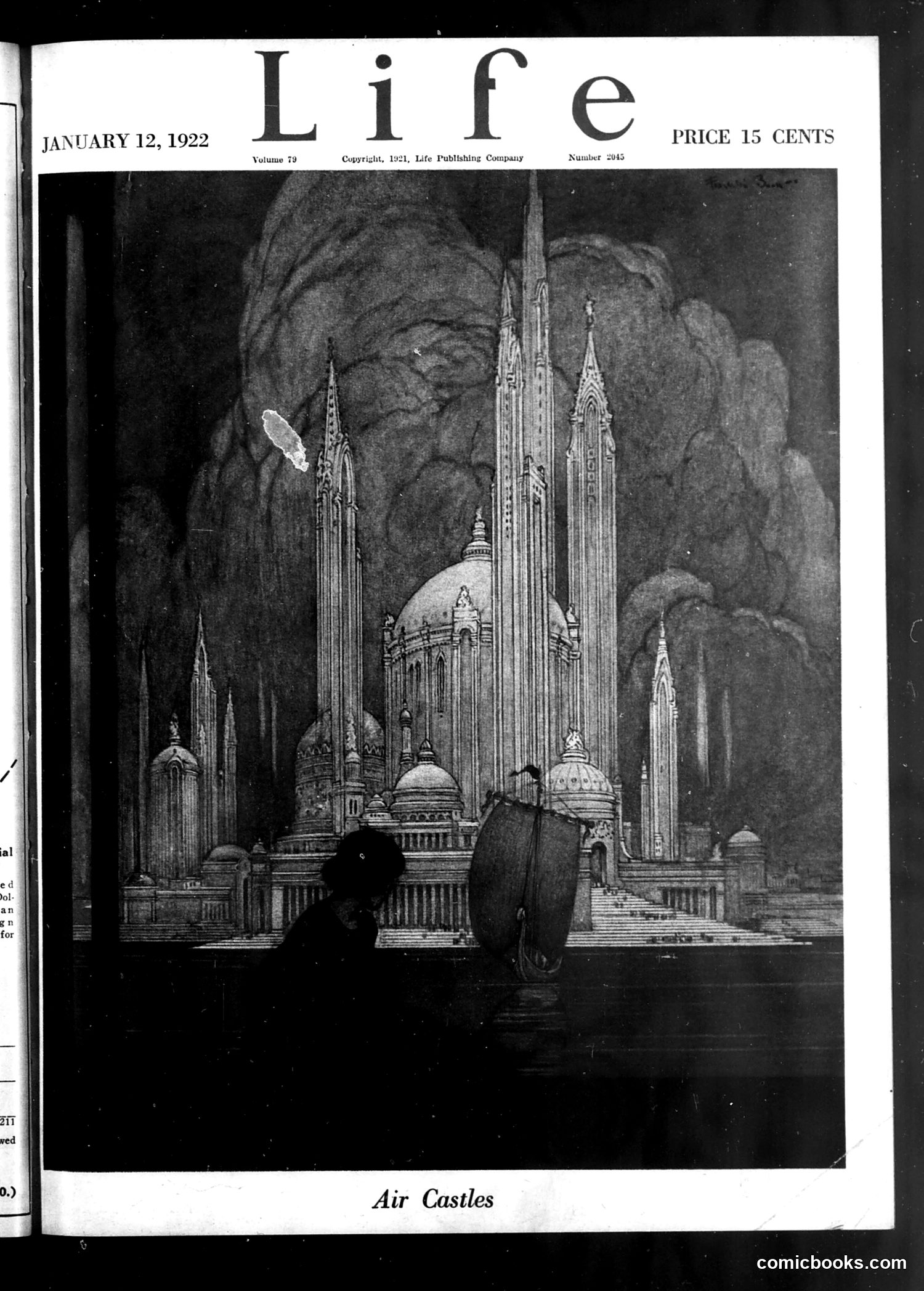
This is a satirical illustration titled "Air Castles," a phrase meaning impractical dreams or wishful thinking. The image depicts an elaborate, fantastical cityscape of towering spires and domes floating in clouds, with silhouettes of figures (appearing to be a man and woman) gazing upward from below. The satire likely critiques post-WWI optimism or unrealistic expectations about the future—a common theme in 1920s commentary. The "air castles" represent grand but unattainable visions, while the earthbound observers below symbolize ordinary people dreaming of impossible prosperity or social change. Without additional context from the magazine's text, the specific target isn't certain, but the imagery suggests skepticism toward idealistic post-war hopes.
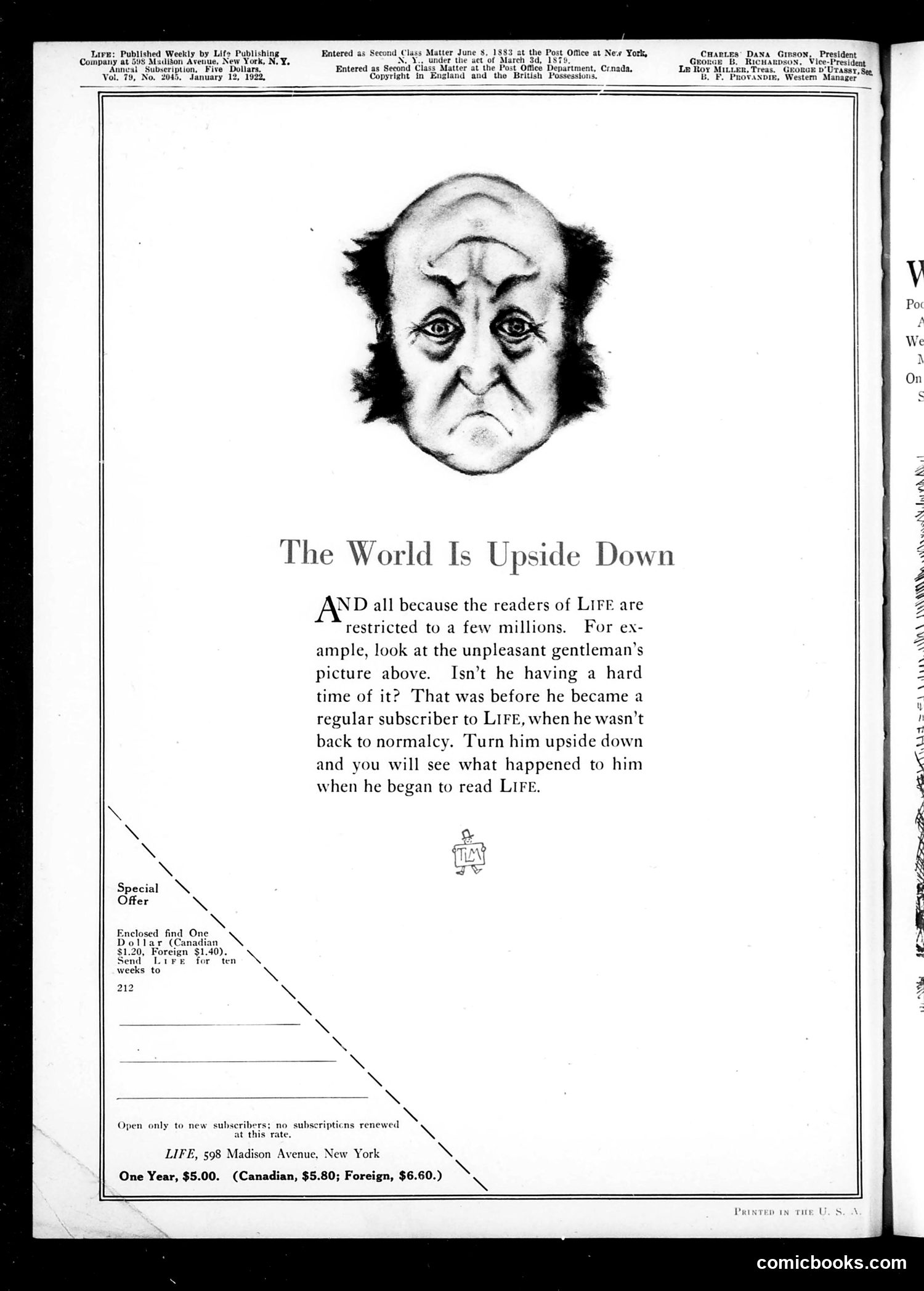
This is a **subscription advertisement** for *LIFE* magazine using dark humor. The centerpiece is a grotesque inverted face—distorted and unhappy—illustrating the ad's headline "The World Is Upside Down." The satire claims that subscribing to *LIFE* magazine caused this person's misfortune. The text jokes that before becoming a regular subscriber, he was normal; after reading *LIFE*, his world literally inverted. The implication is that *LIFE*'s satirical content about current events was so shocking or absurd it drove readers to despair. This reflects early 20th-century humor: magazines mocked social upheaval through exaggeration. The ad uses self-deprecating satire to market the publication—essentially claiming *LIFE*'s hard truths about society are transformatively disturbing, positioning the magazine as unflinchingly honest commentary.
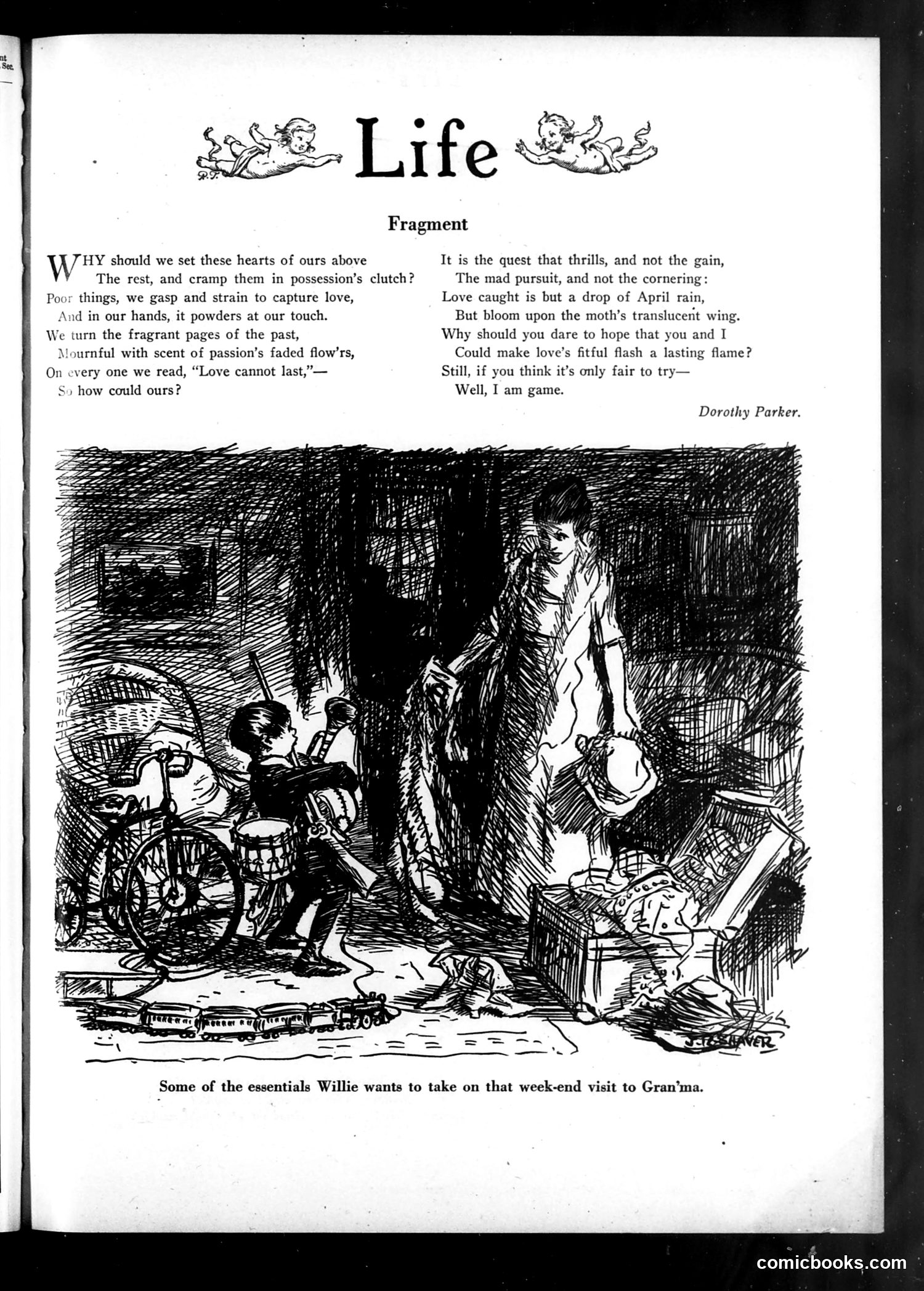
This page from *Life* magazine features a poem titled "Fragment" by Dorothy Parker about love's transience and futility. Parker questions why we cling to love when it inevitably fades, comparing passion to "a drop of April rain" that blooms briefly before disappearing. The accompanying illustration depicts a domestic scene: a woman packing a suitcase while a young boy plays with toys (a tricycle and toy train) on the floor. The caption reads: "Some of the essentials Willie wants to take on that week-end visit to Gran'ma." The cartoon's humor lies in the contrast between Parker's melancholic poem about love's impermanence and the mundane, domestic reality of a child's packing dilemma—highlighting life's ordinary complications that persist regardless of romantic ideals.
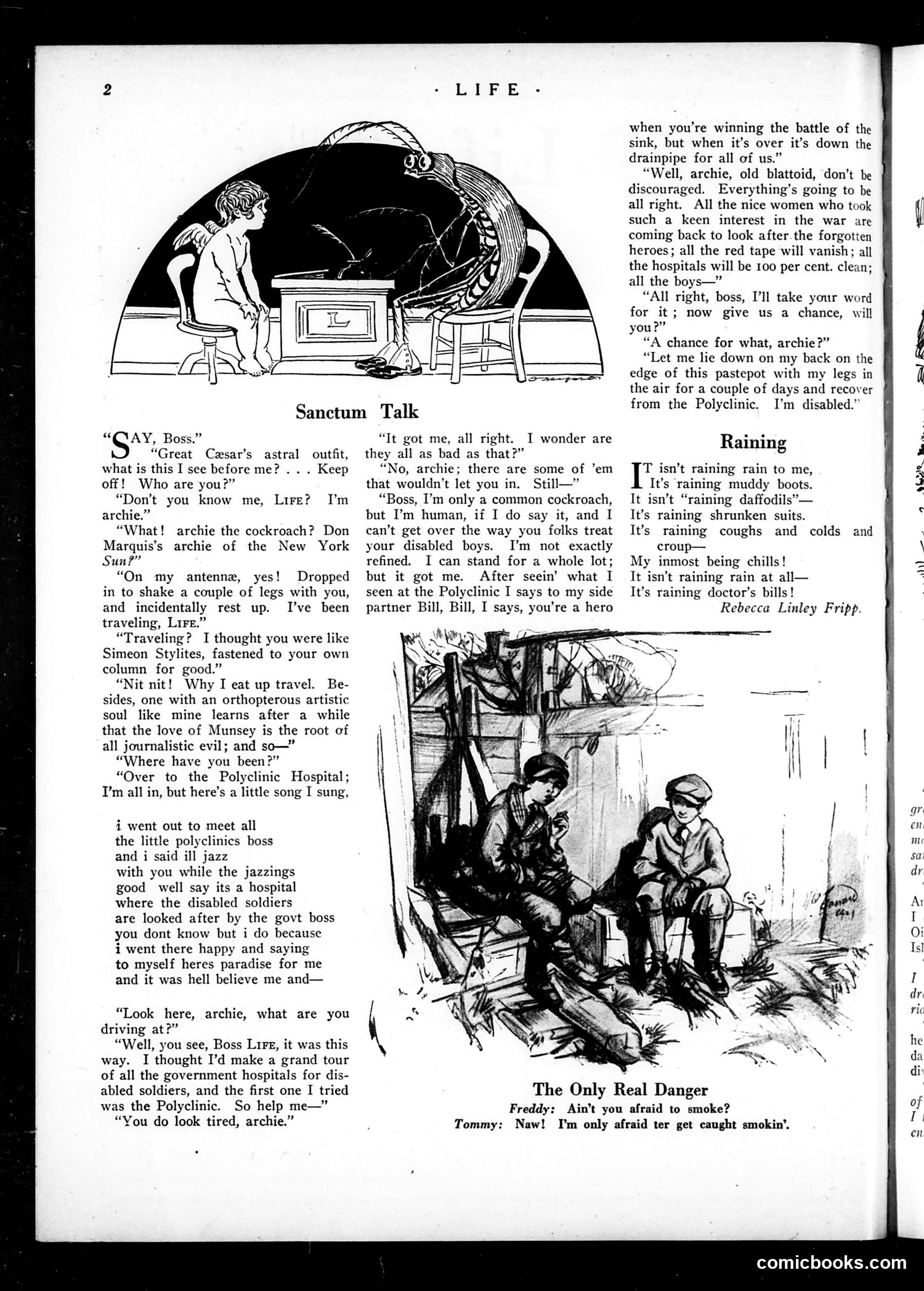
This page contains three distinct pieces: **"Sanctum Talk"** features a dialogue between "Boss" (Life's editor) and "Archie" (a cockroach character—Life's mascot). Archie describes visiting the Polyclinic Hospital to see disabled soldiers returning from World War I. The conversation satirizes the contrast between public patriotism during wartime versus societal indifference to veterans' suffering afterward. Archie's poem criticizes how disabled soldiers are neglected despite their sacrifice. **"Raining"** is a humorous poem listing all the things "raining" besides water—muddy boots, coughs, doctor's bills—reflecting post-war hardship and inflation. **"The Only Real Danger"** shows two boys discussing smoking, with the punchline that one fears getting caught rather than health consequences—typical early 20th-century juvenile humor. The page addresses WWI veteran welfare concerns through satire.
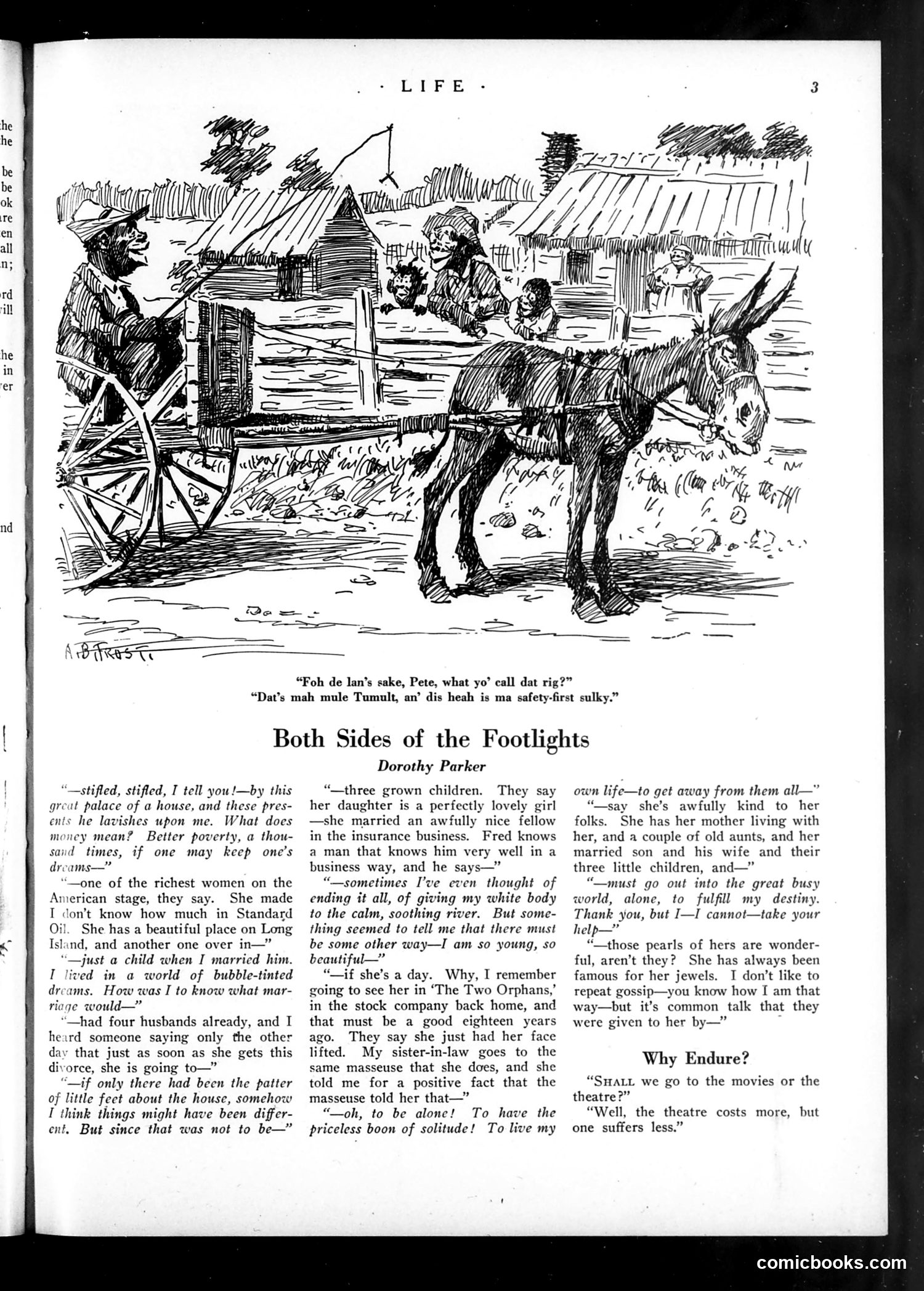
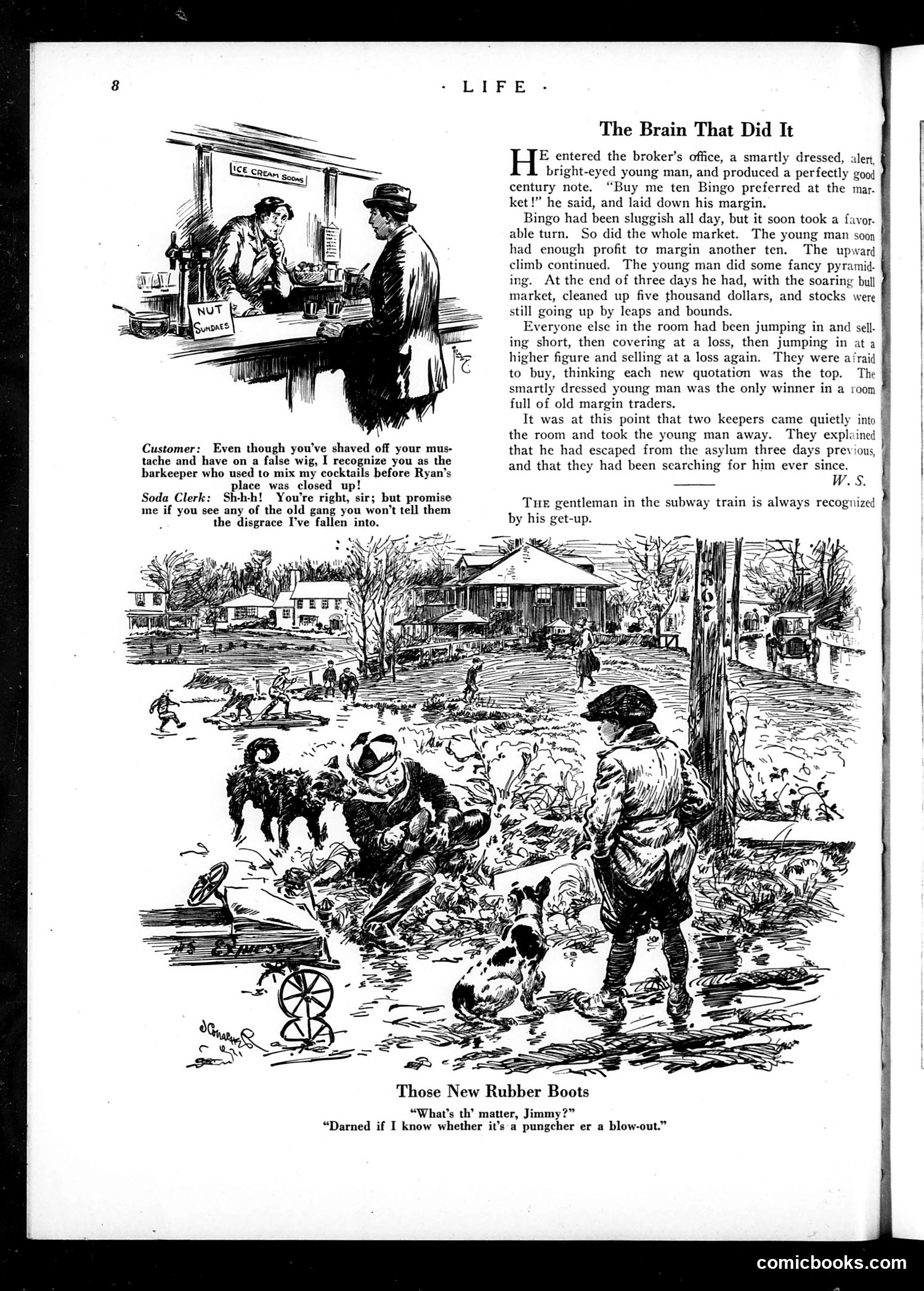
The main illustration shows a rural farm scene with a man operating a mule-drawn cart, depicting working-class agricultural life. The caption uses dialect humor: "Foh de lan's sake, Pete, what yo' call dis rig?" / "Dat's mah mule Tumult, an' dis heah is ma safety-first sulky." This satirizes the "safety-first" industrial movement popular in early 20th-century America—a workplace safety campaign that became widespread corporate messaging. The joke mocks applying this modern, urban safety rhetoric to rural farming with a mule and cart, suggesting the gap between industrial workplace concerns and rural life. The accompanying article "Both Sides of the Footlights" by Dorothy Parker discusses theatrical life and gossip, unrelated to the cartoon.
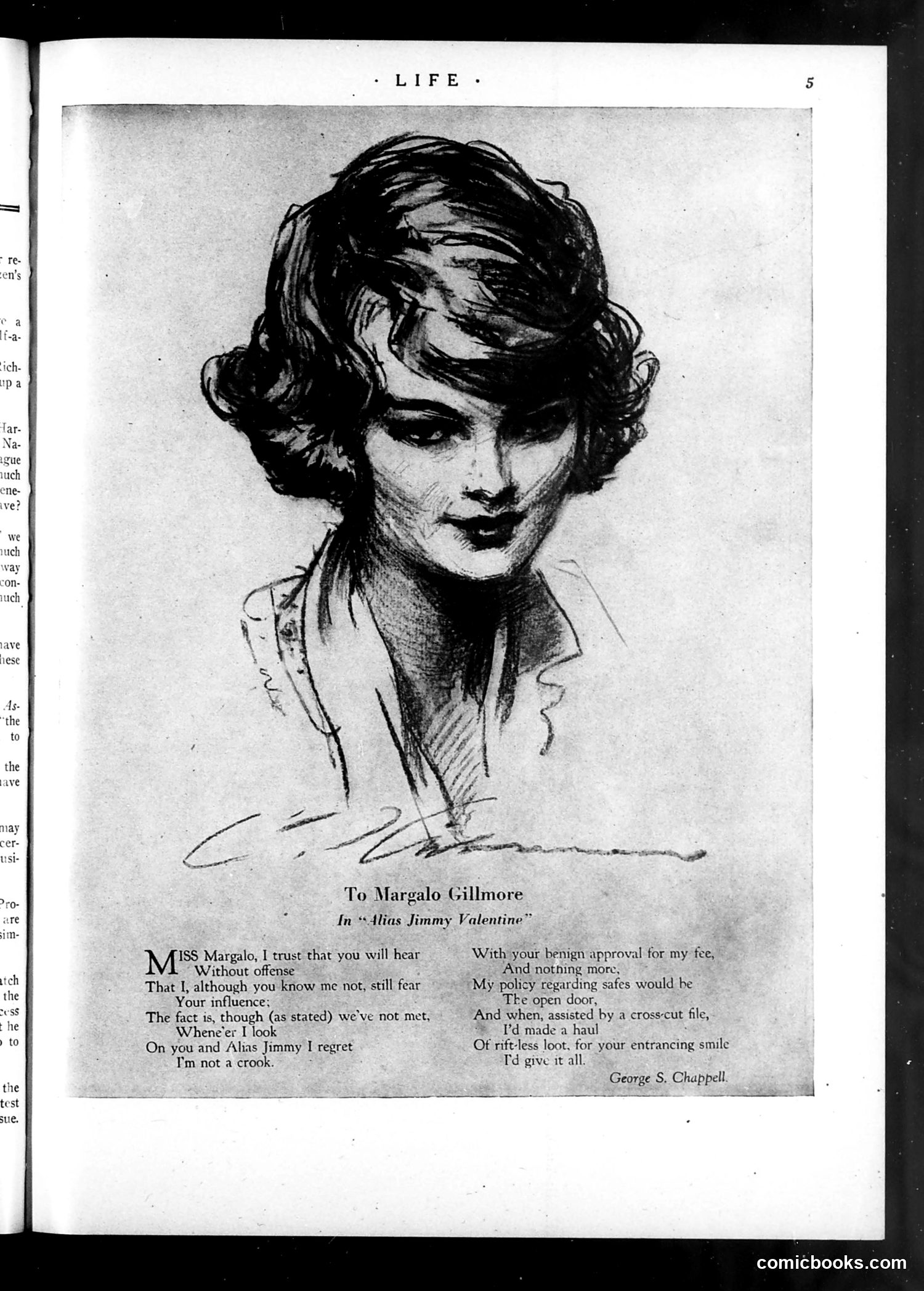
This page features a portrait sketch of Margalo Gillmore, a stage actress, dedicated by cartoonist George S. Chappell. The accompanying poem is a flirtatious tribute that plays on her role in the play "Miss Jimmy Valentine." The verse is a mock-serious declaration: Chappell claims he fears her influence despite never meeting her, joking that he's "not a crook" (a humorous reference to her character's association with a criminal). He promises to be an "open door" for her and would happily commit theft or other crimes for her "entrancing smile." This is light satirical flattery typical of early 20th-century magazine humor—theatrical gossip and celebrity admiration dressed up as comedic verse. The drawing style suggests this page appeared during the 1920s-1930s theater era.
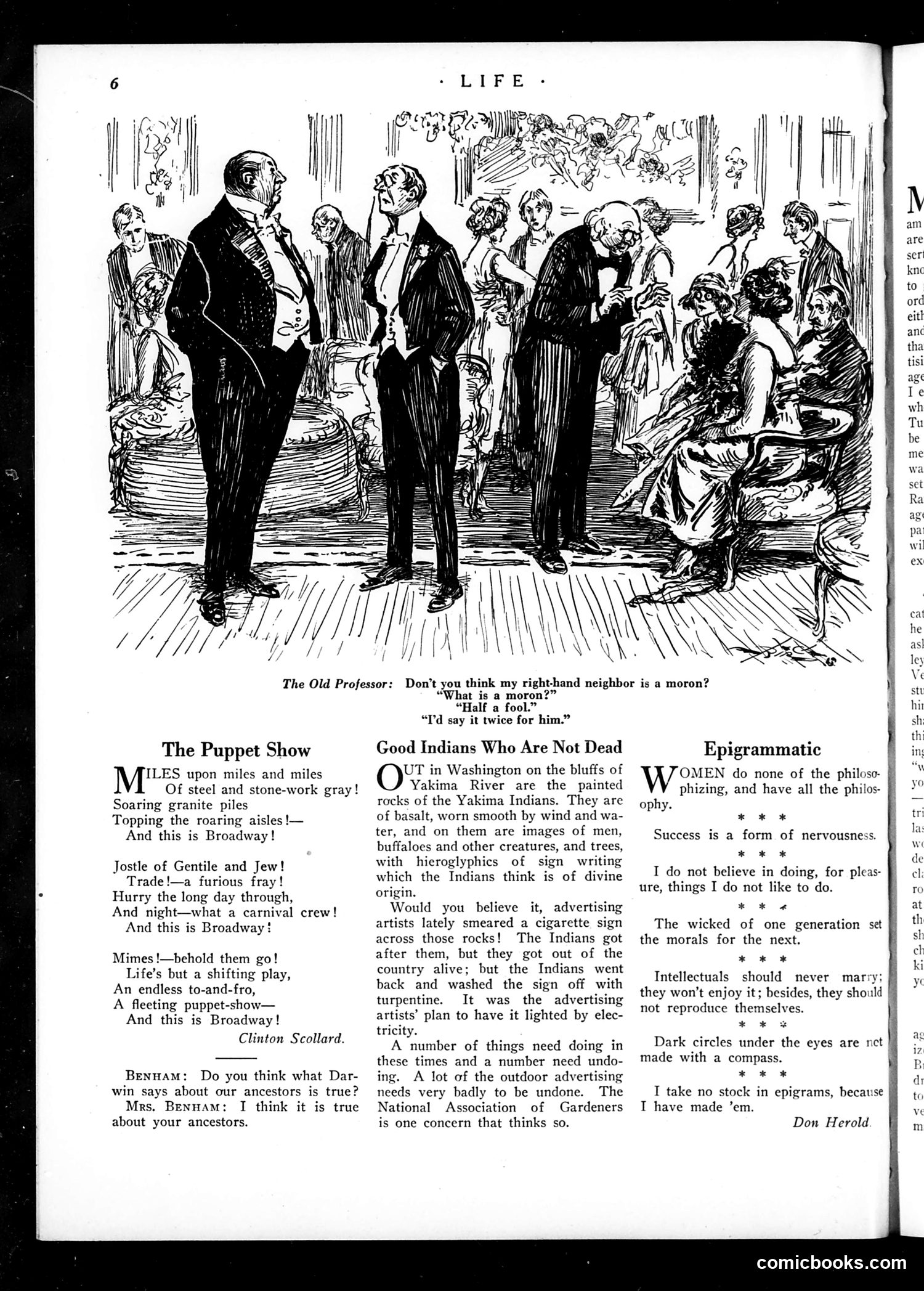
The top illustration depicts a formal social gathering with well-dressed men in suits discussing what appears to be an intellectual disagreement. The caption quotes "The Old Professor" asking his neighbor if he thinks the man to his right is a moron, with the neighbor responding "Half a fool" and the professor saying "I'd say a twice for him." This is satirizing pretentious academic or intellectual circles—specifically mocking pompous professors and their tendency toward pedantic argumentation and dismissive characterization of those they disagree with. The humor lies in the professor's insistence on semantic precision ("twice" rather than "half") about insulting terminology, suggesting absurd intellectual vanity masquerading as rigorous debate. The page also contains unrelated short poems and social commentary pieces typical of Life's satirical format.
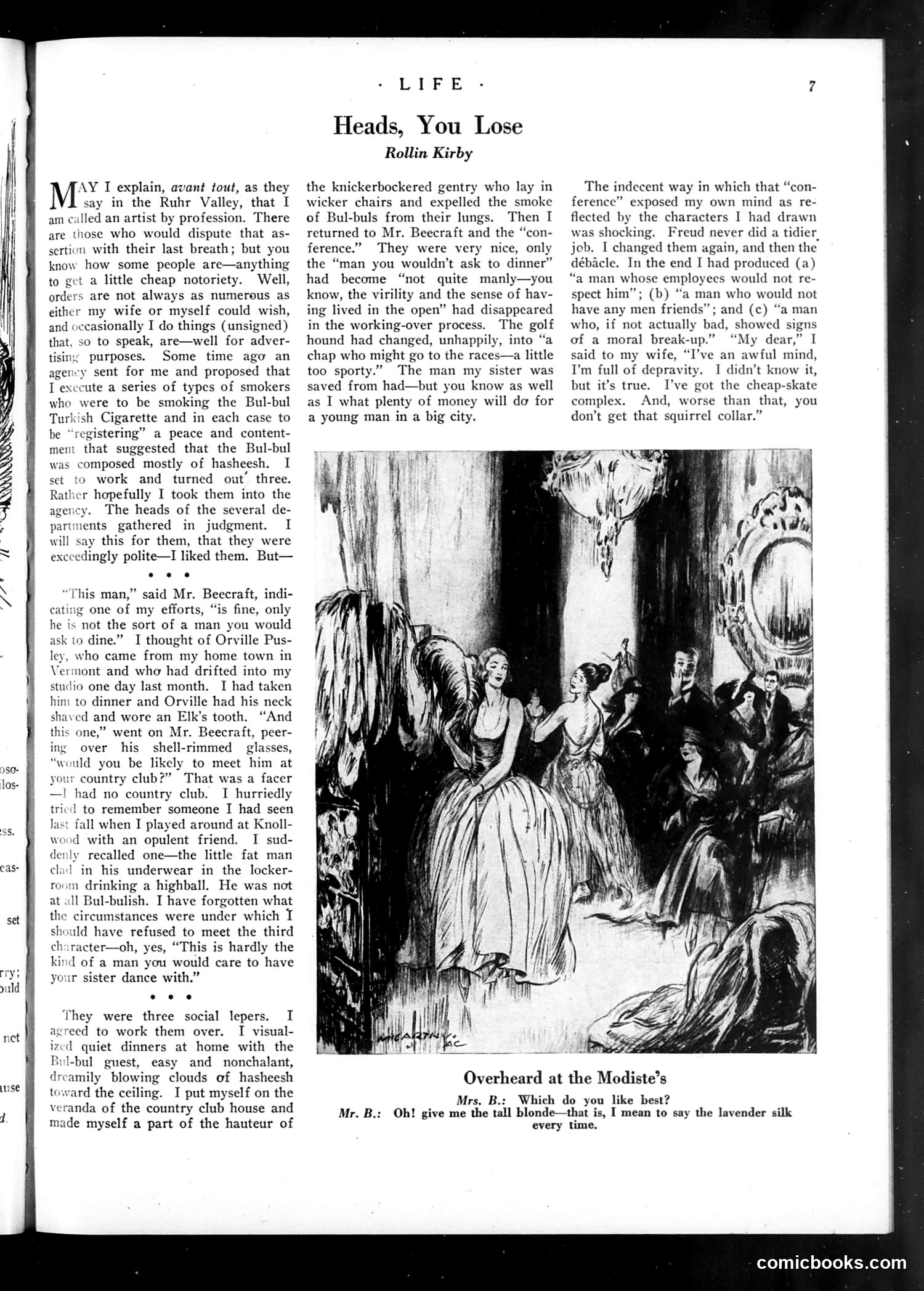
This page contains a short story by Rollin Kirby about social awkwardness among the wealthy. The narrator describes attempting to recruit smokers for a Bull-bul Turkish Cigarette advertising campaign, specifically targeting men from prominent families. Mr. Beercraft becomes the reluctant subject of this scheme. The accompanying illustration, captioned "Overheard at the Modiste's," depicts a social scene at a dressmaker's shop. The caption shows Mrs. B. praising a particular style of silk to Mr. B., with the satirical humor suggesting the superficiality of high-society conversations—women caring primarily about material appearance and fabric quality rather than substantive matters. The sketch ridicules the vapidity of wealthy social circles.
This story satirizes stock market speculation during the early 20th century. A sharp young man enters a broker's office and makes extraordinary profits through margin trading—buying and selling stocks on borrowed money at inflated prices. Within three days, he turns a small profit into thousands of dollars while the market climbs dramatically. Two asylum keepers then arrive, revealing he's an escaped patient they've been hunting. The joke's dark irony: his "brilliant" trading success was actually the reckless behavior of a mentally unstable person. The satire mocks both the speculator's overconfidence and the absurdity of a bull market where anyone—even the insane—could profit through reckless gambling disguised as shrewd investing.
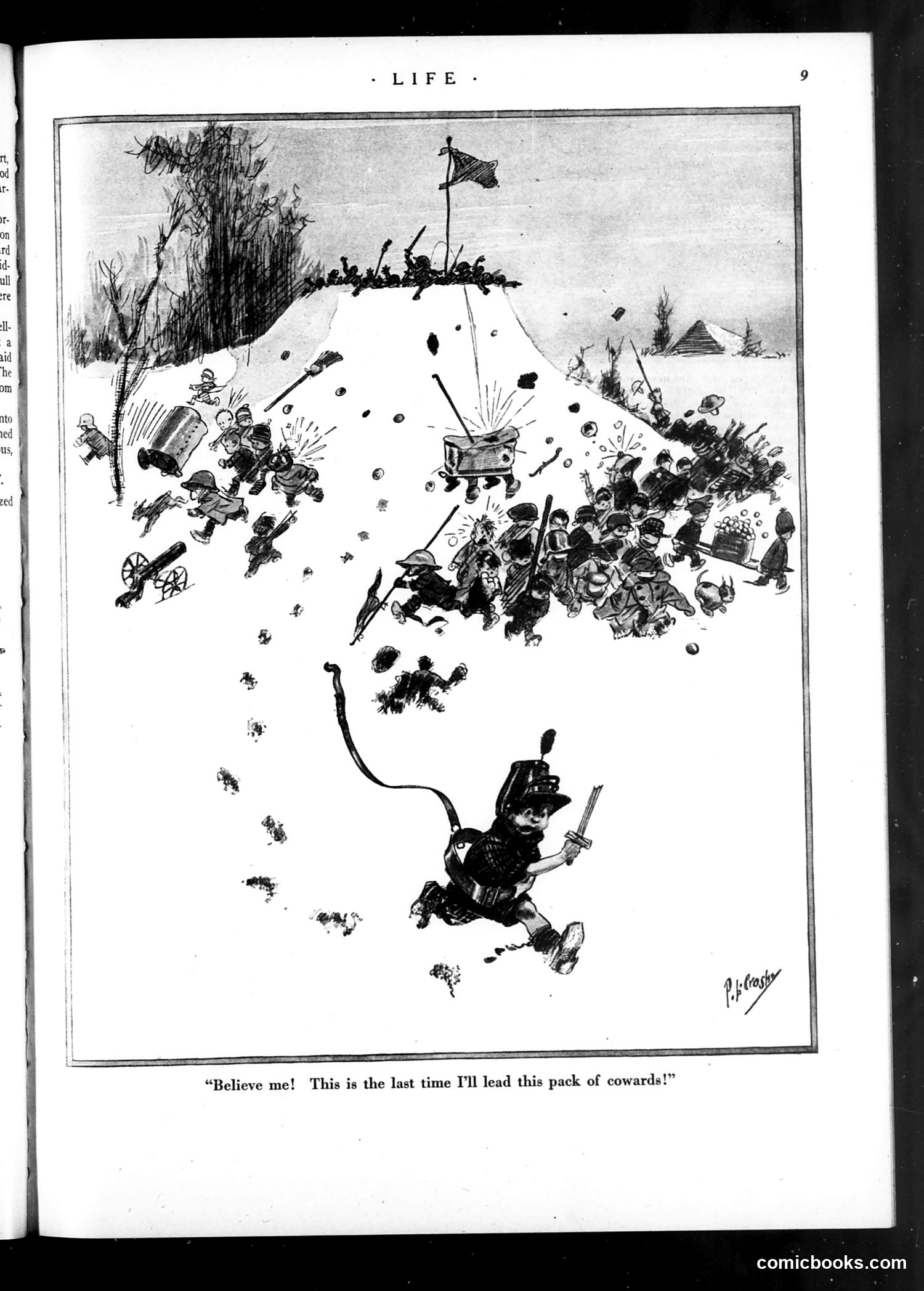
This cartoon depicts a military leader at the bottom, connected by a long rope or chain to a fortified position above where soldiers cluster around a flag. The caption reads: "Believe me! This is the last time I'll lead this pack of cowards!" The satire appears to mock a military commander's frustration with his troops' perceived cowardice or incompetence during what seems to be a wartime assault or siege. The fortified hill with flag suggests a strategic objective. The "pack of cowards" reference suggests the soldiers are reluctant or ineffective combatants. Without knowing the specific historical context, this likely critiques either military leadership failures or soldier morale during a particular conflict, using the commander's exasperated declaration as dark humor about the gap between authority and actual capability.
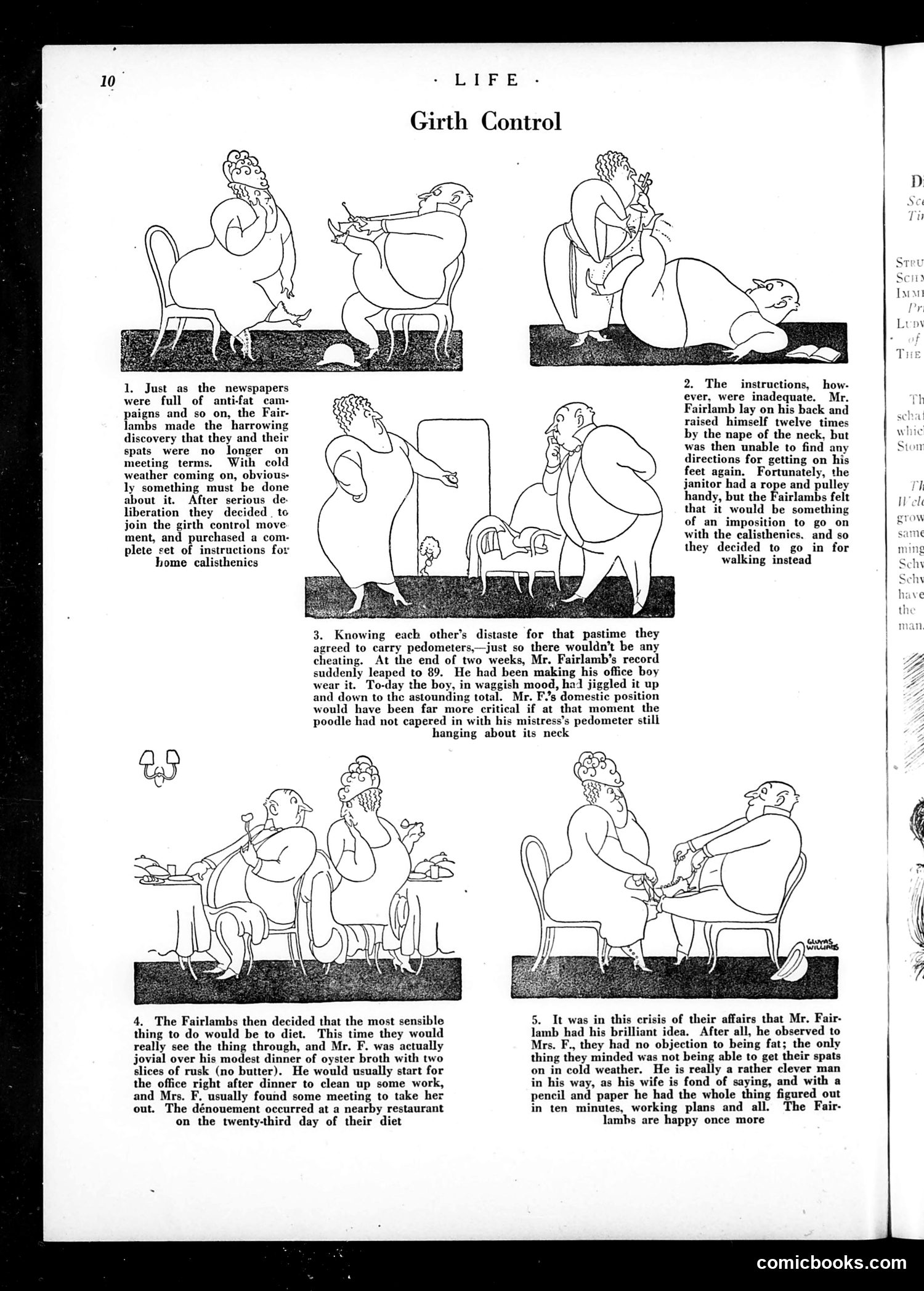
This six-panel cartoon mocks the Fairlamb couple's attempts at dieting and exercise. The narrative follows their increasingly desperate efforts: they discover spots on their lamb (a pun on their surname) are gone, join a gym, carry pedometers to prevent cheating, attempt modest dieting, and ultimately devise a scheme where Mr. Fairlamb briefly starves himself before lunch meetings. The satire targets the era's obsession with reducing diets and fitness crazes—presented as simultaneously ridiculous and ineffective. The couple's elaborate schemes (pedometers, gym attendance, elaborate meal-timing) highlight how people devise complicated workarounds rather than simply eating less. The joke culminates in the husband's modest success through calculated restraint, suggesting that weight loss requires uncomfortable discipline rather than fashionable remedies.
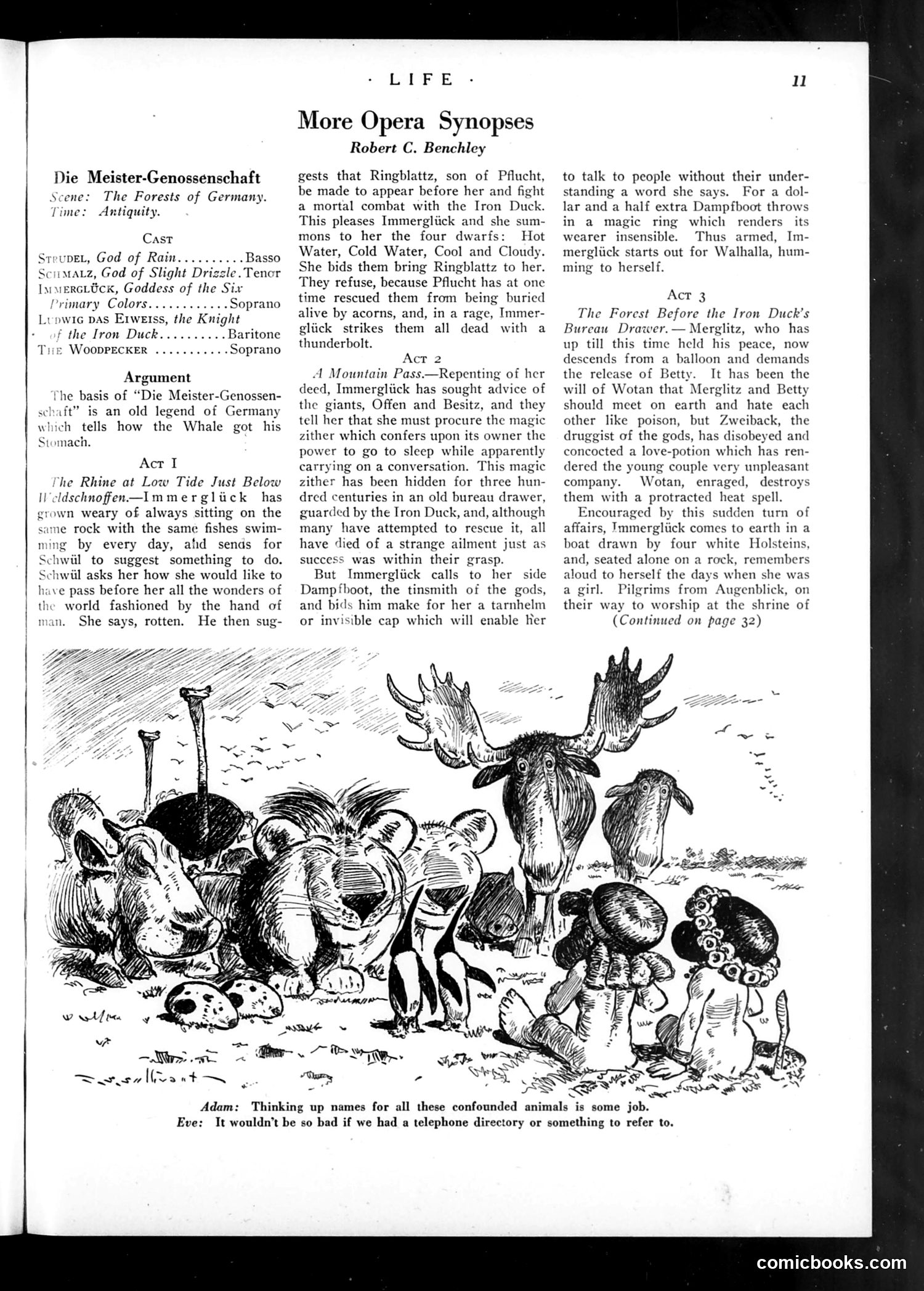
This page contains opera synopses by Robert C. Benchley, a humor columnist. The main cartoon illustrates *Die Meister-Genossenschaft*, a German opera about mythological creatures. The satirical joke at bottom features Adam and Eve examining a confusing menagerie of fantastical animals. Adam quips that naming "all these confounded animals" is tedious work. Eve responds that a "telephone directory" would help organize the chaos. The humor targets the absurdity of opera plots—particularly Germanic operas with their elaborate mythological casts—and pokes fun at the audience's confusion trying to follow such fantastical storylines. The anachronistic telephone reference (a modern convenience) underscores the ridiculous gap between biblical creation and contemporary complexity, satirizing both opera's pretentiousness and the period's bewilderment at technological change.
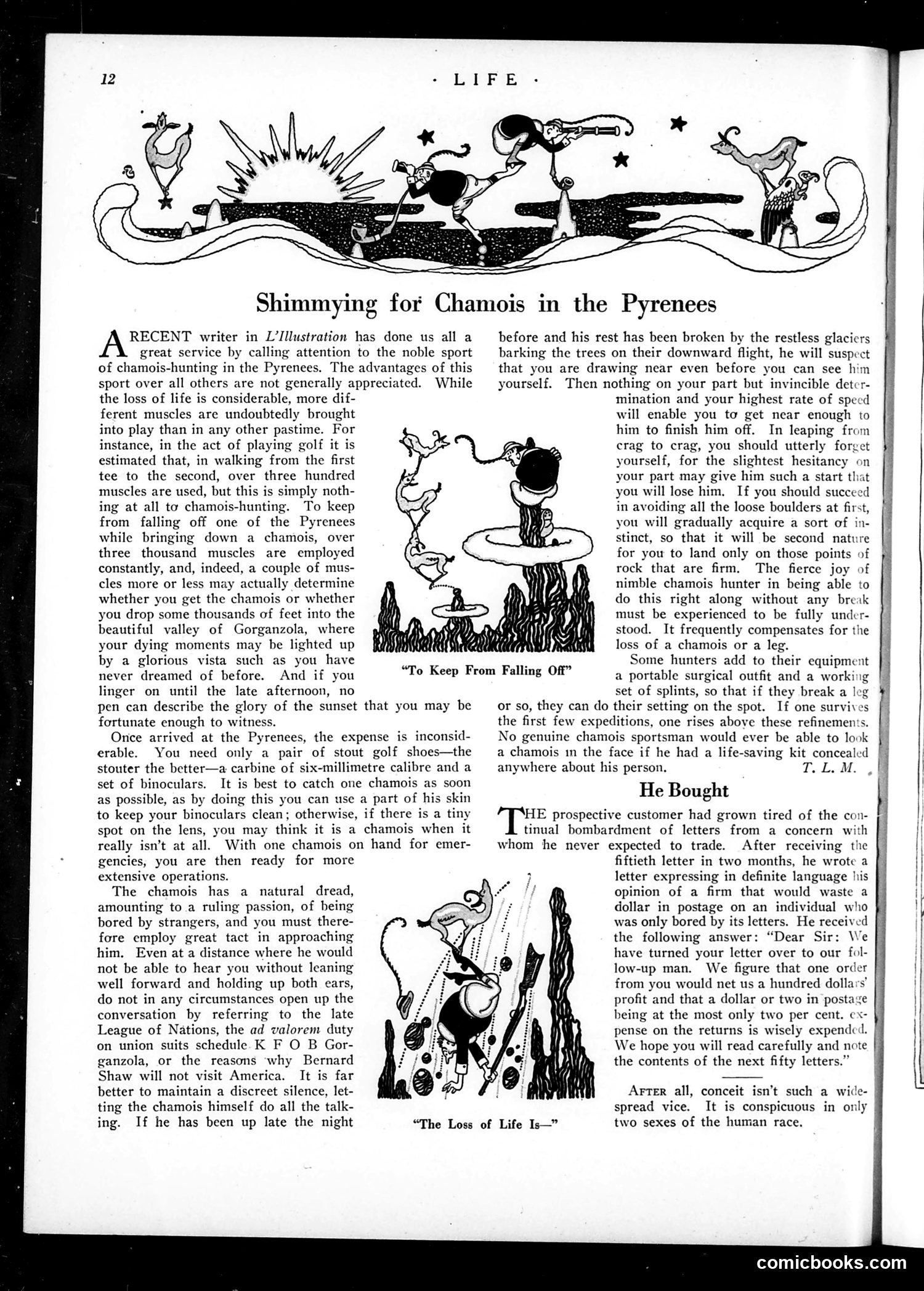
This page contains two distinct humor pieces: **"Shimming for Chamois in the Pyrenees"** is a tongue-in-cheek sports article mocking the pursuit of chamois (mountain goats) in the French Alps. The decorative header shows hunters in exaggerated action poses. The text humorously describes the extreme physical demands and dangers—comparing it to golf in absurdity—while offering deadpan practical advice about equipment and technique. The cartoons ("To Keep From Falling Off" and "The Loss of Life Is") illustrate the hazards comically. **"He Bought"** is a brief satirical anecdote about a customer receiving a form letter from a firm offering to buy complaints about their service. The joke hinges on the customer's logical response: if the company profits from complaints, they'd be complicit in two-cent vice. Both pieces exemplify *Life* magazine's characteristic style of witty social commentary through absurdist humor.
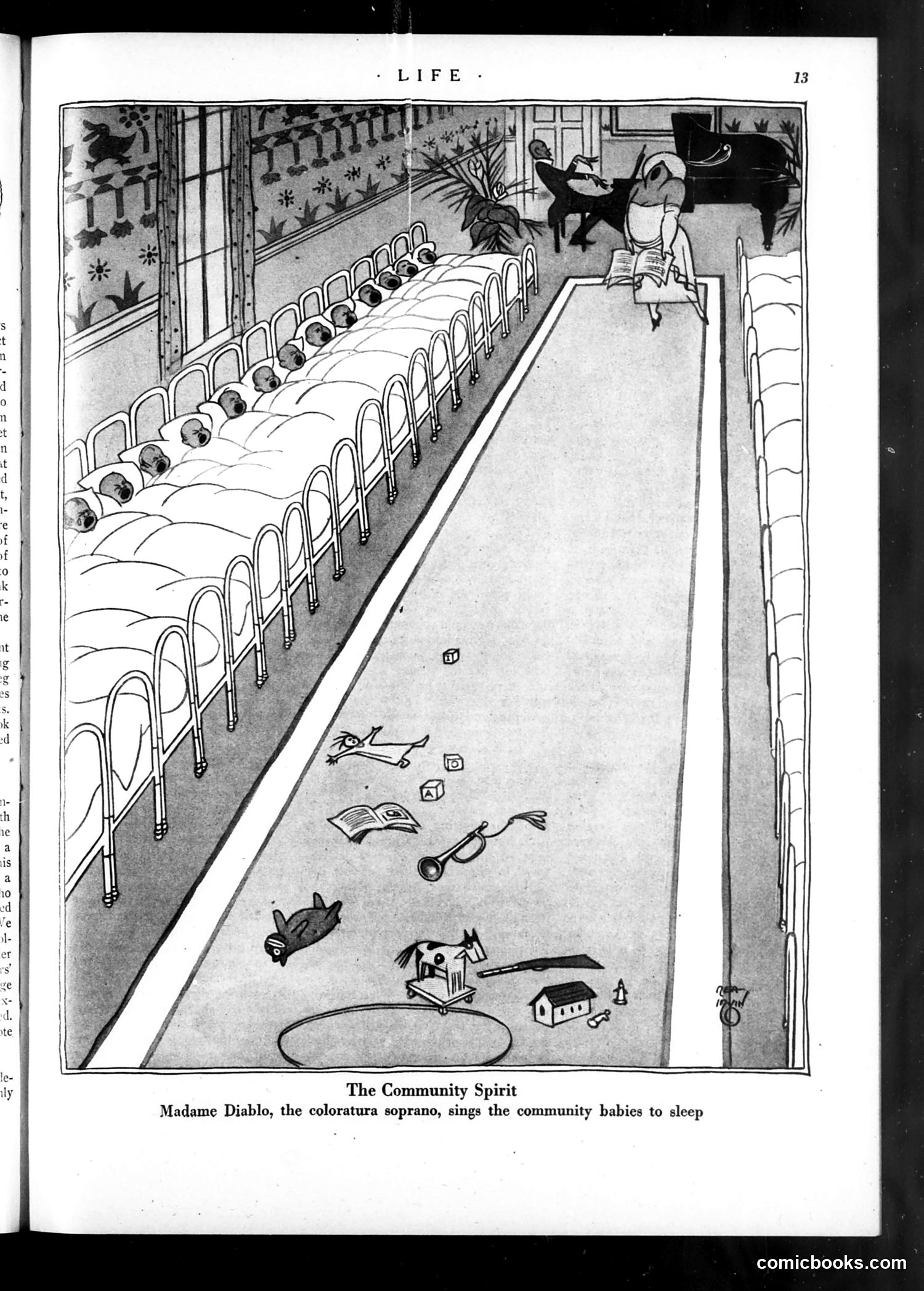
This satirical cartoon depicts a large dormitory-style bedroom where dozens of babies sleep in identical cribs arranged in institutional rows. A woman identified as "Madame Diablo, the coloratura soprano" stands at the end of the room singing to the infants. The satire targets communal child-rearing ideals—likely those promoted by radical or socialist movements of the early 20th century. The cartoon mocks the notion of "community spirit" applied to collective baby care, presenting it as dehumanizing and absurd. The toys scattered on the floor suggest standardized, impersonal upbringing. The exaggerated scale of the dormitory and the mechanical uniformity of the arrangement emphasize the cartoon's criticism of removing child-rearing from individual family care to state or collective control.
This page is primarily **text-based editorial content**, not a political cartoon. The article discusses **Colonel Waterson**, an editor and politician, praising his qualities as a writer and public figure. The piece celebrates his abilities in "praise and never hesitated to use it" and notes his gifts for "dissent, remonstrance and execration." The small decorative illustrations are merely **ornamental flourishes** (laurel wreaths, small sketches) rather than satirical cartoons. The accompanying discussion of Irish independence and European post-war conditions appears serious rather than satirical. Without identifying the specific Waterson referenced, the page functions as **commemorative journalism** rather than satire, typical of Life's mix of commentary and eulogy during this period.
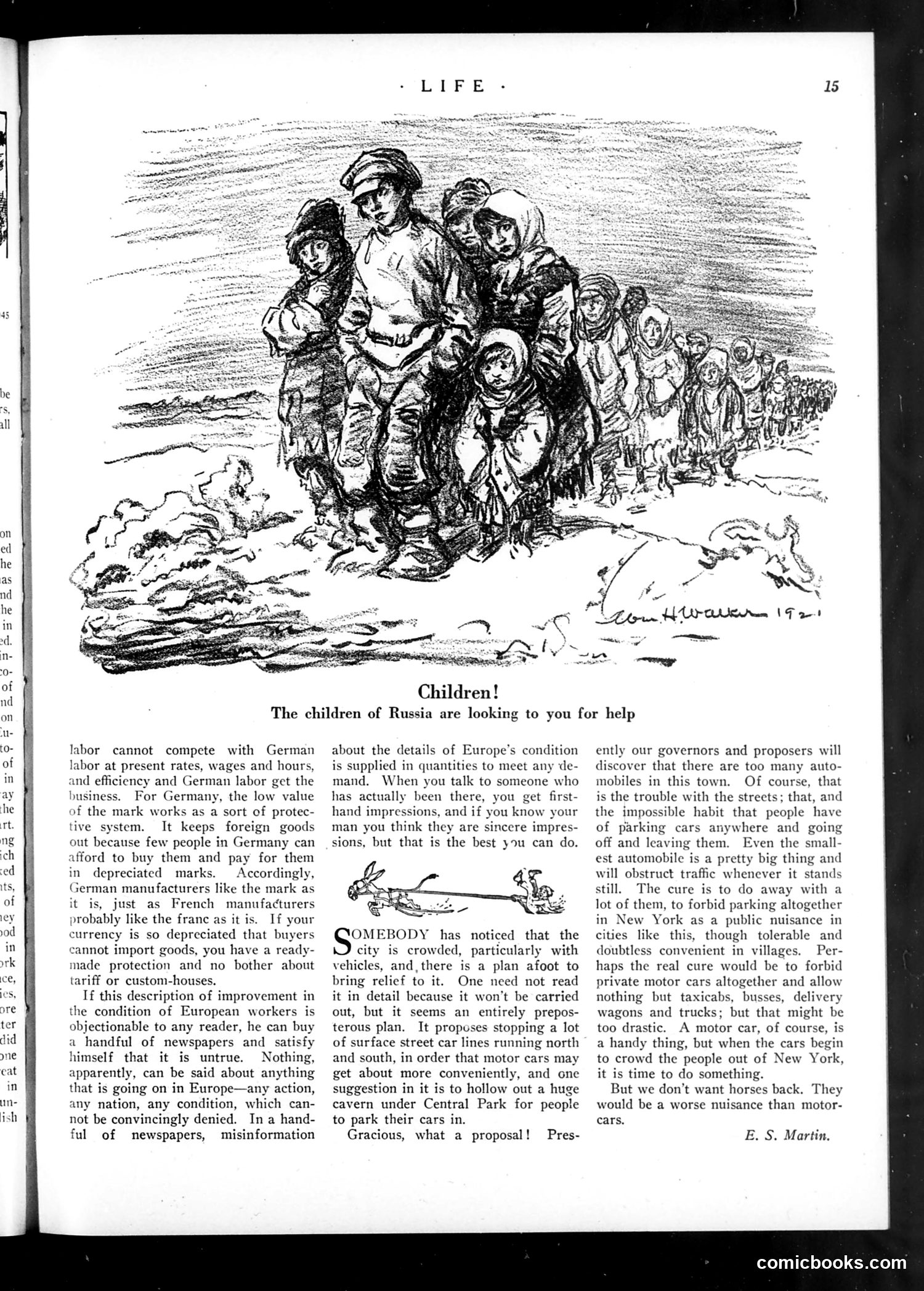
This page combines a political cartoon with editorial commentary on post-WWI conditions. **The Cartoon:** The sketch depicts Russian children in a ragged procession, appearing impoverished and displaced—likely refugees or victims of the Russian Revolution/Civil War. The caption "Children! The children of Russia are looking to you for help" is a humanitarian appeal to American readers. **The Editorial Context:** The accompanying text by E.S. Martin addresses European economic conditions, particularly Germany's depreciated currency (the mark) giving it competitive advantage in labor and manufacturing. The author criticizes sensationalist newspaper coverage of European affairs, contrasting it with firsthand impressions. **The Point:** The cartoon juxtaposes the human suffering in Russia with abstract economic discussion, implicitly asking: while we debate trade policy and currency rates, shouldn't humanitarian aid to desperate children be our priority? It's an appeal to American conscience and generosity during post-war European crisis, criticizing the tendency to reduce human suffering to economic abstractions.
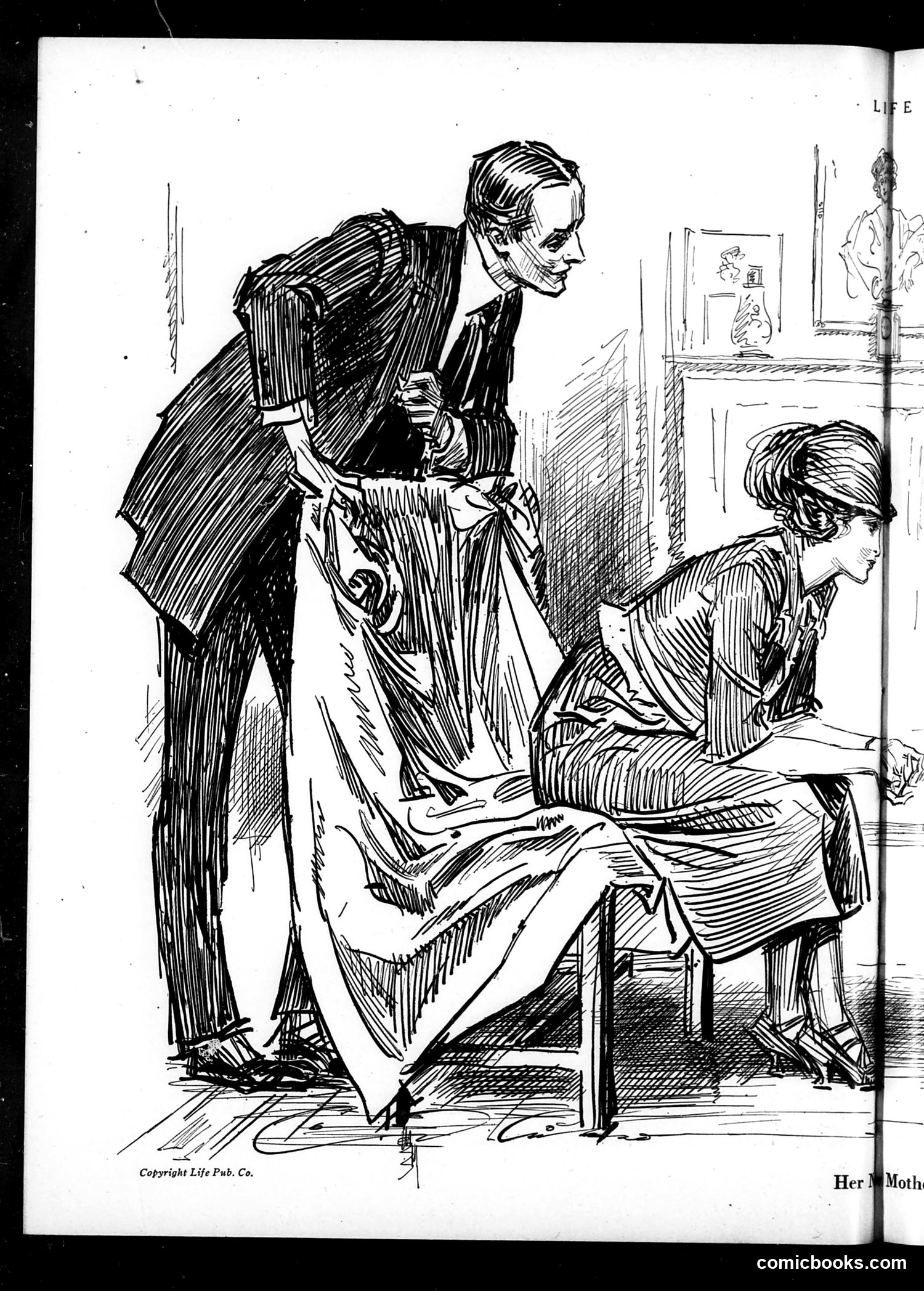
This is a sketch-style illustration showing a well-dressed man in a pinstriped suit leaning over a seated woman. The page appears to be from Life magazine (visible copyright notice: "Copyright Life Pub. Co."). The partial text visible reads "Her M Moth" (likely "Her Mother" or similar), suggesting this depicts a domestic or social interaction. The man's posture is patronizing or condescending—he's bending toward the seated woman in a way that suggests he's speaking down to her or offering unwanted advice. Without complete caption text, the specific satirical target is unclear, but the cartoon likely comments on gender dynamics, male condescension toward women, or family relationship tensions—common themes in Life magazine's social satire of the early-to-mid 20th century.
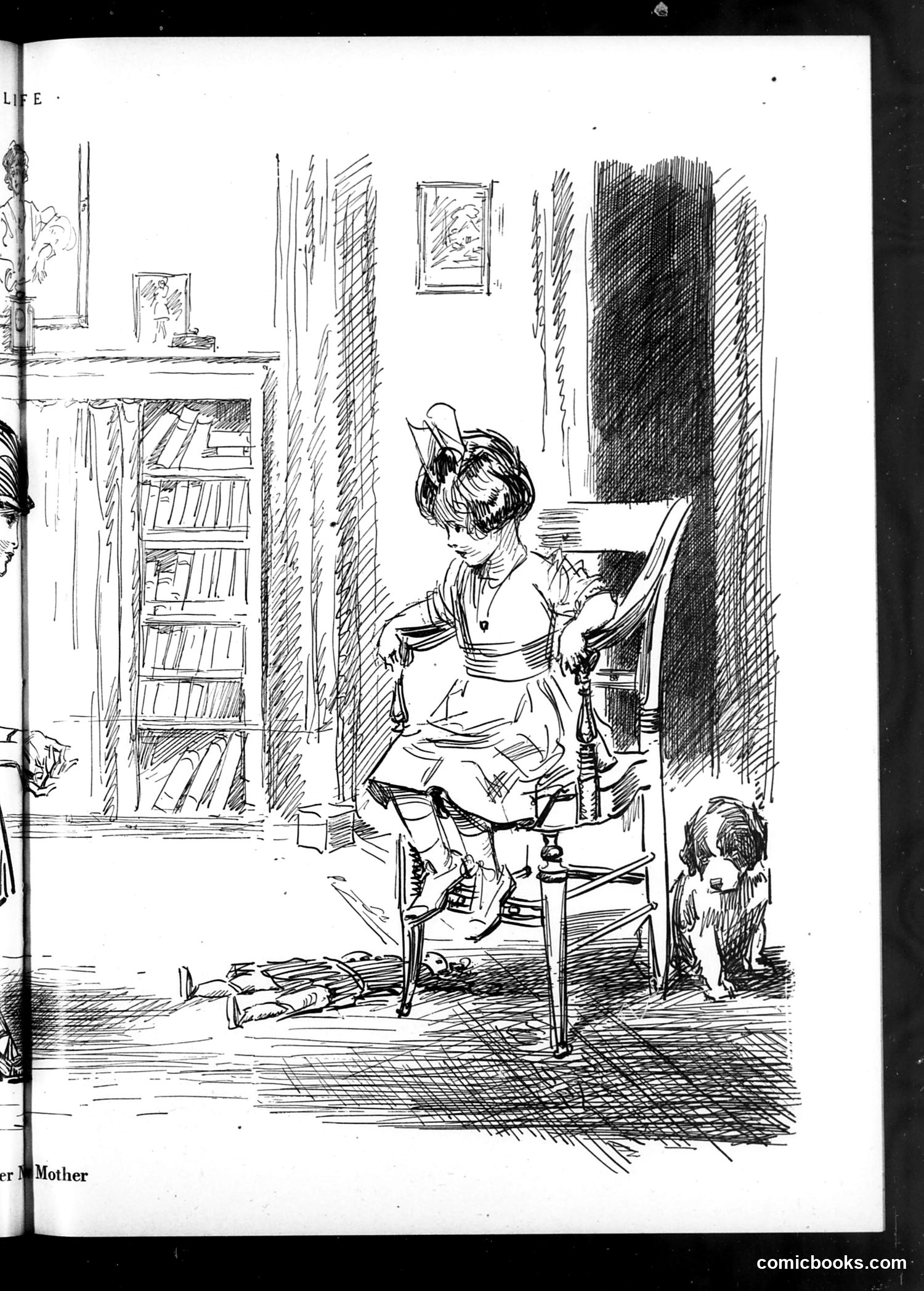
This appears to be a domestic scene from a *Life* magazine illustration, likely early-to-mid 20th century. The caption reads "er Mother," suggesting this is part of a series or comic strip. The image shows a woman seated in a chair, reading while a small dog sits nearby. A bookshelf is visible in the background, along with framed pictures on the walls—suggesting an educated, middle-class household. The specific satirical point is unclear without the full caption or surrounding context. However, the domestic setting and the woman's absorbed reading pose likely comment on contemporary gender roles, motherhood, leisure, or women's intellectual pursuits. The humor may derive from contrasting expectation versus reality regarding mothers' activities or priorities. The OCR text is too corrupted to provide definitive interpretation.
This page satirizes the theatrical pretensions and marketing of contemporary Broadway plays (circa 1920s). The critic skewers three productions: **"Danger"** by Cosmo Hamilton is mocked as fundamentally prudish despite being advertised as "the sexiest" play of the season. Life's writer notes it's actually quite conservative—essentially a morality tale about an ambitious woman, a maternal woman, and a man who predictably ends up with the latter, complete with discovered baby clothes. The satire targets both the play's conventional moralism and the absurdity of audience members finding scandal where none exists. **"The Dover Road"** by A.A. Milne receives genuine praise as competent light comedy with good acting. **"The Married Woman"** by Fernald is criticized as bloated—1,200 pages of dialogue when 400 would suffice—and philosophically outdated, since other playwrights have already explored its central question about why novels end at marriage. The satire throughout mocks theatrical marketing hype, formulaic playwriting, and middlebrow audience expectations of the era.
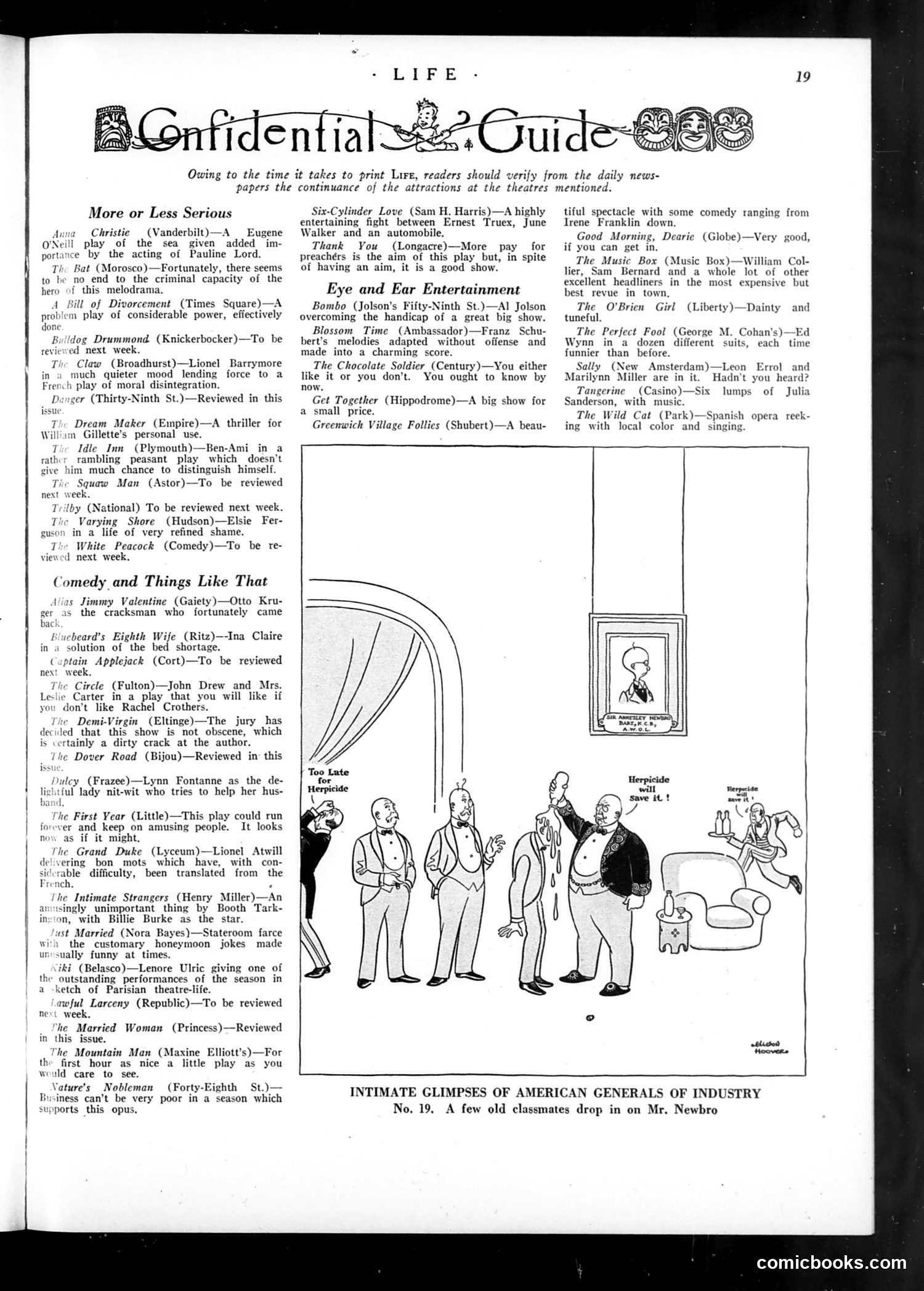
This is a **theater review and entertainment guide** rather than a political cartoon page. It's a listing of Broadway shows currently running, with brief critical assessments organized by category: "More or Less Serious," "Comedy and Things Like That," and "Eye and Ear Entertainment." The single **cartoon illustration** at bottom shows five men in business suits visiting what appears to be an office or home, with the caption "INTIMATE GLIMPSES OF AMERICAN GENERALS OF INDUSTRY: No. 19. A few old classmates drop in on Mr. Newbro." The satire is gentle corporate humor: it depicts businessmen as "generals of industry" and suggests that successful executives receive social visits from old acquaintances—likely implying either networking or old friends seeking advantage from the wealthy man's success. The cartoon mocks the pretentiousness of treating businessmen with military-style gravitas. The page primarily serves as a practical entertainment guide for 1920s theatergoers, listing shows starring notable performers like Al Jolson and Lionel Barrymore.
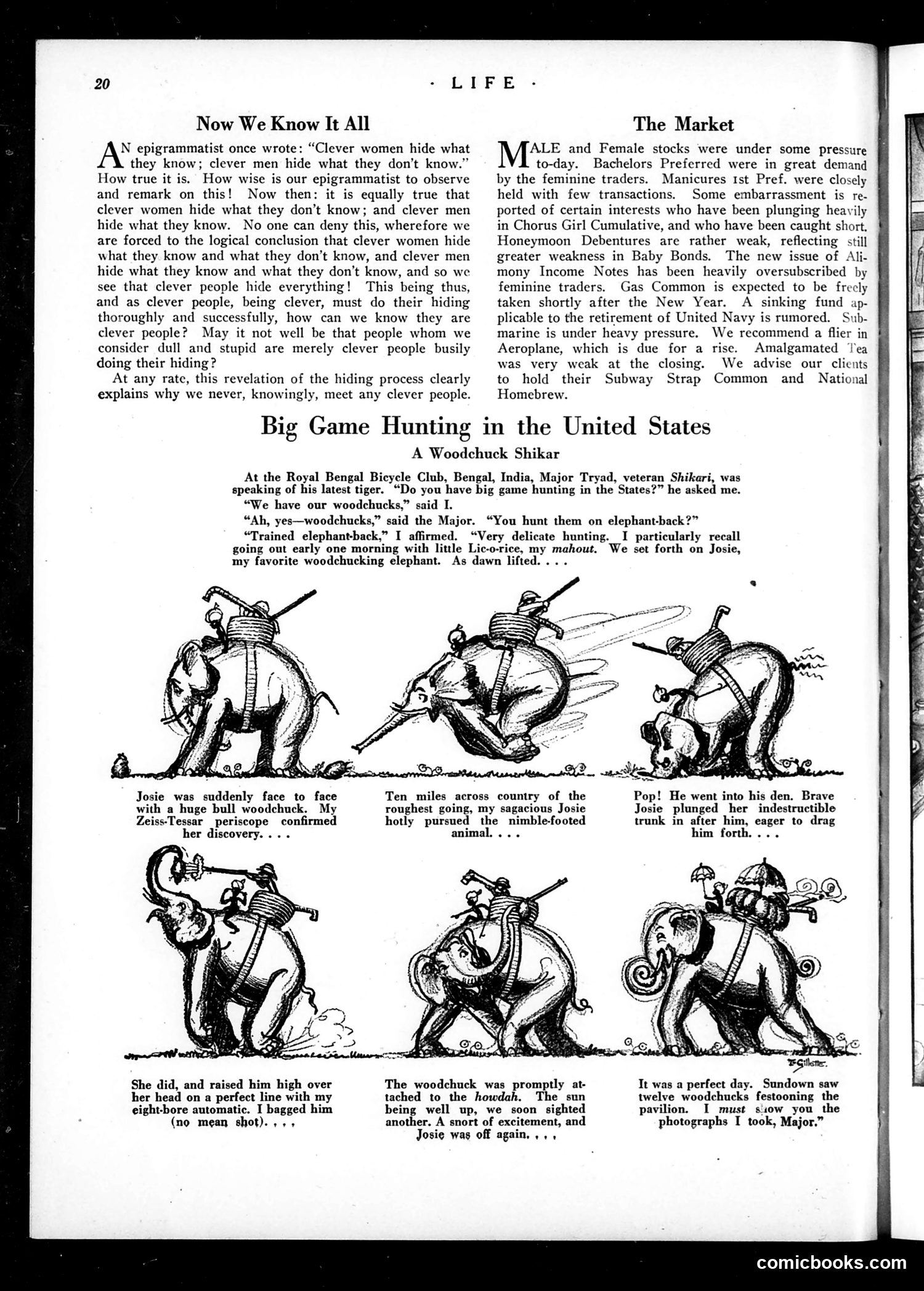
This is a humorous tall tale mocking both colonial big-game hunting culture and American exaggeration. A British Major in India asks an American about hunting in the States. The American absurdly claims to hunt woodchucks using trained elephants, a howdah (elephant carriage), rifles, and periscopes—the exact apparatus used for hunting tigers in India. The joke satirizes the pretentiousness of big-game hunters by applying their elaborate, expensive methods to catching common American rodents. It's also self-deprecating American humor: the narrator treats a humble woodchuck with the same grandiose seriousness that colonial hunters reserved for dangerous tigers, complete with a detailed narrative of an elaborate hunt culminating in twelve kills. The accompanying illustrations show the elephants and hunter in exaggerated action, emphasizing the absurd disproportion between weaponry and prey.
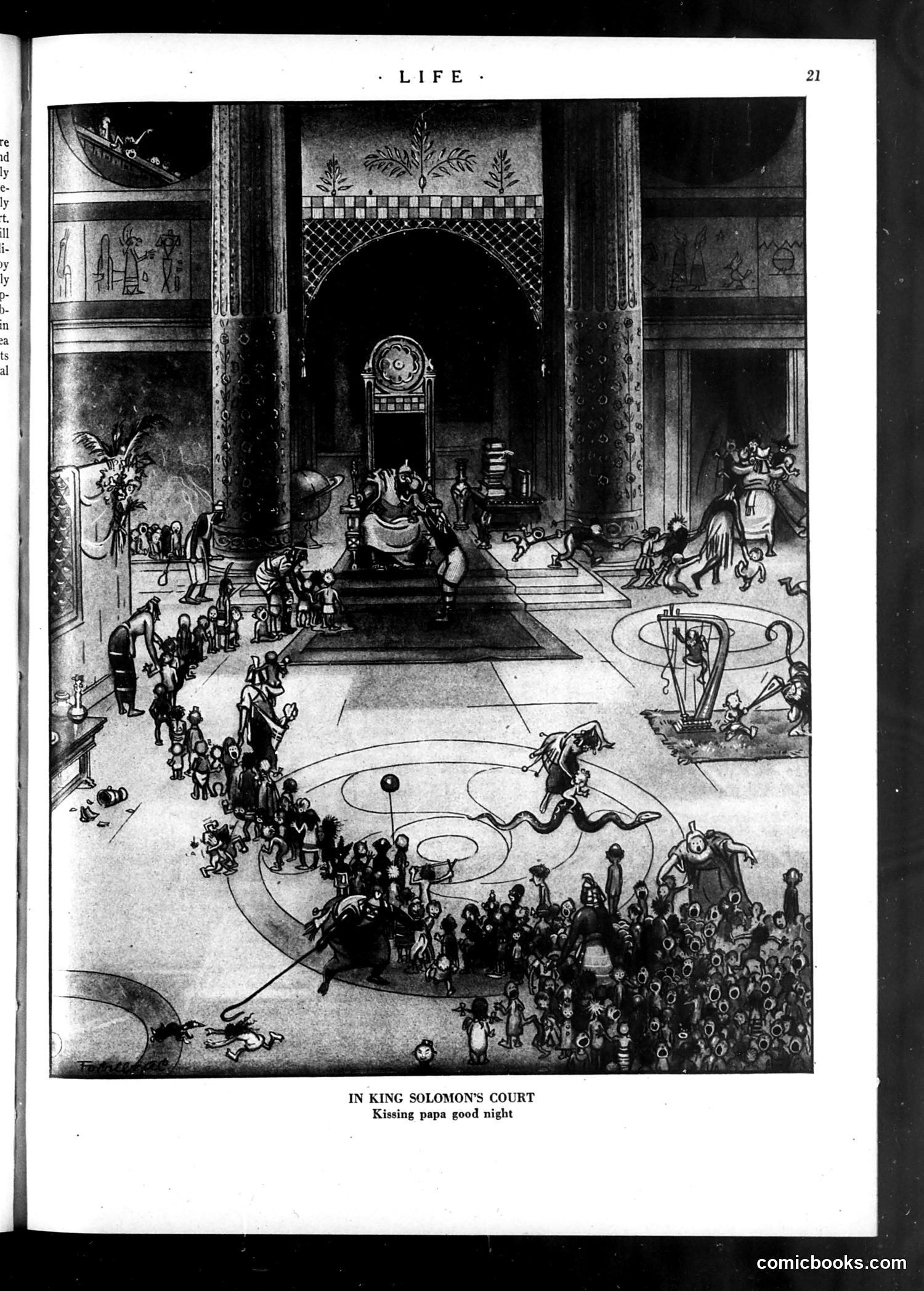
This satirical illustration depicts a grand palace courtroom scene with numerous figures arranged hierarchically. The caption "Kissing papa good night" suggests parody of filial devotion or obsequious behavior toward authority. The composition shows crowds of small figures in the foreground and elevated officials or dignitaries in the background, with classical architectural elements (columns, arches, decorative panels). The artist appears to mock excessive courtroom ritual and the sycophantic behavior of courtiers competing for a ruler's favor. The biblical reference to King Solomon likely invokes wisdom and justice, contrasting ironically with what appears to be frivolous ceremony and flattery. Without clearer identification of specific figures or the magazine's date, the exact political target remains unclear, though the satire targets formal court hierarchies and performative deference to power.
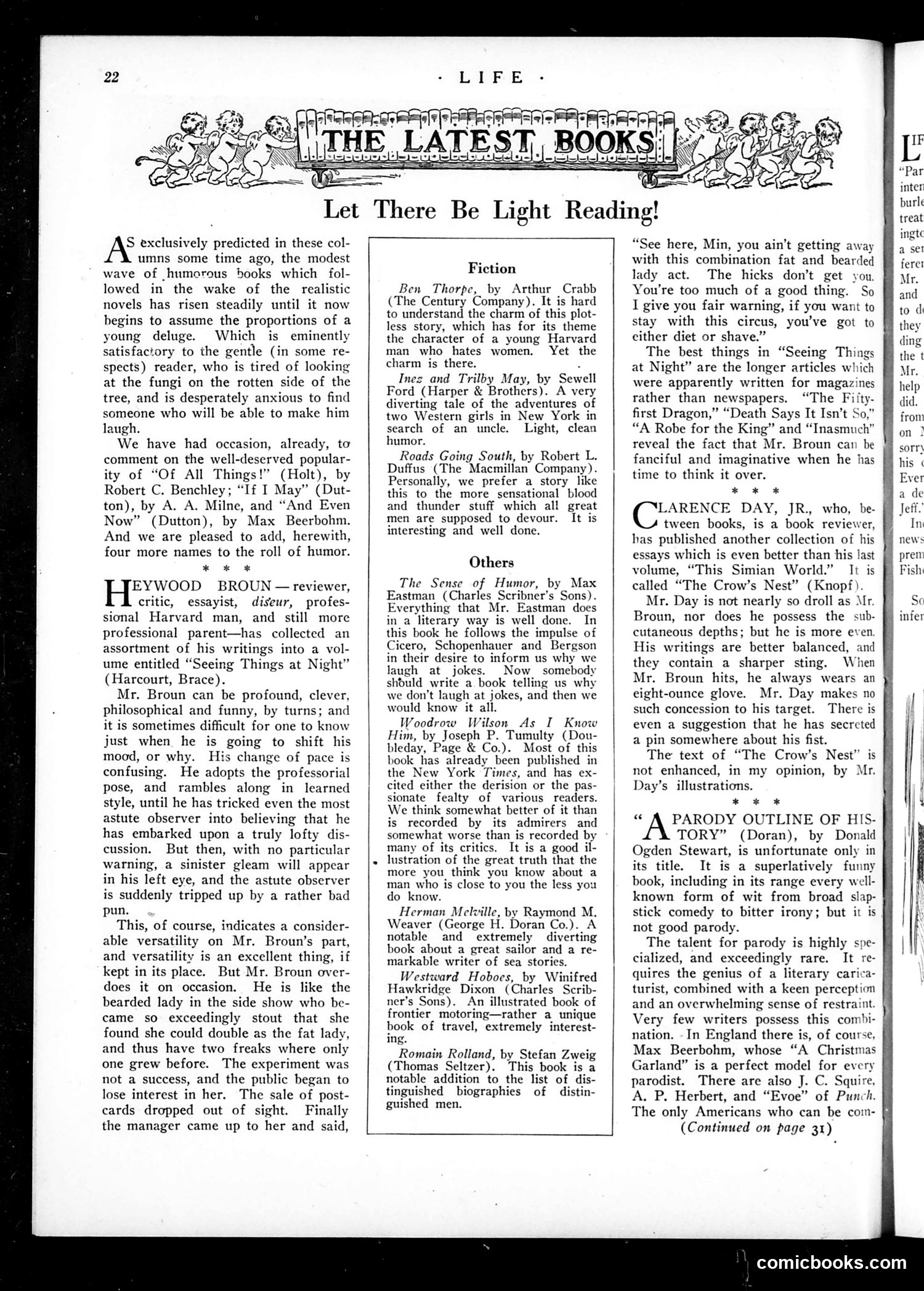
This is a straightforward book review column, not political satire. The page discusses a recent surge in humorous literature following the popularity of serious realistic novels. The reviewer celebrates this shift, noting readers are "desperately anxious" for humor after consuming heavy fiction. The column reviews several books, including works by Heywood Broun (essayist and critic), whose collected writings the reviewer praises for versatility while noting he sometimes overextends his range—compared amusingly to a sideshow performer who became both bearded lady and fat lady, confusing audiences. Other reviewed titles include fiction like *Ben Thorpe* and *Inez and Trilby May*, Max Eastman's philosophical *The Sense of Humor*, and notably Joseph Tumulty's memoir about President Woodrow Wilson, which the reviewer treats diplomatically as mediocre despite passionate defenders and detractors. The decorated header with cherubs and books emphasizes the lighthearted tone. This represents Life magazine's literary criticism function during the early 1920s.
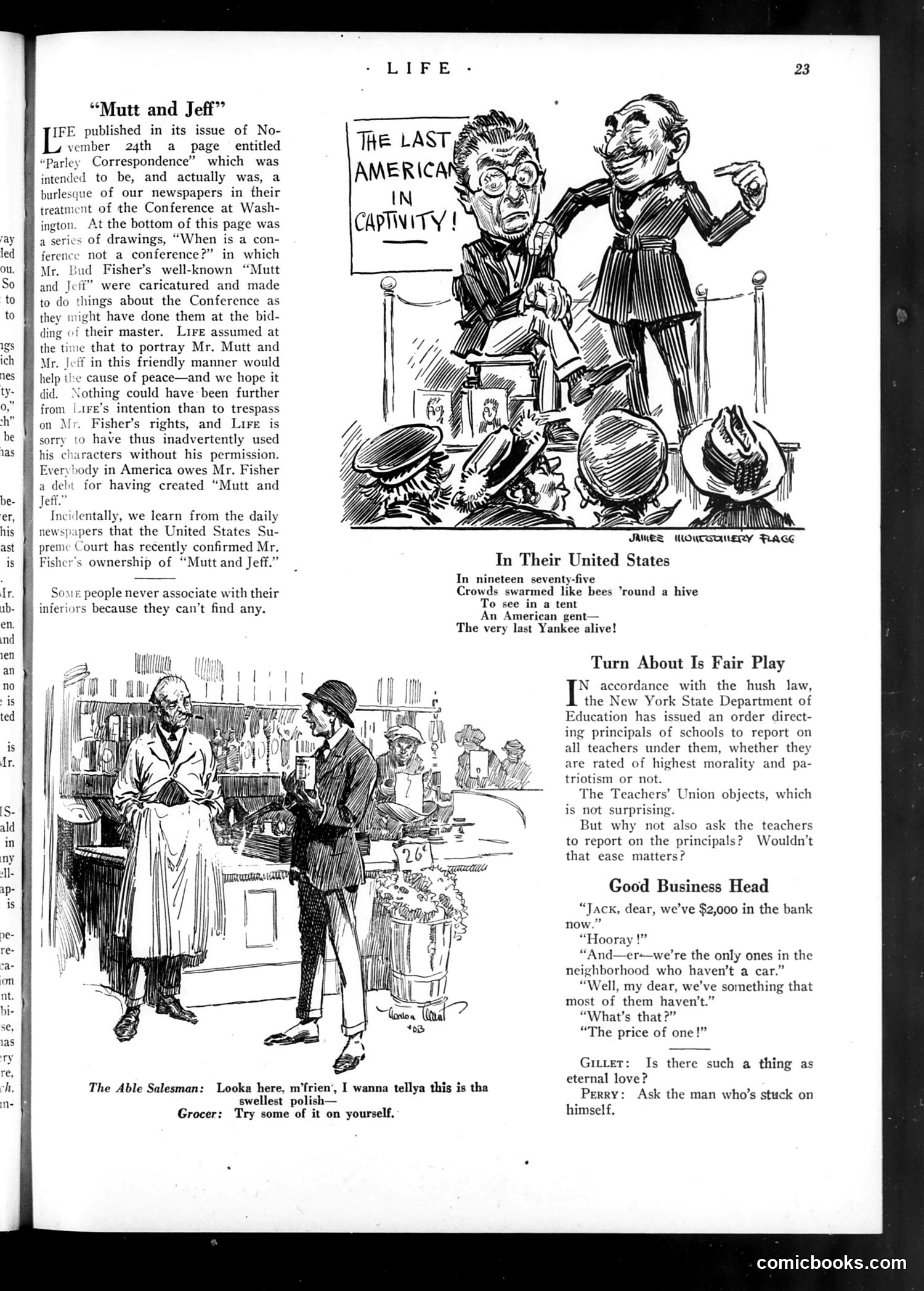
This page contains multiple satirical pieces from an early 20th-century Life magazine: **"Mutt and Jeff" Editorial**: Life magazine apologizes for republishing cartoons featuring the popular "Mutt and Jeff" comic strip characters without permission from creator Bud Fisher. The piece explains they did so satirically to mock newspaper coverage of the Washington Conference (likely the 1921-22 arms limitation conference), but acknowledged they should have obtained Fisher's consent. The Supreme Court had apparently confirmed Fisher's ownership rights. **Top Cartoon** ("In Their United States"): A caricatured figure displaying an American in captivity, satirizing either isolationism or American international standing. **Other Items**: The page includes brief humorous dialogues mocking teacher oversight policies, materialism, and romantic notions—typical Life magazine satire of social hypocrisy and middle-class pretensions. The overall page reflects early-century American satirical journalism's style: wordplay, social commentary, and gentle mockery of contemporary politics and manners.
This is primarily a **full-page advertisement** for Phoenix Hosiery, not a political cartoon. The ornamental Art Deco border frames promotional copy rather than satirical imagery. The ad makes a playful pun on "hosiery exposition" (a trade show) by calling it "Exposiery" — a joke about stockings being visibly displayed everywhere on streets. The text emphasizes Phoenix stockings' dual appeal: they're fashionable ("elegance") yet practical and affordable ("durability," "long mileage and low cost"). It claims Phoenix achieved "first in world sales" through superior manufacturing. This appears to be typical early-20th-century *Life* magazine advertising, which often mixed product promotion with wordplay and light humor aimed at middle-class consumers—particularly women buying hosiery for their families.
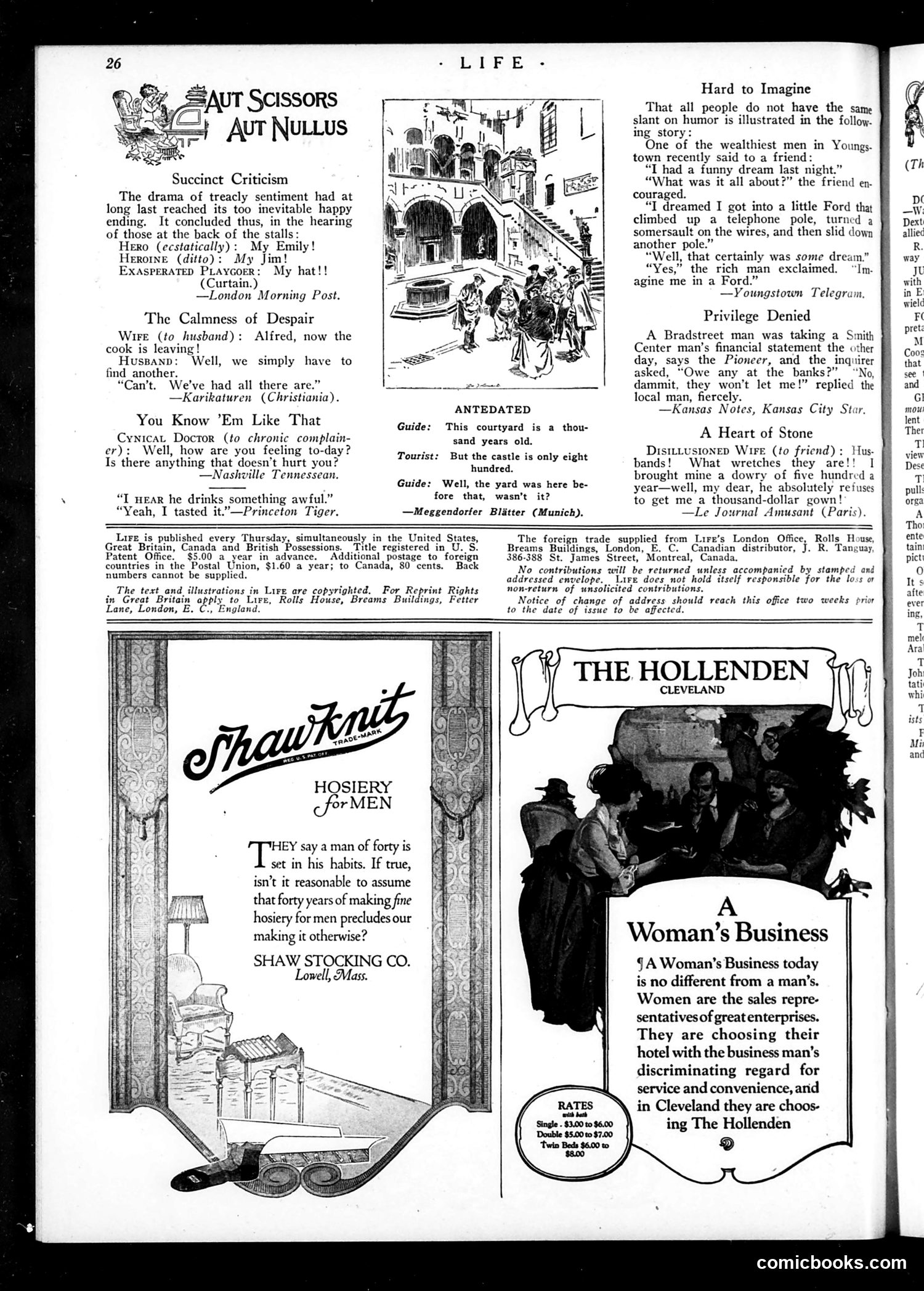
This page combines short satirical jokes from international sources with advertisements. The humor pieces mock universal human follies: **"Succinct Criticism"** ridicules overly sentimental theater—an exasperated playgoer loses patience with clichéd romantic dialogue ("My Emily!" / "My Jim!"). **"The Calmness of Despair"** jokes about domestic help shortages, with a wife claiming all available cooks have already left. **"You Know 'Em Like That"** features a cynical doctor's quip that a complainer drinks heavily—the punchline: the speaker tasted it himself. **"Hard to Imagine"** mocks wealthy people's detachment from ordinary life. A rich man finds his dream funny precisely because *he* was in a Ford—implying such vehicles are beneath his station. **"Privilege Denied"** inverts sympathy: a poor farmer jokes bitterly that banks won't even *let* him borrow money. These represent typical early-20th-century Life magazine content: light, cynical observations about class, marriage, and human nature, sourced globally. The advertisements for Shawknit hosiery and The Hollenden hotel occupy the lower half.
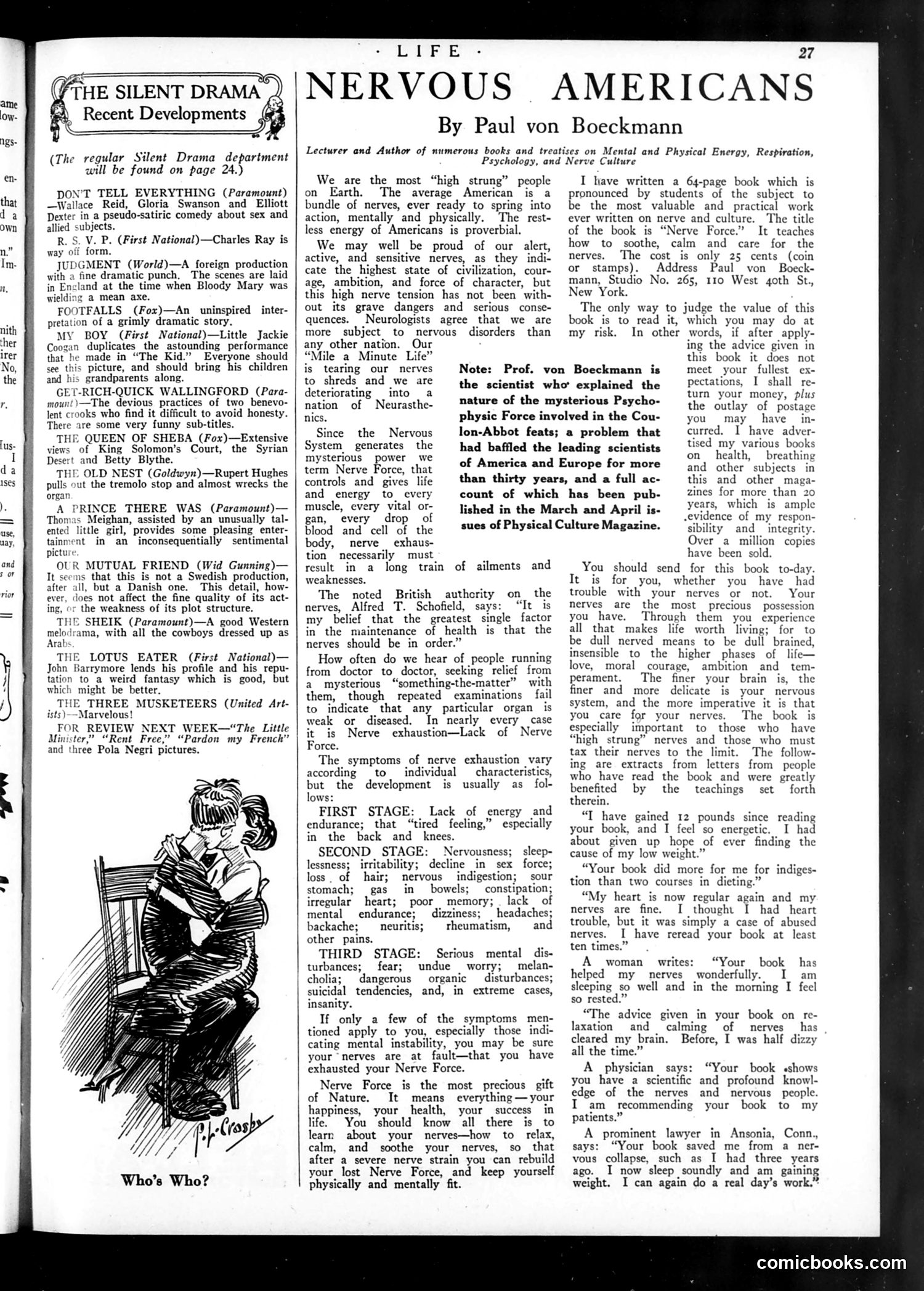
This page presents Paul von Boeckmann's health advice article alongside movie reviews. The main illustration shows a figure in a chair, likely depicting "nerve exhaustion"—a genuine diagnosis of the 1920s. **The Article's Context:** Von Boeckmann argues that Americans' fast-paced lifestyle ("Mile a Minute Life") causes widespread "neurasthenia" (nerve exhaustion), a then-legitimate medical condition. He describes three stages of deterioration from fatigue to serious mental disturbance, positioning his 64-page book "Nerve Force" as the solution. **Why This Mattered Then:** In the early 1920s, neurasthenia was blamed on modern industrialization and American pace. The "high-strung American" was a recognized cultural type. Von Boeckmann's appeal to scientific authority and testimonial letters reflected contemporary health anxieties. **For Modern Readers:** This resembles today's wellness industry—pseudoscientific health claims marketed through expert credentials and customer testimonials. The condition itself is now understood as stress-related rather than "nerve force" depletion.
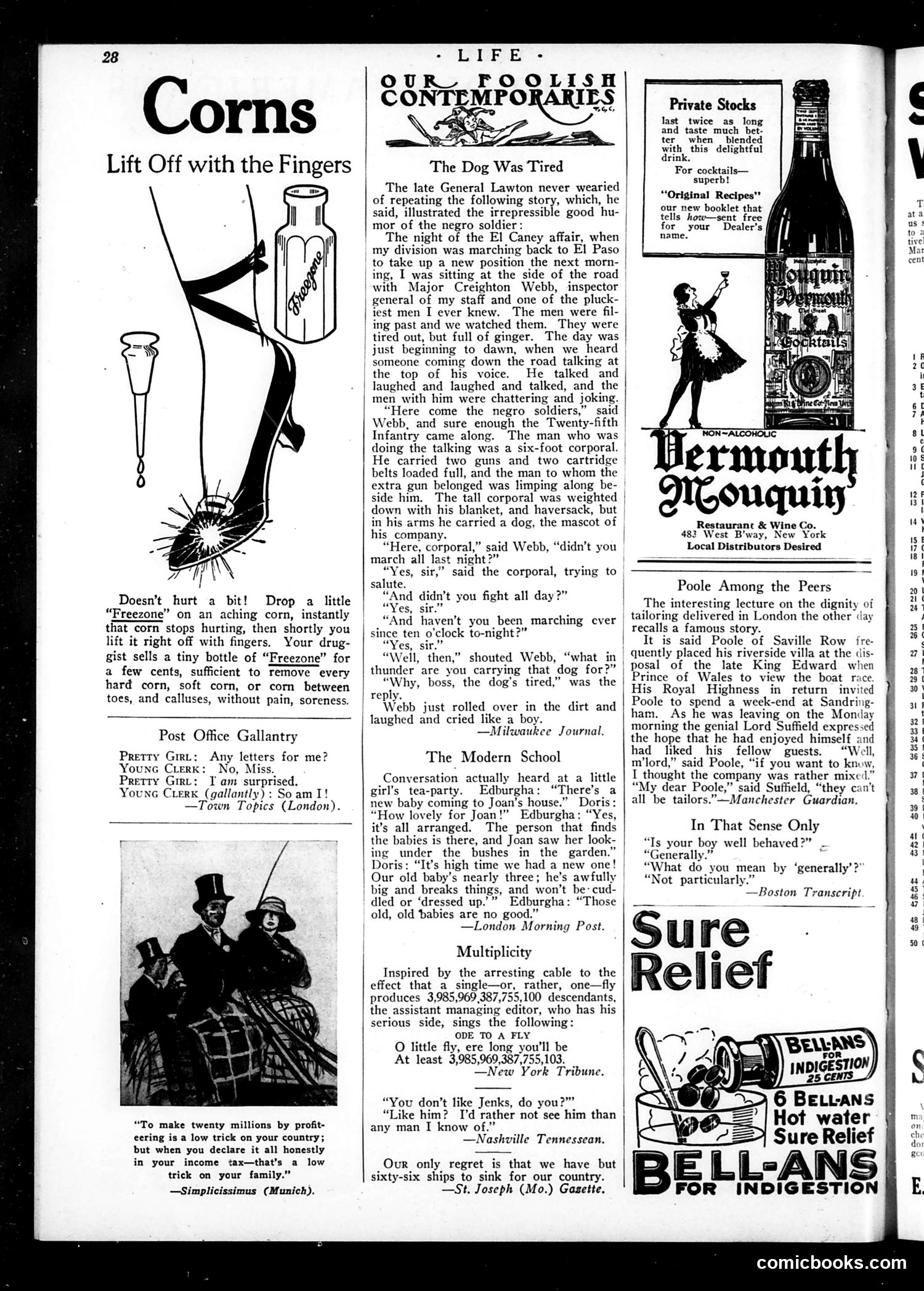
This page from *Life* magazine contains humorous anecdotes and advertisements typical of early 20th-century American satire. **Main Content:** The "Corns" section is a Freezone product advertisement disguised as helpful advice. **Notable Anecdotes:** - **"The Dog Was Tired"**: A story attributed to General Lawton about a Black soldier during the Spanish-American War (El Caney battle) who carries an exhausted dog despite his own exhaustion. The humor relies on the soldier's illogical reasoning ("the dog's tired"), presented as evidence of good humor among Black troops—a paternalistic stereotype common to the era. - **"The Modern School"**: Girls casually discussing babies appearing under bushes, reflecting period ignorance about reproduction. - **"Post Office Gallantry"** and other short quips offer mild workplace and social humor. The page reflects *Life*'s position as a satirical magazine mixing product ads with commentary on contemporary social attitudes, often reinforcing period stereotypes while claiming satirical intent.
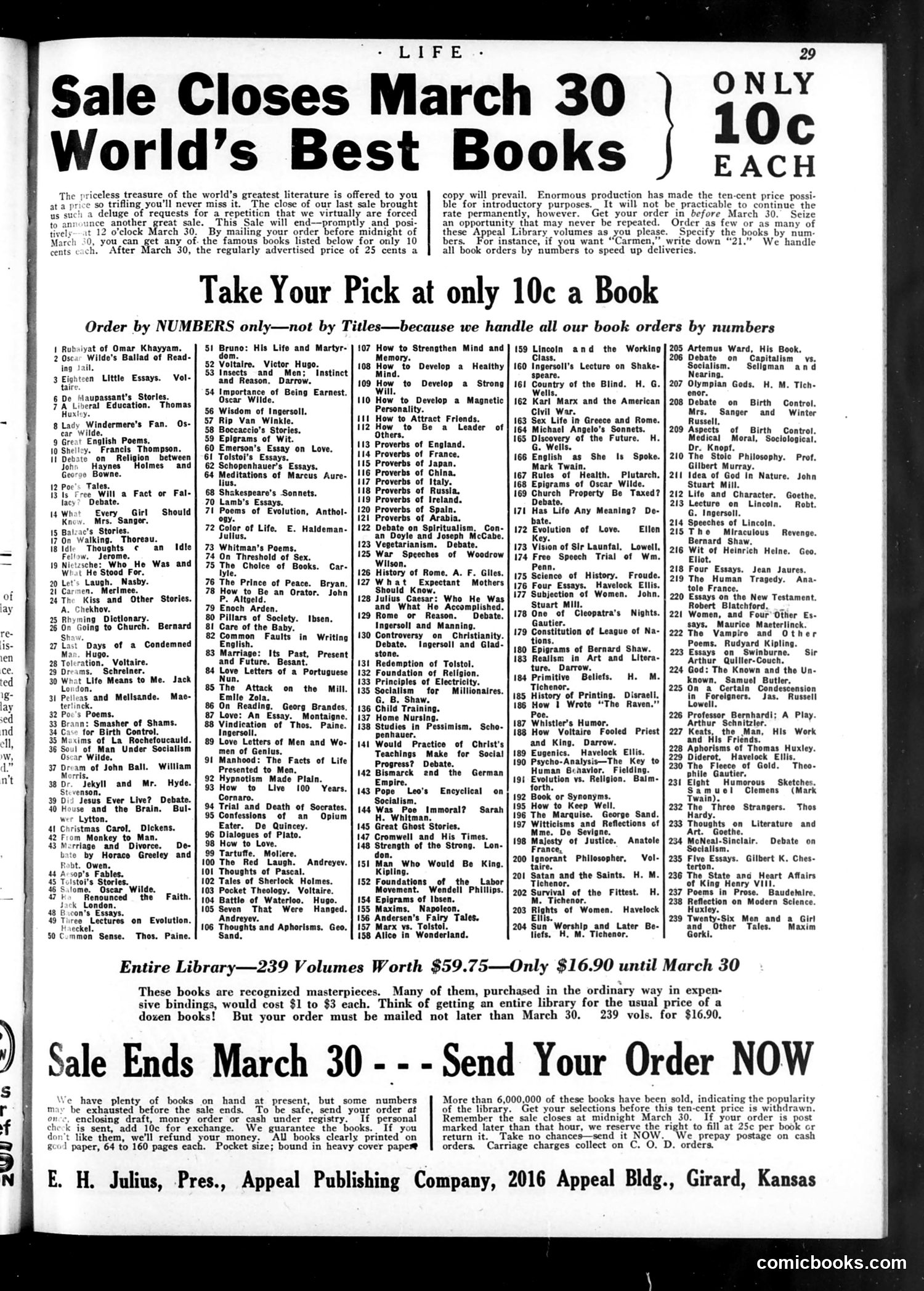
This page is **entirely advertising**—not political satire or comics content. It's a book-sale advertisement from the Appeal Publishing Company promoting a clearance sale of classic literature at 10 cents per volume (closing March 30). The catalog lists 200+ titles including works by Oscar Wilde, Tolstoy, Voltaire, Shakespeare, and contemporary progressives like Clarence Darrow and Margaret Sanger. Notably, titles like "Case for Birth Control" and "Vindication of Thomas Paine" suggest the publisher's reformist orientation—typical of early 20th-century radical presses. The sale's framing—"World's Best Books" at "enormous production" discounts—targets budget-conscious readers seeking access to classical and progressive literature. The marketing emphasizes the once-in-a-lifetime nature of the offer to drive urgency. This reflects the era's earnest democratization of literature, not satire.
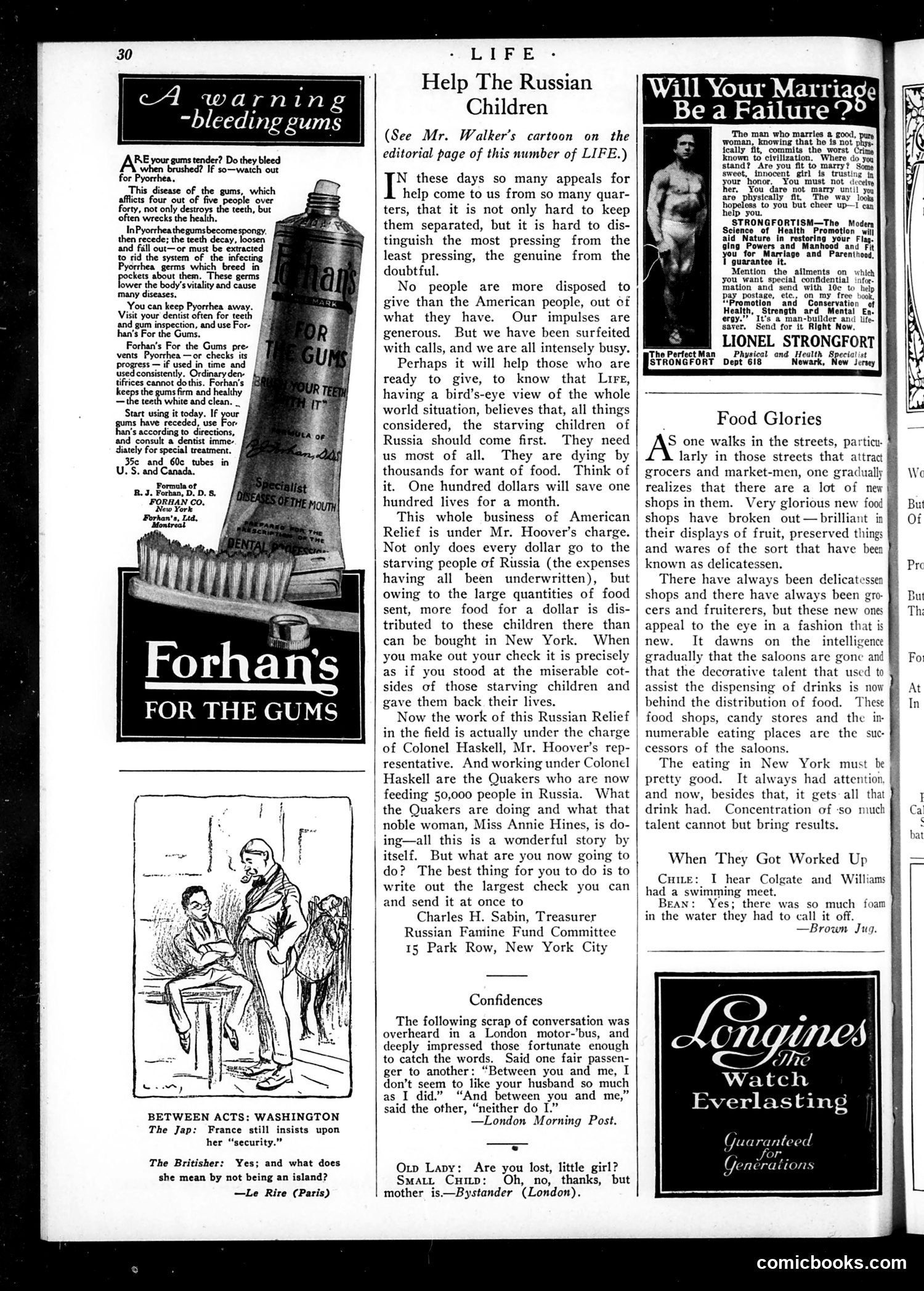
This page contains primarily **advertisements and charitable appeals**, not political satire. The main content is an appeal for American donations to help starving Russian children, published during the post-WWI famine (likely early 1920s). The text emphasizes that Herbert Hoover's American Relief Administration distributes aid efficiently, with Colonel Haskell overseeing operations and Quakers feeding 50,000 Russians. Donors are urged to send checks to the Russian Famine Fund Committee. The page also includes: - A **Forhan's toothpaste ad** about preventing pyorrhea (gum disease) - A brief **political cartoon** mocking French and British diplomacy regarding security and island status - Humorous "**Confidences**" snippets—short jokes about marital discord and a lost child The cartoons are minor, serving as filler. The page's primary purpose is soliciting charitable donations during a genuine humanitarian crisis.
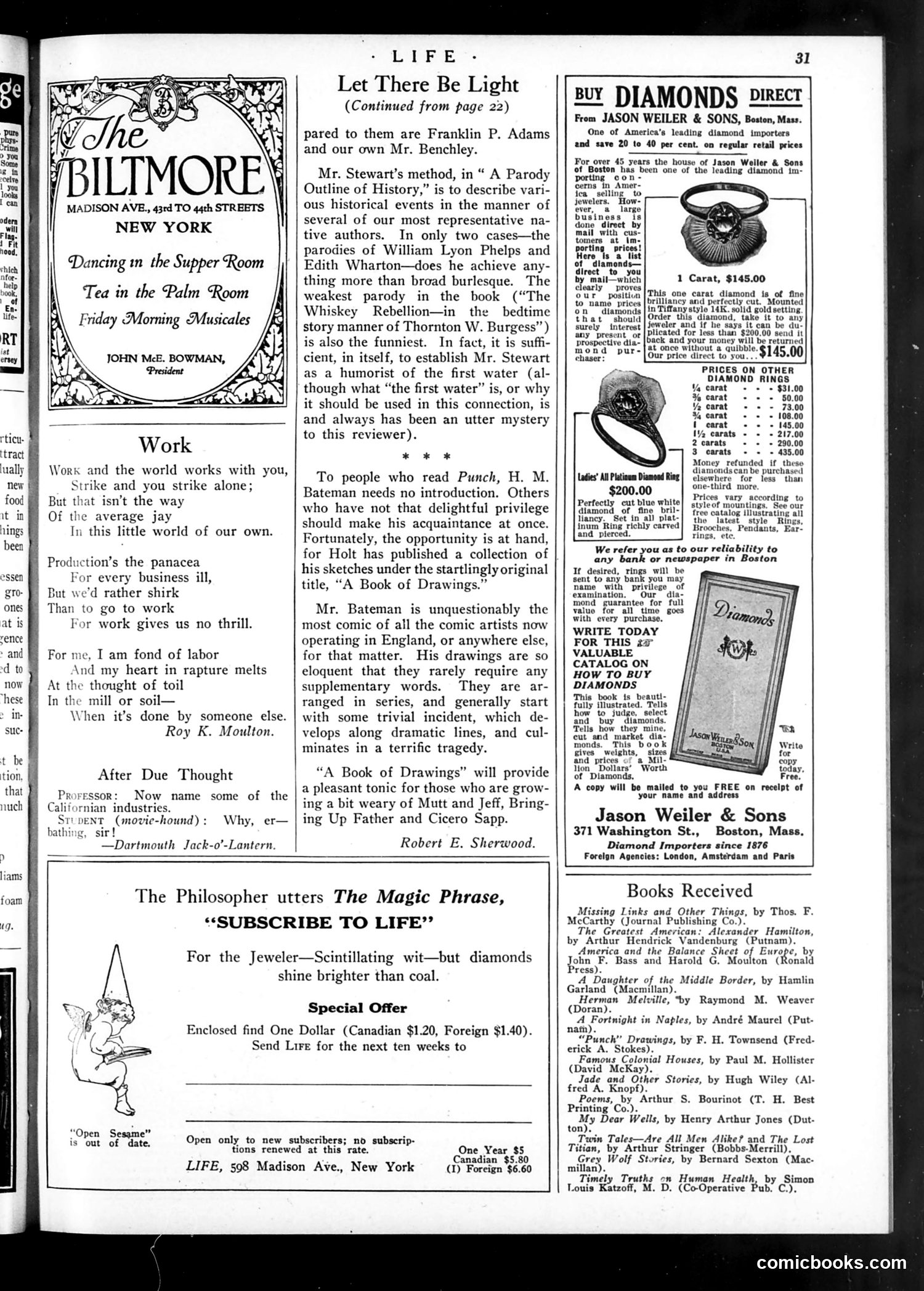
This page is primarily **advertising and literary content** rather than political satire. The main elements are: **The Biltmore Hotel advertisement** (top left) promotes luxury amenities—supper room dancing, tea service, and Friday morning musicales—targeting affluent New Yorkers. **Literary reviews** by Robert E. Sherwood discuss new books, particularly praising H.M. Bateman's comic drawings and a collection of literary parodies by Mr. Stewart. **"Work" and "After Due Thought"** are light humorous verses and jokes about labor avoidance and student ignorance—typical period humor without sharp political edge. **The dominant content is diamond advertising** (Jason Weiler & Sons, Boston), emphasizing direct importing to undercut retail prices by 20-40%—a common 1920s sales pitch. **"The Philosopher utters The Magic Phrase: 'SUBSCRIBE TO LIFE'"** is self-promotional advertising for the magazine itself, with a special subscription offer. The page reflects 1920s consumer culture and upper-class leisure rather than containing political commentary or social satire.
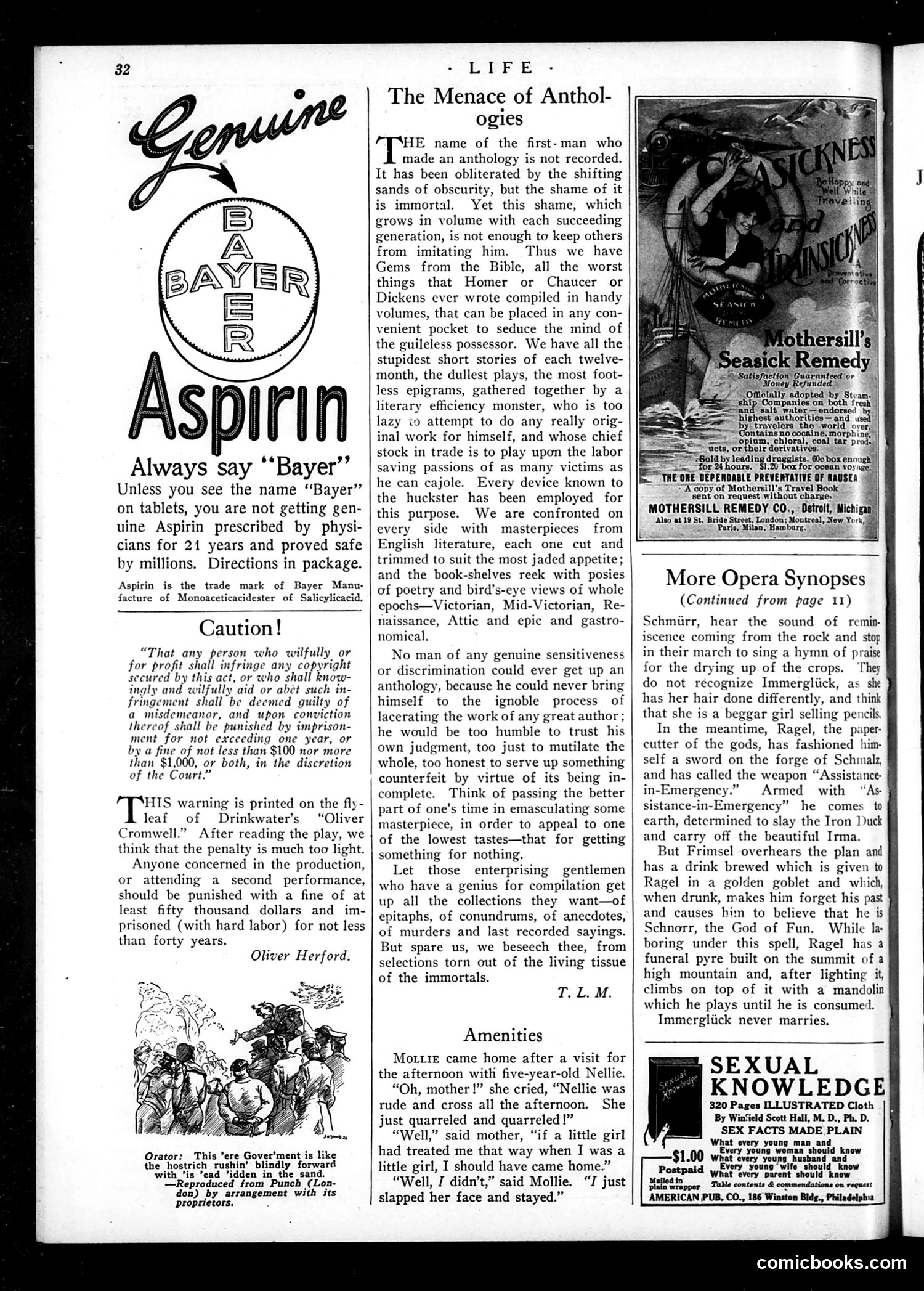
This page contains several distinct pieces of satirical commentary: **"The Menace of Anthologies"** (main article): Attacks the proliferation of compiled literary collections—"Gems from the Bible," Victorian poetry selections, etc. The author (T.L.M.) argues that anthology-makers are lazy opportunists who mutilate great works by cutting them into digestible pieces for mass consumption. The satire targets both the editors' lack of integrity and the public's appetite for shortcuts to culture. **Oliver Herford's cartoon**: Mocks a theatrical production of Drinkwater's "Oliver Cromwell," suggesting it deserves punishment worse than copyright infringement—implying the play itself is so bad it's nearly criminal to perform it. **The Punch reproduction cartoon**: Shows an orator comparing government to an ostrich burying its head in sand—standard political satire about willful governmental blindness or avoidance. The page is otherwise dominated by **Bayer Aspirin advertising** and other commercial content typical of early 20th-century magazines.