
Life, 1922-01-12 · page 26 of 34
Life — January 12, 1922 — page 26: what you’re looking at
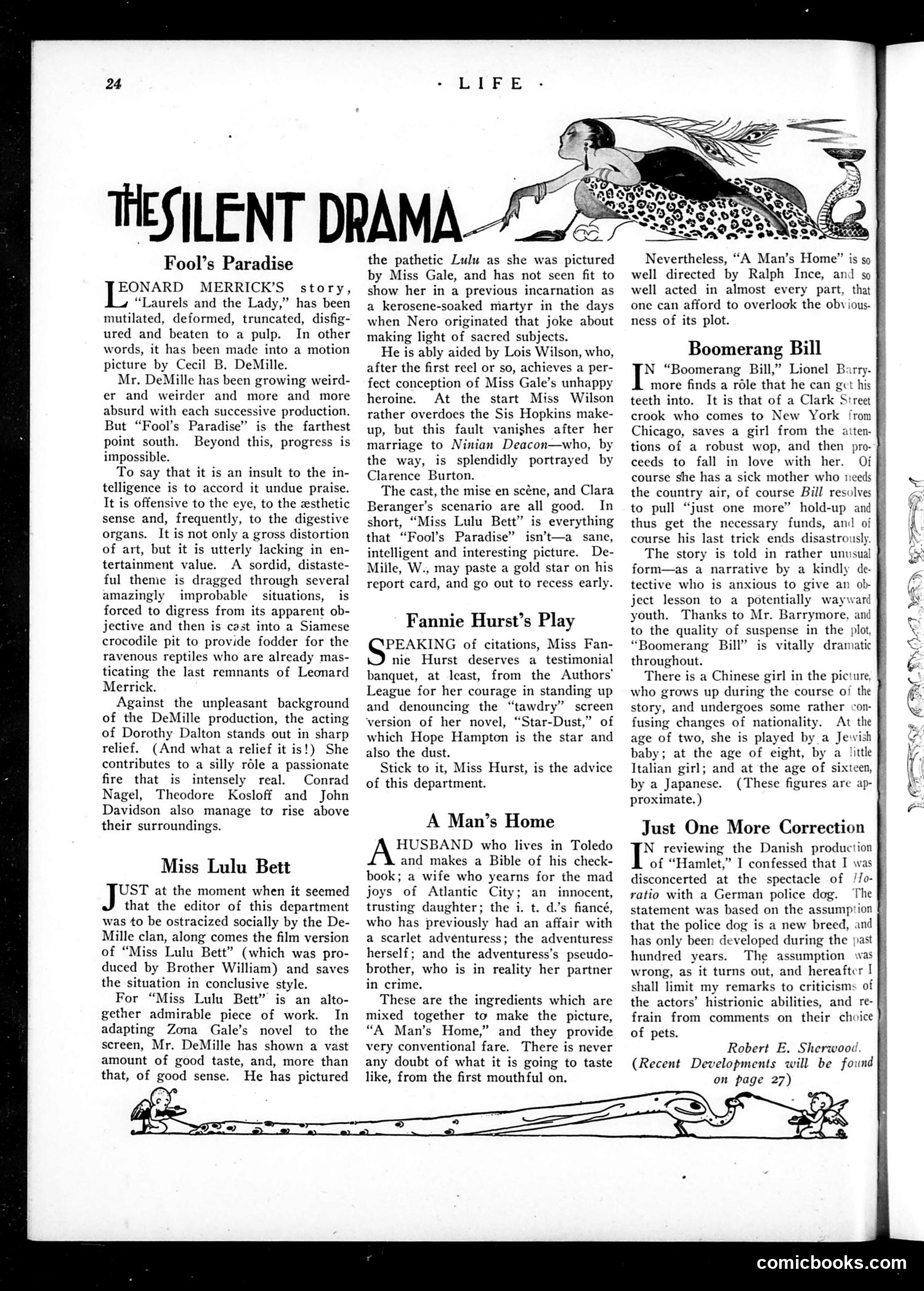
A restored page from Life, 1922-01-12. Page through the whole issue in the reader above.
📄 Transcribed text from this page (OCR, searchable)
Machine-transcribed from the original scan — historical spelling and the odd misread are preserved.
Fool’s Paradise | ees MERRICK’S story, “Laurels and the Lady,” has been mutilated, deformed, truncated, disfig- ured and beaten to a pulp. In other words, it has been made into a motion picture by Cecil B. DeMille. Mr. DeMille has been growing weird- er and weirder and more and more absurd with each successive production. But “Fool’s Paradise” is the farthest point south. Beyond this, progress is impossible. To say that it is an insult to the in- telligence is to accord it undue praise. It is offensive to the eye, to the esthetic sense and, frequently, to the digestive organs. It is not only a gross distortion of art, but it is utterly lacking in en- tertainment value. A sordid, distaste- ful theme is dragged through several amazingly improbable situations, is forced to digress from its apparent ob- jective and then is cast into a Siamese crocodile pit to provide fodder for the ravenous reptiles who are already mas- ticating the last remnants of Leonard Merrick. Against the unpleasant background of the DeMille production, the acting of Dorothy Dalton stands out in sharp relief. (And what a relief it is!) She contributes to a silly réle a passionate fire that is intensely real. Conrad Nagel, Theodore Kosloff and John Davidson also manage to rise above their surroundings. Miss Lulu Bett UST at the moment when it seemed that the editor of this department was to be ostracized socially by the De- Mille clan, along comes the film version of “Miss Lulu Bett” (which was pro- duced by Brother William) and saves the situation in conclusive style. For “Miss Lulu Bett” is an alto- gether admirable piece of work. In adapting Zona Gale’s novel to the screen, Mr. DeMille has shown a vast amount of good taste, and, more than that, of good sense. He has pictured the pathetic Lulu as she was pictured by Miss Gale, and has not seen fit to show her in a previous incarnation as a kerosene-soaked martyr in the days when Nero originated that joke about making light of sacred subjects. He is ably aided by Lois Wilson, who, after the first reel or so, achieves a per- fect conception of Miss Gale’s unhappy heroine. At the start Miss Wilson rather overdoes the Sis Hopkins make- up, but this fault vanishes after her marriage to Ninian Deacon—who, by the way, is splendidly portrayed by Clarence Burton. The cast, the mise en scéne, and Clara Beranger’s scenario are all good. In short, “Miss Lulu Bett” is everything that “Fool’s Paradise” isn’t—a sane, intelligent and interesting picture. De- Mille, W., may paste a gold star on his report card, and go out to recess early. Fannie Hurst’s Play PEAKING of citations, Miss Fan- nie Hurst deserves a testimonial banquet, at least, from the Authors’ League for her courage in standing up and denouncing the “tawdry” screen version of her novel, “Star-Dust,” of which Hope Hampton is the star and also the dust. Stick to it, Miss Hurst, is the advice of this department. A Man’s Home HUSBAND who lives in Toledo and makes a Bible of his check- book; a wife who yearns for the mad joys of Atlantic City; an innocent, trusting daughter; the i. t. d.’s fiancé, who has previously had an affair with a scarlet adventuress; the adventuress herself; and the adventuress’s pseudo- brother, who is in reality her partner in crime. These are the ingredients which are mixed together to make the picture, “A Man’s Home,” and they provide very conventional fare. There is never any doubt of what it is going to taste like, from the first mouthful on. Nevertheless, “A Man’s Home” is so well directed by Ralph Ince, and sof well acted in almost every part, that one can afford to overlook the obvious- ness of its plot. Boomerang Bill N “Boomerang Bill,” Lionel Barry- F more finds a role that he can get his teeth into. It is that of a Clark Street crook who comes to New York from P Chicago, saves a girl from the aiten- tions of a robust wop, and then pro- ceeds to fall in love with her. Of course she has a sick mother who needs the country air, of course Bill resolves to pull “just one more” hold-up and thus get the necessary funds, and of course his last trick ends disastrously. The story is told in rather unusual form—as a narrative by a kindly de. tective who is anxious to give an ob- ject lesson to a potentially wayward youth. Thanks to Mr. Barrymore, and to the quality of suspense in the plot, “Boomerang Bill” is vitally dramatic throughout. There is a Chinese girl in the picture, who grows up during the course oi the story, and undergoes some rather con- fusing changes of nationality. At the age of two, she is played by a Jewish baby; at the age of eight, by a little Italian girl; and at the age of sixteen, by a Japanese. (These figures are ap- proximate.) Just One More Correction N reviewing the Danish production of “Hamlet,” I confessed that I was disconcerted at the spectacle of //o- ratio with a German police dog. The statement was based on the assumption that the police dog is a new breed, and has only been developed during the past hundred years. The assumption was wrong, as it turns out, and hereafter | shall limit my remarks to criticisms of the actors’ histrionic abilities, and re- frain from comments on their choice of pets. Robert E. Sherwood. (Recent Developments will be found f on page 27) cs comicbooks.com