
Life, 1922-01-12 · page 9 of 34
Life — January 12, 1922 — page 9: what you’re looking at
What you’re looking at
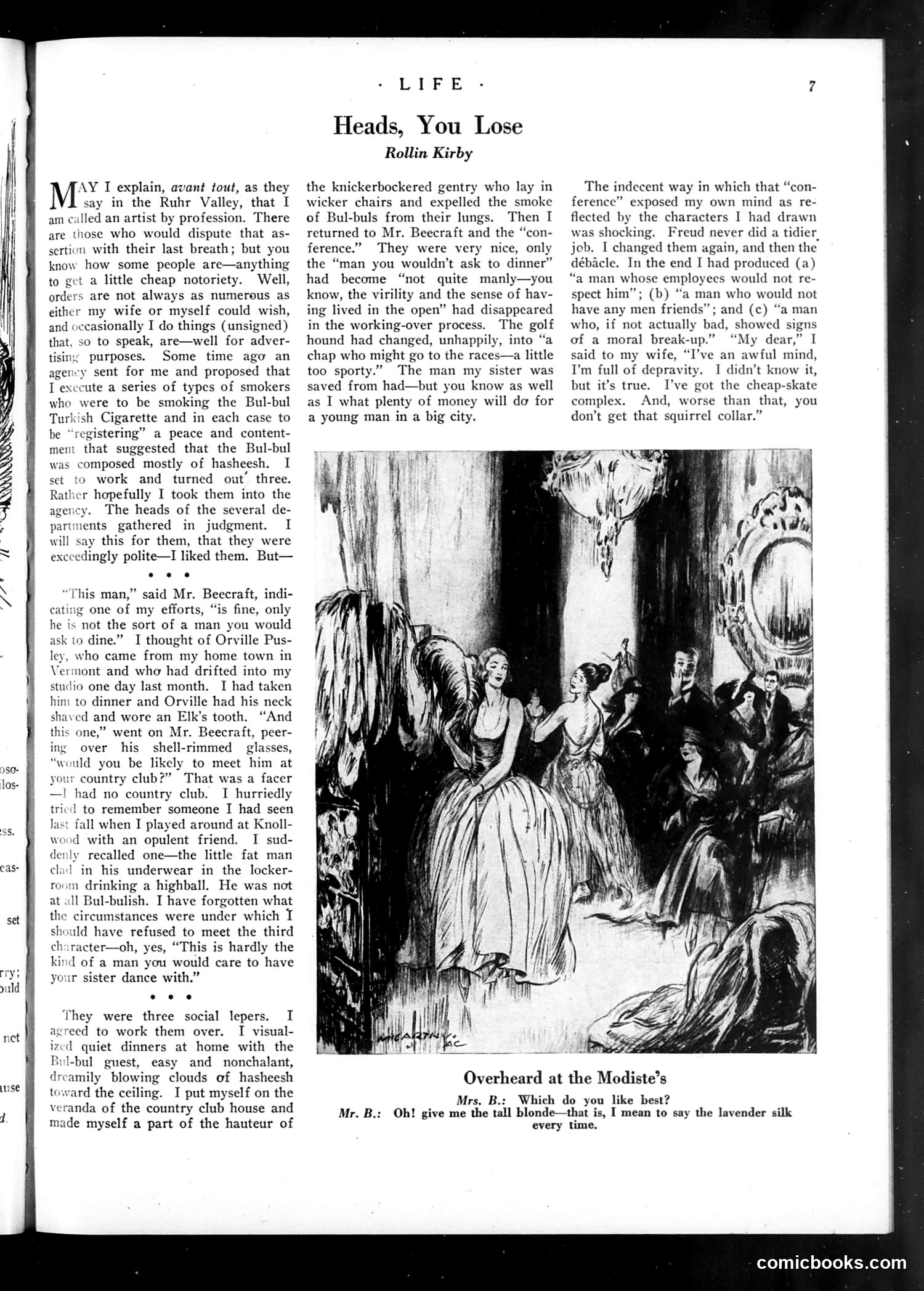
This page contains a short story by Rollin Kirby about social awkwardness among the wealthy. The narrator describes attempting to recruit smokers for a Bull-bul Turkish Cigarette advertising campaign, specifically targeting men from prominent families. Mr. Beercraft becomes the reluctant subject of this scheme. The accompanying illustration, captioned "Overheard at the Modiste's," depicts a social scene at a dressmaker's shop. The caption shows Mrs. B. praising a particular style of silk to Mr. B., with the satirical humor suggesting the superficiality of high-society conversations—women caring primarily about material appearance and fabric quality rather than substantive matters. The sketch ridicules the vapidity of wealthy social circles.
📄 Transcribed text from this page (OCR, searchable)
Machine-transcribed from the original scan — historical spelling and the odd misread are preserved.
AY I explain, avant tout, as they say in the Ruhr Valley, that I am culled an artist by profession. There are those who would dispute that as- sertion with their last breath; but you know how some people are—anything get a little cheap notoriety. Well, s are not always as numerous as my wife or myself could wish, and occasionally I do things (unsigned) that, so to speak, are—well for adver- tis purposes. Some time ago an y sent for me and proposed that I execute a series of types of smokers who were to be smoking the Bul-bul Turkish Cigarette and in each case to be “registering” a peace and content- ment that suggested that the Bul-bul was composed mostly of hasheesh. I set to work and turned out’ three. Rather hopefully I took them into the agel The heads of the several de- partments gathered in judgment. I will say this for them, that they were exceedingly polite—I liked them. But— eee “This man,” said Mr. Beecraft, indi- cating one of my efforts, “is fine, only he is not the sort of a man you would ask to dine.” I thought of Orville Pus- ley, who came from my home town in Vermont and who had drifted into my studio one day last month. I had taken him to dinner and Orville had his neck shaved and wore an Elk’s tooth. “And this one,” went on Mr. Beecraft, peer- ing over his shell-rimmed glasses, “would you be likely to meet him at your country club?” That was a facer —! had no country club. I hurriedly to remember someone I had seen t when I played around at Knoll- wood with an opulent friend. I sud- denly recalled one—the little fat man clad in his underwear in the locker- room drinking a highball. He was not at all Bul-bulish. I have forgotten what the circumstances were under which T should have refused to meet the third character—oh, yes, “This is hardly the kind of a man you would care to have your sister dance with.” “hey were three social lepers. I greed to work them over. I visual- ized quiet dinners at home with the Bul-bul guest, easy and nonchalant, nily blowing clouds of hasheesh ard the ceiling. I put myself on the veranda of the country club house and made myself a part of the hauteur of LIFE Heads, You Lose Rollin Kirby the knickerbockered gentry who lay in wicker chairs and expelled the smoke of Bul-buls from their lungs. Then I returned to Mr. Beecraft and the “con- ference.” They were very nice, only the “man you wouldn’t ask to dinner” had become “not quite manly—you know, the virility and the sense of hav- ing lived in the open” had disappeared in the working-over process. The golf hound had changed, unhappily, into “a chap who might go to the races—a little too sporty.” The man my sister was saved from had—but you know as well as I what plenty of money will do for a young man in a big city. The indecent way in which that “con- ference” exposed my own mind as re- flected by the characters I had drawn was shocking. Freud never did a tidier, job. I changed them again, and then the débacle. In the end I had produced (a) “a man whose employees would not re- spect him”; (b) “a man who would not have any men friends”; and (c) “a man who, if not actually bad, showed signs of a moral break-up.” “My dear,” I said to my wife, “I’ve an awful mind, I’m full of depravity. I didn’t know it, but it’s true. I’ve got the cheap-skate complex. And, worse than that, you don’t get that squirrel collar.” F Overheard at the Modiste’s Mrs. B.: Mr. B.: Which do you like best? Oh! give me the tall blonde—that is, I mean to say the lavender silk every time. comicbooks.com