
Life, 1922-01-12 · page 24 of 34
Life — January 12, 1922 — page 24: what you’re looking at
What you’re looking at
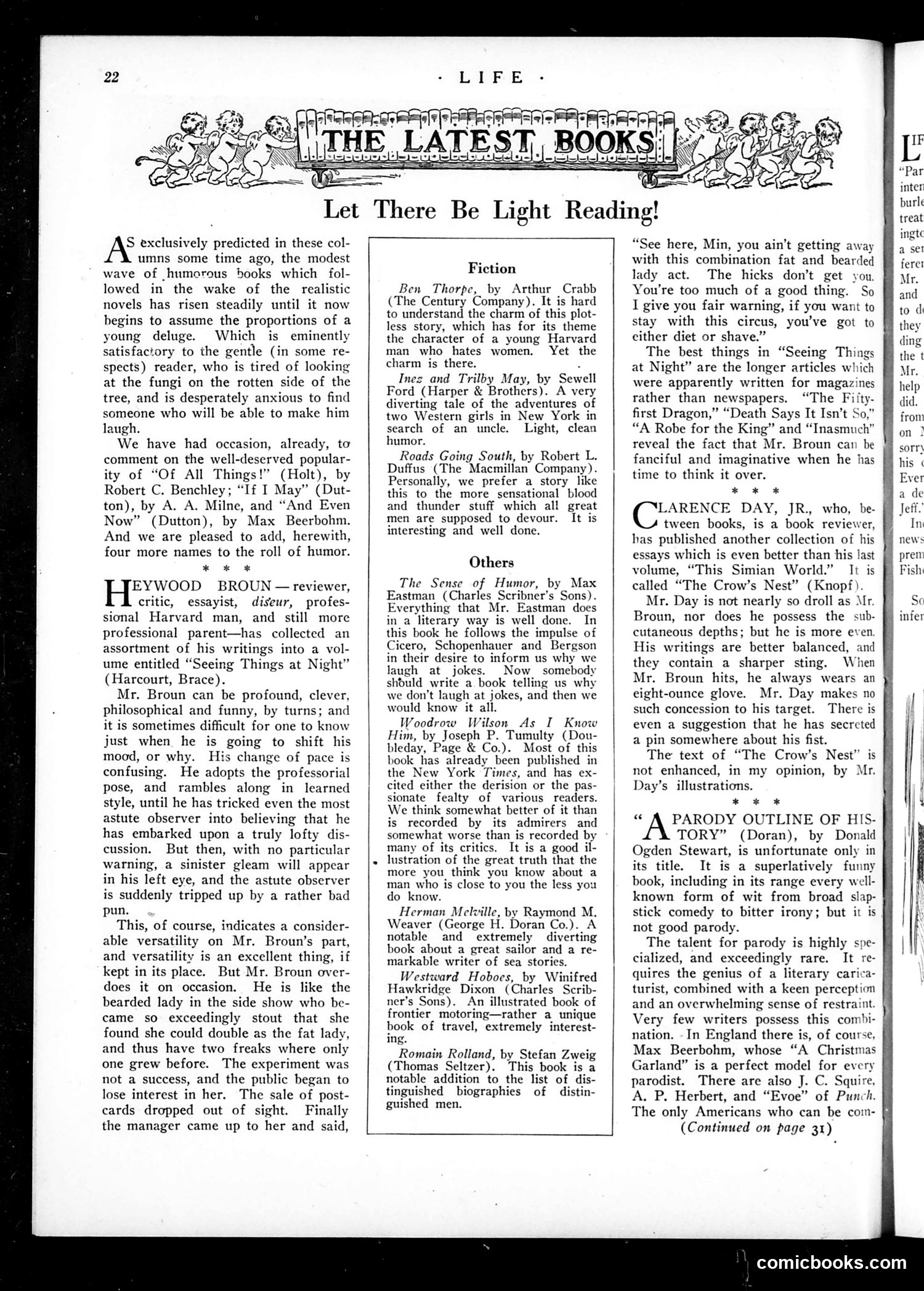
This is a straightforward book review column, not political satire. The page discusses a recent surge in humorous literature following the popularity of serious realistic novels. The reviewer celebrates this shift, noting readers are "desperately anxious" for humor after consuming heavy fiction. The column reviews several books, including works by Heywood Broun (essayist and critic), whose collected writings the reviewer praises for versatility while noting he sometimes overextends his range—compared amusingly to a sideshow performer who became both bearded lady and fat lady, confusing audiences. Other reviewed titles include fiction like *Ben Thorpe* and *Inez and Trilby May*, Max Eastman's philosophical *The Sense of Humor*, and notably Joseph Tumulty's memoir about President Woodrow Wilson, which the reviewer treats diplomatically as mediocre despite passionate defenders and detractors. The decorated header with cherubs and books emphasizes the lighthearted tone. This represents Life magazine's literary criticism function during the early 1920s.
📄 Transcribed text from this page (OCR, searchable)
Machine-transcribed from the original scan — historical spelling and the odd misread are preserved.
ey Let There Be Light Reading! S exclusively predicted in these col- umns some time ago, the modest wave of humorous books which fol- lowed in the wake of the realistic novels has risen steadily until it now begins to assume the proportions of a young deluge. Which is eminently satisfactory to the gentle (in some re- spects) reader, who is tired of looking at the fungi on the rotten side of the tree, and is desperately anxious to find someone who will be able to make him laugh. We have had occasion, already, to comment on the well-deserved popular- ity of “Of All Things!” (Holt), by Robert C. Benchley; “If I May” (Dut- ton), by A. A. Milne, and “And Even Now” (Dutton), by Max Beerbohm. And we are pleased to add, herewith, four more names to the roll of humor. * * EYWOOD BROUN —reviewer, critic, essayist, diseur, profes- sional Harvard man, and still more professional parent—has collected an assortment of his writings into a vol- ume entitled “Seeing Things at Night” (Harcourt, Brace). Mr. Broun can be profound, clever, philosophical and funny, by turns; and it is sometimes difficult for one to know just when he is going to shift his mood, or why. His change of pace is confusing. He adopts the professorial pose, and rambles along in learned style, until he has tricked even the most astute observer into believing that he has embarked upon a truly lofty dis- cussion. But then, with no particular warning, a sinister gleam will appear in his left eye, and the astute observer is suddenly tripped up by a rather bad pun. This, of course, indicates a consider- able versatility on Mr. Broun’s part, and versatility is an excellent thing, if kept in its place. But Mr. Broun over- does it on occasion. He is like the bearded lady in the side show who be- came so exceedingly stout that she found she could double as the fat lady, and thus have two freaks where only one grew before. The experiment was not a success, and the public began to lose interest in her. The sale of post- cards dropped out of sight. Finally the manager came up to her and said, Fiction Ben Thorpe, by Arthur Crabb (The Century Company). It is hard to understand the charm of this plot- less story, which has for its theme the character of a young Harvard man who hates women. Yet the charm is there. . Inez and Trilby May, by Sewell Ford (Harper & Brothers). A very diverting tale of the adventures of two Western girls in New York in search of an uncle. Light, clean humor. Roads Going South, by Robert L. Duffus (The Macmillan Company). Personally, we prefer a story like this to the more sensational blood and thunder stuff which all great men are supposed to devour. It is interesting and well done. Others The Sense of Humor, by Max Eastman (Charles Scribner’s Sons). Everything that Mr. Eastman does in a literary way is well done. In this book he follows the impulse of Cicero, Schopenhauer and Bergson in their desire to inform us why we laugh at jokes. Now somebody should write a book telling us why we don’t laugh at jokes, and then we would know it all. Woodrow Wilson. As I Know Him, by Joseph P. Tumulty (Dou- bleday, Page & Co.). Most of this book has already been published in the New York Times, and has ex- cited either the derision or the pas- sionate fealty of various readers. We think somewhat better of it than is recorded by its admirers and somewhat worse than is recorded by many of its critics. It is a good il- lustration of the great truth that the more you think you know about a man who is close to you the less you do know. Herman Melville, by Raymond M. Weaver (George H. Doran Co.). A notable and extremely diverting book about a great sailor and a re- markable writer of sea stories. Westward Hoboes, by Winifred Hawkridge Dixon (Charles Scrib- ner’s Sons). An illustrated book of frontier motoring—rather a unique book of travel, extremely interest- ing. Romain Rolland, by Stefan Zweig (Thomas Seltzer). This book is a notable addition to the list of dis- tinguished biographies of distin- guished men. “See here, Min, you ain't getting away with this combination fat and bearded lady act. The hicks don’t get you. You're too much of a good thing. So I give you fair warning, if you want to stay with this circus, you’ve got to either diet or shave.” The best things in “Seeing Things at Night” are the longer articles which were apparently written for magaz rather than newspapers. “The first Dragon,” “Death Says It Isn’t So, “A Robe for the King” and “Inasmuch’ reveal the fact that Mr. Broun can be fanciful and imaginative when he has time to think it over. * * * LARENCE DAY, JR., who, be- tween books, is a book reviewer, has published another collection of his essays which is even better than his last volume, “This Simian World.” It is called “The Crow’s Nest” (Knopf). Mr. Day is not nearly so droll as Mr. Broun, nor does he possess the sub- cutaneous depths; but he is more even. His writings are better balanced, and they contain a sharper sting. When Mr. Broun hits, he always wears an eight-ounce glove. Mr. Day makes no such concession to his target. There is even a suggestion that he has secreted a pin somewhere about his fist. The text of “The Crow’s Nest” is not enhanced, in my opinion, by Mr. Day’s illustrations. * * * ss PARODY OUTLINE OF HIS- TORY” (Doran), by Donald Ogden Stewart, is unfortunate only in its title. It is a superlatively funny book, including in its range every well- known form of wit from broad slap- stick comedy to bitter irony; but it is not good parody. The talent for parody is highly spe- cialized, and exceedingly rare. It re- quires the genius of a literary carica- [ turist, combined with a keen perception and an overwhelming sense of restraint. Very few writers possess this combi nation. -In England there is, of course, Max Beerbohm, whose “A Christmas Garland” is a perfect model for every parodist. There are also J. C. Squire, 7 A. P. Herbert, and “Evoe” of Punch. The only Americans who can be com- (Continued on page 31) “Par inter burl treat ingtc a ser feret Mr. and to d they ding the t Mr. help did. from on | sorry comicbooks.com