
Life, 1922-01-12 · page 5 of 34
Life — January 12, 1922 — page 5: what you’re looking at
What you’re looking at
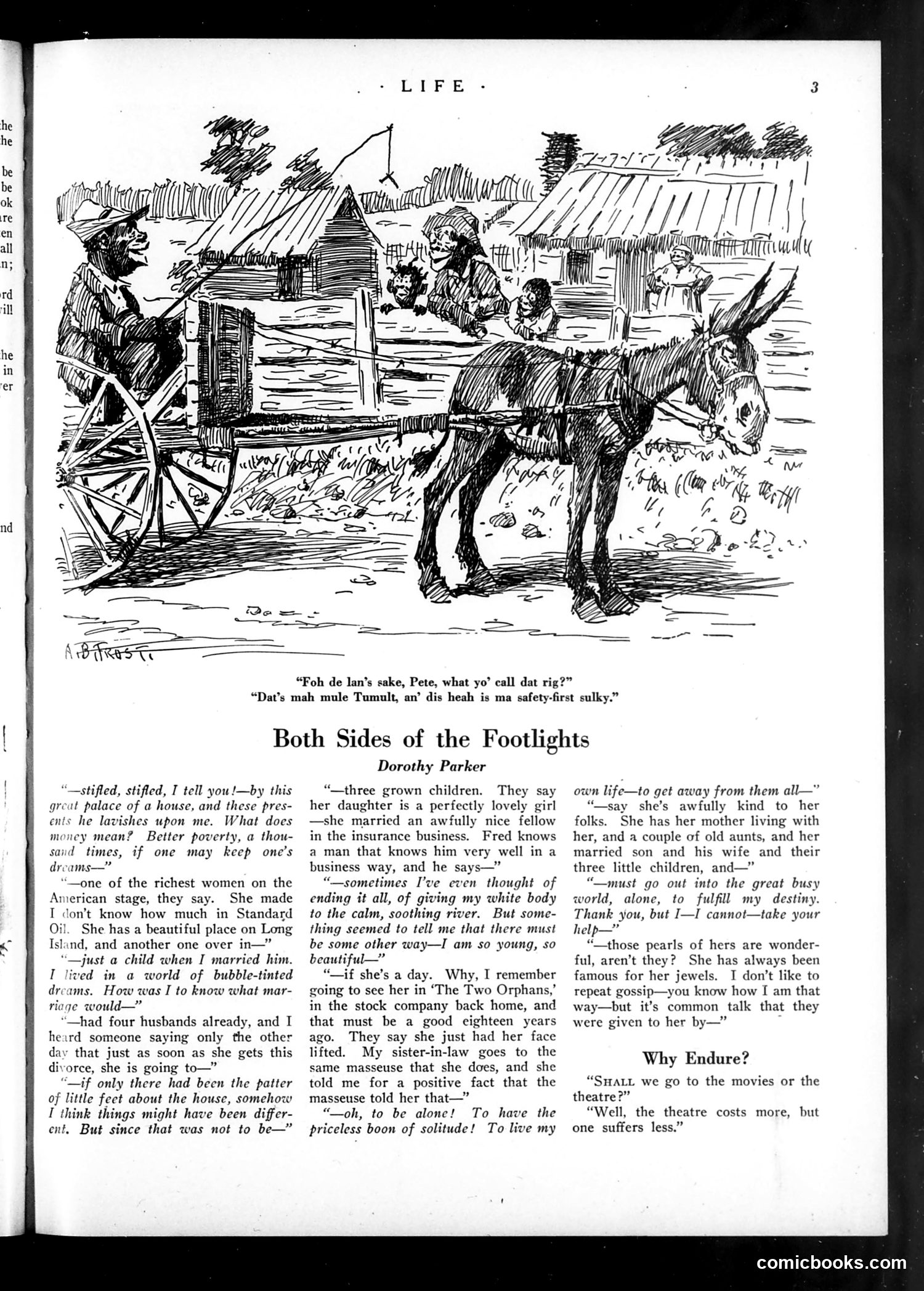
The main illustration shows a rural farm scene with a man operating a mule-drawn cart, depicting working-class agricultural life. The caption uses dialect humor: "Foh de lan's sake, Pete, what yo' call dis rig?" / "Dat's mah mule Tumult, an' dis heah is ma safety-first sulky." This satirizes the "safety-first" industrial movement popular in early 20th-century America—a workplace safety campaign that became widespread corporate messaging. The joke mocks applying this modern, urban safety rhetoric to rural farming with a mule and cart, suggesting the gap between industrial workplace concerns and rural life. The accompanying article "Both Sides of the Footlights" by Dorothy Parker discusses theatrical life and gossip, unrelated to the cartoon.
📄 Transcribed text from this page (OCR, searchable)
Machine-transcribed from the original scan — historical spelling and the odd misread are preserved.
e f} fit | “Foh de lan’s sake, Pete, what yo’ call dat rig?” “Dat’s mah mule Tumult, an’ dis heah is ma safety-first sulky.” Both Sides of the Footlights “stifled, stifled, I tell you!—by this great palace of a house, and these pres- ents he lavishes upon me. What does ney mean? Better poverty, a thou- said times, if one may keep one’s dreams—” “—one of the richest women on the American stage, they say. She made I don’t know how much in Standard Oil. She has a beautiful place on Long Island, and another one over in—” “—just a child when I married him. I lived in a world of bubble-tinted dreams. How was I to know what mar- riage would—’ “—had four husbands already, and I heard someone saying only the other day that just as soon as she gets this divorce, she is going to—” “—if only there had been the patter of little feet about the house, somehow I think things might have been differ- ent. But since that was not to be—” Dorothy Parker “—three grown children. They say her daughter is a perfectly lovely girl —she married an awfully nice fellow in the insurance business. Fred knows a man that knows him very well in a business way, and he says—” “—sometimes I’ve even thought of ending it all, of giving my white body to the calm, soothing river. But some- thing seemed to tell me that there must be some other way—I am so young, so beautiful—’ “_if she’s a day. Why, I remember going to see her in ‘The Two Orphans,’ in the stock company back home, and that must be a good eighteen years ago. They say she just had her face lifted. My sister-in-law goes to the same masseuse that she does, and she told me for a positive fact that the masseuse told her that—” “—oh, to be alone! To have the priceless boon of solitude! To live my own life—to get away from them all—” “say she’s awfully kind to her folks. She has her mother living with her, and a couple of old aunts, and her married son and his wife and their three little children, and—” “—must go out into the great busy world, alone, to fulfill my destiny. Thank you, but I—I cannot—take your help—’ “those pearls of hers are wonder- ful, aren’t they? She has always been famous for her jewels. I don’t like to repeat gossip—you know how I am that way—but it’s common talk that they were given to her by—” Why Endure? “SHALL we go to the movies or the theatre?” “Well, the theatre costs more, but one suffers less.” comicbooks.com