
Life, 1922-01-12 · page 30 of 34
Life — January 12, 1922 — page 30: what you’re looking at
What you’re looking at
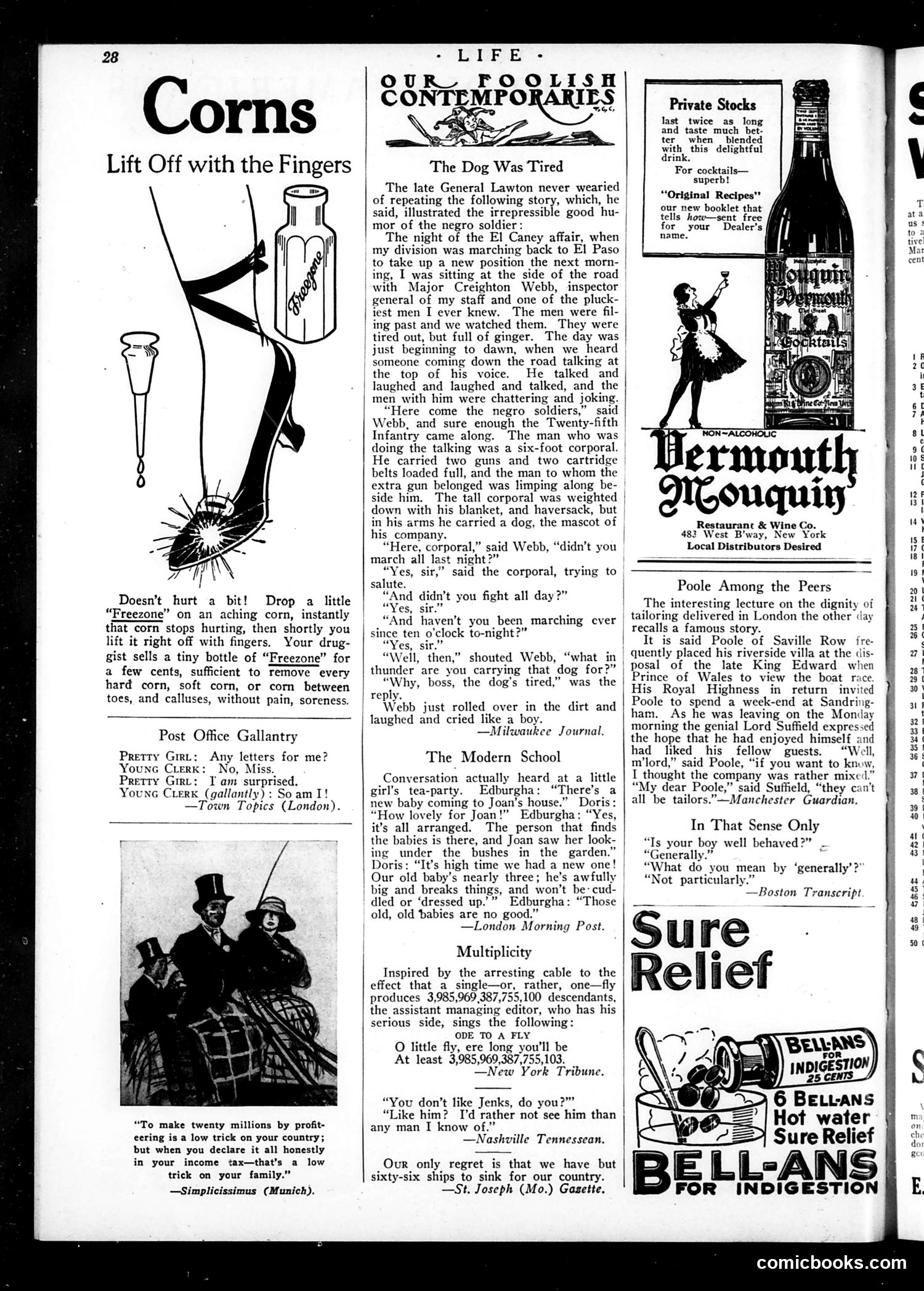
This page from *Life* magazine contains humorous anecdotes and advertisements typical of early 20th-century American satire. **Main Content:** The "Corns" section is a Freezone product advertisement disguised as helpful advice. **Notable Anecdotes:** - **"The Dog Was Tired"**: A story attributed to General Lawton about a Black soldier during the Spanish-American War (El Caney battle) who carries an exhausted dog despite his own exhaustion. The humor relies on the soldier's illogical reasoning ("the dog's tired"), presented as evidence of good humor among Black troops—a paternalistic stereotype common to the era. - **"The Modern School"**: Girls casually discussing babies appearing under bushes, reflecting period ignorance about reproduction. - **"Post Office Gallantry"** and other short quips offer mild workplace and social humor. The page reflects *Life*'s position as a satirical magazine mixing product ads with commentary on contemporary social attitudes, often reinforcing period stereotypes while claiming satirical intent.
📄 Transcribed text from this page (OCR, searchable)
Machine-transcribed from the original scan — historical spelling and the odd misread are preserved.
Corns Lift Off with the Fingers Doesn’t hurt a bit! Drop a little “Freezone” on an aching corn, instantly that corn stops hurting, then shortly you lift it right off with fingers. Your drug- gist sells a tiny bottle of “Freezone” for a few cents, sufficient to remove every hard corn, soft corn, or corn between toes, and calluses, without pain, soreness. Post Office Gallantry Pretty Giri: Younc CierK: No, Miss. Pretty Girt: I am surprised. YounG Cierk (gallantly) : Soam I! —Town Topics (London). Any letters for me? “To make twenty millions by profit- eering is a low trick on your country; but when you declare it all honestly in your income tax—that’s a low trick on your family.” —Simplicissimus (Munich). The Dog Was Tired The late General Lawton never wearied of repeating the following story, which, he said, illustrated the irrepressible good hu- mor of the negro soldier: The night of the El Caney affair, when my division was marching back to El Paso to take up a new position the next morn- | ing, I was sitting at the side of the road with Major Creighton Webb, inspector general of my staff and one of the pluck- iest men I ever knew. The men were fil- ing past and we watched them, They were tired out, but full of ginger. The day was just beginning to dawn, when we heard someone coming down the road talking at the top of his voice. He talked and | laughed and laughed and talked, and the men with him were chattering and joking, “Here come the negro soldiers,” Infantry came along. The man who was doing the talking was a six-foot corporal. He carried two guns and two cartridge belts loaded full, and the man to whom the extra gun belonged was limping along be- side him. The tall corporal was weighted down with his blanket, and haversack, but in his arms he carried a dog, the mascot of his company. “Here, corporal,” said Webb, “didn’t you march all last night?” “Yes, sir,” said the corporal, salute. | “And didn’t you fight all day?” | “Yes, sir.” “And haven’t you been marching ever since ten o'clock to-night?” | “Yes, sir.” “Well, then,” shouted Webb, “what in thunder are you carrying that dog for?” “Why, boss, the dog's tired,” was the | trying to reply. w ebb just rolled over in the dirt and laughed and cried like a boy. —Milwaukee Journal. The Modern School heard at a little “There’s a Conversation actually girl’s tea-party. Edburgha: new baby coming to Joan’s house.” Doris: “How lovely for Joan!” Edburgha: “Yes, it’s all arranged. The person that finds the babies is there, and Joan saw her look- ing under the bushes in the garden.” Doris: “It’s high time we had a new one! Our old baby’s nearly three; he’s awfully big and breaks things, and won't be-cud- dled or ‘dressed up.’” Edburgha: “Those old, old babies are no good.” —London Morning Post. Multiplicity Inspired by the arresting cable to the effect that a single—or, rather, one—fly produces 3,985,969,387,755,100 descendants, the assistant managing editor, who has his serious side, sings the following: ODE TO A FLY O little fly, ere long you'll be At least 3,985,969,387,755,103. —New York Tribune. “You don’t like Jenks, do you?” “Like him? I'd rather not see him than any man I know of.” —Nashville Tennessean. Our only regret is that we have but sixty-six ships to sink for our country. —St. Joseph (Mo.) Gazette. | said | Webb, and sure enough the Twenty-fifth Private Stocks last twice as long and taste much bet- ter when — blended with this delightful rink, For cocktails— superb! “Original Recipes’* our new booklet that tells how—sent free for your Dealer’s Restaurant & Wine Co. 483 West B’way, New York Local Distributors Desired Poole Among the Peers The interesting lecture on the dignity of tailoring delivered in London the other day recalls a famous story. It is said Poole of Saville Row fre- quently placed his riverside villa at the dis- posal of the late King Edward n Prince of Wales to view the boat 5 His Royal Highness in return invited Poole to spend a week-end at Sandring- ham. As he was leaving on the Monday morning the genial Lord Suffield expressed the hope that he had enjoyed himsel had liked his fellow guests. “Well, m’lord,” said Poole, “if you want to know, I thought the company was rather mixc‘ “My dear Poole,” said Suffield, “they can't all be tailors.”—Manchester Guardian. In That Sense Only “Is your boy well behaved?” ~ “Generally.” “What do you mean by ‘generally’ ?" “Not particularly.” —Boston Transcript Sure = 6 BELL-ANS Hot water Les, Sure Relief i] FOR INDIGESTION Ss Ns arse comicbooks.com