
Life, 1922-01-12 · page 20 of 34
Life — January 12, 1922 — page 20: what you’re looking at
What you’re looking at
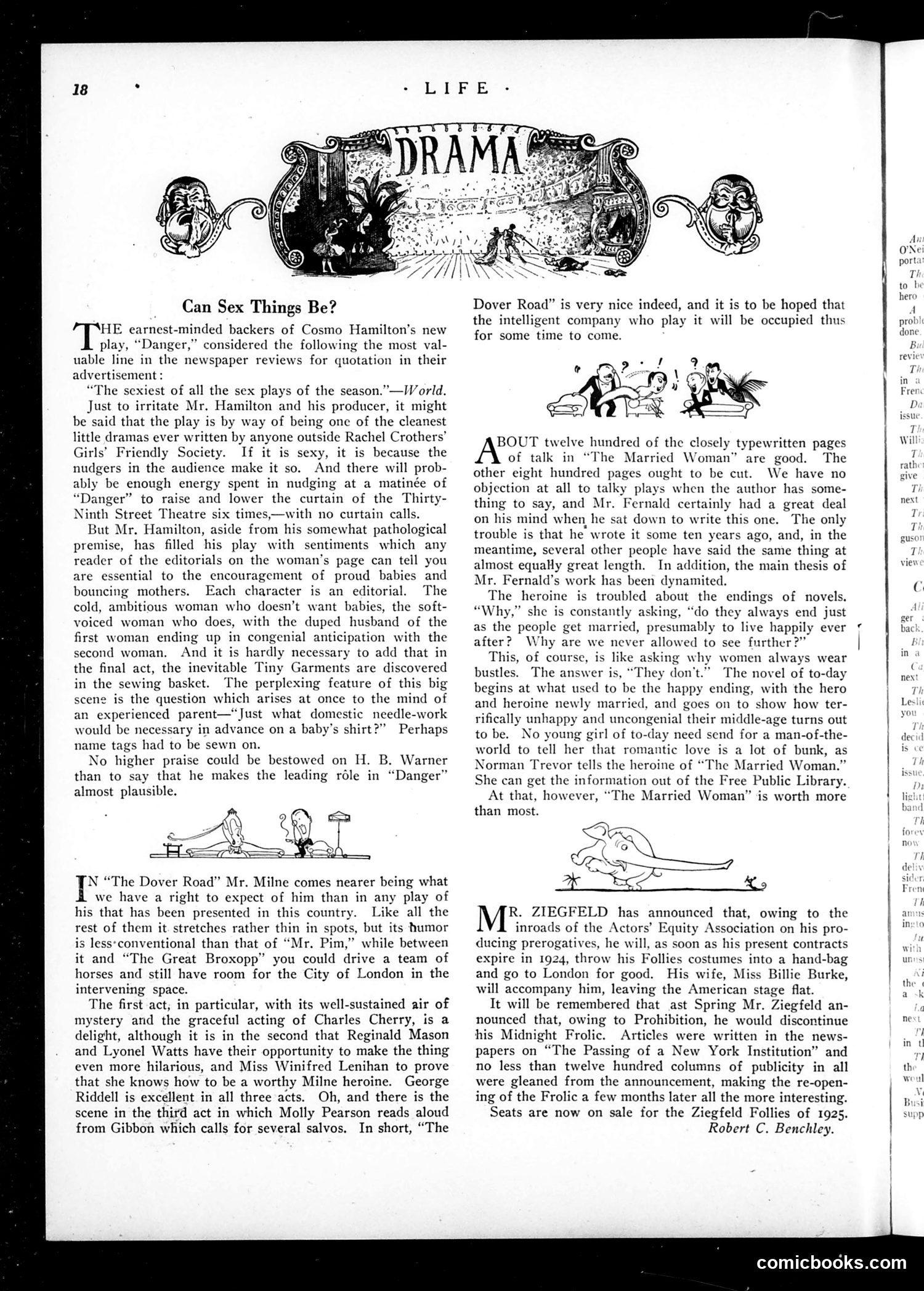
This page satirizes the theatrical pretensions and marketing of contemporary Broadway plays (circa 1920s). The critic skewers three productions: **"Danger"** by Cosmo Hamilton is mocked as fundamentally prudish despite being advertised as "the sexiest" play of the season. Life's writer notes it's actually quite conservative—essentially a morality tale about an ambitious woman, a maternal woman, and a man who predictably ends up with the latter, complete with discovered baby clothes. The satire targets both the play's conventional moralism and the absurdity of audience members finding scandal where none exists. **"The Dover Road"** by A.A. Milne receives genuine praise as competent light comedy with good acting. **"The Married Woman"** by Fernald is criticized as bloated—1,200 pages of dialogue when 400 would suffice—and philosophically outdated, since other playwrights have already explored its central question about why novels end at marriage. The satire throughout mocks theatrical marketing hype, formulaic playwriting, and middlebrow audience expectations of the era.
📄 Transcribed text from this page (OCR, searchable)
Machine-transcribed from the original scan — historical spelling and the odd misread are preserved.
Can Sex Things Be? TE earnest-minded backers of Cosmo Hamilton’s new play, “Danger,” considered the following the most val- uable line in the newspaper reviews for quotation in their advertisement : “The sexiest of all the sex plays of the season.”—IV orld. Just to irritate Mr. Hamilton and his producer, it might be said that the play is by way of being one of the cleanest little dramas ever written by anyone outside Rachel Crothers’ Girls’ Friendly Society. If it is sexy, it is because the nudgers in the audience make it so. And there will prob- ably be enough energy spent in nudging at a matinée of “Danger” to raise and lower the curtain of the Thirty- Ninth Street Theatre six times,—with no curtain calls. But Mr. Hamilton, aside from his somewhat pathological premise, has filled his play with sentiments which any reader of the editorials on the woman’s page can tell you are essential to the encouragement of proud babies and bouncing mothers. Each character is an editorial. The cold, ambitious woman who doesn’t want babies, the soft- voiced woman who does, with the duped husband of the first woman ending up in congenial anticipation with the second woman. And it is hardly necessary to add that in the final act, the inevitable Tiny Garments are discovered in the sewing basket. The perplexing feature of this big scene is the question which arises at once to the mind of an experienced parent—‘“Just what domestic needle-work would be necessary in advance on a baby’s shirt?” Perhaps name tags had to be sewn on. No higher praise could be bestowed on H. B. Warner than to say that he makes the leading rdle in “Danger” almost plausible. N “The Dover Road” Mr. Milne comes nearer being what we have a right to expect of him than in any play of his that has been presented in this country. Like all the rest of them it stretches rather thin in spots, but its humor is less*conventional than that of “Mr. Pim,” while between it and “The Great Broxopp” you could drive a team of horses and still have room for the City of London in the intervening space. The first act, in particular, with its well-sustained air of mystery and the graceful acting of Charles Cherry, is a delight, although it is in the second that Reginald Mason and Lyonel Watts have their opportunity to make the thing even more hilarious, and Miss Winifred Lenihan to prove that she knows how to be a worthy Milne heroine. George Riddell is excellent in all three acts. Oh, and there is the scene in the third act in which Molly Pearson reads aloud from Gibbon which calls for several salvos. In short, “The Dover Road” is very nice indeed, and it is to be hoped that the intelligent company who play it will be occupied thus for some time to come. BOUT twelve hundred of the closely typewritten pages of talk in “The Married Woman” are good. The other eight hundred pages ought to be cut. We have no objection at all to talky plays when the author has some- thing to say, and Mr. Fernald certainly had a great deal on his mind when he sat down to write this one. The only trouble is that he wrote it some ten years ago, and, in the meantime, several other people have said the same thing at almost equally great length. In addition, the main thesis of Mr. Fernald’s work has been dynamited. The heroine is troubled about the endings of novels. “Why,” she is constantly asking, “do they always end just as the people get married, presumably to live happily ever after? Why are we never allowed to see further?” This, of course, is like asking why women always wear bustles. The answer is, “They don't.” The novel of to-day begins at what used to be the happy ending, with the hero and heroine newly married, and goes on to show how ter- rifically unhappy and uncongenial their middle-age turns out to be. No young girl of to-day need send for a man-of-the- world to tell her that romantic love is a lot of bunk, as Norman Trevor tells the heroine of “The Married Woman.” She can get the information out of the Free Public Library. At that, however, “The Married Woman” ‘is worth more than most. Aes 2 < i: n= <a R. ZIEGFELD has announced that, owing to the inroads of the Actors’ Equity Association on his pro- ducing prerogatives, he will, as soon as his present contracts expire in 1924, throw his Follies costumes into a hand-bag and go to London for good. His wife, Miss Billie Burke, will accompany him, leaving the American stage flat. It will be remembered that ast Spring Mr. Ziegfeld an- nounced that, owing to Prohibition, he would discontinue his Midnight Frolic. Articles were written in the news- papers on “The Passing of a New York Institution” and no less than twelve hundred columns of publicity in all were gleaned from the announcement, making the re-open- ing of the Frolic a few months later all the more interesting. Seats are now on sale for the Ziegfeld Follies of 1925. Robert C. Benchley. An ONei porta Th to he hero prol done comicbooks.com