
Life, 1922-01-12 · page 17 of 34
Life — January 12, 1922 — page 17: what you’re looking at
What you’re looking at
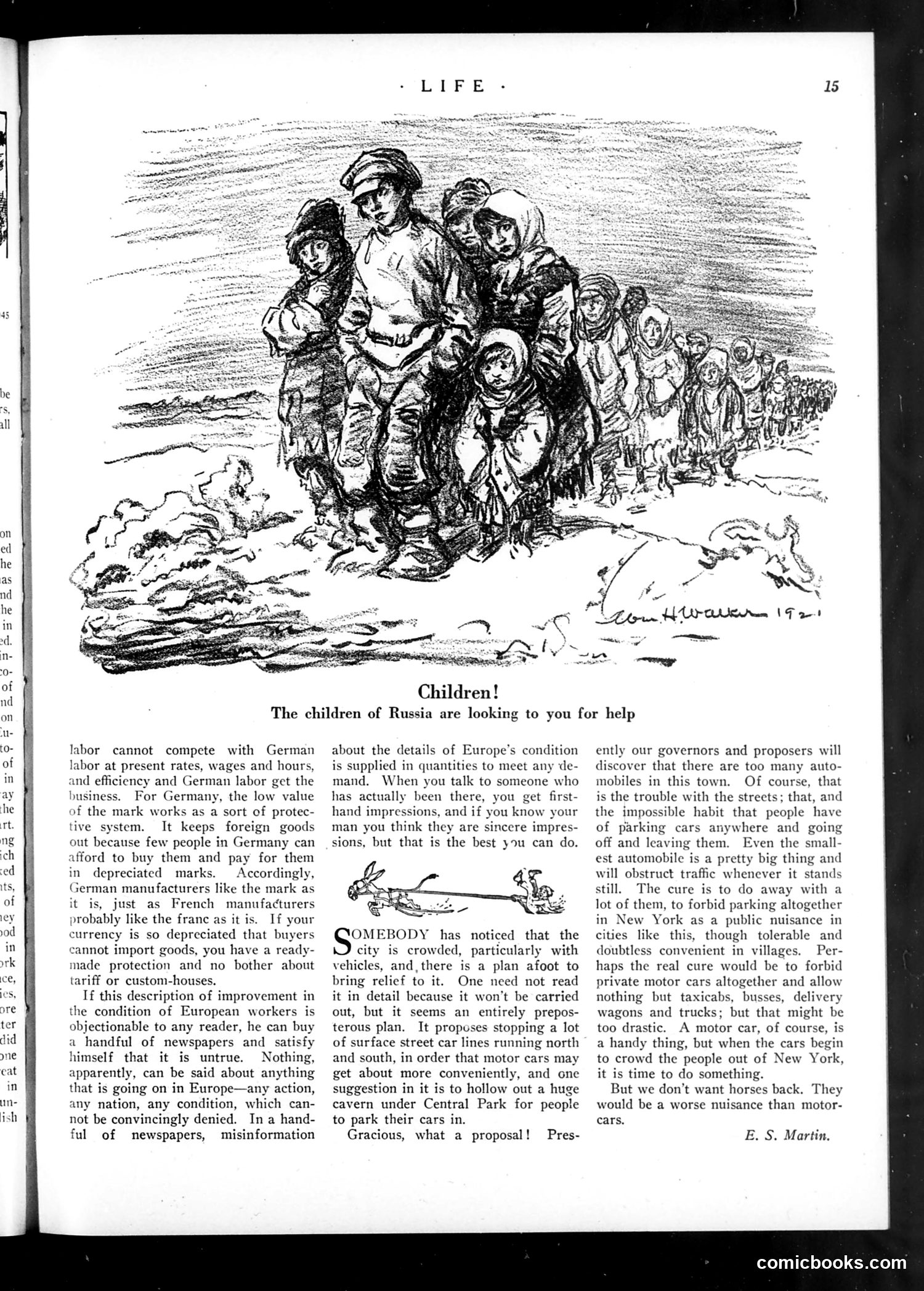
This page combines a political cartoon with editorial commentary on post-WWI conditions. **The Cartoon:** The sketch depicts Russian children in a ragged procession, appearing impoverished and displaced—likely refugees or victims of the Russian Revolution/Civil War. The caption "Children! The children of Russia are looking to you for help" is a humanitarian appeal to American readers. **The Editorial Context:** The accompanying text by E.S. Martin addresses European economic conditions, particularly Germany's depreciated currency (the mark) giving it competitive advantage in labor and manufacturing. The author criticizes sensationalist newspaper coverage of European affairs, contrasting it with firsthand impressions. **The Point:** The cartoon juxtaposes the human suffering in Russia with abstract economic discussion, implicitly asking: while we debate trade policy and currency rates, shouldn't humanitarian aid to desperate children be our priority? It's an appeal to American conscience and generosity during post-war European crisis, criticizing the tendency to reduce human suffering to economic abstractions.
📄 Transcribed text from this page (OCR, searchable)
Machine-transcribed from the original scan — historical spelling and the odd misread are preserved.
Children! The children of Russia are looking to you for help labor cannot compete with German labor at present rates, wages and hours, and efficiency and German labor get the business. For Germany, the low value of the mark works as a sort of protec- ive system. It keeps foreign goods out because few people in Germany can afford to buy them and pay for them in depreciated marks. Accordingly, German manufacturers like the mark as it is, just as French manufacturers probably like the franc as it is. If your currency is so depreciated that buyers cannot import goods, you have a ready- made protection and no bother about tariff or custom-houses. If this description of improvement in the condition of European workers is objectionable to any reader, he can buy a handful of newspapers and satisfy himself that it is untrue. Nothing, apparently, can be said about anything that is going on in Europe—any action, any nation, any condition, which can- not be convincingly denied. In a hand- ful of newspapers, misinformation about the details of Europe’s condition is supplied in quantities to meet any de- mand. When you talk to someone who has actually been there, you get first- hand impressions, and if you know your man you think they are sincere impres- sions, but that is the best you can do. ape has noticed that the city is crowded, particularly with vehicles, and, there is a plan afoot to bring relief to it. One need not read it in detail because it won't be carried out, but it seems an entirely prepos- terous plan. It proposes stopping a lot of surface street car lines running north and south, in order that motor cars may get about more conveniently, and one suggestion in it is to hollow out a huge cavern under Central Park for people to park their cars in. Gracious, what a proposal! Pres- ently our governors and proposers will discover that there are too many auto- mobiles in this town. Of course, that is the trouble with the streets; that, and the impossible habit that people have of parking cars anywhere and going off and leaving them. Even the small- est automobile is a pretty big thing and will obstruct traffic whenever it stands still. The cure is to do away with a lot of them, to forbid parking altogether in New York as a public nuisance in cities like this, though tolerable and doubtless convenient in villages. Per- haps the real cure would be to forbid private motor cars altogether and allow nothing but taxicabs, busses, delivery wagons and trucks; but that might be too drastic. A motor car, of course, is a handy thing, but when the cars begin to crowd the people out of New York, it is time to do something. But we don’t want horses back. They would be a worse nuisance than motor- cars, E. S. Martin. comicbooks.com