
Life, 1922-01-12 · page 16 of 34
Life — January 12, 1922 — page 16: what you’re looking at
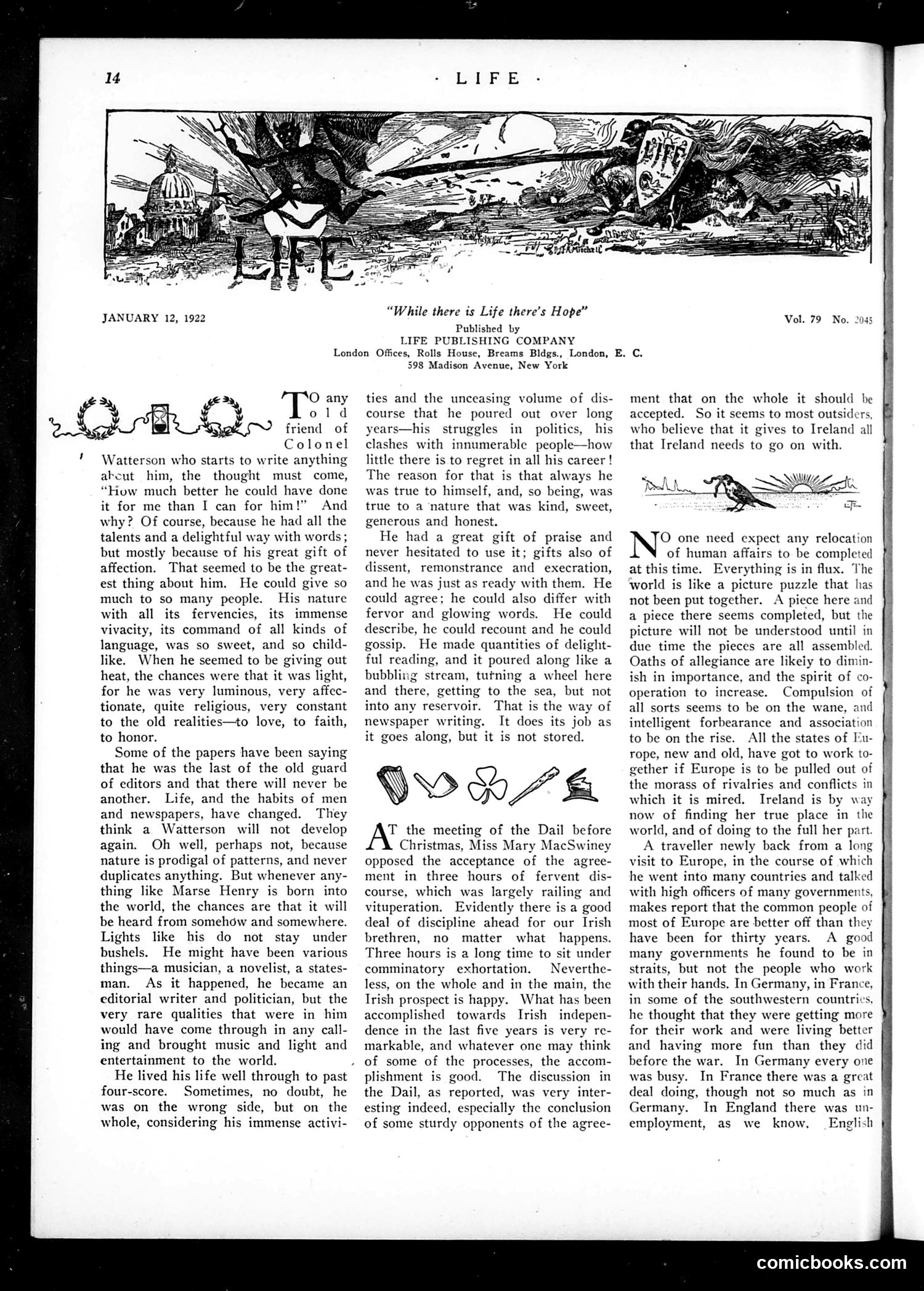
What you’re looking at
This page is primarily **text-based editorial content**, not a political cartoon. The article discusses **Colonel Waterson**, an editor and politician, praising his qualities as a writer and public figure. The piece celebrates his abilities in "praise and never hesitated to use it" and notes his gifts for "dissent, remonstrance and execration." The small decorative illustrations are merely **ornamental flourishes** (laurel wreaths, small sketches) rather than satirical cartoons. The accompanying discussion of Irish independence and European post-war conditions appears serious rather than satirical. Without identifying the specific Waterson referenced, the page functions as **commemorative journalism** rather than satire, typical of Life's mix of commentary and eulogy during this period.
📄 Transcribed text from this page (OCR, searchable)
Machine-transcribed from the original scan — historical spelling and the odd misread are preserved.
JANUARY 12, 1922 “While there is Life there’s Hope” Published by LIFE PUBLISHING COMPANY Vol. 79 No. 2045 London Offices, Rolls House, Breams Bldgs., London, E. C. O any old friend of Colonel Watterson who starts to write anything akcut him, the thought must come, “How much better he could have done it for me than I can for him!” And why? Of course, because he had all the talents and a delightful way with words; but mostly because of his great gift of affection. That seemed to be the great- est thing about him. He could give so much to so many people. His nature with all its fervencies, its immense vivacity, its command of all kinds of language, was so sweet, and so child- like. When he seemed to be giving out heat, the chances were that it was light, for he was very luminous, very affec- tionate, quite religious, very constant to the old realities—to love, to faith, to honor. Some of the papers have been saying that he was the last of the old guard of editors and that there will never be another. Life, and the habits of men and newspapers, have changed. They think a Watterson will not develop again. Oh well, perhaps not, because nature is prodigal of patterns, and never duplicates anything. But whenever any- thing like Marse Henry is born into the world, the chances are that it will be heard from somehow and somewhere. Lights like his do not stay under bushels. He might have been various things—a musician, a novelist, a states- man. As it happened, he became an editorial writer and politician, but the very rare qualities that were in him would have come through in any call- ing and brought music and light and entertainment to the world. He lived his life well through to past four-score. Sometimes, no doubt, he was on the wrong side, but on the whole, considering his immense activi- 598 Madison Avenue, New York ties and the unceasing volume of dis- course that he poured out over long years—his struggles in polit his clashes with innumerable people—how little there is to regret in all his career ! The reason for that is that always he was true to himself, and, so being, was true to a nature that was kind, sweet, generous and honest. He had a great gift of praise and never hesitated to use it; gifts also of dissent, remonstrance and execration, and he was just as ready with them. He could agree; he could also differ with fervor and glowing words. He could describe, he could recount and he could gossip. He made quantities of delight- ful reading, and it poured along like a bubbling stream, tufning a wheel here and there, getting to the sea, but not into any reservoir. That is the way of newspaper writing. It does its job as it goes along, but it is not stored. VY HAE T the meeting of the Dail before Christmas, Miss Mary MacSwiney opposed the acceptance of the agree- ment in three hours of fervent dis- course, which was largely railing and vituperation. Evidently there is a good deal of discipline ahead for our Irish brethren, no matter what happens. Three hours is a long time to sit under comminatory exhortation. Neverthe- less, on the whole and in the main, the Trish prospect is happy. What has been accomplished towards Irish indepen- dence in the last five years is very re- markable, and whatever one may think of some of the processes, the accom- plishment is good. The discussion in the Dail, as reported, was very inter- esting indeed, especially the conclusion of some sturdy opponents of the agree- ment that on the whole it should be accepted. So it seems to most outsiders, who believe that it gives to Ireland all that Ireland needs to go on with. O one need expect any relocation of human affairs to be completed at this time. Everything is in flux. The world is like a picture puzzle that has not been put together. A piece here and a piece there seems completed, but the picture will not be understood until in due time the pieces are all assembled. Oaths of allegiance are likeiy to dimin- ish in importance, and the spirit of co- operation to increase. Compulsion of all sorts seems to be on the wane, and intelligent forbearance and association to be on the rise. All the states of Eu- rope, new and old, have got to work to- gether if Europe is to be pulled out of the morass of rivalries and conflicts in which it is mired. Ireland is by way now of finding her true place in the world, and of doing to the full her part. A traveller newly back from a long visit to Europe, in the course of which he went into many countries and talked with high officers of many governments, makes report that the common people of most of Europe are better off than they have been for thirty years. A good many governments he found to be in straits, but not the people who work with their hands. In Germany, in France, in some of the southwestern countries, he thought that they were getting more for their work and were living better and having more fun than they did before the war. In Germany every one was busy. In France there was a great deal doing, though not so much as in Germany. In England there was un- employment, as we know. English comicbooks.com