
A complete issue · 34 pages · 1922
Life — January 5, 1922
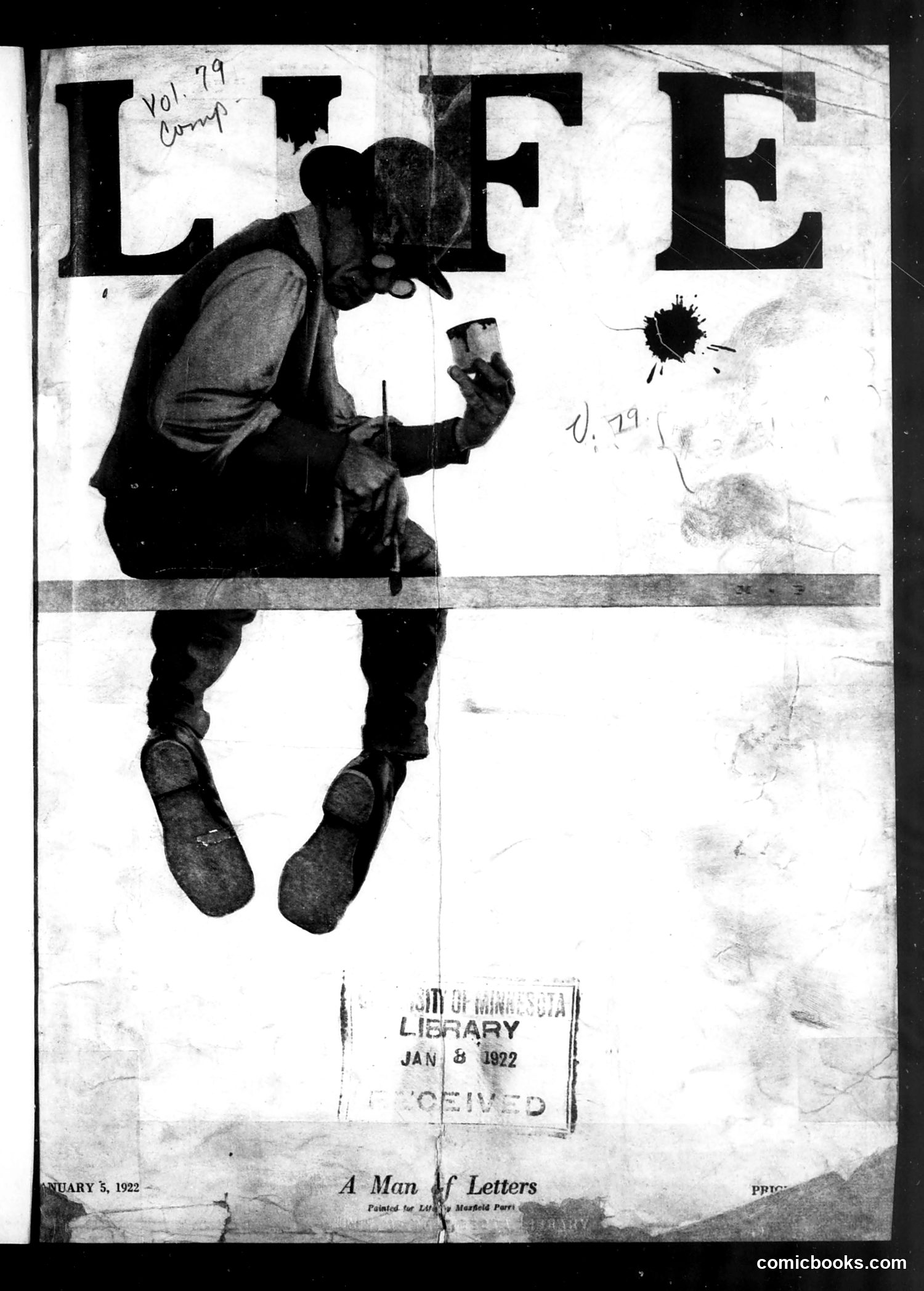
This cartoon depicts a figure suspended in mid-air, apparently falling or floating, clutching what appears to be a small card or letter. The title "A Man of Letters" is a pun—literally showing someone defined by correspondence rather than accomplishment. The satirical point likely mocks someone prominent in 1922 whose primary activity or notoriety involved written communication (letters, statements, or documents) rather than substantive action. Without clearer identification of the specific figure or accompanying article context, the exact target is unclear, though the exaggerated pose and precarious position suggest ridicule of someone whose reputation rests on words alone rather than concrete deeds. The library stamp dates this to January 1922.
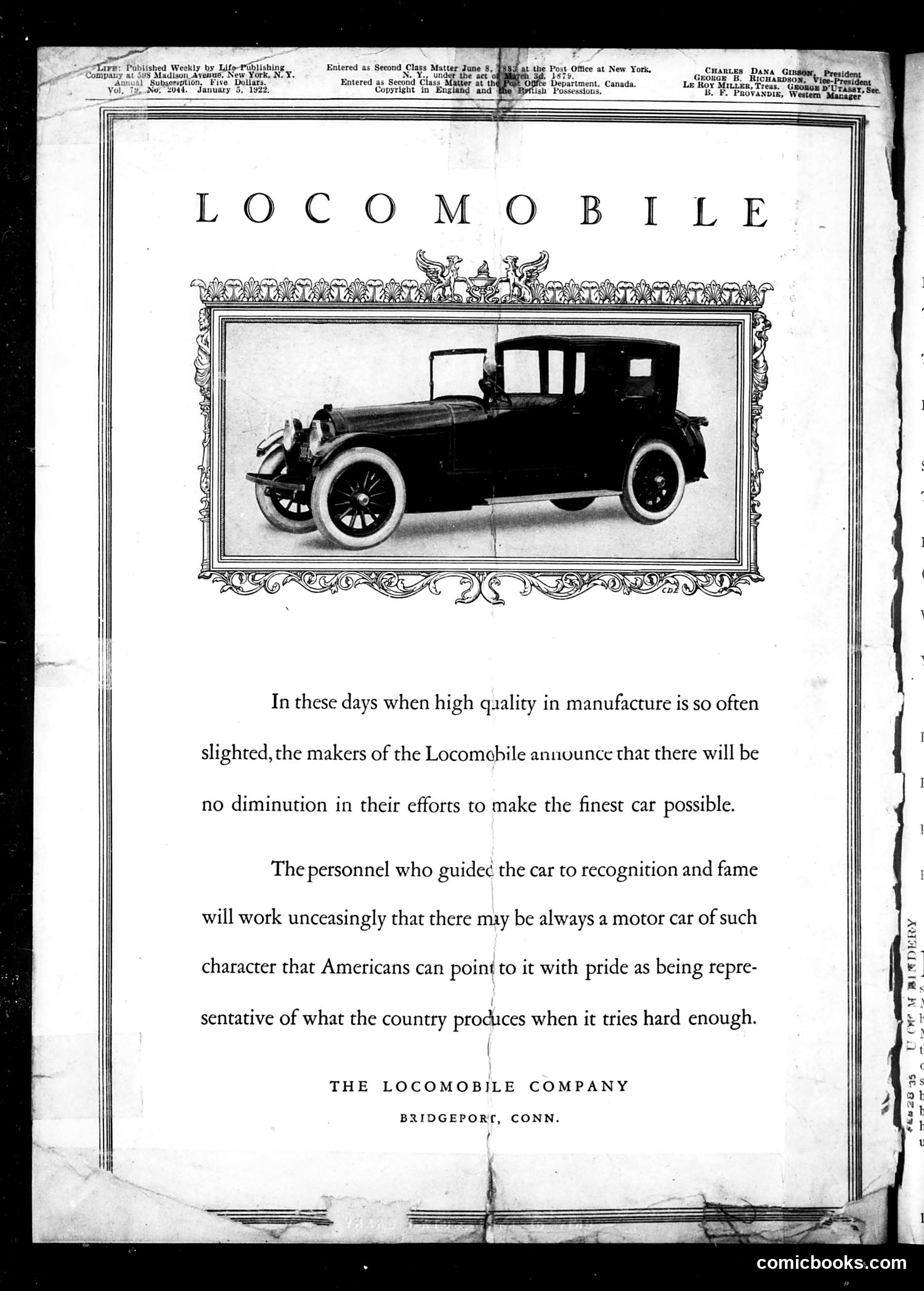
This is not a satirical cartoon but rather a **straightforward automobile advertisement** for the Locomobile Company of Bridgeport, Connecticut, published in Life magazine on January 5, 1922. The ad features a photograph of an early 1920s touring car and appeals to American pride and quality manufacturing. The text emphasizes that despite economic pressures of the era ("when high quality in manufacture is so often slighted"), Locomobile remains committed to producing "the finest car possible." It's a luxury car advertisement positioning the vehicle as representative of American industrial excellence and craftsmanship. There is no political satire or cartoon present—this is purely commercial advertising copy from the post-World War I era, when American manufacturing prowess was a source of national pride.
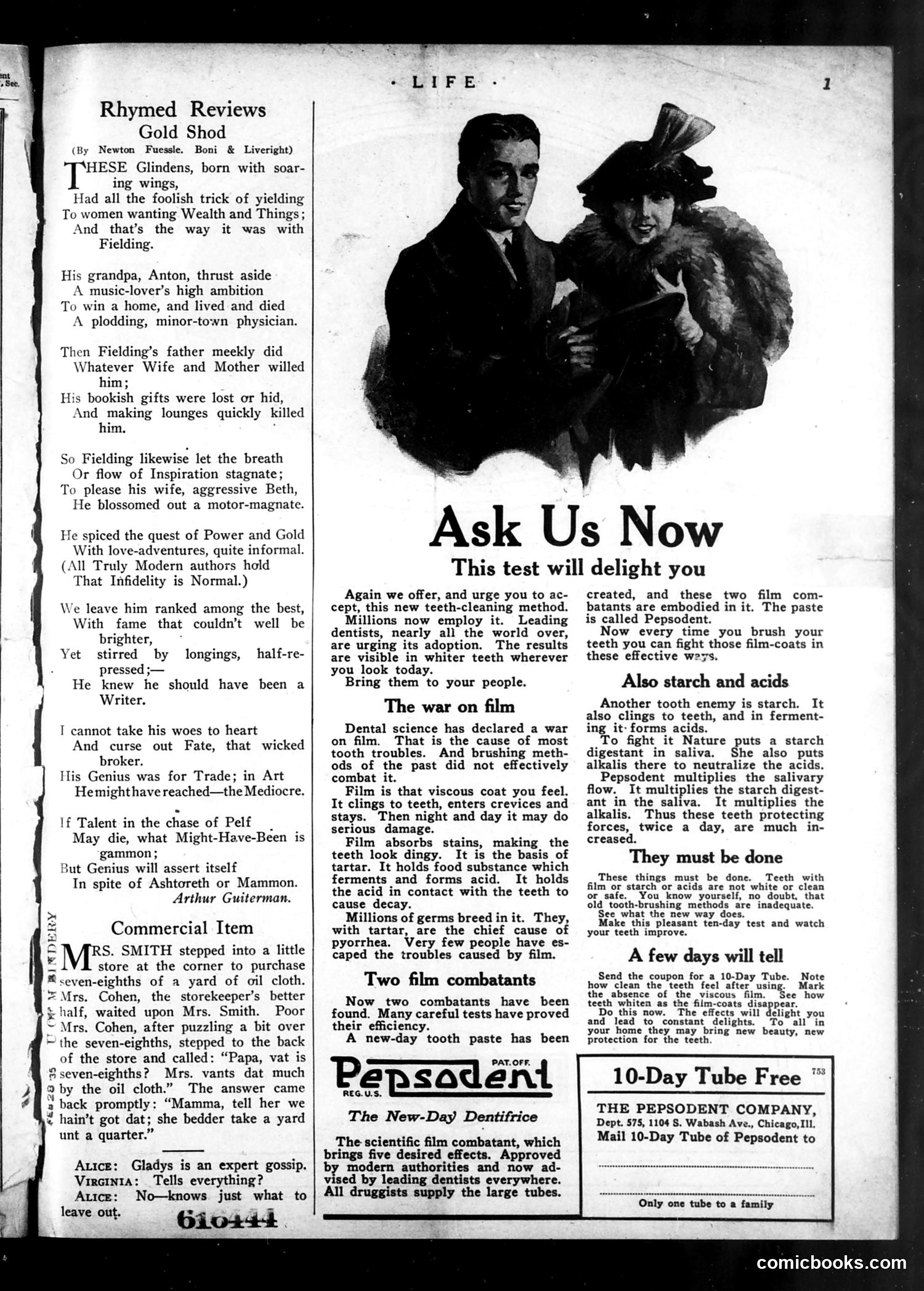
This page contains a **poetry review** titled "Rhymed Reviews: Gold Shod" by Newton Fuessle, Boni & Liveright, critiquing a literary work. The poem satirizes a character named Fielding whose family lacked ambition and whose own talents were wasted—he became a "motor-magnate" instead of a writer, disappointing the reviewer's expectations. The page is **primarily advertising**, dominated by a Pepsodent toothpaste advertisement featuring two figures (a man and woman). The ad promotes a "new-day" dentifrice using scientific language about film-coating teeth and fighting decay—typical early-20th-century marketing rhetoric. A brief "Commercial Item" story about Mrs. Smith purchasing cloth completes the content. The page reflects 1920s consumer culture and literary criticism conventions.
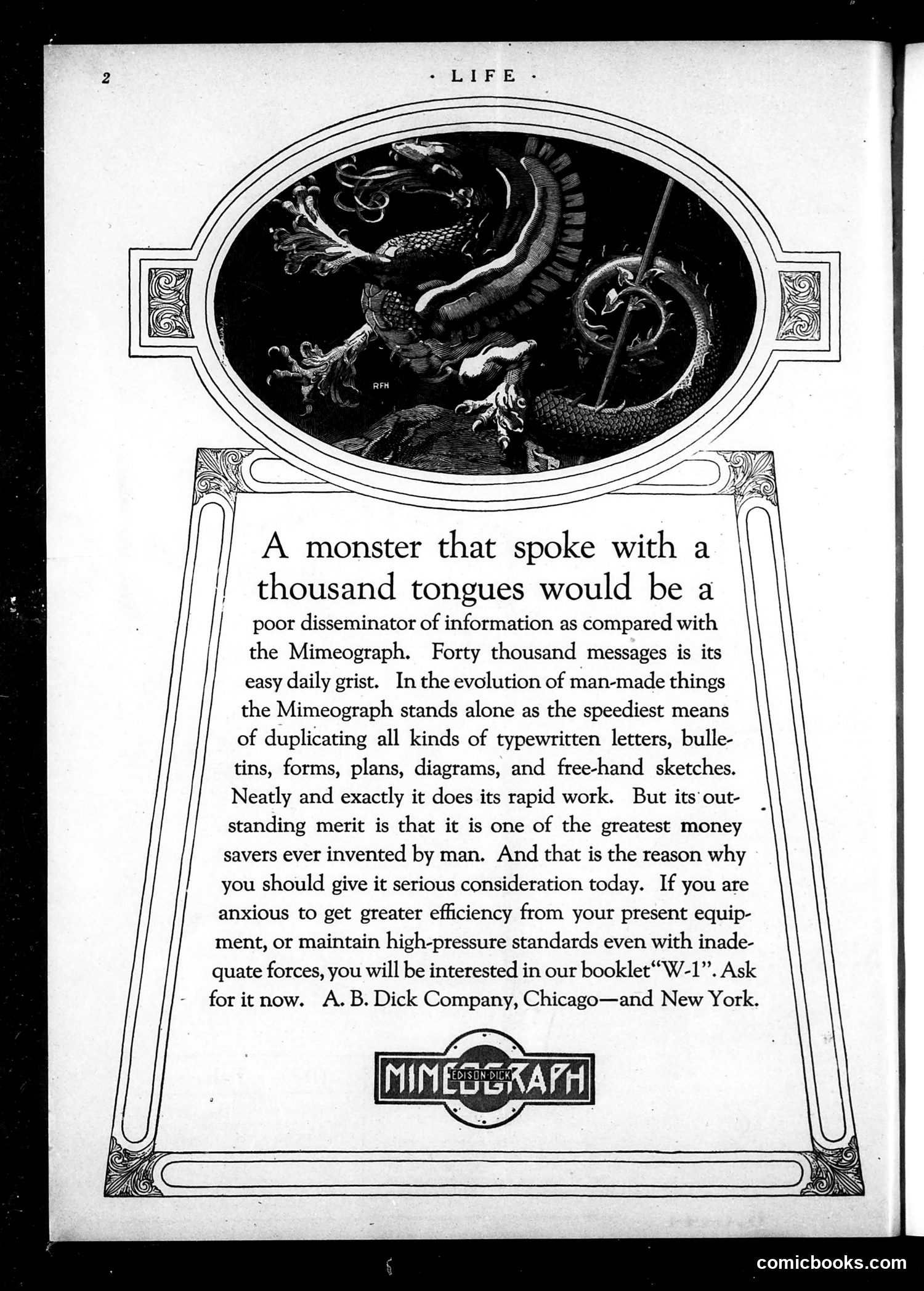
This page is primarily a **product advertisement** for the Mimeograph machine, manufactured by A.B. Dick Company. The ornamental illustration at top depicts fantastical dragons or monsters engaged in combat—a classical artistic motif used decoratively. The advertisement's central claim compares the Mimeograph favorably to an imaginary "monster with a thousand tongues" as a means of information distribution. The copy emphasizes the machine's efficiency: capable of duplicating "forty thousand messages" daily, it could reproduce "typewritten letters, bulletins, forms, plans, diagrams, and free-hand sketches" quickly and affordably. The advertisement targets business managers seeking operational efficiency and cost savings, positioning the Mimeograph as essential office equipment for organizations requiring rapid document duplication. This reflects early-20th-century business modernization.
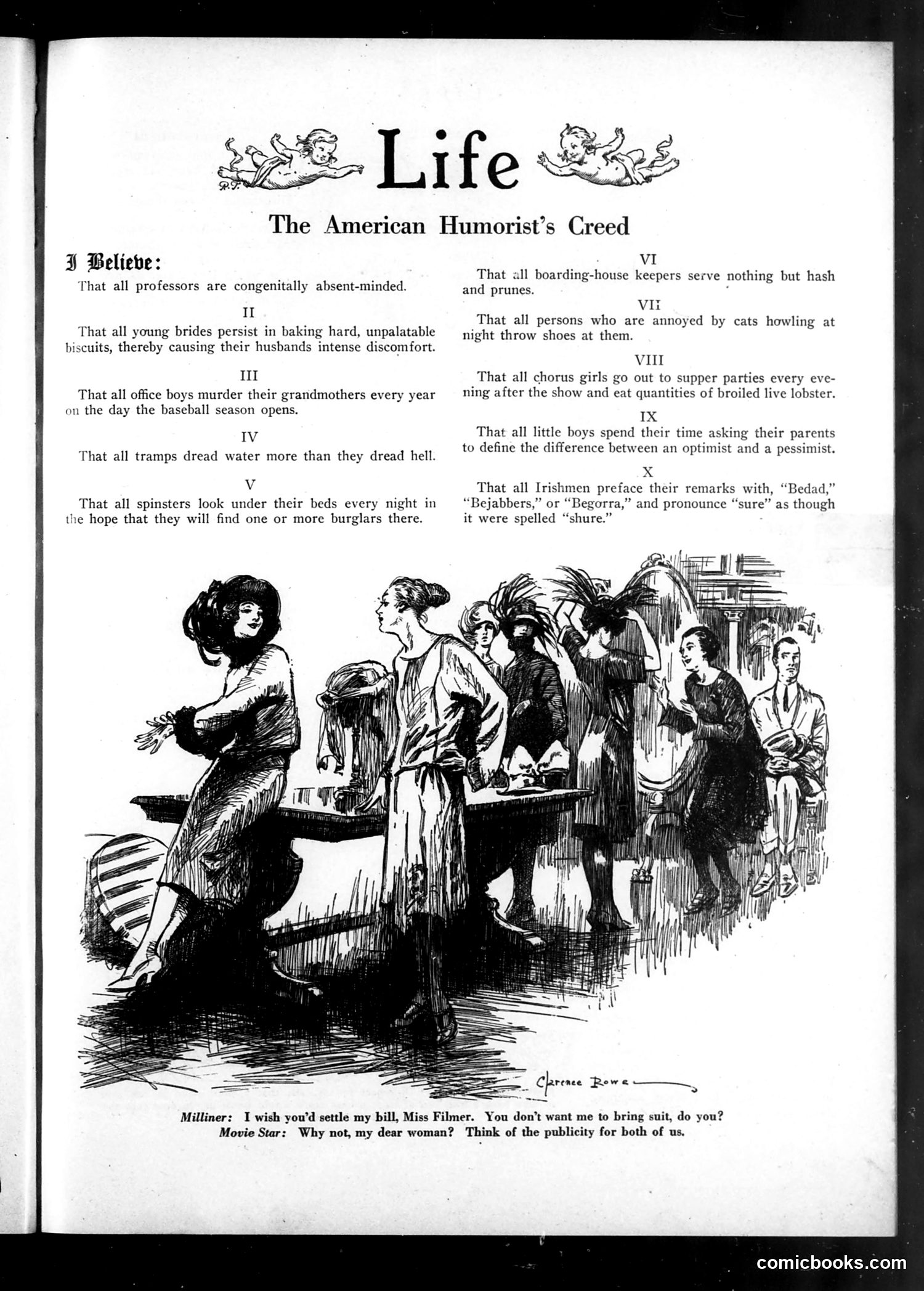
This page presents satirical observations about American life and character types. The "creed" consists of nine humorous "beliefs" mocking various stereotypes: absent-minded professors, inept newlywed women, office boys, tramps, spinsters, boarding-house keepers, cat owners, chorus girls, and Irish immigrants. The accompanying illustration shows a social scene where a man (labeled "Milliner") proposes settling a bill with a woman (identified as "Miss Filmer," apparently a movie star). His suggestion that they settle publicly "for the publicity for both of us" satirizes both the emerging film industry's obsession with publicity and the era's materialism. The humor relies on period stereotypes and observational comedy typical of Life magazine's early 20th-century satirical approach to American social habits.
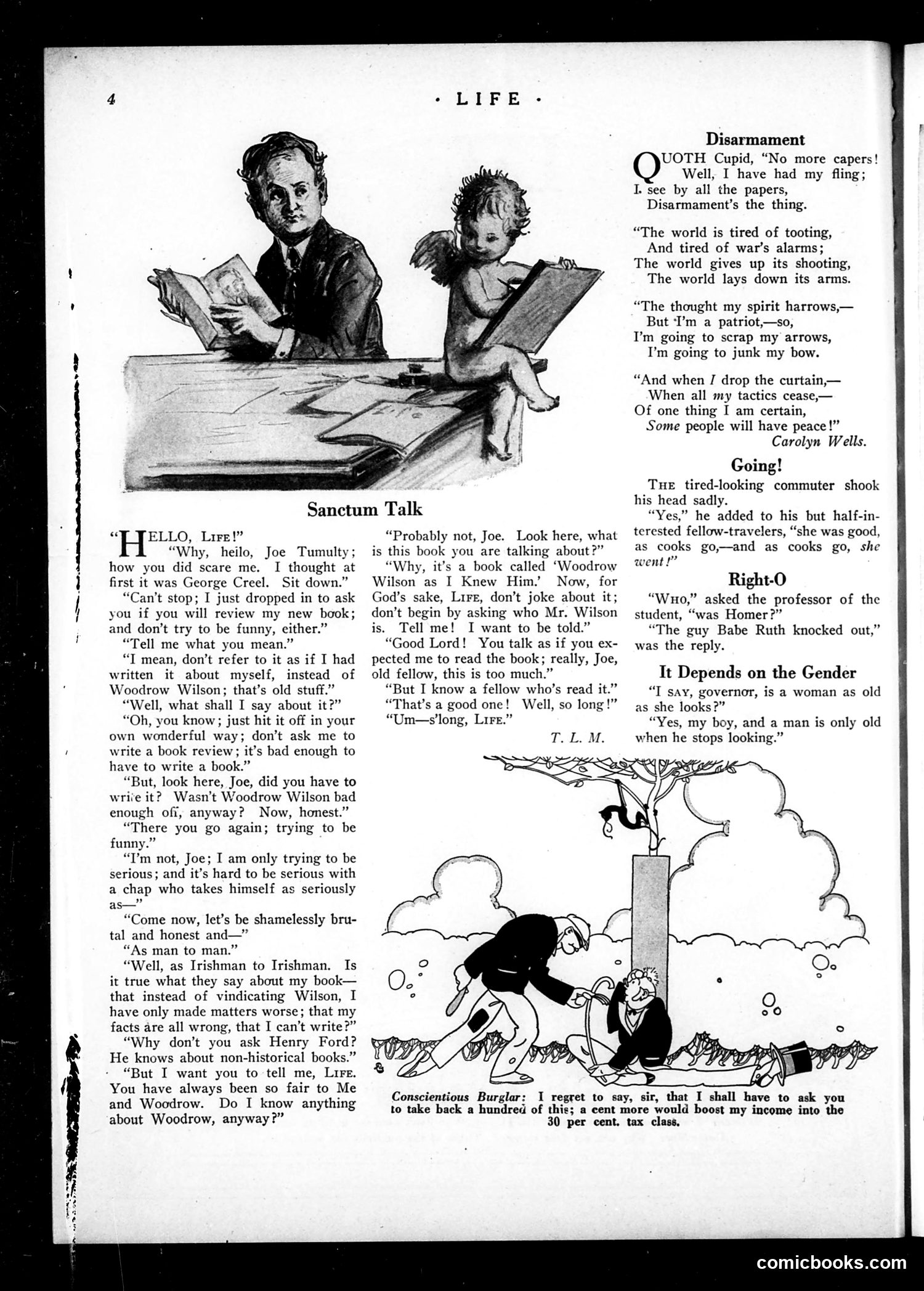
This page contains three separate satirical pieces: 1. **"Sanctum Talk"**: A dialogue between "Joe Tumulty" (Woodrow Wilson's secretary) and an unnamed editor about reviewing Wilson's book. The satire mocks Wilson's self-aggrandizing writing and Tumulty's obsequious role. 2. **"Disarmament"**: Verse by Carolyn Wells expressing pacifist sentiment, suggesting the world should abandon weapons ("scrape my arrows, / junk my bow"). 3. **"Conscious Burglar"**: A cartoon where a burglar requests the victim increase his income "30 per cent" to fund his class—satirizing socialist redistribution arguments. The page broadly satirizes post-WWI politics: pacifism, Wilson's self-promotion, and working-class economic demands. The tone is conservative, mocking disarmament and socialist principles while ridiculing the administration.
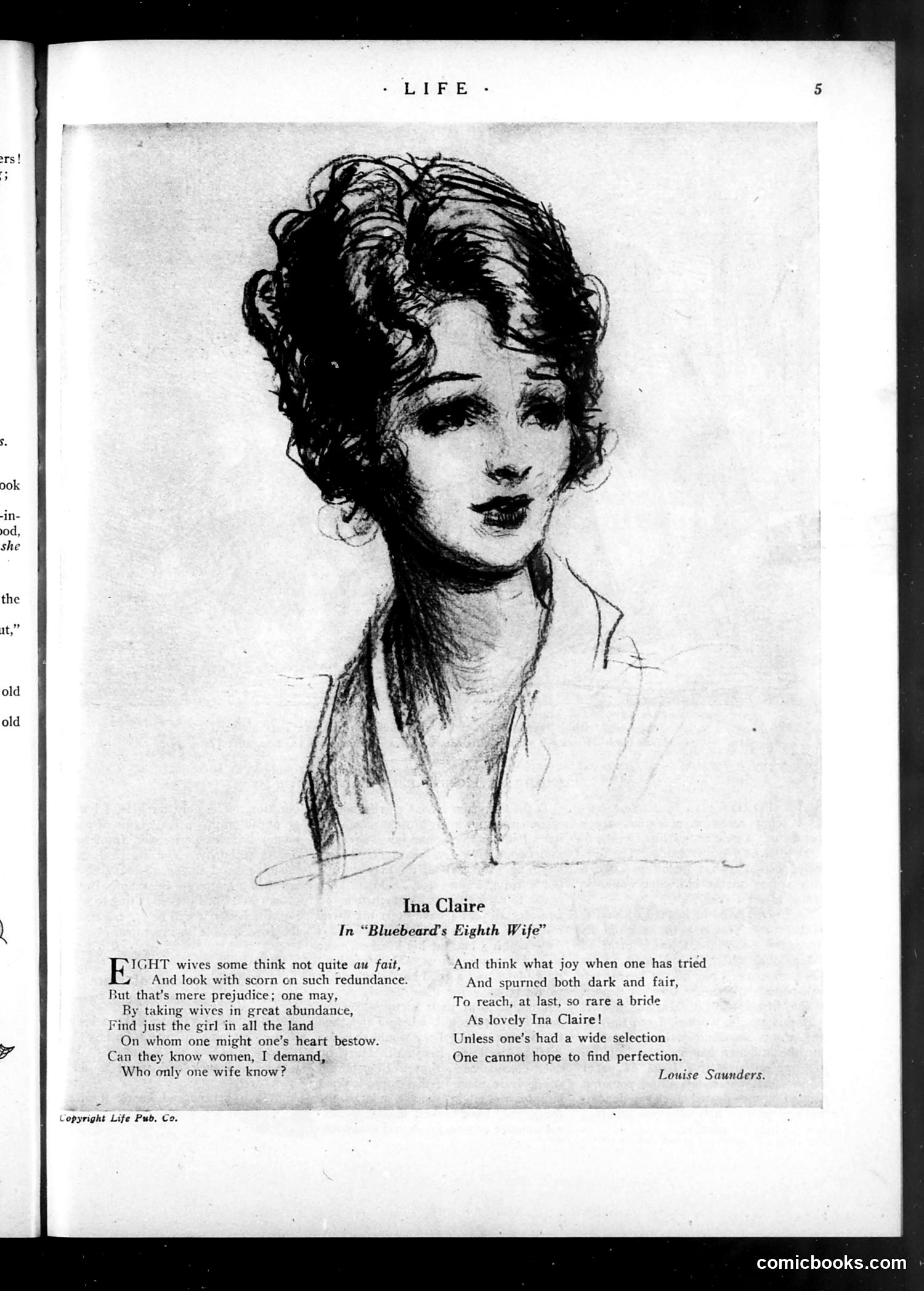
This page features a portrait sketch of actress **Ina Claire**, labeled as appearing in *"Bluebeard's Eighth Wife."* Below is a poem by **Louise Saunders** about wives and marriage. The poem satirizes attitudes toward polygamy and multiple marriages. It argues that men who take many wives in abundance deserve scorn, yet paradoxically "one might one's heart bestow" on such a man. The final couplet praises Claire as a rare and lovely bride, suggesting her desirability makes finding perfection in a partner nearly impossible. This appears to be a lighthearted commentary on marriage standards and romantic ideals, using the theatrical context of the Bluebeard tale (famously about a serial wife-killer) as the satirical framework. The piece celebrates Claire's attractiveness while poking fun at marital expectations.
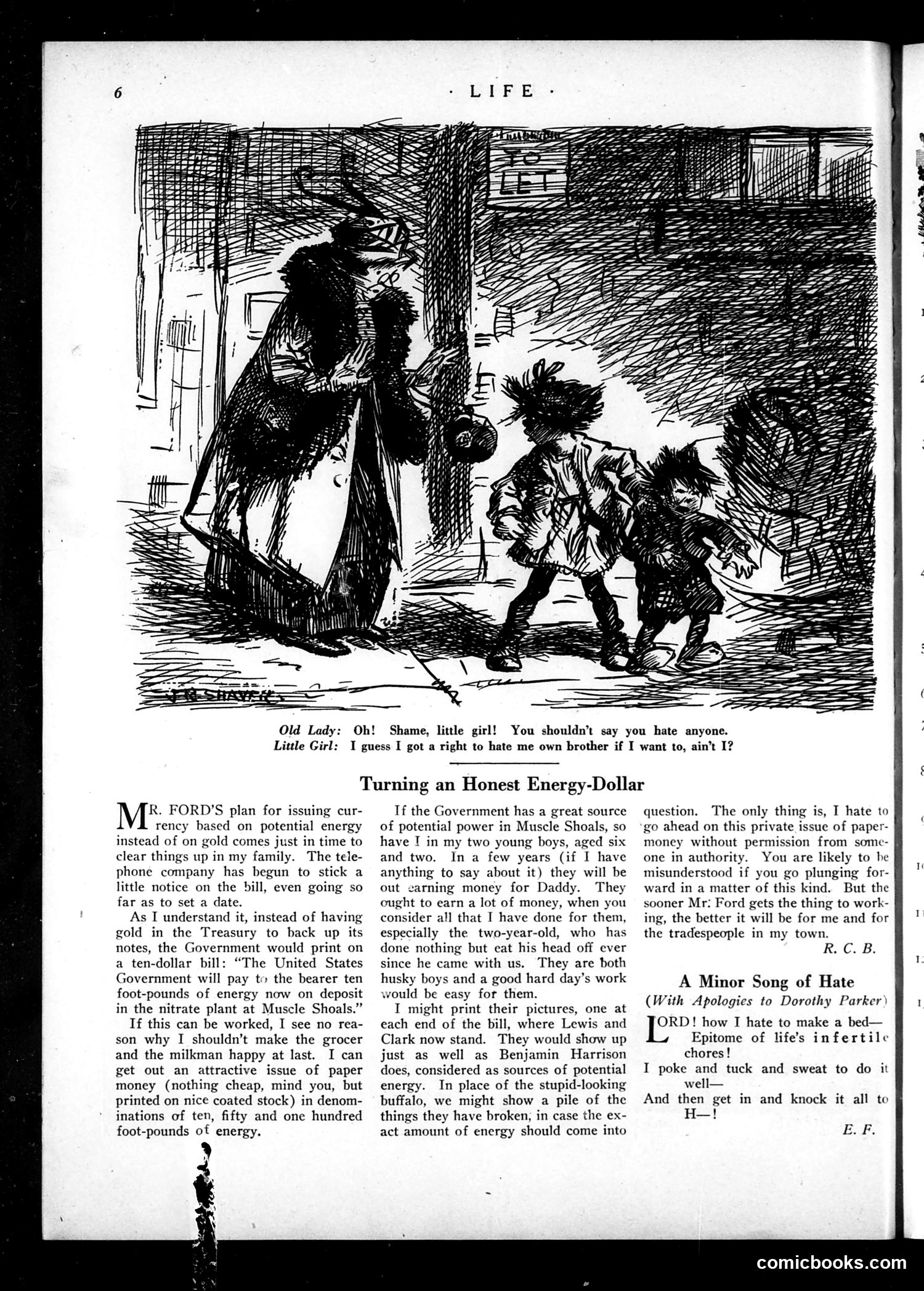
This cartoon satirizes **Henry Ford's proposal to issue currency backed by "potential energy"** rather than gold. The sketch shows an old woman confronting children on the street, mocking the impractical scheme. The article explains Ford's plan: the U.S. Government would print ten-dollar bills backed by energy produced at Muscle Shoals (a hydroelectric facility), rather than gold reserves. The author argues this is absurd—suggesting they could monetize images of children or broken buffalo to represent "energy." The humor targets Ford's business hubris: his ambitious but economically nonsensical proposal to replace the gold standard with an ephemeral concept. The cartoon's woman represents common sense objecting to this financial fantasy, emphasizing how disconnected the idea is from practical reality.
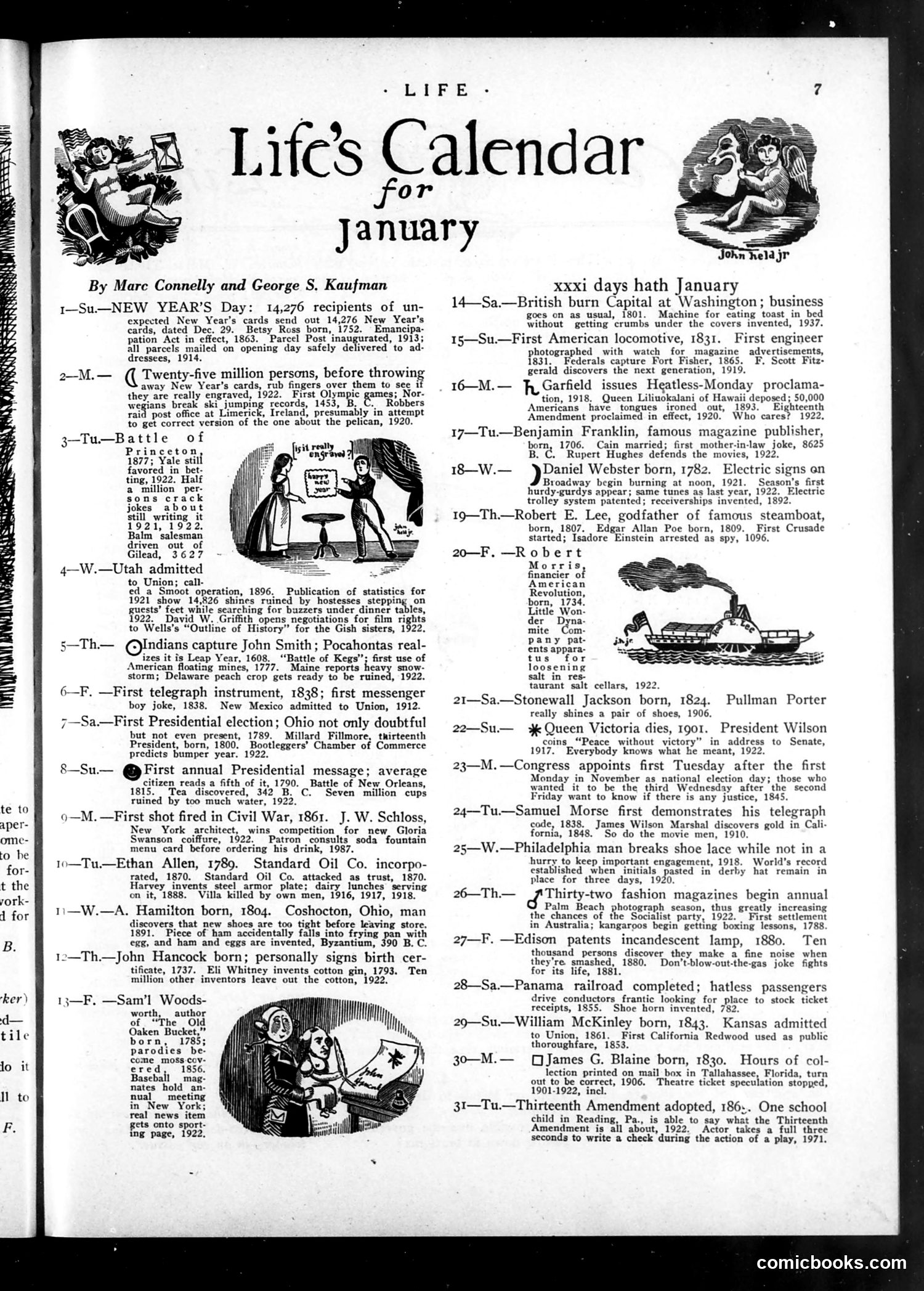
This is a "Life's Calendar for January" — a humorous historical almanac mixing significant events with satirical commentary. The page contains two illustrations accompanying calendar entries. The left cartoon (January 3rd) depicts a woman scolding a man about "writing it." The caption references the "Battle of Princeton" (1776), but the joke appears to be about domestic dispute — likely satirizing how people blame their spouses for not documenting or remembering important matters. The right cartoon (around January 13th, partially visible) shows someone reading, seemingly related to publishing or literary topics. These are **not** political cartoons about current events, but rather humorous historical vignettes using past dates as hooks for domestic comedy — a common Life magazine format of this era (1920s).
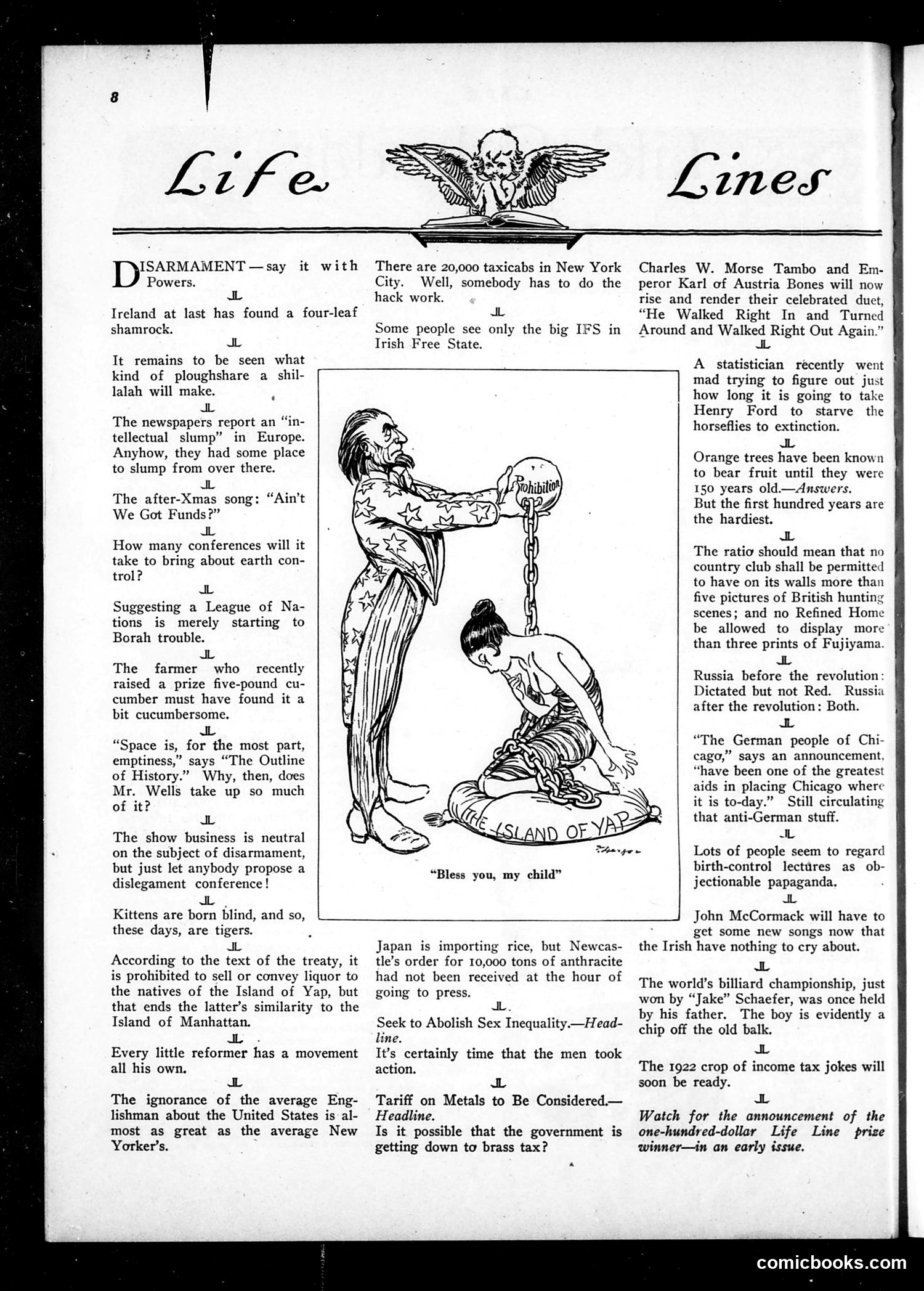
The main cartoon depicts **Lady Liberty (or Justice) in chains**, labeled "Island of Yap," holding a ball and chain. A figure below appears to be breaking free or struggling. This references the **Island of Yap dispute**—a territorial conflict between the U.S. and Japan over this Pacific island after World War I. The text notes the irony that while America claims to liberate territories, it's actually restricting Yap's autonomy, contradicting American ideals of freedom. The surrounding "Life Lines" are brief satirical commentaries on contemporary 1920s issues: Irish independence, taxicabs, conferences, and tax policy. The cartoon critiques American hypocrisy regarding self-determination while exercising imperial control over Pacific territories.
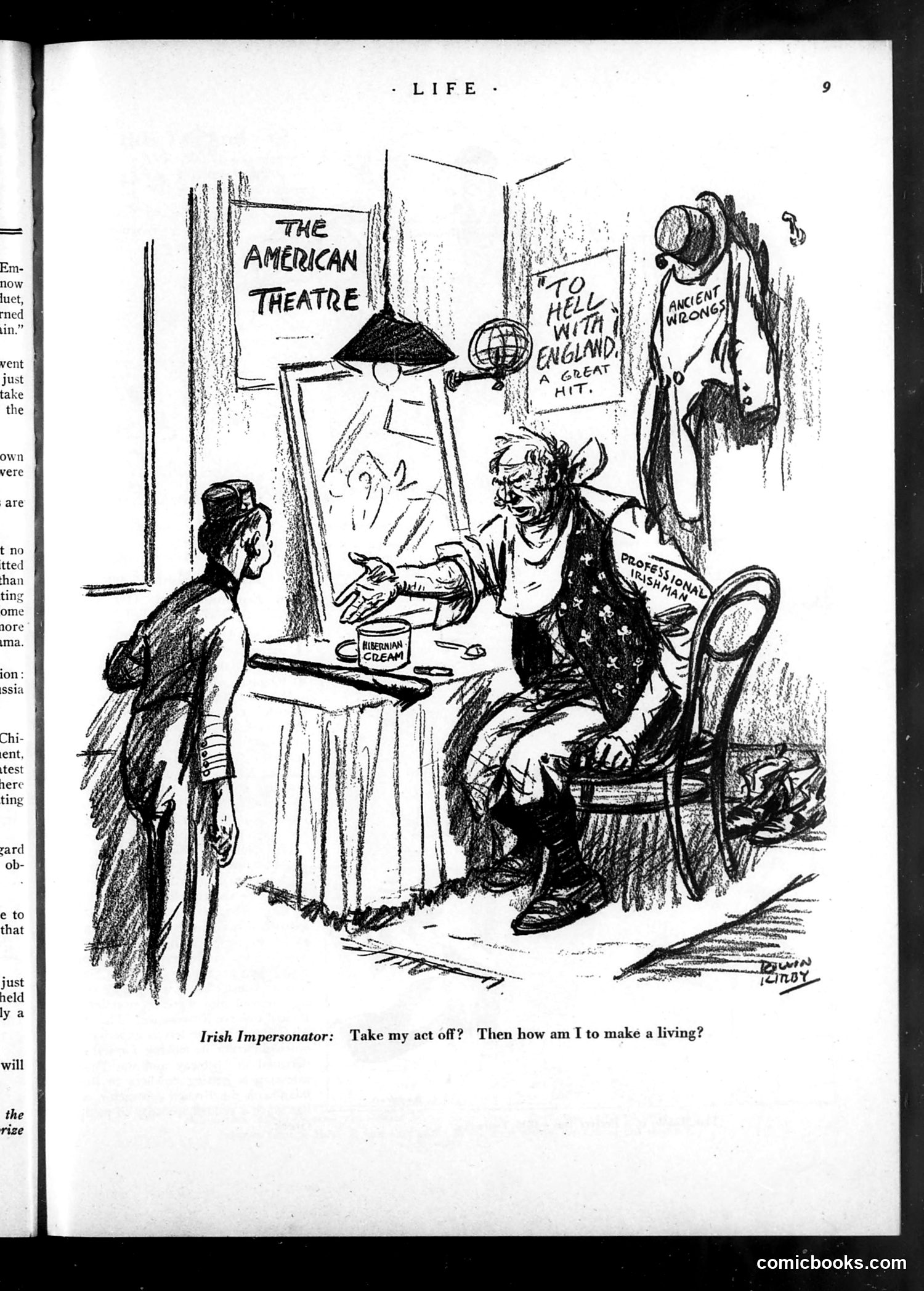
This political cartoon satirizes Irish immigrants in early 20th-century America. An Irish caricature (identifiable by exaggerated features typical of the era's ethnic stereotyping) sits at a table labeled "BIRMINGHAM CREAM," wearing theatrical costume pieces marked "Ancient Wrongs" and "Professional Agitator." A visitor asks: "Take my act off? Then how am I to make a living?" The satire suggests Irish-Americans were exploiting grievances about English colonial history ("To Hell with England") and professional victimhood as a theatrical performance to earn money or political influence. The signs advertising "The American Theatre" reinforce the notion that Irish political activism was performative rather than genuine. This reflects anti-Irish prejudice and dismissal of legitimate historical grievances as mere theatrical exploitation.
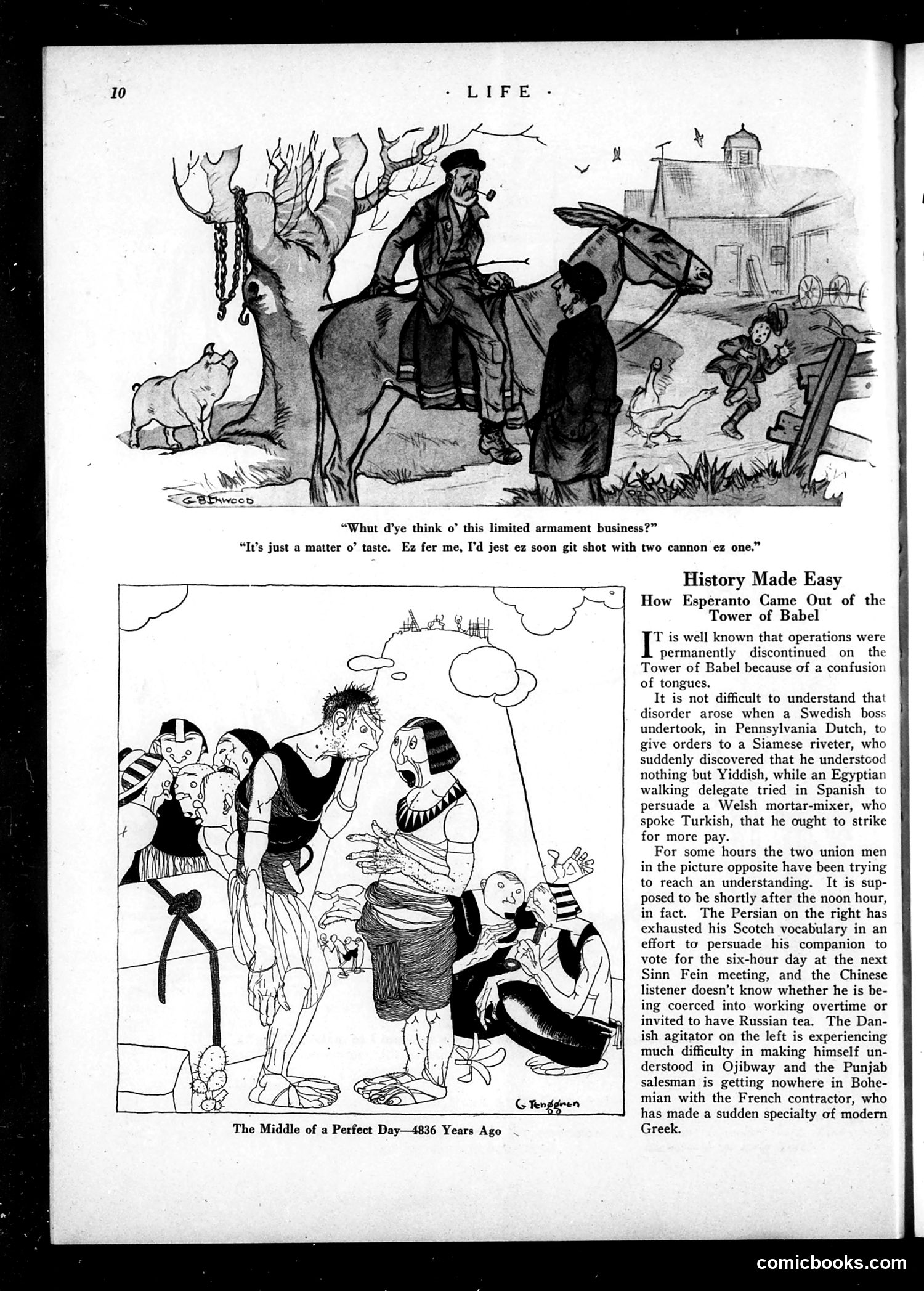
**Top Cartoon:** A man on horseback discusses "limited armament business" with another man. The rider boasts he'll "git shot with two cannon es one"—a humorous take on military excess and the absurdity of competitive armament buildup, likely referencing early 20th-century arms races among nations. **Bottom Section:** "History Made Easy" presents a visual gag titled "The Middle of a Perfect Day—4836 Years Ago," depicting the Tower of Babel confusion with multiple figures speaking different languages (indicated by speech bubbles). The accompanying text humorously explains how Esperanto speakers got separated during historical events like labor disputes and international negotiations, attributing modern communication breakdowns to ancient linguistic confusion. It's satirizing both language barriers and labor disputes of the era.
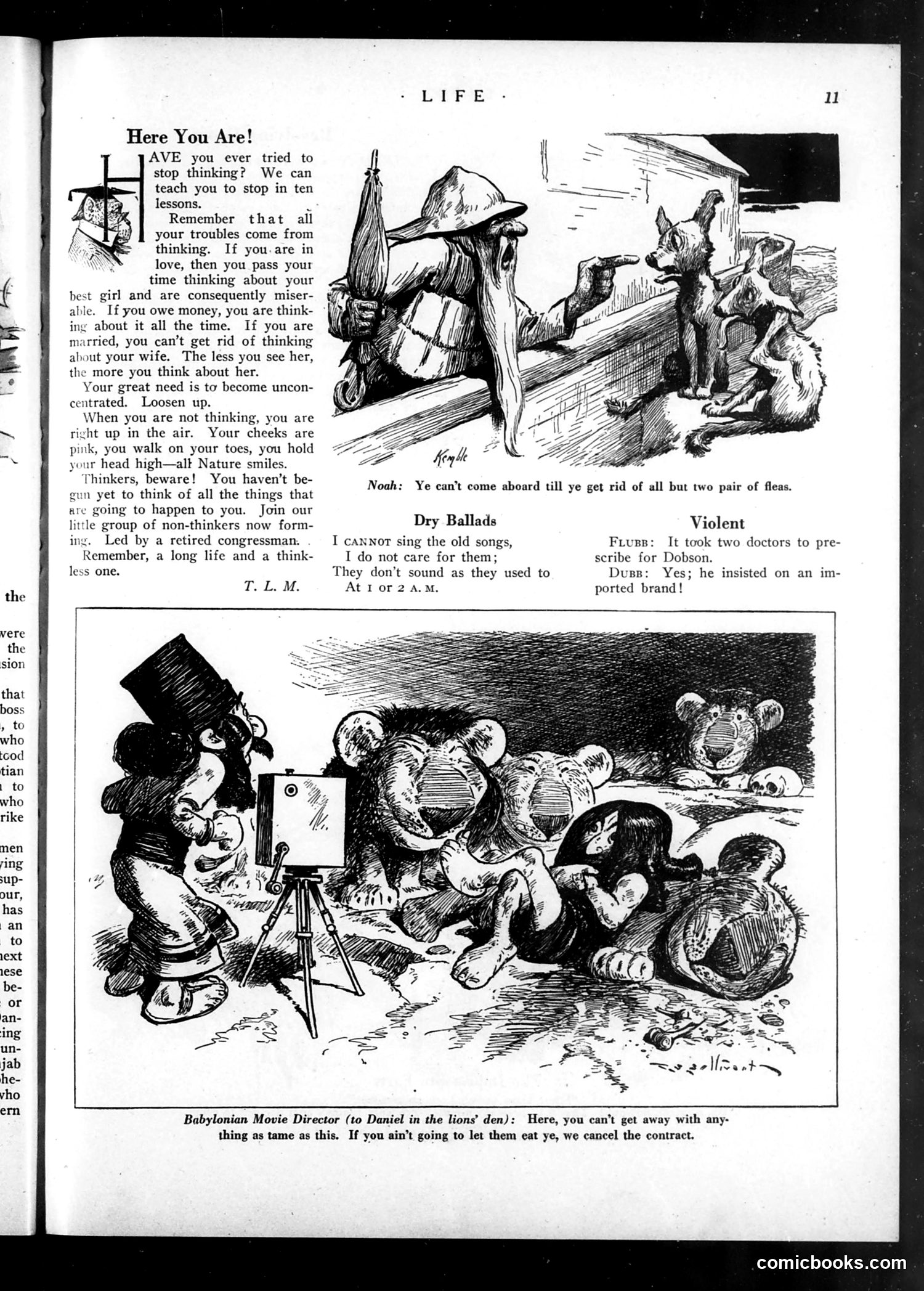
This page contains satirical humor pieces typical of *Life* magazine's style. **Top cartoon** ("Noah"): A humorous domestic scene where a man and woman argue about fleas on animals boarding Noah's ark—a biblical reference used for absurdist comedy about domestic disagreements. **"Dry Ballads" and "Violent"**: Brief joke exchanges about outdated songs and a doctor's prescription brand—topical humor of the era. **Large bottom cartoon** ("Babylonian Movie Director"): The main satire depicts lions being filmed for a movie, with a director instructing that "tame" lions won't suffice—if they won't eat the actors, the contract is cancelled. This mocks 1920s-era Hollywood's dangerous filmmaking practices and the exploitation of actors in pursuit of sensational scenes. The satire critiques both filmmakers' ruthlessness and the era's appetite for violent spectacle.
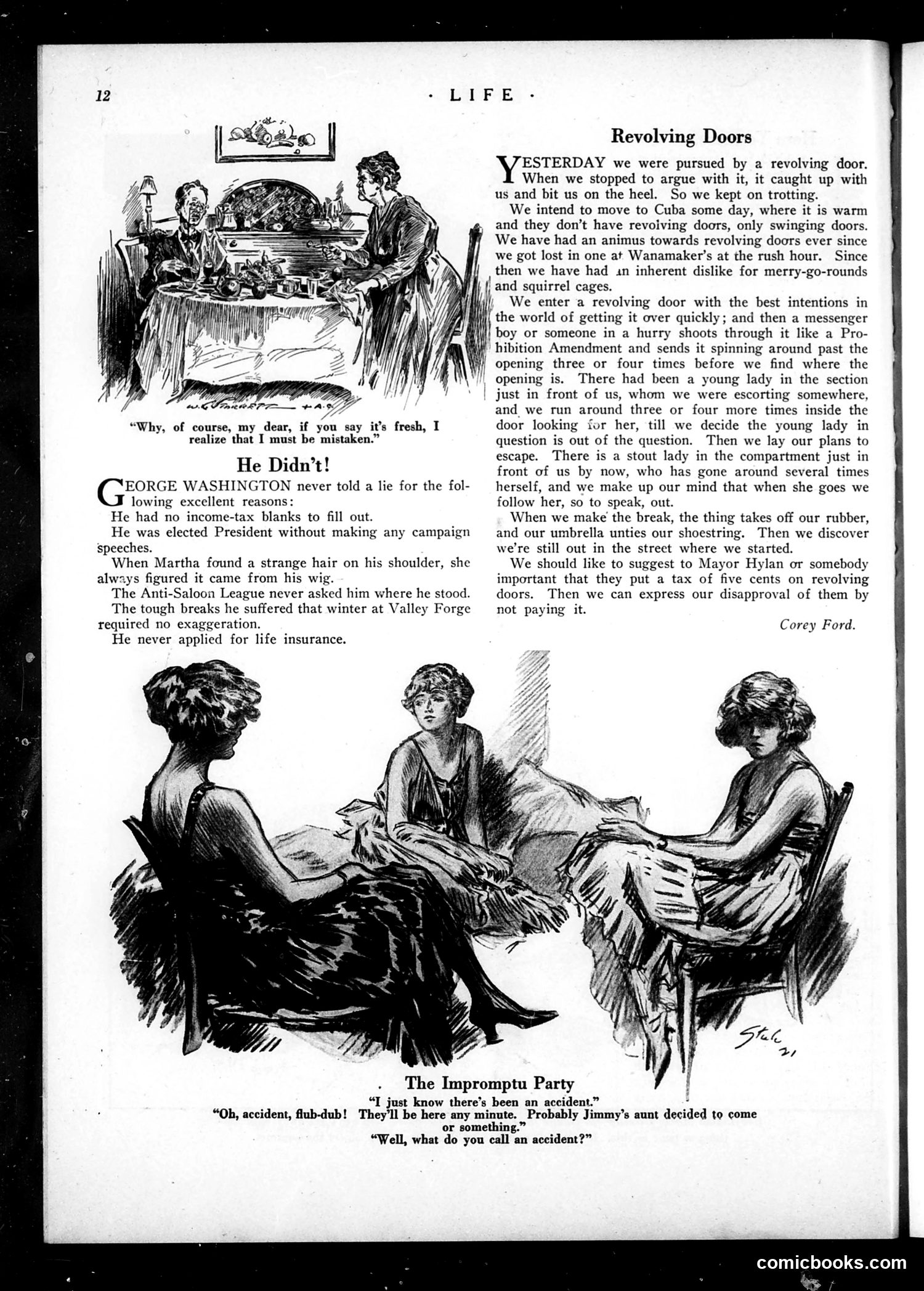
This page contains three distinct pieces of satire: **"Revolving Doors"** (by Corey Ford): A humorous complaint about the mechanical frustration of revolving doors in public buildings—particularly how they spin unpredictably, trapping people and possessions. The author suggests taxing these devices as a nuisance. **"He Didn't!"**: A satirical tribute to George Washington's honesty, listing supposed examples of his integrity (never lying about income taxes, never making campaign speeches, Martha trusting him completely). The humor relies on readers recognizing these as clearly false modern behaviors Washington supposedly avoided. **"The Impromptu Party"**: A cartoon about an unexpected guest arriving, with one woman claiming it's merely an "accident" while another questions what qualifies as accidental. The page reflects early 20th-century urban life complaints and period humor conventions.
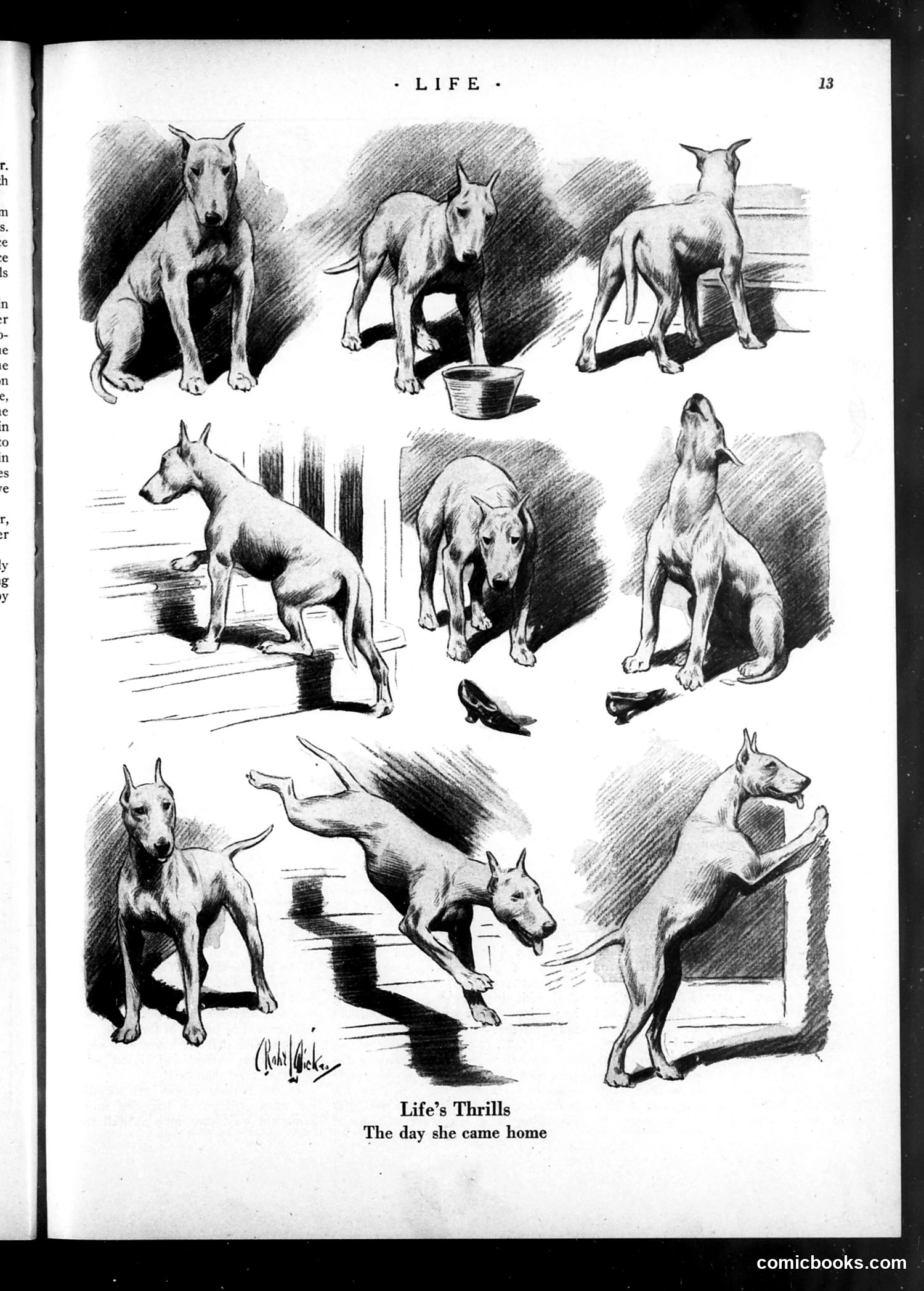
This page features a series of sketches by artist Childe Hassam depicting a dog in various emotional states and poses. The caption "Life's Thrills / The day she came home" suggests the narrative of a pet dog experiencing excitement upon a person's return home. The drawings show the dog standing alertly, eating from a bowl, walking, lying down, playing with what appears to be a shoe, and jumping or playing. The satire humorously exaggerates the dog's emotional journey during the mundane domestic event of someone arriving home. Rather than political commentary, this appears to be gentle social satire about the intensity of pet-owner relationships and how dogs perceive ordinary household events as momentous occasions worthy of dramatic expression.
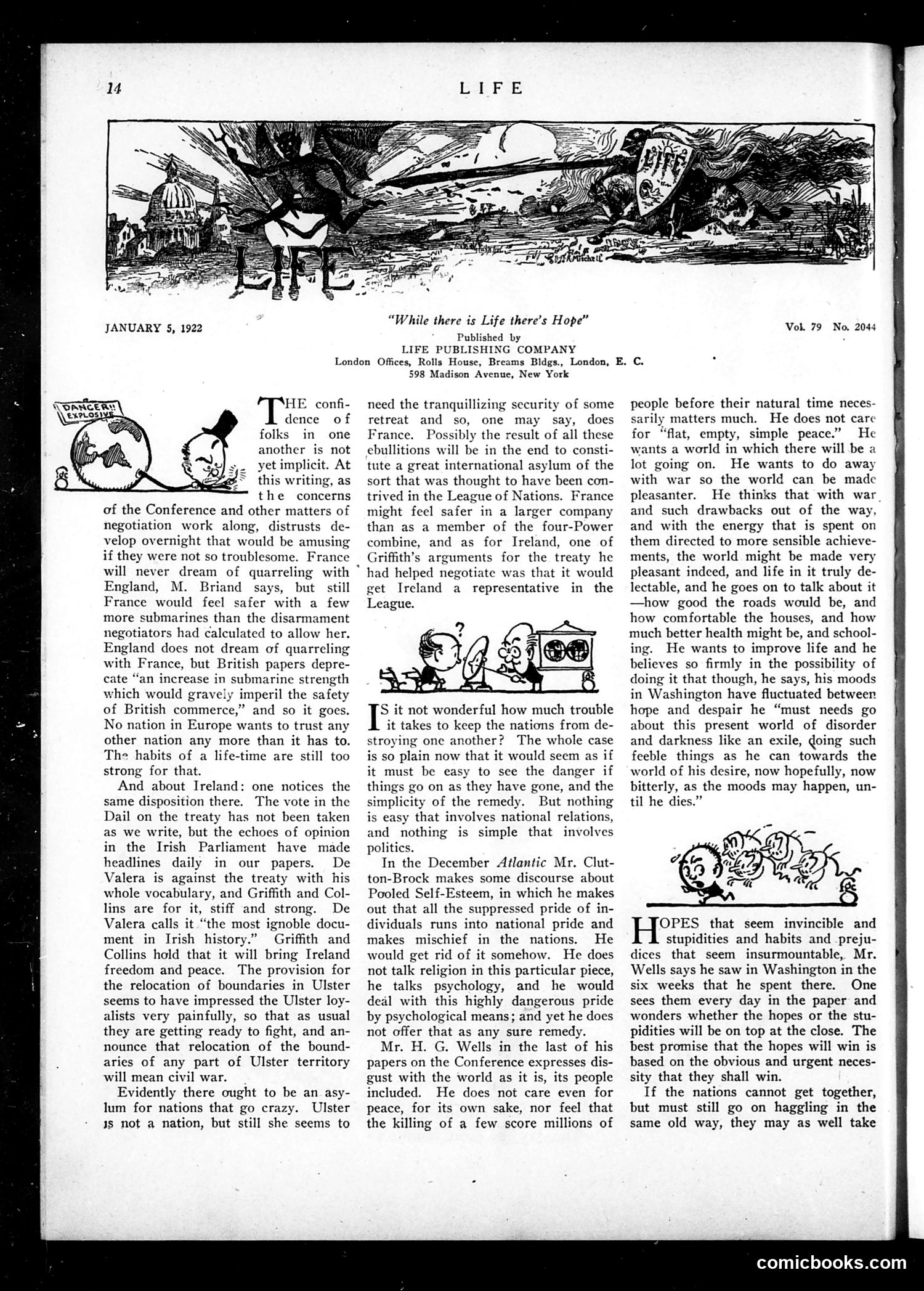
This editorial page discusses post-WWI peace negotiations and national anxieties. The main cartoon (top left) depicts a caricatured figure labeled "Dancer" emerging from or interacting with a globe, apparently satirizing diplomatic instability or the chaotic state of international relations after World War I. The text addresses Ireland's position in League of Nations negotiations, disarmament concerns, and disputes over Ulster's boundaries. Writers critique how nations struggle to cooperate, referencing H.G. Wells's pessimistic views on world order. The smaller cartoons appear to illustrate domestic anxieties—one shows figures near what appears to be a radio or entertainment device, possibly mocking popular distractions from serious political problems. The overall message: nations bicker over details while fundamental peace remains elusive.
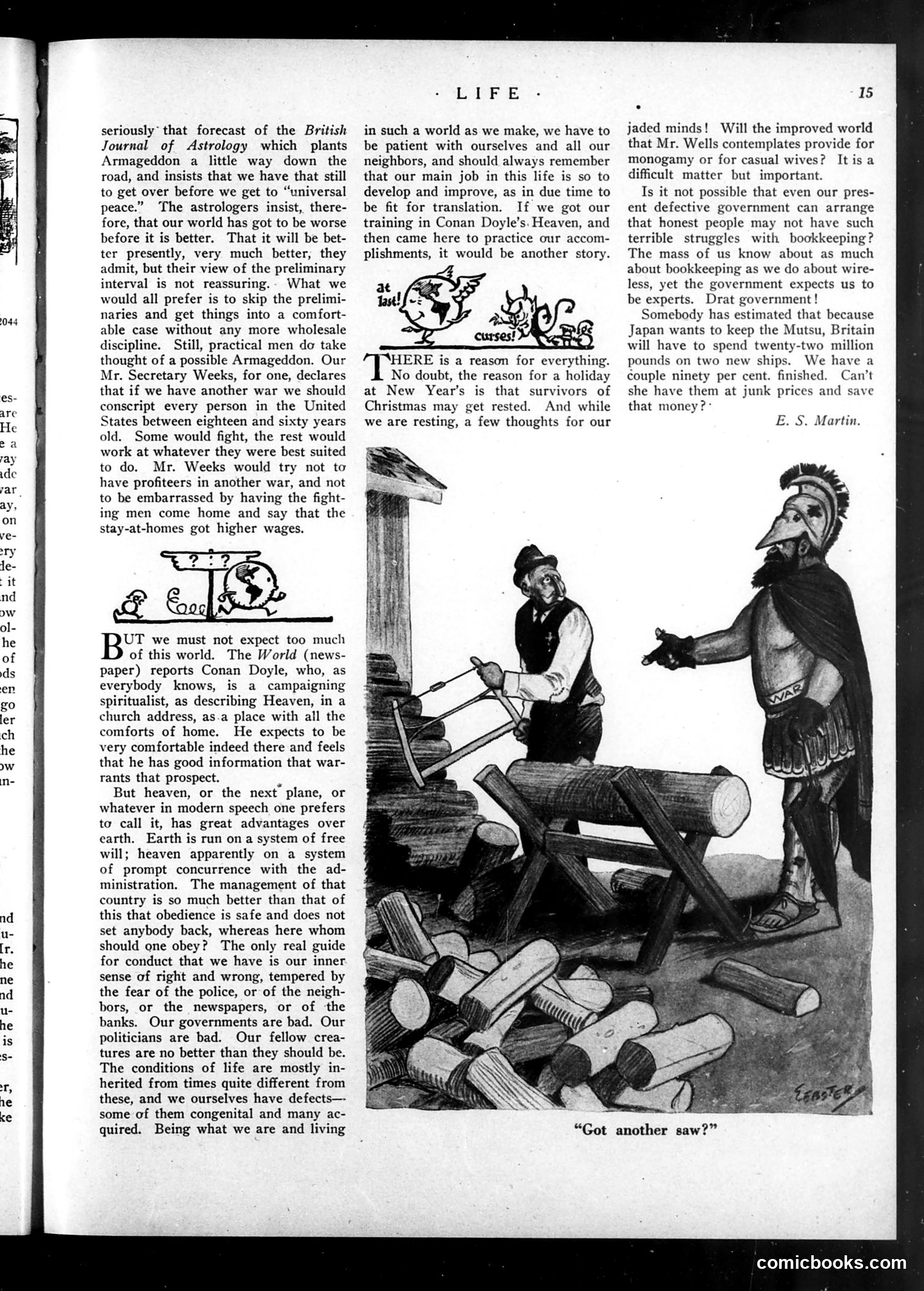
This page from *Life* magazine contains satirical commentary on post-WWI social issues rather than a traditional political cartoon. The main illustration (captioned "Got another saw?") depicts a classical warrior figure watching a man sawing logs, likely satirizing the contrast between military glory and mundane civilian labor—a common post-war theme about soldiers' repatriation and economic disruption. The text discusses several contemporary concerns: Secretary of War Weeks's proposal for conscription in future conflicts; spiritualist Arthur Conan Doyle's description of Heaven as comfortable domestic life; comparisons between earthly governance and heavenly administration; and H.G. Wells's utopian predictions. The final section, signed by E.S. Martin, shifts to practical grievances: government incompetence in taxation/bookkeeping, Japan's naval expansion forcing British military spending, and the gap between expert bureaucratic demands and ordinary citizens' capabilities. The tone is mordantly humorous about societal inefficiency and government waste.
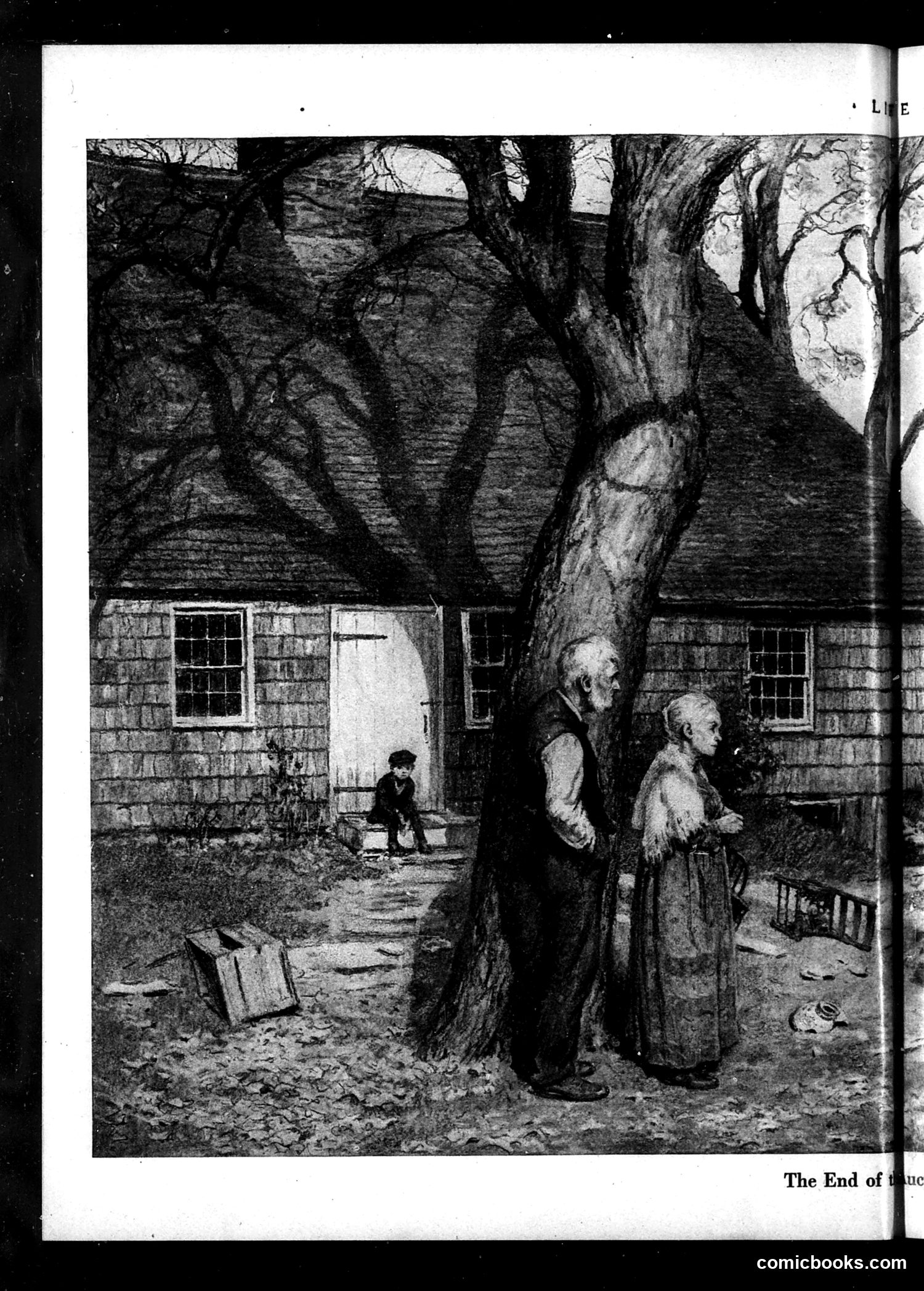
This appears to be an illustration from Life magazine showing a rural or working-class scene. Two figures stand near a large, gnarled tree beside simple wooden buildings with shuttered windows. A child sits alone in the background. The scene conveys poverty and hardship through its sparse, bare-branched landscape and modest dwellings. The caption "The End of" suggests this concludes a narrative or social commentary, though the full text is cut off. Without the complete caption, the specific satirical target remains unclear—it could be addressing rural poverty, industrial decline, or social conditions of the era. The image's mood is decidedly melancholic rather than humorous, suggesting serious social critique rather than typical political satire.
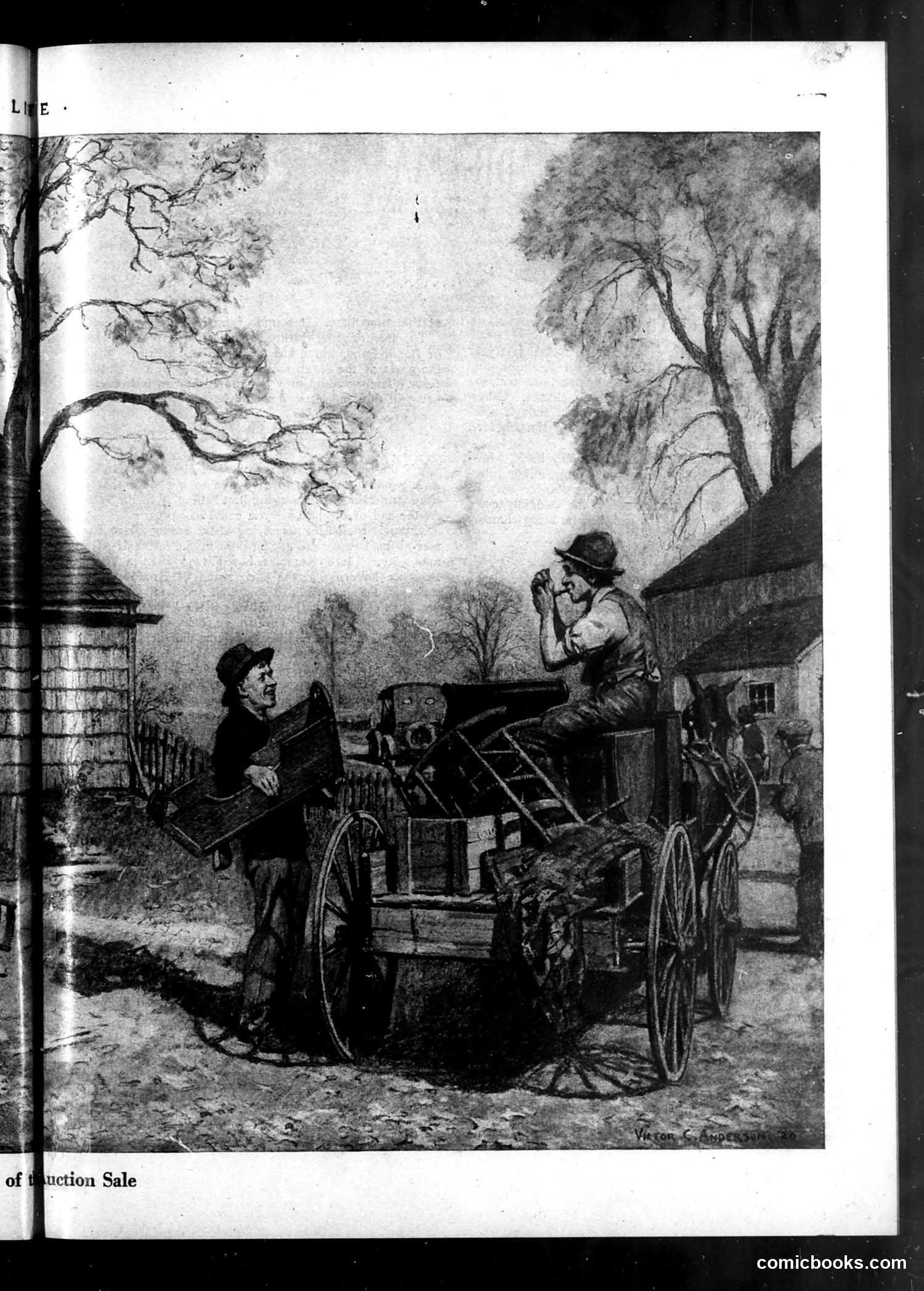
This page shows a satirical illustration depicting two figures with a cart or wagon loaded with goods. The image appears to be commentary on a public auction or sale, likely of confiscated or repossessed property. The figures seem to represent common people or working-class individuals conducting a transaction. The scene is set in a rural or small-town environment with bare trees and modest buildings, suggesting economic hardship or distress. The artistic style and presentation suggest this is social satire about commerce, poverty, or economic disparity. However, the OCR text is largely illegible, making it difficult to identify specific political figures or determine the exact satirical target. Without clearer text or caption information, the precise historical context and intended commentary remain unclear from this reproduction alone.
This page contains theater reviews of three plays. The critic discusses **Ben-Ami** in "The Idle Inn," a play about Jewish peasant life featuring a horsethief protagonist who literally tosses women around—behavior the critic finds both dramatically authentic and socially excessive. The humor lies in the reviewer's deadpan complaint that he once tried this courtship method himself, with disastrous results. The second review examines **Clare Kummer's** "The Mountain Man," praising its first act but finding it deteriorates. The critic expresses relief that Kummer—typically associated with frivolous Broadway entertainments—hasn't become entirely serious in her recent work. The references to "Six Brown Brothers" and the "House of David Band" suggest contemporary musical groups performing in these productions. The satire targets both overwrought theatrical realism and the arbitrary mixing of entertainment genres in stage productions.
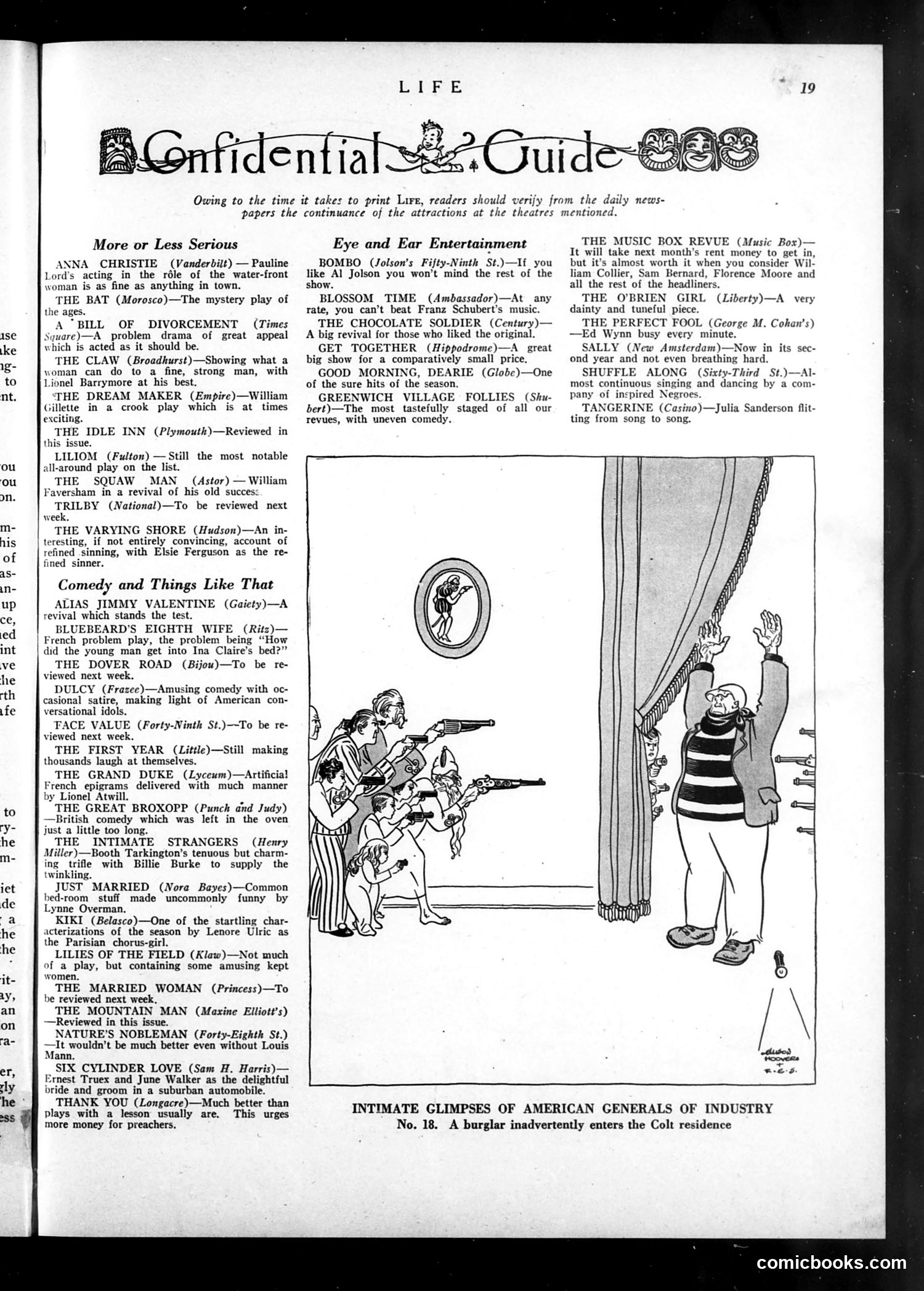
This page from *Life* magazine contains theater reviews and a cartoon titled "Intimate Glimpses of American Generals of Industry," depicting a burglar entering the Colt residence. The cartoon satirizes wealthy industrialists by showing a burglar attempting to rob a mansion belonging to the Colt family (makers of firearms). The humor lies in ironic contrast: a burglar—himself a criminal—is committing theft against the wealthy industrial magnates. The satire suggests that these "generals of industry" are themselves thieves or robbers in their business practices, making them fair targets for actual burglary. This reflects Progressive-era skepticism toward monopolistic industrialists and their wealth accumulation. The surrounding text consists entirely of Broadway theater reviews from what appears to be the early 1920s, covering comedies, dramas, and musical revues featuring prominent actors of the era.
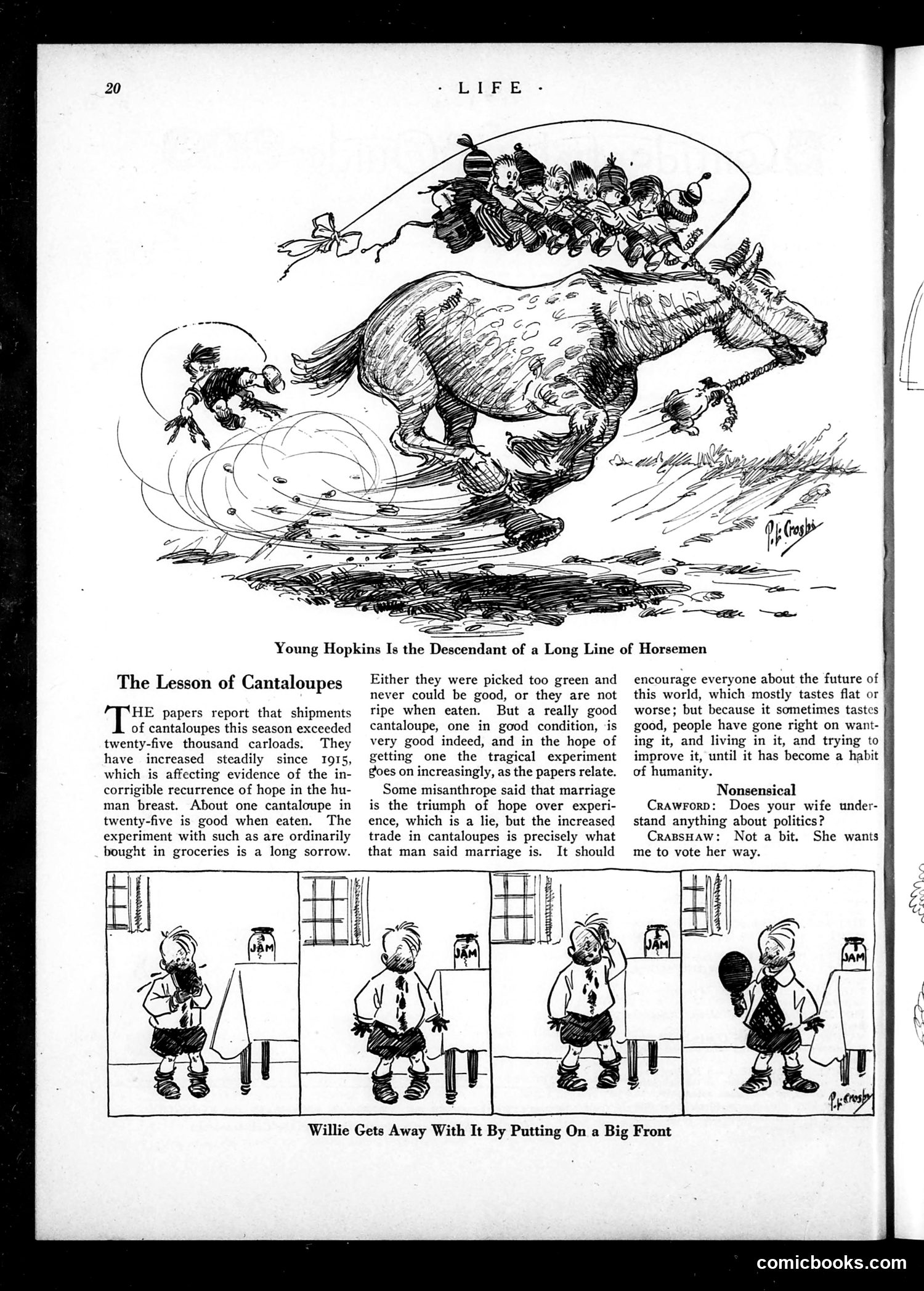
This *Life* magazine page contains two satirical pieces: **"The Lesson of Cantaloupes"** is a philosophical essay comparing human nature to cantaloupe shopping. The writer observes that despite poor odds (only 1 in 25 melons are actually good), people keep buying them, hoping for that one perfect melon. He uses this as a metaphor for human optimism and perseverance—we keep trying to improve life despite frequent disappointment, much like marriage (a jab at romantic hope versus reality). It's gentle social commentary on human stubbornness and hope. **"Nonsensical"** is a short joke about marital politics: a wife who claims to understand nothing about politics still demands her husband vote her way—absurd behavior presented as typical spousal contradiction. **"Young Hopkins Is the Descendant of a Long Line of Horsemen"** shows a child riding wildly on what appears to be a cow or ox, suggesting inherited recklessness. The comic strip below shows "Willie Gets Away With It By Putting On a Big Front"—a child using exaggerated confidence to escape consequences. All three items mock human behavior—irrational optimism, marital dynamics, and bluffing.
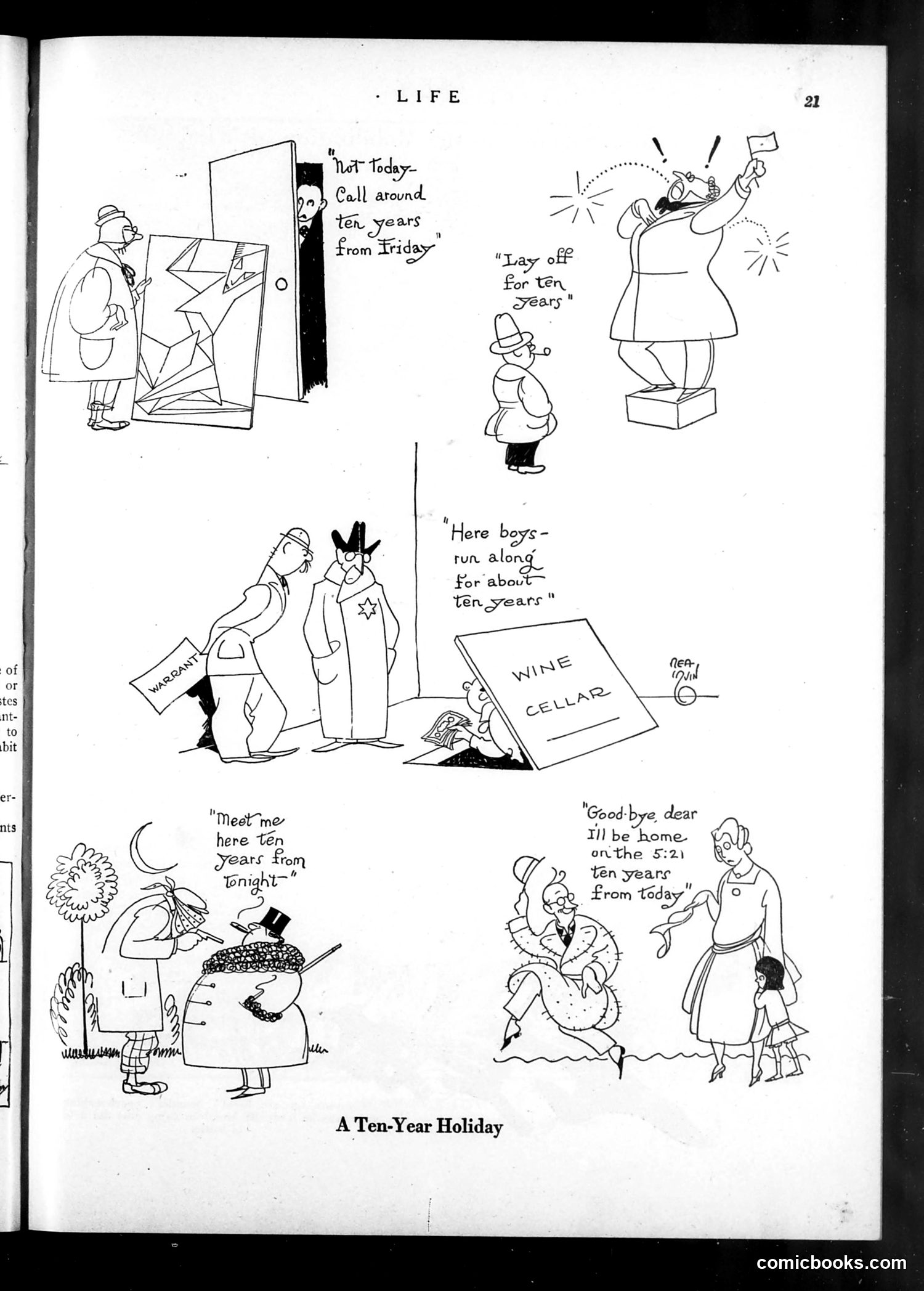
This satirical comic uses the fantasy premise of a ten-year absence to mock contemporary social situations. The six panels show various characters making arrangements for decade-long disappearances: a man dodging a phone call, someone celebrating a prolonged absence, a couple meeting secretly in a wine cellar, and a spouse departing for ten years. The satire targets common domestic frustrations and social obligations of the era—avoiding creditors or annoying calls, escaping marriage or responsibility, and general social entanglements. The humor relies on the exaggeration that these situations are so unbearable that vanishing for a decade seems preferable to dealing with them. The comic reflects early-to-mid 20th century attitudes toward marital discord, financial pressures, and social constraints, presenting escape fantasy as comedic relief from everyday annoyances.
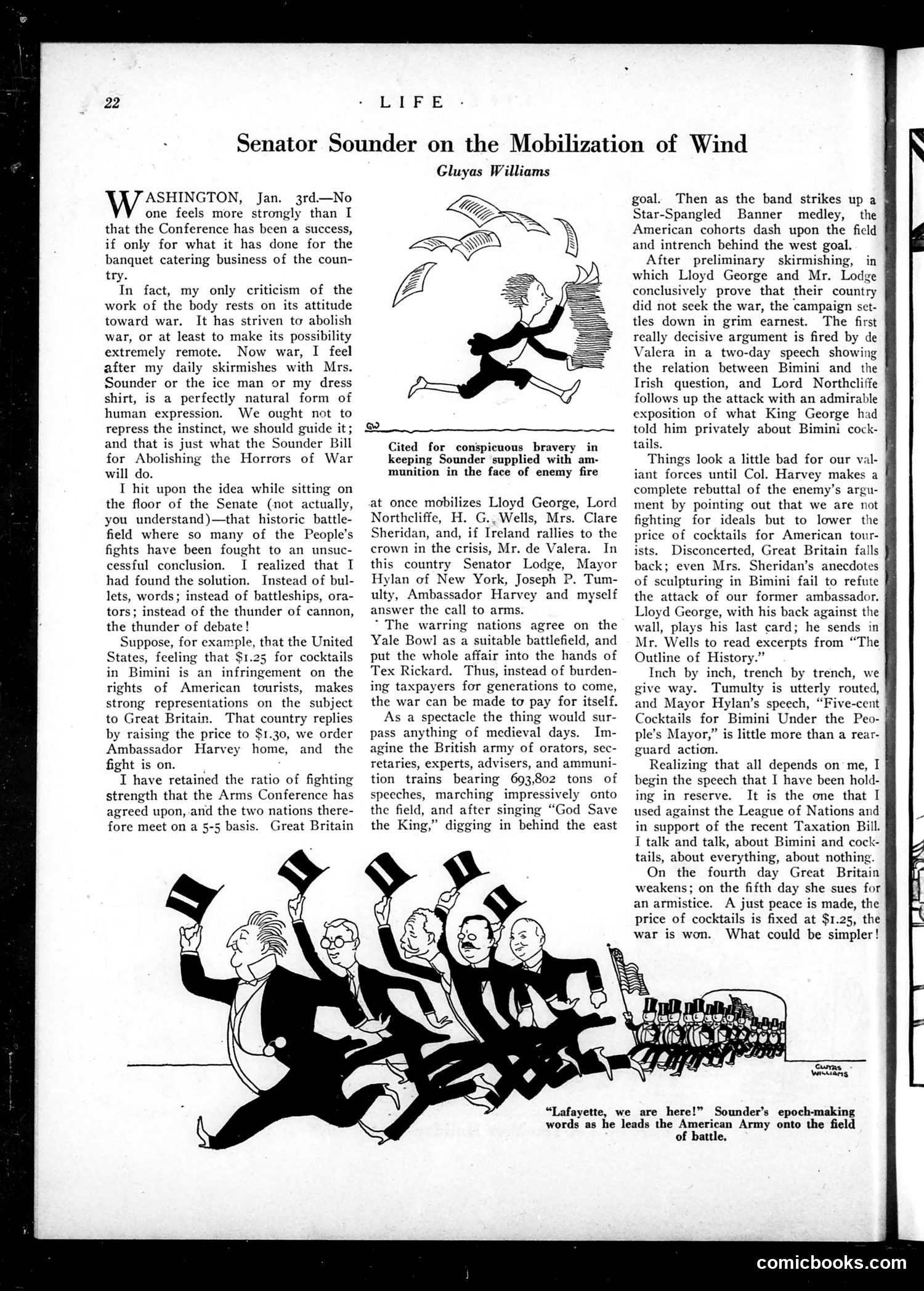
This satirical piece mocks post-WWI disarmament conferences (likely the 1921-22 Washington Naval Conference) and pacifist sentiment. The humor centers on a fictional "Senator Sounder" proposing to replace military warfare with rhetorical combat—substituting orators for soldiers and speeches for ammunition. The cartoon depicts political figures (Lloyd George, H.G. Wells, Senator Lodge, Mayor Hylan, Ambassador Harvey) as combatants wielding flags in a absurd "battle." The satire ridicules both pacifism and political grandstanding: replacing actual war with endless oratory is presented as equally ridiculous and wasteful. The framing device—using a trivial dispute over cocktail prices in Bimini—underscores the author's skepticism about whether earnest debate can solve real international conflicts. The piece suggests that politicians' speeches are mere "wind," deflating both militarism and its opponents with equal contempt.
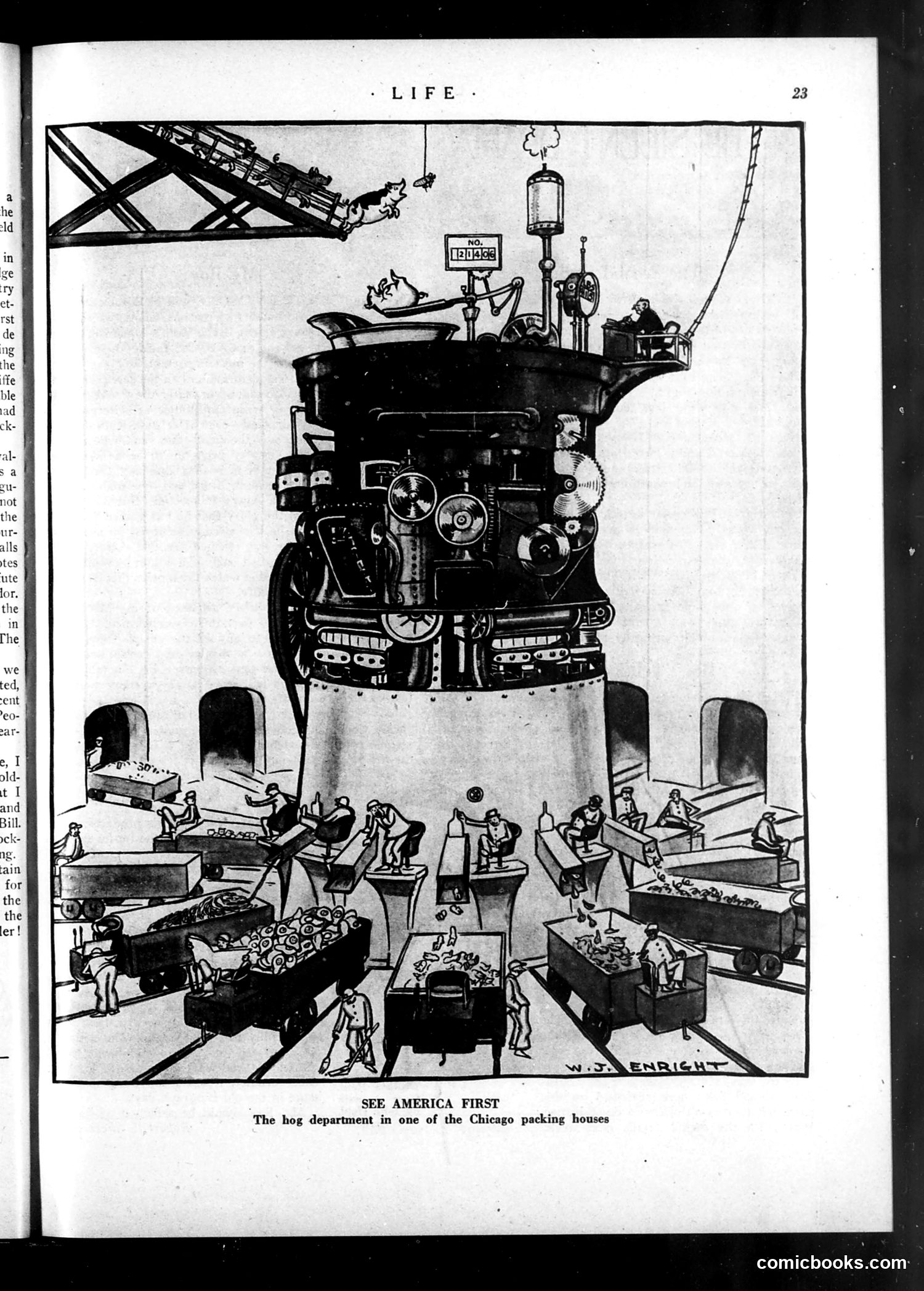
This cartoon depicts an enormous, grotesque head of a pig towering over a factory floor filled with workers and cattle cars. The "See America First" caption frames industrial meat processing as a distinctly American achievement worth showcasing. The satire appears to critique American industrial capitalism and labor practices circa the early 20th century. By elevating the pig's head to monumental proportions—treating it like a national monument—the artist mocks the reverence given to industrial productivity and mechanized slaughter. The tiny workers below emphasize human insignificance within the industrial system. This likely references Upton Sinclair's *The Jungle* (1906) and ongoing criticism of Chicago's notoriously brutal meatpacking conditions, suggesting that Americans should confront, not celebrate, their industrial food production.
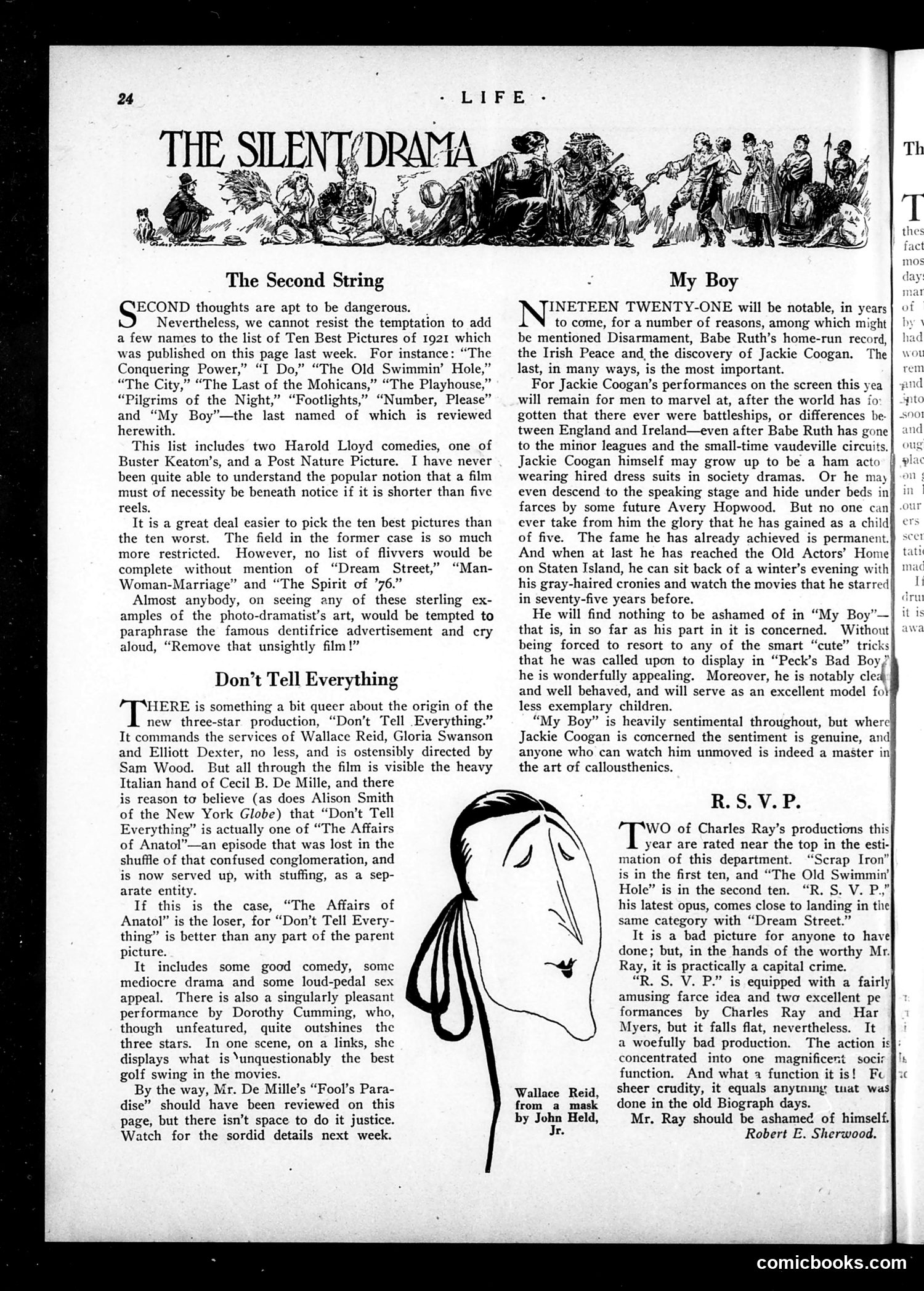
This page reviews recent silent films from 1921, supplementing an earlier "Ten Best Pictures" list. The content critiques Hollywood productions and studio practices of the era. **Key references:** - **Jackie Coogan**: A child actor celebrated for his performances; the reviewer predicts his fame will outlast major events like Babe Ruth's baseball records and international peace agreements. - **Wallace Reid, Gloria Swanson, Cecil B. De Mille**: Major stars and directors of the period. The reviewer suspects "Don't Tell Everything" is actually a recycled segment from De Mille's "The Affairs of Anatol," repackaged as a separate film—critiquing studio cost-cutting and creative dishonesty. - **Film quality debate**: The piece defends short films (under five reels) against the prevailing notion they're inherently inferior to longer features. The cartoon shows Wallace Reid's profile, accompanying the review's discussion of his work. The satire targets studio practices and questions about film authorship and originality in early Hollywood.
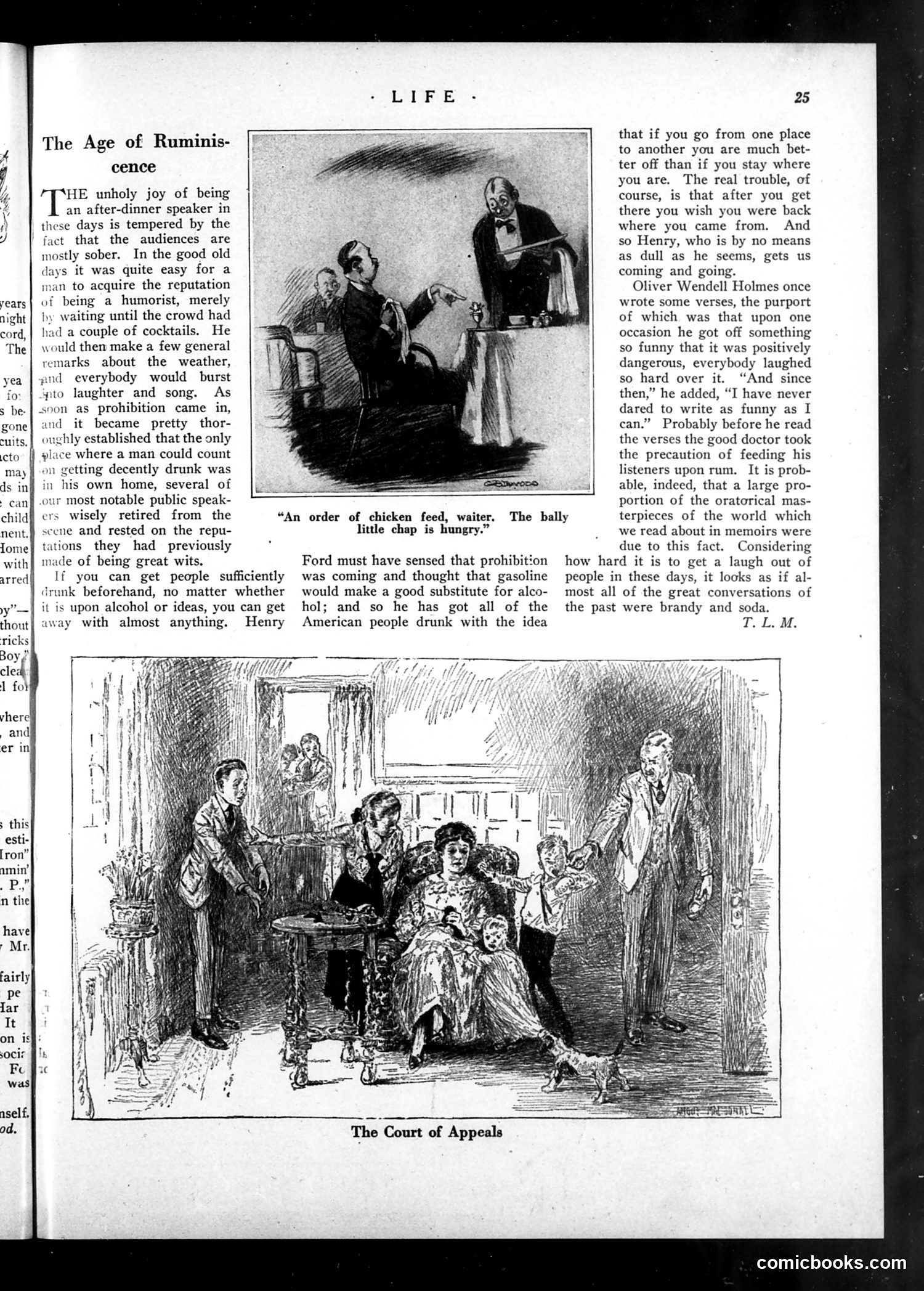
This satirical piece comments on **Prohibition's impact on public speaking and humor**. The author argues that before Prohibition, after-dinner speakers could rely on drunk audiences to laugh at mediocre jokes about weather—merely waiting for cocktails to loosen crowds' inhibitions made them seem witty. Now that Prohibition has eliminated public drinking, speakers must actually be funny, which is harder. The text references **Henry Ford**, suggesting Ford deliberately intoxicated Americans with consumer ideology (gasoline/automobiles) as a substitute for alcohol—a clever metaphor for mass marketing replacing alcohol as society's intoxicant. The two illustrations appear to show social scenes: the upper depicts a waiter serving a hungry child ("chicken feed"), while "The Court of Appeals" (lower) shows what appears to be a legal or formal proceeding. Both cartoons likely humorously depict consequences of Prohibition's social disruption, though their specific satirical targets remain unclear from the image alone.
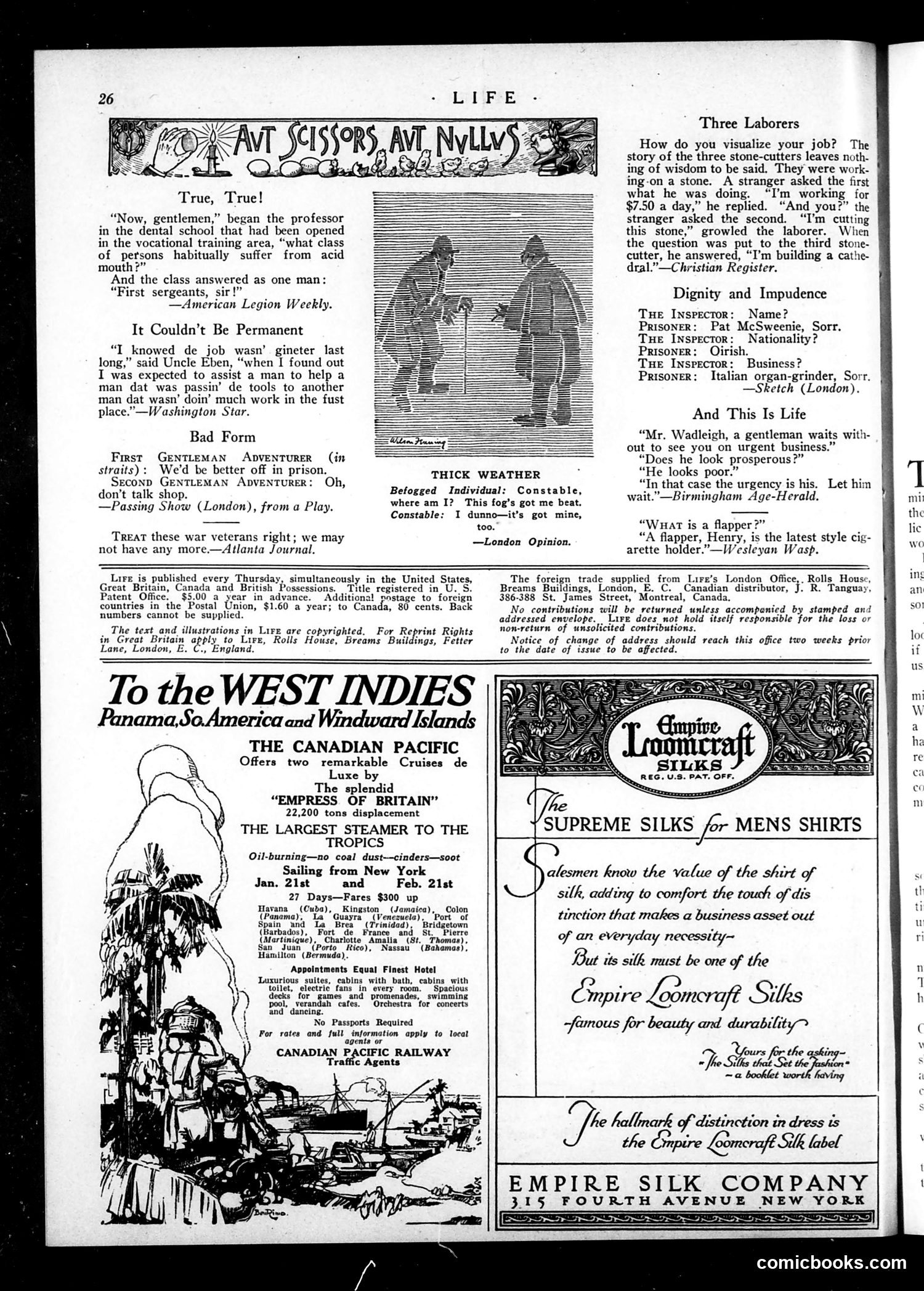
This page from *Life* magazine (early 20th century) contains several brief satirical pieces and jokes reflecting working-class and social themes of the era: **"Three Laborers"** presents a parable about perspective: three stone-cutters describe their identical work differently—one sees only wages ($7.50/day), another sees the task itself, and the third sees meaningful purpose (building a cathedral). The satire suggests that attitude and vision, not circumstances, define one's work. **"It Couldn't Be Permanent"** and **"Bad Form"** are brief comedic anecdotes about employment and social propriety, typical of the magazine's humor format. **"Dignity and Impudence"** appears to be a dialogue between a prison inspector and an Irish prisoner (Pat McSweenie) identified as an Italian organ-grinder—likely playing on ethnic stereotypes common to 1920s American humor. The remaining pieces mock bureaucratic absurdity, poverty, and social pretension. The page also advertises Canadian Pacific cruise ships and Empire Loomcraft silk shirts—typical commercial content for the era.
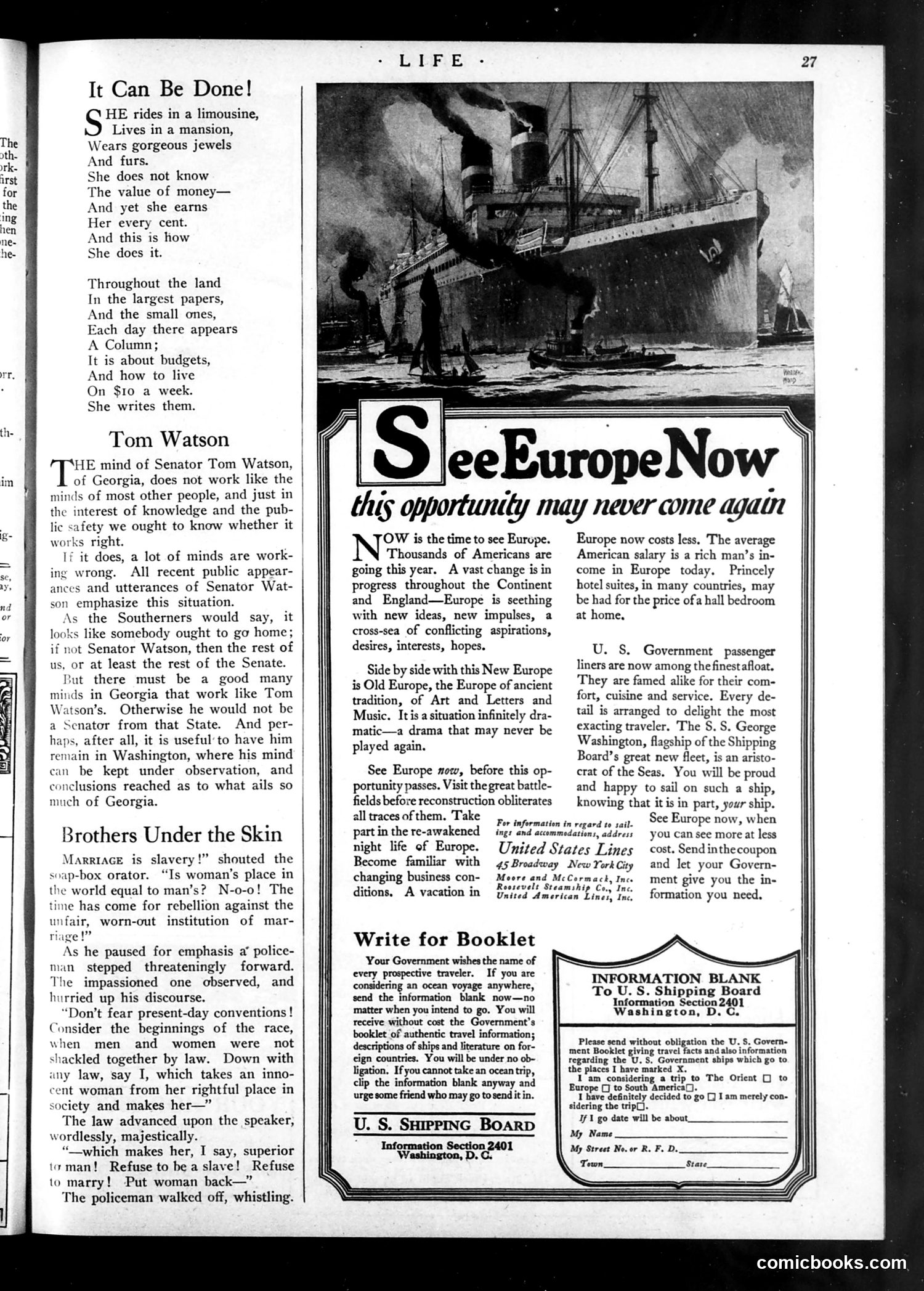
This page contains two distinct pieces: **"It Can Be Done!"** — A satirical poem mocking a wealthy woman who writes budget advice columns despite living luxuriously (limousine, mansion, jewels). The joke: she's unqualified to teach financial restraint to ordinary people but profits from doing so anyway. This reflects early-20th-century class criticism and the irony of the wealthy dispensing poverty advice. **"Tom Watson"** — A brief political commentary on Senator Tom Watson of Georgia, questioning whether his mind "works right" given his recent public statements. The author suggests Watson's views are so problematic that he should return home rather than remain in Washington. This appears to be contemporary political criticism, though the specific statements referenced aren't detailed here. **The remainder** is advertising for European travel and U.S. Shipping Board services—typical *Life* magazine content of the period. The satire targets hypocrisy (unqualified advice-givers) and questions a politician's fitness for office, reflecting *Life*'s role as a vehicle for social and political commentary.
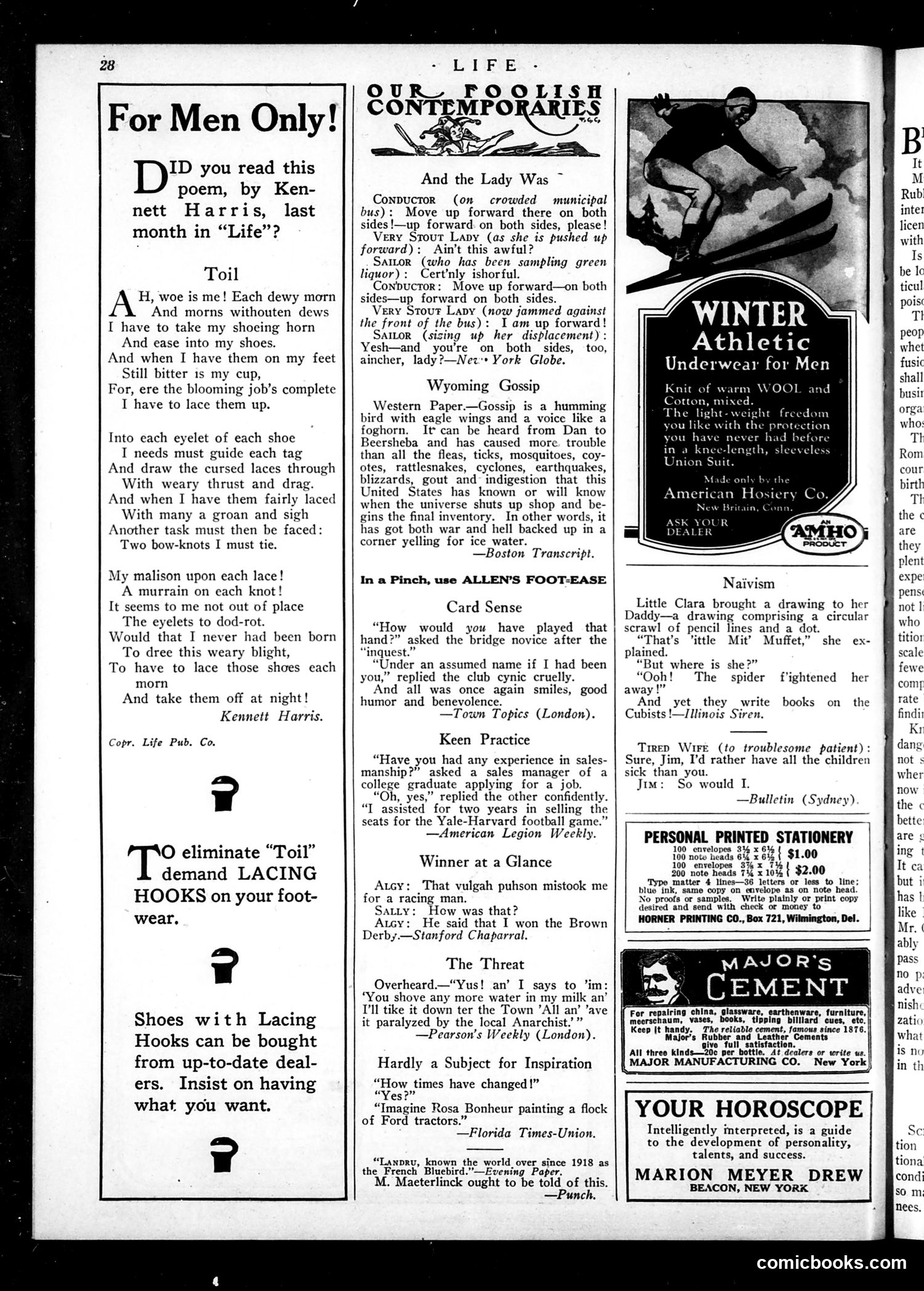
This page features humorous poetry and brief satirical anecdotes typical of early-20th-century Life magazine humor. **Main Content:** The featured poem "Toil" by Kennett Harris humorously complains about the tedious necessity of lacing shoes each morning and evening. The satire is straightforward: it exaggerates the mundane frustration of shoe-lacing into mock-tragic verse. The advertisement below cleverly capitalizes on this complaint, promoting "lacing hooks" as a solution to eliminate the "toil." **Supporting Humor Pieces:** Brief jokes address recognizable frustrations: crowded public transportation ("And the Lady Was"), bridge card games, and sports. The humor relies on wordplay and social observation rather than political commentary. **Context for Modern Readers:** Before slip-on shoes became common, lace-up footwear required genuine daily effort. Life magazine's blend of satirical poetry with targeted product advertisements reflects early advertising that used humor to address real consumer problems—here, literally transforming a complaint into a sales pitch.
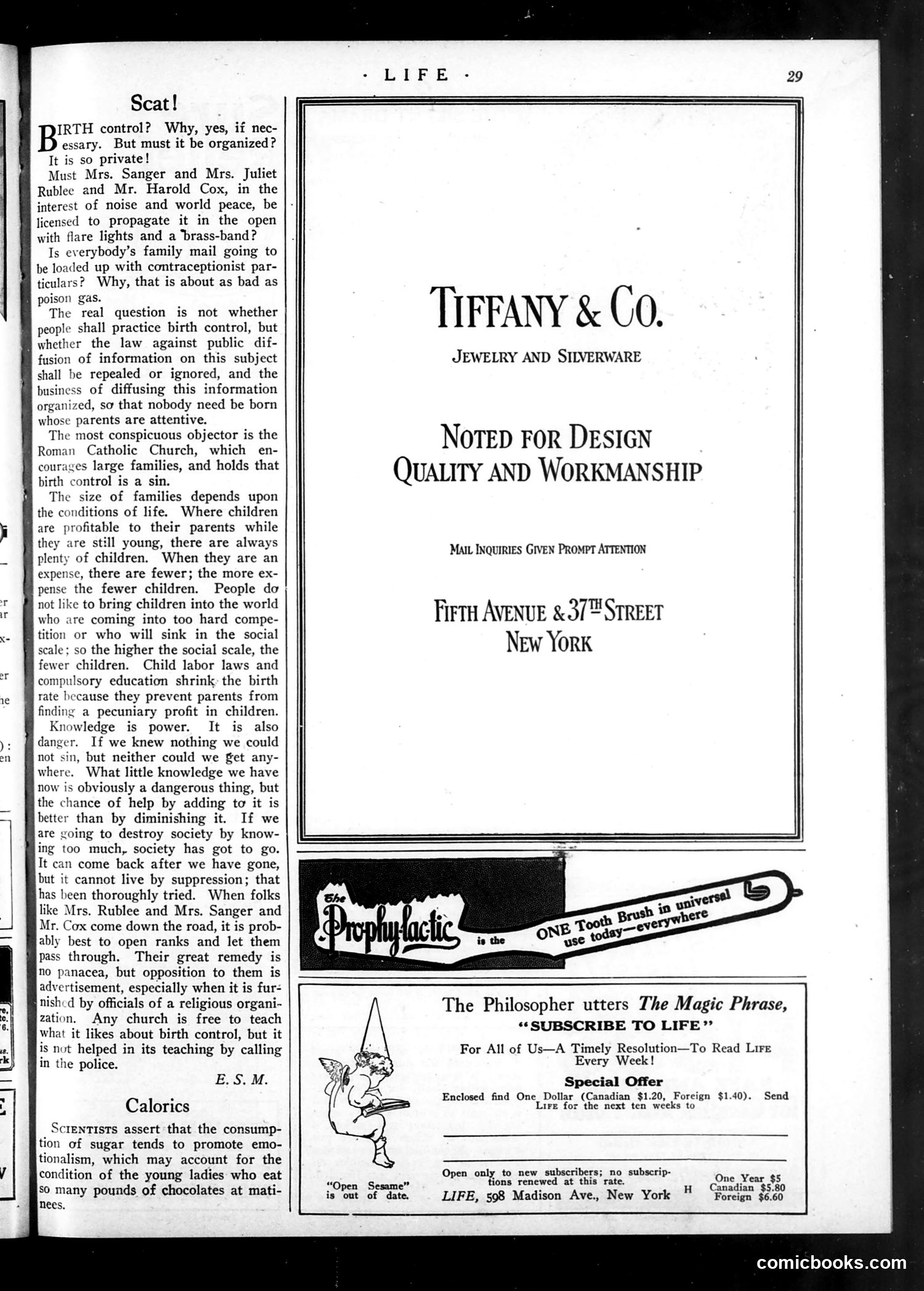
This editorial piece by E.S.M. satirizes opposition to public birth control education. The title references figures like **Margaret Sanger** and **Juliet Rublee**—real birth control activists—who the author depicts as being criticized for organizing openly about contraception rather than keeping it "private." The satire targets the **Roman Catholic Church** and conservative objectors who claim public discussion of birth control is scandalous ("as bad as poison gas"). The author argues this opposition is hypocritical: knowledge about birth control shouldn't be suppressed, and ironically, the Church's resistance itself serves as "advertisement" for the cause. The piece uses economic logic—families have fewer children when they're expensive rather than profitable—to argue birth control information serves society's interests. The final section mocks the idea that "knowledge is power" but also "danger," suggesting society must choose progress over suppression. The remaining page content includes advertisements (Tiffany & Co., Prophylactic toothbrushes) and a brief joke about women eating chocolates at matinees causing "emotionalism."
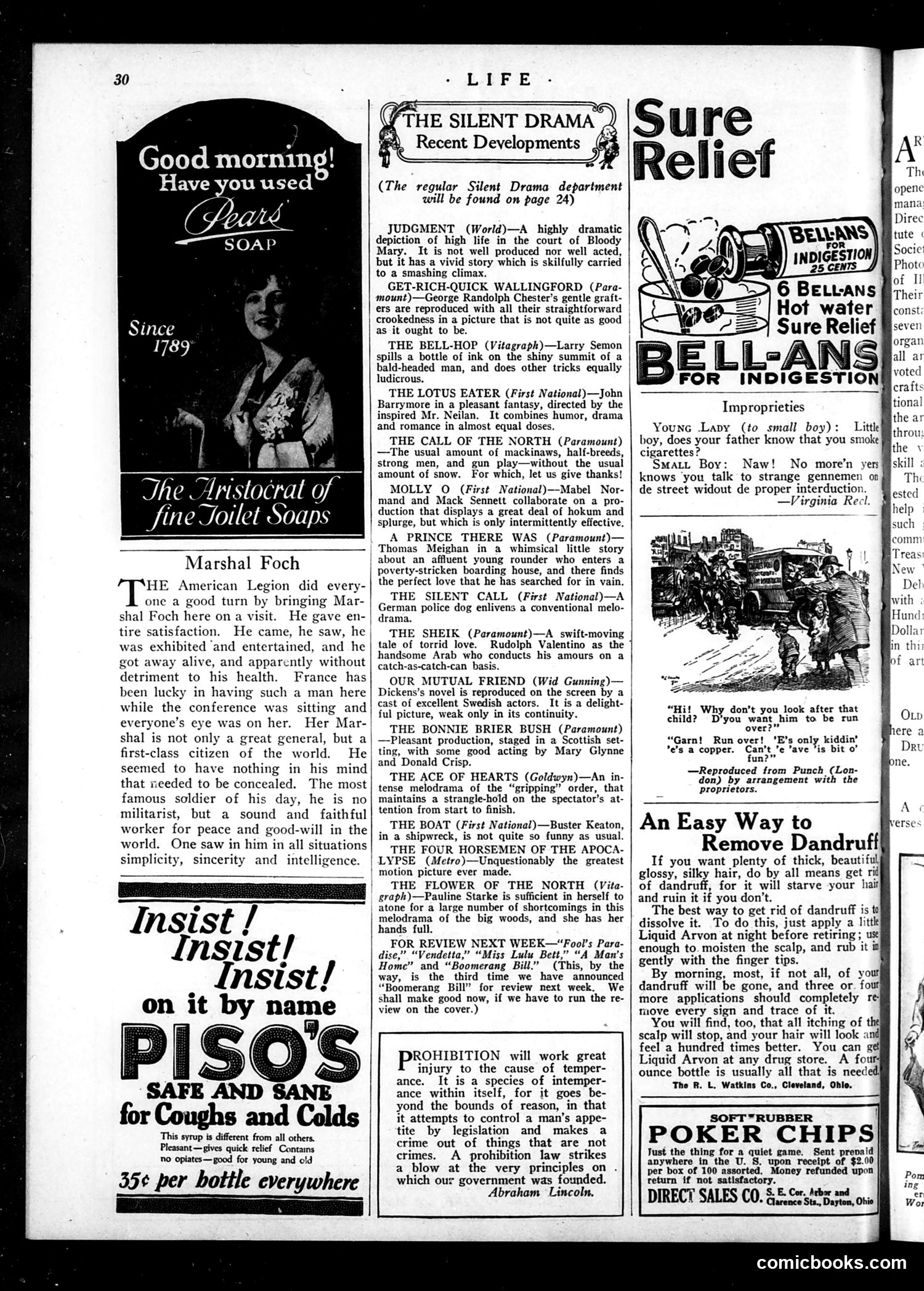
This page is **primarily advertising and entertainment reviews**, not political satire. The main editorial content concerns **Marshal Foch's visit to America**. The piece praises the French military leader as a dignified statesman and peacemaker—not merely a militarist—during a period when international conferences (likely post-WWI peace negotiations) were underway. The tone suggests Foch's visit reassured Americans of France's commitment to peaceful resolution rather than military aggression. The bulk of the page consists of **silent film reviews** (typical for Life magazine of this era) and advertisements for consumer products: Pears' Soap, Piso's cough syrup, Bell-Ans indigestion relief, and poker chips. There is **no identifiable political cartoon** on this page. The Marshal Foch section is straightforward editorial commentary celebrating a foreign dignitary's character and diplomatic value, not satire or caricature.
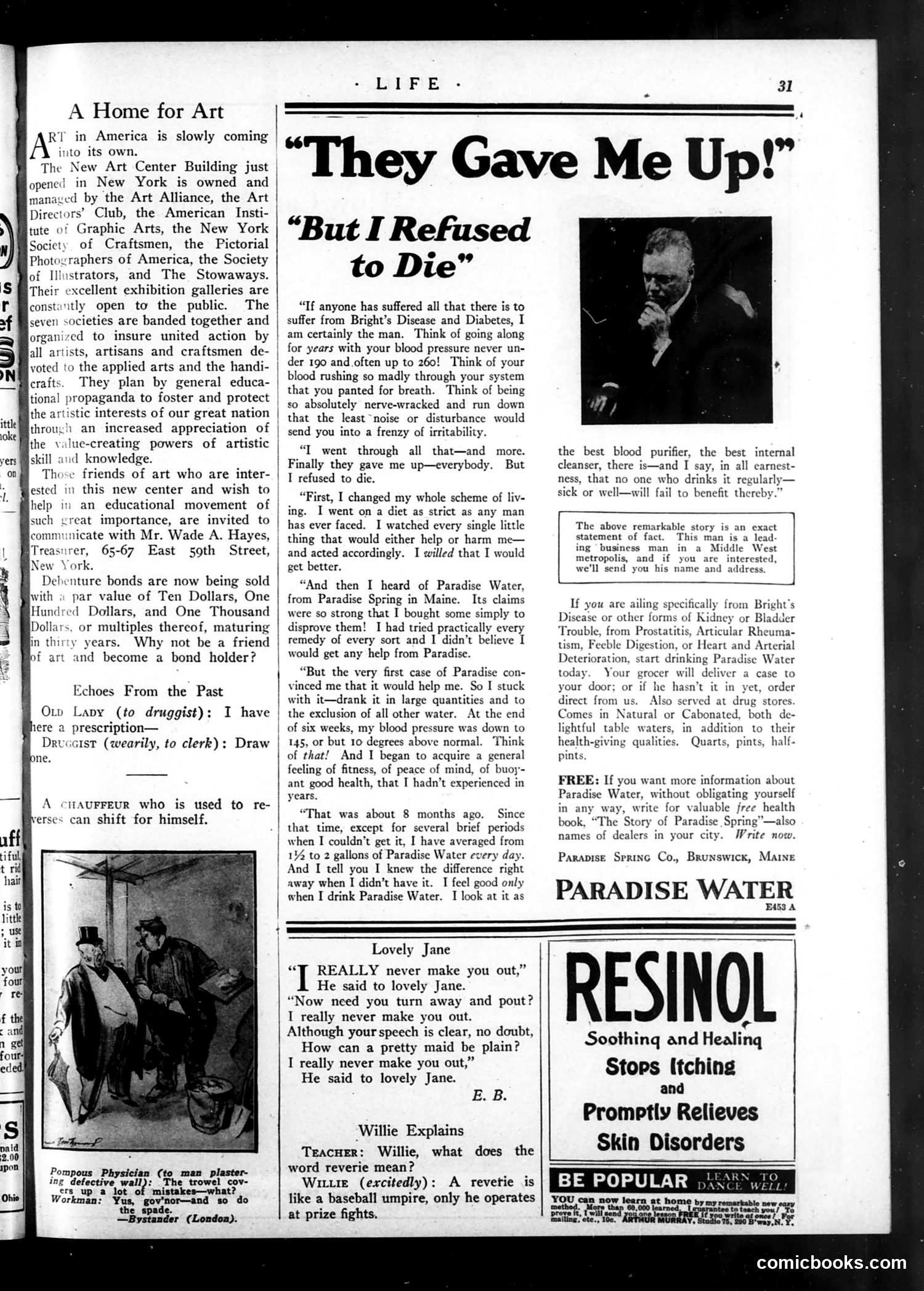
This page contains primarily **advertising and light humor** rather than political satire. The main content is a testimonial advertisement for "Paradise Water," a patent medicine from Maine claiming to cure Bright's Disease and Diabetes. The named patient describes miraculous recovery through strict dieting and drinking the water—a typical health-fraud advertisement of the early 20th century. The page also includes: - **"A Home for Art"**: an earnest announcement about a new arts center in New York - **Three brief humorous "Echoes"**: lightweight jokes about an old lady getting a prescription, a chauffeur, and a workman being insulted by a physician The cartoon illustration shows a "Pompous Physician" condescending to a working man—gentle class satire. The **Paradise Water ad is the real artifact of interest** for modern readers: it exemplifies how unregulated medical claims flourished before FDA oversight, exploiting desperate patients with vague testimonials and pseudoscientific language.
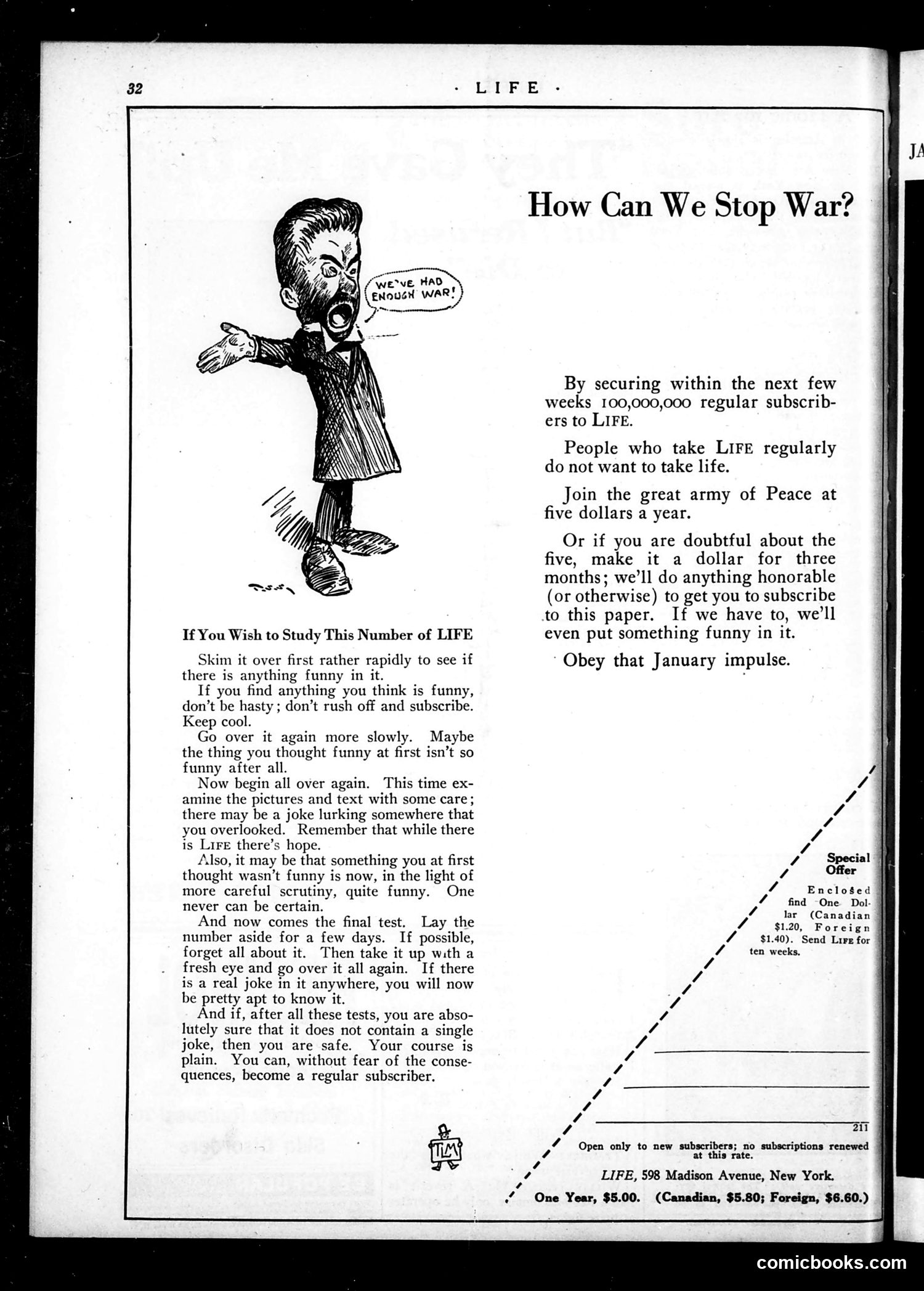
This is a satirical advertisement for *Life* magazine itself, disguised as social commentary. The cartoon shows a figure (likely representing a politician or warmonger) declaring "We've had enough war!"—expressing public exhaustion after World War I. The joke is darkly ironic: *Life* claims that acquiring 100 million subscribers will stop war, because "people who take LIFE regularly do not want to take life." The pun equates reading the magazine with pacifism. The text below mockingly instructs readers on whether to subscribe, using intentionally convoluted logic: read it multiple times, forget about it, reread it, and only subscribe if you find *no* jokes in it. This is self-aware satire—admitting the magazine may not be funny while simultaneously promoting subscriptions. The "Special Offer" box pitches reduced subscription rates. The overall effect satirizes both aggressive magazine marketing and post-WWI peace rhetoric, suggesting that cynical commercial interests hide behind noble causes.