
Life, 1922-01-05 · page 16 of 34
Life — January 5, 1922 — page 16: what you’re looking at
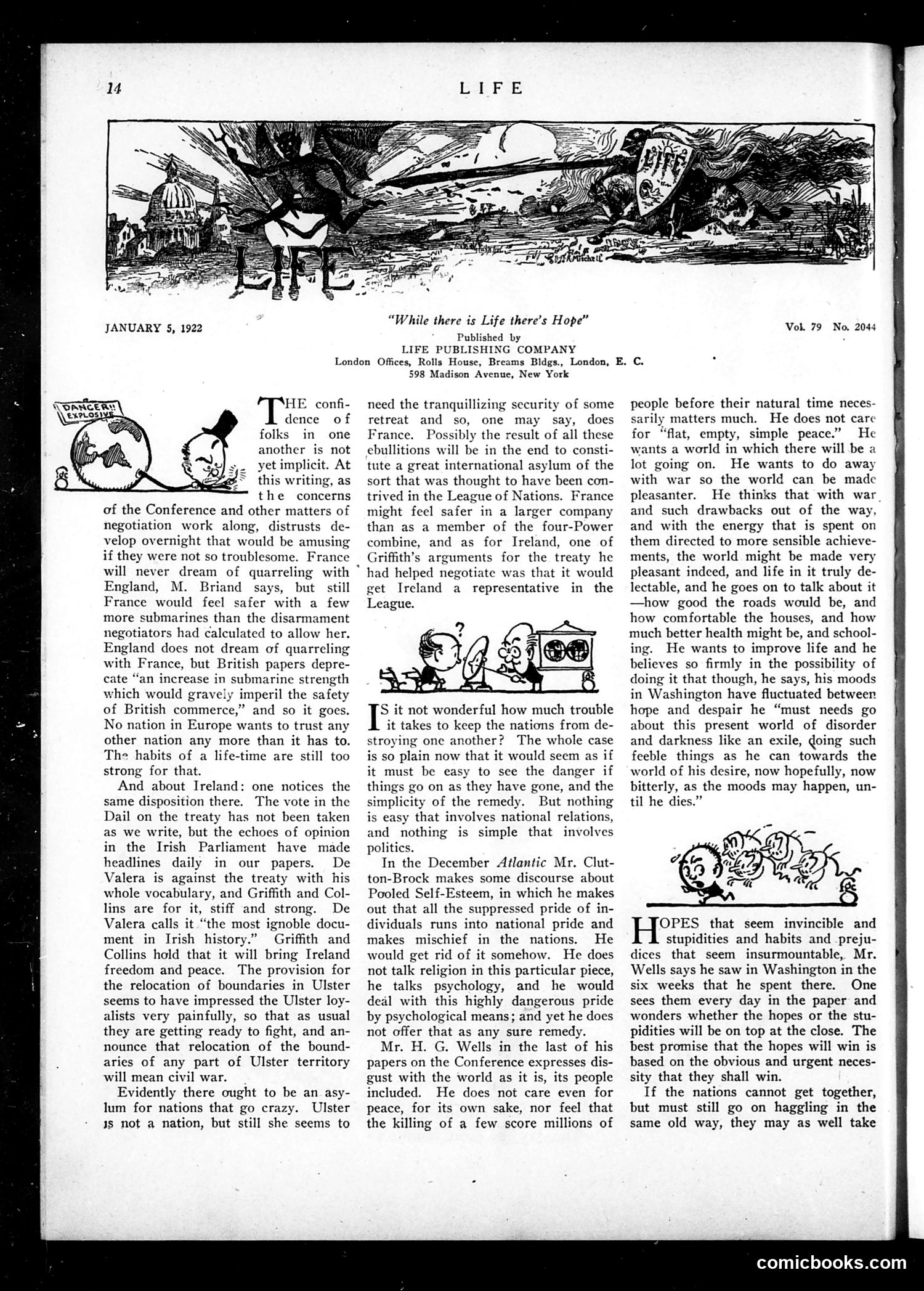
What you’re looking at
This editorial page discusses post-WWI peace negotiations and national anxieties. The main cartoon (top left) depicts a caricatured figure labeled "Dancer" emerging from or interacting with a globe, apparently satirizing diplomatic instability or the chaotic state of international relations after World War I. The text addresses Ireland's position in League of Nations negotiations, disarmament concerns, and disputes over Ulster's boundaries. Writers critique how nations struggle to cooperate, referencing H.G. Wells's pessimistic views on world order. The smaller cartoons appear to illustrate domestic anxieties—one shows figures near what appears to be a radio or entertainment device, possibly mocking popular distractions from serious political problems. The overall message: nations bicker over details while fundamental peace remains elusive.
📄 Transcribed text from this page (OCR, searchable)
Machine-transcribed from the original scan — historical spelling and the odd misread are preserved.
JANUARY 5, 1922 “While there is Life there’s Hope” Published by LIFE PUBLISHING COMPANY Vol. 79 No. 2044 London Offices, Rolls House, Breams Bldgs., London, E. C. HE confi- dence of folks in one another is not yet implicit. At this writing, as the concerns of the Conference and other matters of negotiation work along, distrusts de- velop overnight that would be amusing if they were not so troublesome. France will never dream of quarreling with * England, M. Briand says, but. still France would feel safer with a few more submarines than the disarmament negotiators had calculated to allow her. England does not dream of quarreling with France, but British papers depre- cate “‘an increase in submarine strength which would gravely imperil the safety of British commerce,” and so it goes. No nation in Europe wants to trust any other nation any more than it has to. The habits of a life-time are still too strong for that. And about Ireland: one notices the same disposition there. The vote in the Dail on the treaty has not been taken as we write, but the echoes of opinion in the Irish Parliament have made headlines daily in our papers. De Valera is against the treaty with his whole vocabulary, and Griffith and Col- lins are for it, stiff and strong. De Valera calls it “the most ignoble docu- ment in Irish history.” Griffith and Collins hold that it will bring Ireland freedom and peace. The provision for the relocation of boundaries in Ulster seems to have impressed the Ulster loy- alists very painfully, so that as usual they are getting ready to fight, and an- nounce that relocation of the bound- aries of any part of Ulster territory will mean civil war. Evidently there ought to be an asy- lum for nations that go crazy. Ulster Js not a nation, but still she seems to 598 Madison Avenue, New York need the tranquillizing security of some retreat and so, one may say, does France. Possibly the result of all these ebullitions will be in the end to consti- tute a great international asylum of the sort that was thought to have been con- trived in the League of Nations. France might feel safer in a larger company than as a member of the four-Power combine, and as for Ireland, one of Griffith’s arguments for the treaty he had helped negotiate was that it would get Ireland a representative in the League. Is it not wonderful how much trouble it takes to keep the nations from de- stroying one another? The whole case is so plain now that it would seem as if it must be easy to see the danger if things go on as they have gone, and the simplicity of the remedy. But nothing is easy that involves national relations, and nothing is simple that involves politics. In the December Aflantic Mr. Clut- ton-Brock makes some discourse about Pooled Self-Esteem, in which he makes out that all the suppressed pride of in- dividuals runs into national pride and makes mischief in the nations. He would get rid of it somehow. He does not talk religion in this particular piece, he talks psychology, and he would deal with this highly dangerous pride by psychological means; and yet he does not offer that as any sure remedy. Mr. H. G. Wells in the last of his papers on the Conference expresses dis- gust with the world as it is, its people included. He does not care even for peace, for its own sake, nor feel that the killing of a few score millions of people before their natural time neces- sarily matters much. He does not care for “flat, empty, simple peace.” He wants a world in which there will be a lot going on. He wants to do away with war so the world can be made pleasanter. He thinks that with war. and such drawbacks out of the way, and with the energy that is spent on them directed to more sensible achieve- ments, the world might be made very pleasant indeed, and life in it truly de- lectable, and he goes on to talk about it —how good the roads would be, and how comfortable the houses, and how much better health might be, and school- ing. He wants to improve life and he believes so firmly in the possibility of doing it that though, he says, his moods in Washington have fluctuated betweer hope and despair he “must needs go about this present world of disorder and darkness like an exile, doing such feeble things as he can towards the world of his desire, now hopefully, now bitterly, as the moods may happen, un- til he dies.” OPES that seem invincible and stupidities and habits and _preju- dices that seem insurmountable, Mr. Wells says he saw in Washington in the six weeks that he spent there. One sees them every day in the paper and wonders whether the hopes or the stu- Pidities will be on top at the close. The best promise that the hopes will win is based on the obvious and urgent neces- sity that they shall win. If the nations cannot get together, but must still go on haggling in the same old way, they may as well take comicbooks.com