
Life, 1922-01-05 · page 20 of 34
Life — January 5, 1922 — page 20: what you’re looking at
What you’re looking at
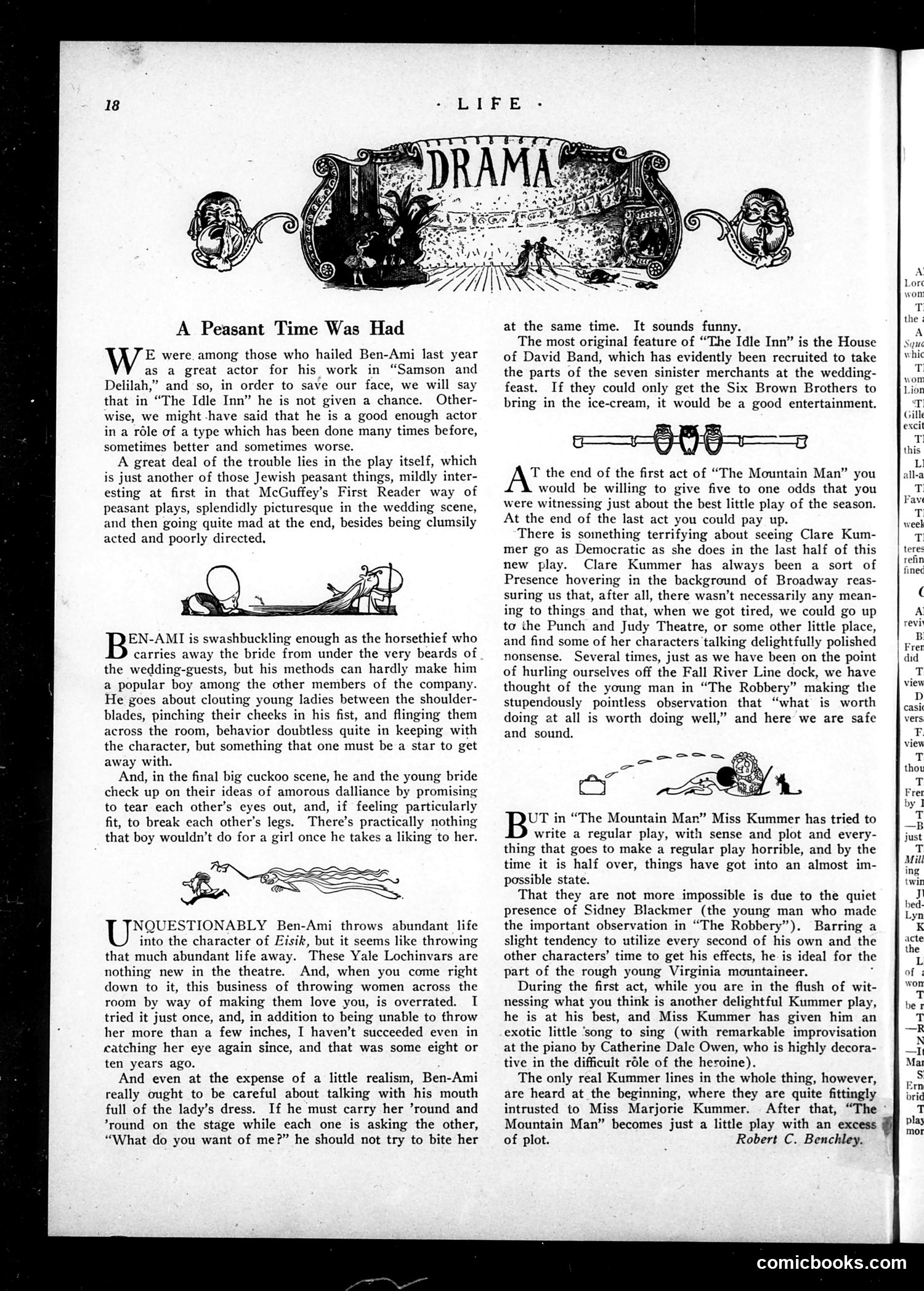
This page contains theater reviews of three plays. The critic discusses **Ben-Ami** in "The Idle Inn," a play about Jewish peasant life featuring a horsethief protagonist who literally tosses women around—behavior the critic finds both dramatically authentic and socially excessive. The humor lies in the reviewer's deadpan complaint that he once tried this courtship method himself, with disastrous results. The second review examines **Clare Kummer's** "The Mountain Man," praising its first act but finding it deteriorates. The critic expresses relief that Kummer—typically associated with frivolous Broadway entertainments—hasn't become entirely serious in her recent work. The references to "Six Brown Brothers" and the "House of David Band" suggest contemporary musical groups performing in these productions. The satire targets both overwrought theatrical realism and the arbitrary mixing of entertainment genres in stage productions.
📄 Transcribed text from this page (OCR, searchable)
Machine-transcribed from the original scan — historical spelling and the odd misread are preserved.
A Peasant Time Was Had E were. among those who hailed Ben-Ami last year as a great actor for his work in “Samson and Delilah,” and so, in order to save our face, we will say that in “The Idle Inn” he is not given a chance. Other- wise, we might -have said that he is a good enough actor in a réle of a type which has been done many times before, sometiines better and sometimes worse. A great deal of the trouble lies in the play itself, which is just another of those Jewish peasant things, mildly inter- esting at first in that McGuffey’s First Reader way of peasant plays, splendidly picturesque in the wedding scene, and then going quite mad at the end, besides being clumsily acted and poorly directed. EN-AML is swashbuckling enough as the horsethief who carries away the bride from under the very beards of the wedding-guests, but his methods can hardly make him a popular boy among the other members of the company. He goes about clouting young ladies between the shoulder- blades, pinching their cheeks in his fist, and flinging them across the room, behavior doubtless quite in keeping with the character, but something that one must be a star to get away with. And, in the final big cuckoo scene, he and the young bride check up on their ideas of amorous dalliance by promising to tear each other’s eyes out, and, if feeling particularly fit, to break each other's legs. There’s practically nothing that boy wouldn’t do for a girl once he takes a liking to her. fy SS NQUESTIONABLY Ben-Ami throws abundant life into the character of Eisik, but it seems like throwing that much abundant life away. These Yale Lochinvars are nothing new in the theatre. And, when you come right down to it, this business of throwing women across the room by way of making them love you, is overrated. I tried it just once, and, in addition to being unable to throw her more than a few inches, I haven’t succeeded even in catching her eye again since, and that was some eight or ten years ago. And even at the expense of a little realism, Ben-Ami really ought to be careful about talking with his mouth full of the lady’s dress. If he must carry her ’round and ’round on the stage while each one is asking the other, “What do you want of me?” he should not try to bite her at the same time. It sounds funny. The most original feature of “The Idle Inn” is the House of David Band, which has evidently been recruited to take the parts of the seven sinister merchants at the wedding- feast. If they could only get the Six Brown Brothers to bring in the ice-cream, it would be a good entertainment. Hie T the end of the first act of “The Mountain Man” you would be willing to give five to one odds that you were witnessing just about the best little play of the season. At the end of the last act you could pay up. There is something terrifying about seeing Clare Kum- mer go as Democratic as she does in the last half of this new play. Clare Kummer has always been a sort of Presence hovering in the background of Broadway reas- suring us that, after all, there wasn’t necessarily any mean- ing to things and that, when we got tired, we could go up to the Punch and Judy Theatre, or some other little place, and find some of her characters talking delightfully polished nonsense. Several times, just as we have been on the point of hurling ourselves off the Fall River Line dock, we have thought of the young man in “The Robbery” making the stupendously pointless observation that “what is worth doing at all is worth doing well,” and here we are safe and sound. Bz in “The Mountain Man” Miss Kummer has tried to write a regular play, with sense and plot and every- thing that goes to make a regular play horrible, and by the time it is half over, things have got into an almost im- possible state. That they are not more impossible is due to the quiet presence of Sidney Blackmer (the young man who made the important observation in “The Robbery”). Barring a slight tendency to utilize every second of his own and the other characters’ time to get his effects, he is ideal for the part of the rough young Virginia mountaineer. During the first act, while you are in the flush of wit- nessing what you think is another delightful Kummer play, he is at his best, and Miss Kummer has given him an exotic little ‘song to sing (with remarkable improvisation at the piano by Catherine Dale Owen, who is highly decora- tive in the difficuit réle of the heroine). The only real Kummer lines in the whole thing, however, are heard at the beginning, where they are quite fittingly intrusted to Miss Marjorie Kummer. After that, “The Mountain Man” becomes just a little play with an excess of plot. Robert C. Benchley. comicbooks.com