
Life, 1922-01-05 · page 27 of 34
Life — January 5, 1922 — page 27: what you’re looking at
What you’re looking at
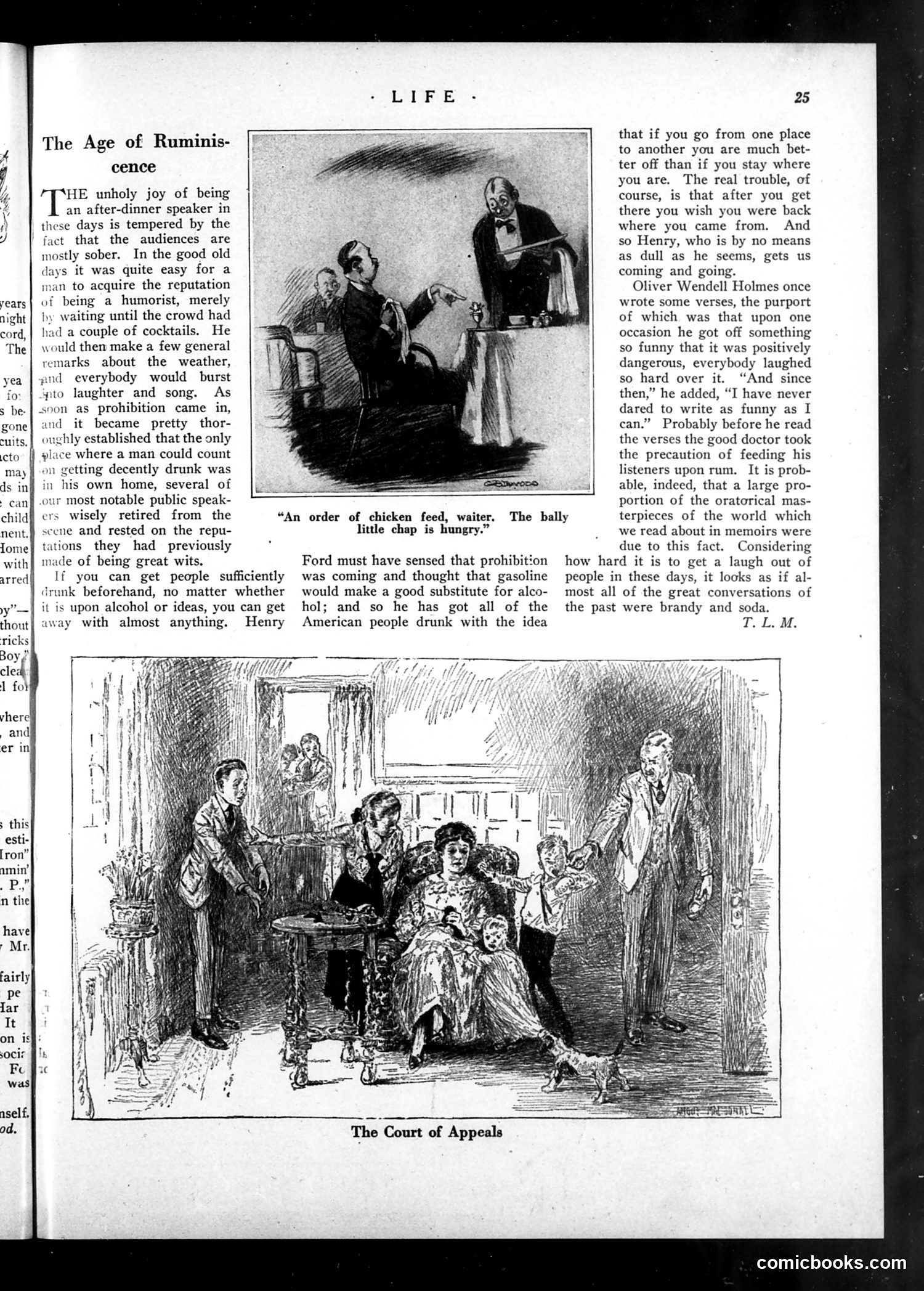
This satirical piece comments on **Prohibition's impact on public speaking and humor**. The author argues that before Prohibition, after-dinner speakers could rely on drunk audiences to laugh at mediocre jokes about weather—merely waiting for cocktails to loosen crowds' inhibitions made them seem witty. Now that Prohibition has eliminated public drinking, speakers must actually be funny, which is harder. The text references **Henry Ford**, suggesting Ford deliberately intoxicated Americans with consumer ideology (gasoline/automobiles) as a substitute for alcohol—a clever metaphor for mass marketing replacing alcohol as society's intoxicant. The two illustrations appear to show social scenes: the upper depicts a waiter serving a hungry child ("chicken feed"), while "The Court of Appeals" (lower) shows what appears to be a legal or formal proceeding. Both cartoons likely humorously depict consequences of Prohibition's social disruption, though their specific satirical targets remain unclear from the image alone.
📄 Transcribed text from this page (OCR, searchable)
Machine-transcribed from the original scan — historical spelling and the odd misread are preserved.
25 The Age of Ruminis- cence HE unholy joy of being an after-dinner speaker in these days is tempered by the fact that the audiences are mostly sober. In the good old days it was quite easy for a man to acquire the reputation of being a humorist, merely by waiting until the crowd had had a couple of cocktails. He would then make a few general remarks about the weather, everybody would burst to laughter and song. As soon as prohibition came in, and it became pretty thor- oughly established that the only || place where a man could count on getting decently drunk was in his own home, several of [ei a oe that if you go from one place to another you are much bet- ter off than if you stay where you are. The real trouble, of course, is that after you get there you wish you were back where you came from. And so Henry, who is by no means as dull as he seems, gets us coming and going. Oliver Wendell Holmes once wrote some verses, the purport of which was that upon one occasion he got off something so funny that it was positively dangerous, everybody laughed so hard over it. “And since then,” he added, “I have never dared to write as funny as I can.” Probably before he read the verses the good doctor took the precaution of feeding his listeners upon rum. It is prob- able, indeed, that a large pro- our most notable public speak- ers wisely retired from the scene and rested on the repu- tations they had previously made of being great wits. lf you can get people sufficiently irunk beforehand, no matter whether it is upon alcohol or ideas, you can get away with almost anything. Henry “An order of chicken feed, waiter. little chap is hungry.” Ford must have sensed that prohibition was coming and thought that gasoline would make a good substitute for alco- hol; and so he has got all of the American people drunk with the idea The bally portion of the oratorical mas- terpieces of the world which we read about in memoirs were due to this fact. Considering how hard it is to get a laugh out of people in these days, it looks as if al- most all of the great conversations of the past were brandy and soda. tT. L. M. The Court of Appeals comicbooks.com