
Life, 1922-01-05 · page 8 of 34
Life — January 5, 1922 — page 8: what you’re looking at
What you’re looking at
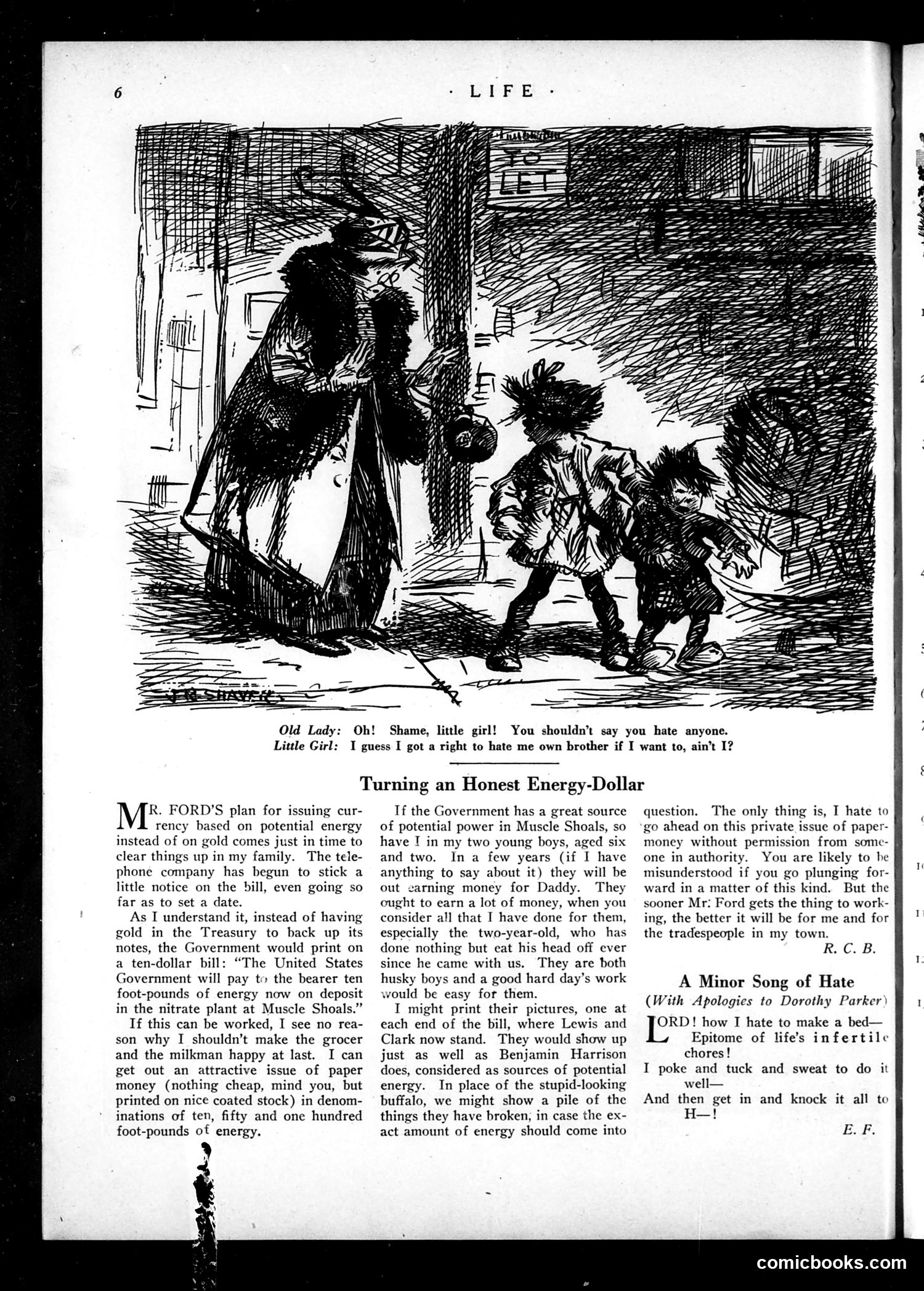
This cartoon satirizes **Henry Ford's proposal to issue currency backed by "potential energy"** rather than gold. The sketch shows an old woman confronting children on the street, mocking the impractical scheme. The article explains Ford's plan: the U.S. Government would print ten-dollar bills backed by energy produced at Muscle Shoals (a hydroelectric facility), rather than gold reserves. The author argues this is absurd—suggesting they could monetize images of children or broken buffalo to represent "energy." The humor targets Ford's business hubris: his ambitious but economically nonsensical proposal to replace the gold standard with an ephemeral concept. The cartoon's woman represents common sense objecting to this financial fantasy, emphasizing how disconnected the idea is from practical reality.
📄 Transcribed text from this page (OCR, searchable)
Machine-transcribed from the original scan — historical spelling and the odd misread are preserved.
Old Lady: Little Girl: Oh! Shame, little girl! You shouldn’t say you hate anyone. I guess I got a right to hate me own brother if I want to, ain’t 1? Turning an Honest Energy-Dollar R. FORD’S plan for issuing cur- rency based on potential energy instead of on gold comes just in time to clear things up in my family. The tele- phone company has begun to stick a little notice on the bill, even going so far as to set a date. As I understand it, instead of having gold in the Treasury to back up its notes, the Government would print on a ten-dollar bill: “The United States Government will pay to the bearer ten foot-pounds of energy now on deposit in the nitrate plant at Muscle Shoals.” If this can be worked, I see no rea- son why I shouldn’t make the grocer and the milkman happy at last. I can get out an attractive issue of paper money (nothing cheap, mind you, but printed on nice coated stock) in denom- inations of ten, fifty and one hundred foot-pounds of energy. If the Government has a great source of potential power in Muscle Shoals, so have I in my two young boys, aged six and two. In a few years (if I have anything to say about it) they will be out earning money for Daddy. They ought to earn a lot of money, when you consider all that I have done for them, especially the two-year-old, who has done nothing but eat his head off ever since he came with us. They are both husky boys and a good hard day’s work would be easy for them. I might print their pictures, one at each end of the bill, where Lewis and Clark now stand. They would show up just as well as Benjamin Harrison does, considered as sources of potential energy. In place of the stupid-looking buffalo, we might show a pile of the things they have broken, in case the ex- act amount of energy should come into question. The only thing is, I hate to go ahead on this private issue of paper- money without permission from some- f one in authority. You are likely to he misunderstood if you go plunging for- ward in a matter of this kind. But the sooner Mr: Ford gets the thing to work- ing, the better it will be for me and for the tradespeople in my town. R.C. B. A Minor Song of Hate (With Apologies to Dorothy Parker) | age how I hate to make a bed— Epitome of life’s infertile chores! I poke and tuck and sweat to do it well— And then get in and knock it all to H-! E. F. comicbooks.com