
Life, 1922-01-05 · page 24 of 34
Life — January 5, 1922 — page 24: what you’re looking at
What you’re looking at
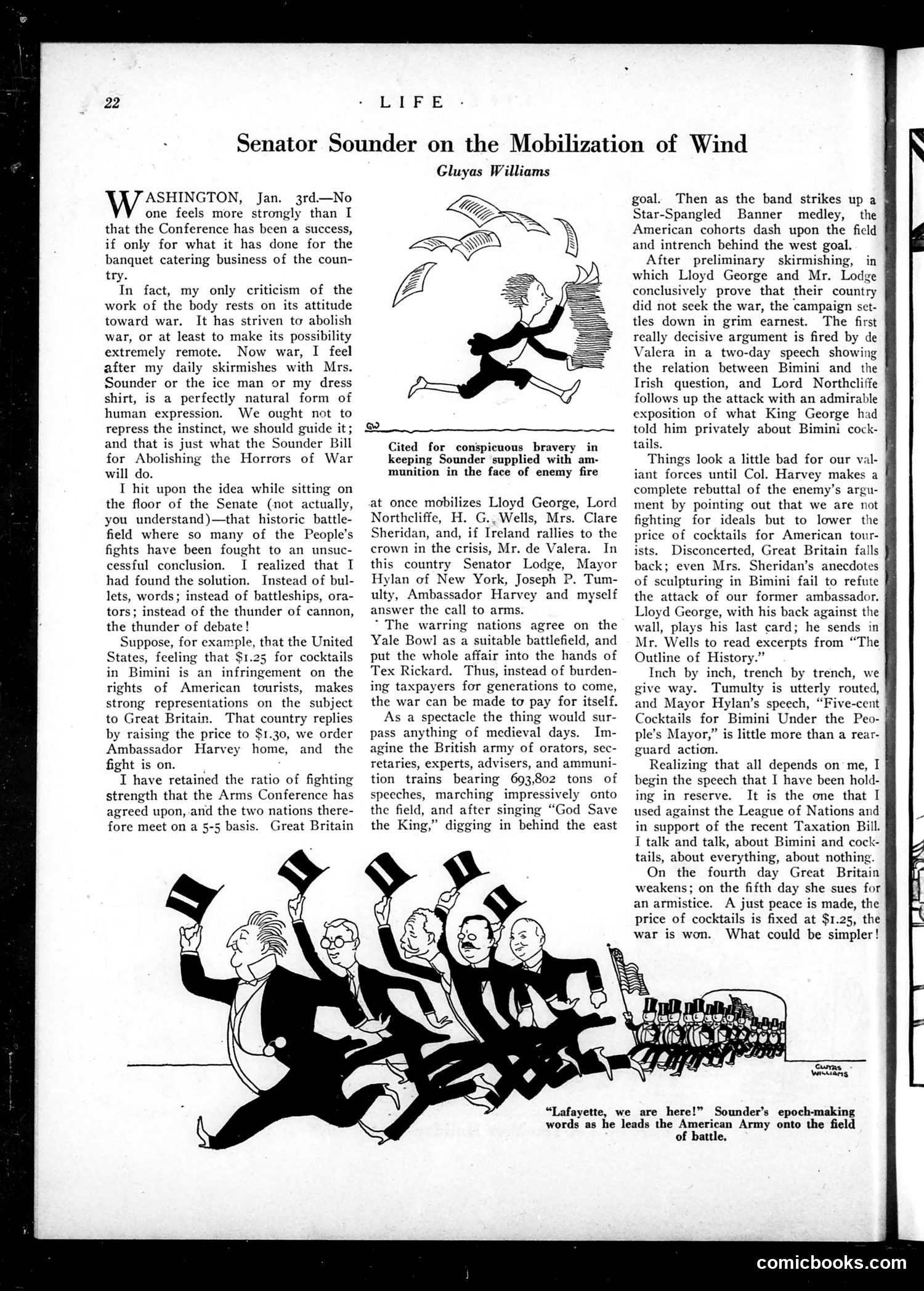
This satirical piece mocks post-WWI disarmament conferences (likely the 1921-22 Washington Naval Conference) and pacifist sentiment. The humor centers on a fictional "Senator Sounder" proposing to replace military warfare with rhetorical combat—substituting orators for soldiers and speeches for ammunition. The cartoon depicts political figures (Lloyd George, H.G. Wells, Senator Lodge, Mayor Hylan, Ambassador Harvey) as combatants wielding flags in a absurd "battle." The satire ridicules both pacifism and political grandstanding: replacing actual war with endless oratory is presented as equally ridiculous and wasteful. The framing device—using a trivial dispute over cocktail prices in Bimini—underscores the author's skepticism about whether earnest debate can solve real international conflicts. The piece suggests that politicians' speeches are mere "wind," deflating both militarism and its opponents with equal contempt.
📄 Transcribed text from this page (OCR, searchable)
Machine-transcribed from the original scan — historical spelling and the odd misread are preserved.
LIFE Senator Sounder on the Mobilization of Wind Gluyas Williams ASHINGTON, Jan. 3rd—No one feels more strongly than I that the Conference has been a success, if only for what it has done for the banquet catering business of the coun- try. In fact, my only criticism of the work of the body rests on its attitude toward war. It has striven to abolish war, or at least to make its possibility extremely remote. Now war, I feel after my daily skirmishes with Mrs. Sounder or the ice man or my dress shirt, is a perfectly natural form of human expression. We ought not to repress the instinct, we should guide it; and that is just what the Sounder Bill for Abolishing the Horrors of War will do. I hit upon the idea while sitting on the floor of the Senate (not actually, you understand)—that historic battle- field where so many of the People’s fights have been fought to an unsuc- cessful conclusion. I realized that I had found the solution. Instead of bul- lets, words; instead of battleships, ora- tors; instead of the thunder of cannon, the thunder of debate! Suppose, for example, that the United States, feeling that $1.25 for cocktails in Bimini is an infringement on the rights of American tourists, makes strong representations on the subject to Great Britain. That country replies by raising the price to $1.30, we order Ambassador Harvey home, and the fight is on. I have retained the ratio of fighting strength that the Arms Conference has agreed upon, and the two nations there- fore meet on a 5-5 basis. Great Britain Cited for conspicuous bravery in keeping Sounder supplied with am- munition in the face of enemy fire at once mobilizes Lloyd George, Lord Northcliffe, H. G.,Wells, Mrs. Clare Sheridan, and, if Ireland rallies to the crown in the crisis, Mr. de Valera. In this country Senator Lodge, Mayor Hylan of New York, Joseph P. Tum- ulty, Ambassador Harvey and myself answer the call to arms. * The warring nations agree on the Yale Bowl as a suitable battlefield, and put the whole affair into the hands of Tex Rickard. Thus, instead of burden- ing taxpayers for generations to come, the war can be made to pay for itself. As a spectacle the thing would sur- pass anything of medieval days. Im- agine the British army of orators, sec- retaries, experts, advisers, and ammuni- tion trains bearing 693,802 tons of speeches, marching impressively onto the field, and after singing “God Save the King,” digging in behind the east goal. Then as the band strikes up a Star-Spangled Banner medley, the American cohorts dash upon the field and intrench behind the west goal. After preliminary skirmishing, in which Lloyd George and Mr. Lodge § conclusively prove that their country did not seek the war, the campaign set- tles down in grim earnest. The first really decisive argument is fired by de Valera in a two-day speech showing the relation between Bimini and the Irish question, and Lord Northcliffe follows up the attack with an admirable exposition of what King George had told him privately about Bimini cock- tails. Things look a little bad for our val- iant forces until Col. Harvey makes a complete rebuttal of the enemy’s argu- ment by pointing out that we are not fighting for ideals but to lower the price of cocktails for American tour- ists. Disconcerted, Great Britain falls back; even Mrs. Sheridan’s anecdotes § of sculpturing in Bimini fail to refute the attack of our former ambassador. Lloyd George, with his back against the wall, plays his last card; he sends in Mr. Wells to read excerpts from “The Outline of History.” Inch by inch, trench by trench, we give way. Tumulty is utterly routed, and Mayor Hylan’s speech, “Five-cent Cocktails for Bimini Under the Peo- j ple’s Mayor,” is little more than a rear- guard action. Realizing that all depends on me, I begin the speech that I have been hold- ing in reserve. It is the one that I used against the League of Nations and in support of the recent Taxation Bill. I talk and talk, about Bimini and cock- tails, about everything, about nothing. On the fourth day Great Britain weakens; on the fifth day she sues for an armistice. A just peace is made, the price of cocktails is fixed at $1.25, the war is won. What could be simpler! wreaths “Lafayette, we are here!” Sounder’s epoch-making words as he leads the American Army onto the field of battle, comicbooks.com