
Life, 1922-01-05 · page 26 of 34
Life — January 5, 1922 — page 26: what you’re looking at
What you’re looking at
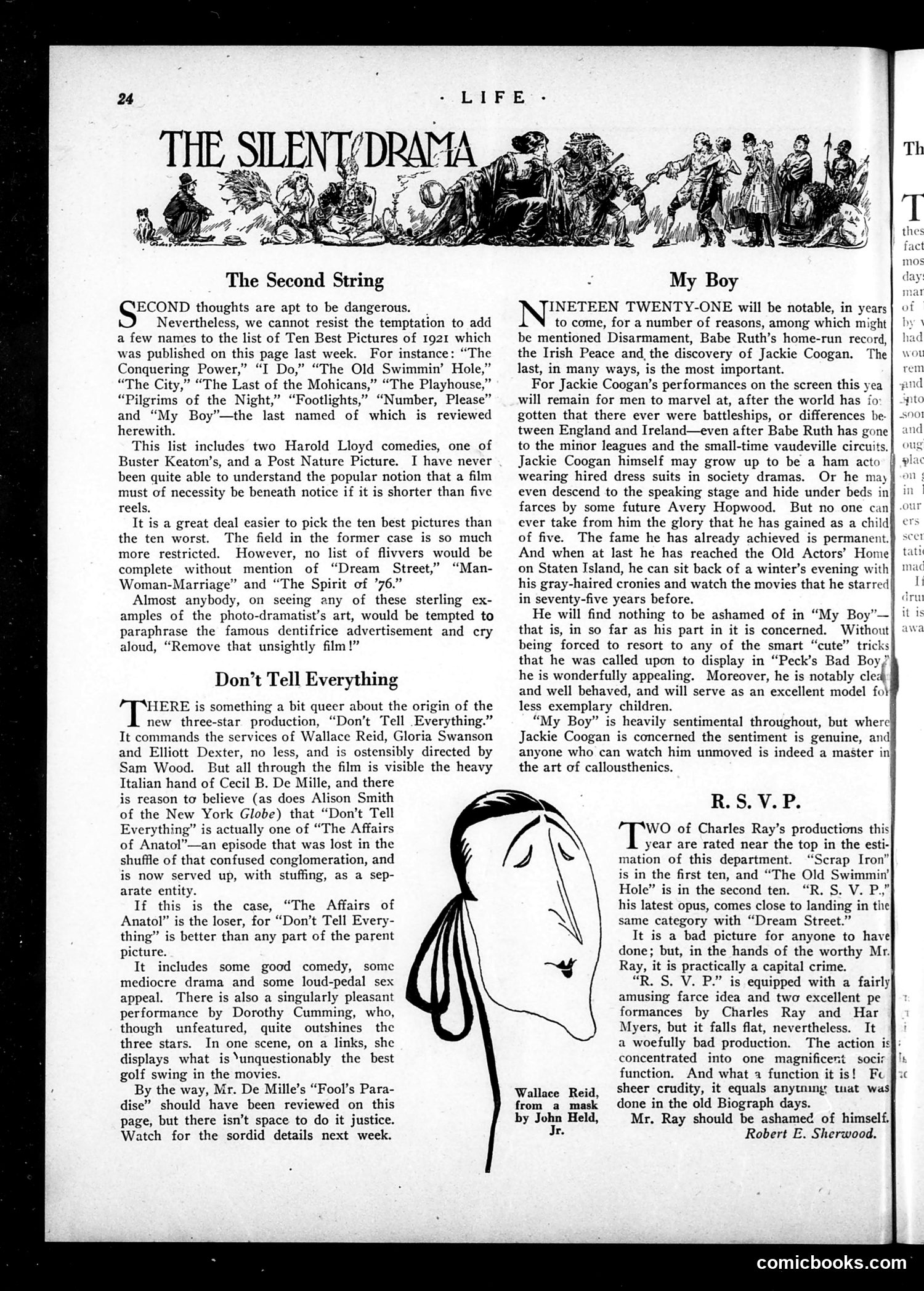
This page reviews recent silent films from 1921, supplementing an earlier "Ten Best Pictures" list. The content critiques Hollywood productions and studio practices of the era. **Key references:** - **Jackie Coogan**: A child actor celebrated for his performances; the reviewer predicts his fame will outlast major events like Babe Ruth's baseball records and international peace agreements. - **Wallace Reid, Gloria Swanson, Cecil B. De Mille**: Major stars and directors of the period. The reviewer suspects "Don't Tell Everything" is actually a recycled segment from De Mille's "The Affairs of Anatol," repackaged as a separate film—critiquing studio cost-cutting and creative dishonesty. - **Film quality debate**: The piece defends short films (under five reels) against the prevailing notion they're inherently inferior to longer features. The cartoon shows Wallace Reid's profile, accompanying the review's discussion of his work. The satire targets studio practices and questions about film authorship and originality in early Hollywood.
📄 Transcribed text from this page (OCR, searchable)
Machine-transcribed from the original scan — historical spelling and the odd misread are preserved.
=. LA FE, The Second String ECOND thoughts are apt to be dangerous. Nevertheless, we cannot resist the temptation to add a few names to the list of Ten Best Pictures of 1921 which was published on this page last week. For instance: “The Conquering Power,” “I Do,” “The Old Swimmin’ Hole,” “The City,” “The Last of the Mohicans,” “The Playhouse,” “Pilgrims of the Night,” “Footlights,’” “Number, Please” and “My Boy’—the last named of which is reviewed herewith. This list includes two Harold Lloyd comedies, one of Buster Keaton’s, and a Post Nature Picture. I have never been quite able to understand the popular notion that a film must of necessity be beneath notice if it is shorter than five reels. It is a great deal easier to pick the ten best pictures than the ten worst. The field in the former case is so much more restricted. However, no list of flivvers would be complete without mention of “Dream Street,” ‘“Man- Woman-Marriage” and “The Spirit of ’76.” Almost anybody, on seeing any of these sterling ex- amples of the photo-dramatist’s art, would be tempted to paraphrase the famous dentifrice advertisement and cry aloud, “Remove that unsightly film!” Don’t Tell Everything HERE is something a bit queer about the origin of the new three-star production, “Don’t Tell Everything.” It commands the services of Wallace Reid, Gloria Swanson and Elliott Dexter, no less, and is ostensibly directed by Sam Wood. But all through the film is visible the heavy Italian hand of Cecil B. De Mille, and there is reason to believe (as does Alison Smith of the New York Globe) that “Don’t Tell Everything” is actually one of “The Affairs of Anatol”—an episode that was lost in the shuffle of that confused conglomeration, and is now served up, with stuffing, as a sep- arate entity. If this is the case, “The Affairs of Anatol” is the loser, for “Don’t Tell Every- thing” is better than any part of the parent picture. It includes some good comedy, some mediocre drama and some loud-pedal sex appeal. There is also a singularly pleasant performance by Dorothy Cumming, who, though unfeatured, quite outshines the three stars. In one scene, on a links, she displays what is ‘unquestionably the best golf swing in the movies. By the way, Mr. De Mille’s “Fool’s Para- dise” should have been reviewed on this page, but there isn’t space to do it justice. Watch for the sordid details next week. te INETEEN TWENTY-ONE will be notable, in years | « to come, for a number of reasons, among which might | | be mentioned Disarmament, Babe Ruth’s home-run record, the Irish Peace and, the discovery of Jackie Coogan. The last, in many ways, is the most important. For Jackie Coogan’s performances on the screen this yea will remain for men to marvel at, after the world has jo gotten that there ever were battleships, or differences be- tween England and Ireland—even after Babe Ruth has gone to the minor leagues and the small-time vaudeville circuits.} ‘ Jackie Coogan himself may grow up to be a ham acto |j 9! wearing hired dress suits in society dramas. Or he may even descend to the speaking stage and hide under beds in} ' farces by some future Avery Hopwood. But no one can} -0u ever take from him the glory that he has gained as a child of five. The fame he has already achieved is permanent. And when at last he has reached the Old Actors’ Home on Staten Island, he can sit back of a winter’s evening with his gray-haired cronies and watch the movies that he starred in seventy-five years before. He will find nothing to be ashamed of in “My Boy’— that is, in so far as his part in it is concerned. Without being forced to resort to any of the smart “cute” tricks that he was called upon to display in “Peck’s Bad Boy he is wonderfully appealing. Moreover, he is notably clea and well behaved, and will serve as an excellent model fo! less exemplary children. “My Boy” is heavily sentimental throughout, but where Jackie Coogan is concerned the sentiment is genuine, and anyone who can watch him unmoved is indeed a master in the art of callousthenics. R.S. V. P. 'WO of Charles Ray’s productions this year are rated near the top in the esti- mation of this department. “Scrap Iron” is in the first ten, and “The Old Swimmin’ Hole” is in the second ten. “R. S. V. P., his latest opus, comes close to landing in the same category with “Dream Street.” It is a bad picture for anyone to have done; but, in the hands of the worthy Mr. Ray, it is practically a capital crime. “R. S. V. P.” is equipped with a fairly amusing farce idea and two excellent pe formances by Charles Ray and Har Myers, but it falls flat, nevertheless. It a woefully bad production. The action is}: concentrated into one magnificent socir J! function. And what a function it is! sheer crudity, it equals anytning, wat was done in the old Biograph days. Mr. Ray should be ashamed of himself. Robert E. Sherwood. Wallace Reid, from a mask by coha Held, re comicbooks.com Th T thes fact mos la ipto and Fe fic