
A complete issue · 34 pages · 1921
Life — November 10, 1921
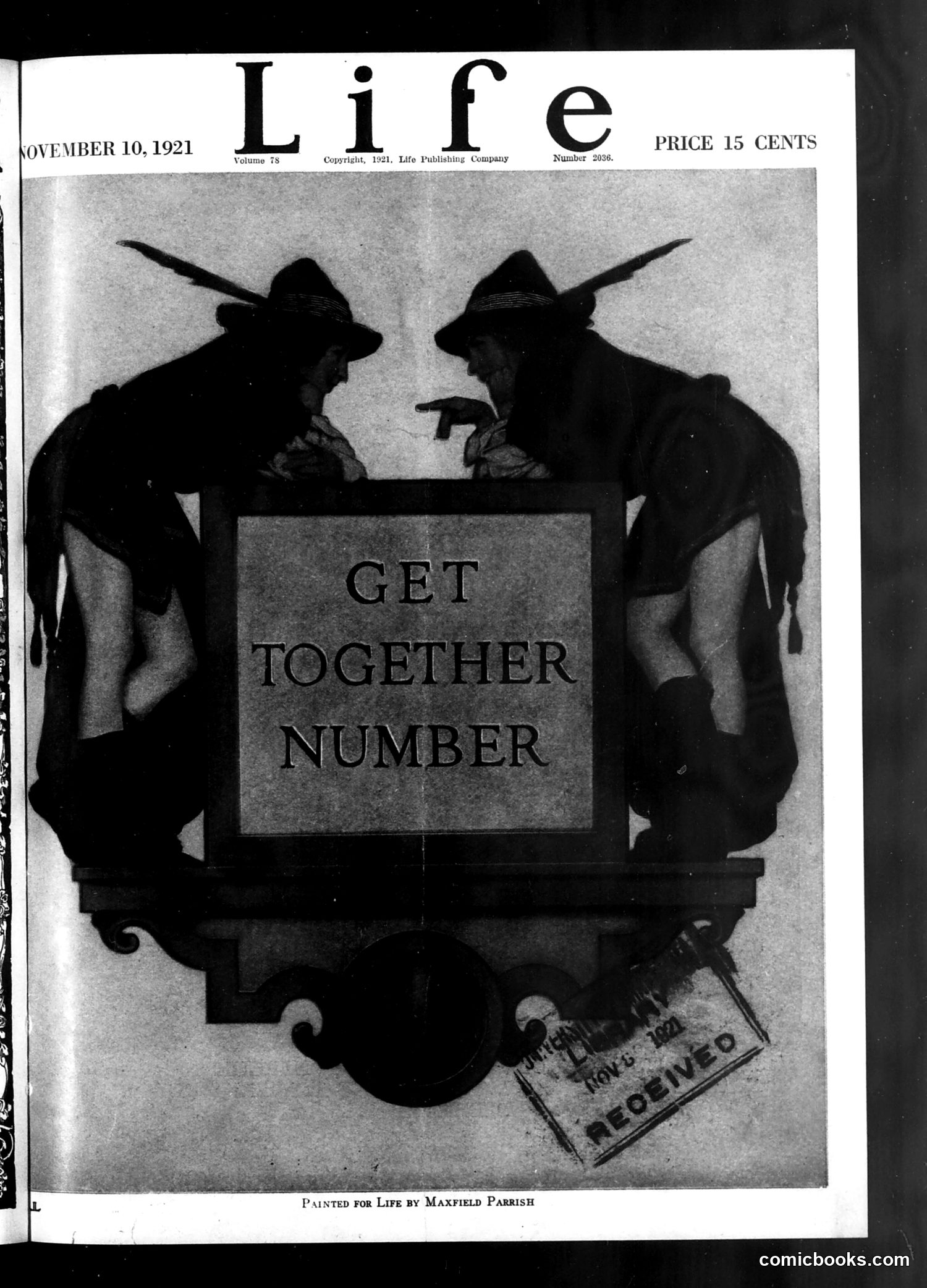
This November 10, 1921 cover depicts two silhouetted figures in cowboy hats facing each other across a table holding a sign reading "GET TOGETHER NUMBER." The mirrored composition suggests political opposition or conflict requiring reconciliation. The "Get Together Number" likely references post-World War I American political divisions—possibly between political parties or factions. The cowboy imagery may evoke American frontier themes of rugged individualism or regional differences. A "Received" stamp appears in the lower right, suggesting this was a mailed copy. The artist is credited as Maxfield Parrish. Without identifying the specific figures, the satire appears to mock the difficulty of achieving political compromise during a fractious period in American politics.
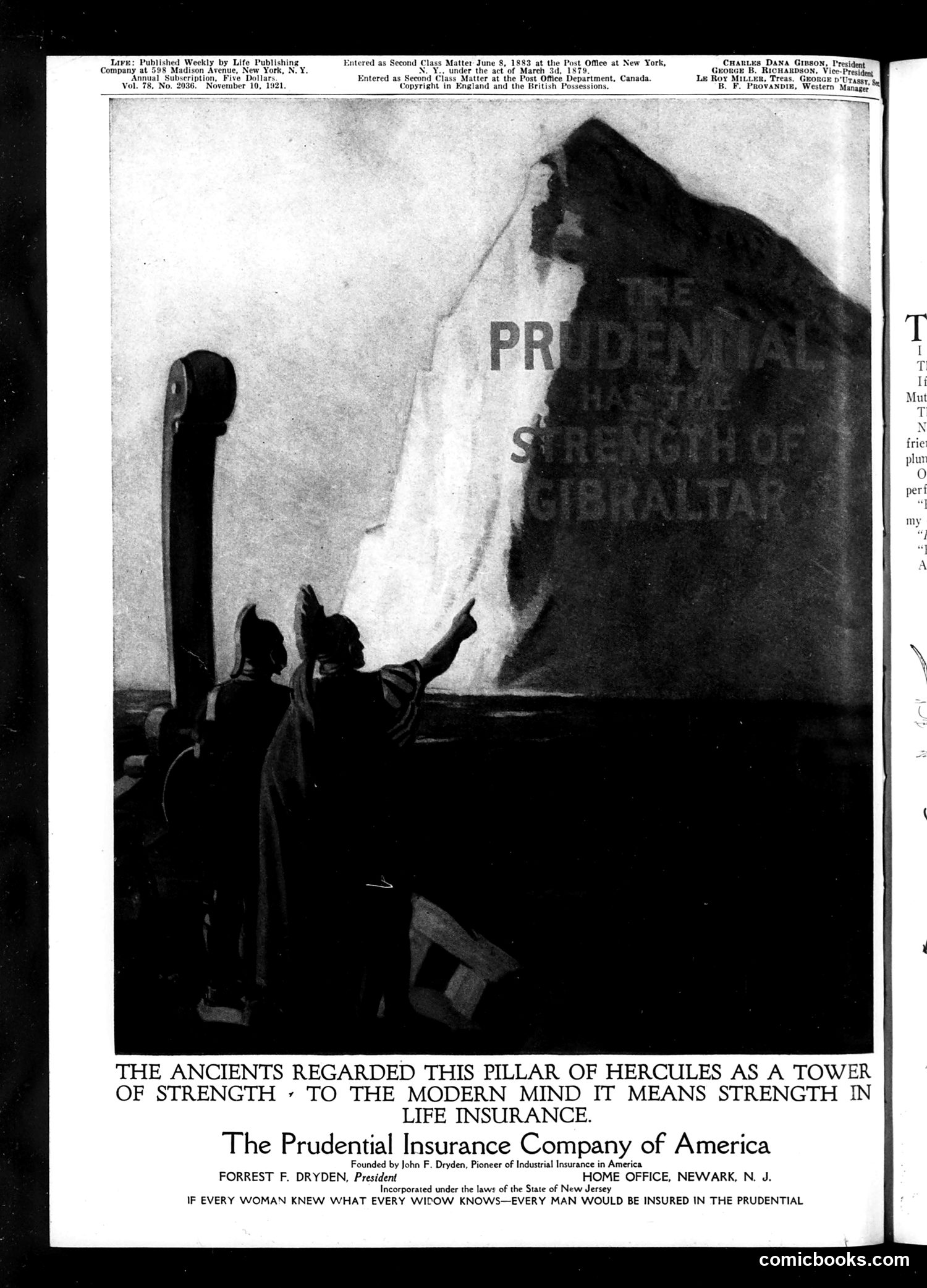
This page is primarily **advertising**, not satire or political commentary. The Prudential Insurance Company uses classical imagery—the Pillar of Hercules, an ancient symbol of strength—to promote life insurance. Two figures gesture toward the massive pillar, which bears text reading "PRUDENTIAL" and "STRENGTH OF GIBRALTAR." The advertisement's logic equates ancient architectural strength with modern financial security: just as the ancients viewed this pillar as a symbol of durability, modern people should view Prudential insurance as life insurance "strength." The tagline—"If every woman knew what every widow knows—every man would be insured in the Prudential"—targets male breadwinners, implying that widows understand insurance's necessity through hardship. This is commercial messaging using classical allusion, not political cartoon satire.
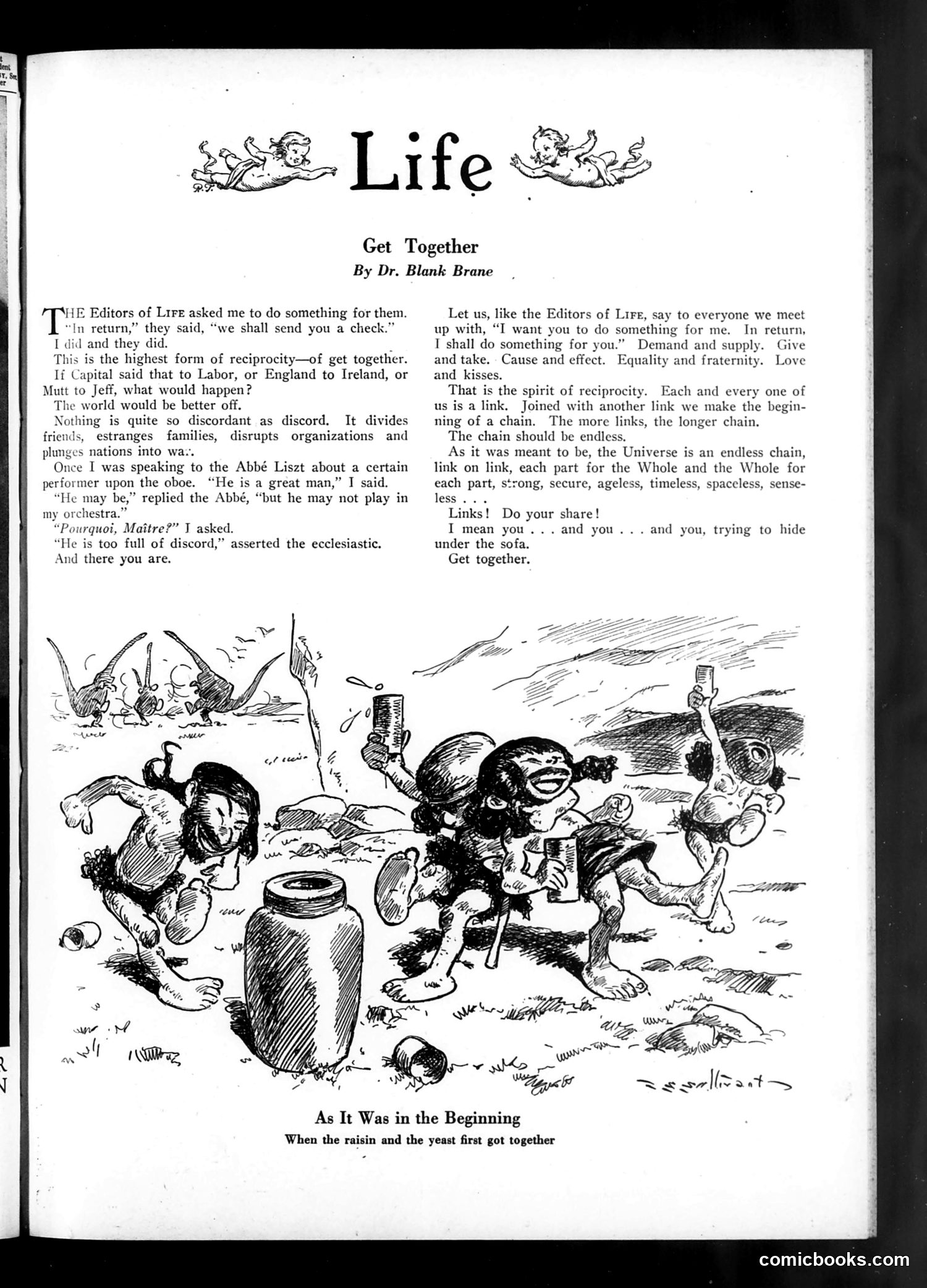
This satirical piece critiques **discord and lack of cooperation** among different social groups. The text uses the metaphor of a chain—each link representing different elements (Capital, Labor, England, Ireland, Matt, Jeff)—to argue that society functions only when interconnected. The crude illustration depicts anthropomorphized figures (appearing to represent different classes or nations) in chaotic, undignified interaction around a jar, captioned "As It Was in the Beginning / When the raisin and the yeast first got together." This suggests **primordial conflict and fermentation**—possibly mocking evolutionary or revolutionary origins of social discord. The piece advocates for "reciprocity," "equality," and "fraternity" as solutions. The tone suggests early 20th-century progressive or socialist sentiment, promoting social unity over class/national division.
This page contains a letter from Baron Shidehara, Japanese Ambassador to the United States, published in *Life* magazine. Rather than a political cartoon, it's satirical commentary on diplomatic etiquette. The letter humorously describes how Ambassador Shidehara was misunderstood as an "outsider" at Washington social events—specifically, his practice of using a walking stick (which grew larger as his "style developed") was mistaken for crude behavior. The satire targets both cross-cultural misunderstandings and American assumptions about foreign diplomats. Shidehara defends himself while critiquing backbiting and gossip among gentlemen, and praises an upcoming Limited Armament Conference as important for world peace. The piece uses gentle humor to address diplomatic tensions during the early 1920s period of arms-control negotiations.
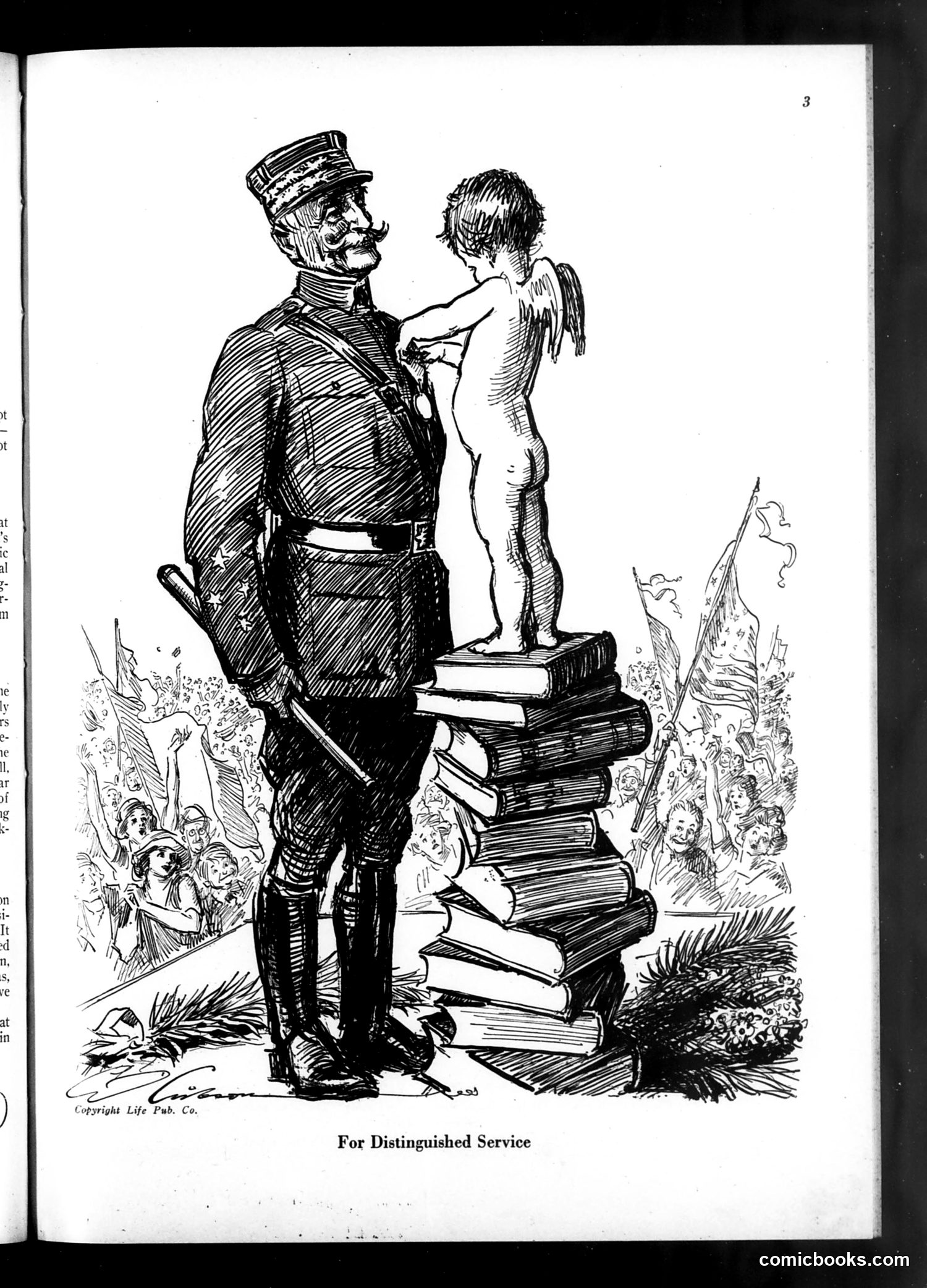
This satirical cartoon depicts a military officer standing on a stack of books while a cherub or cupid figure crowns or adorns him. The caption "For Distinguished Service" suggests ironic commentary on military honors and decorations. The stack of books likely represents education, learning, or intellectual achievement. The composition suggests the satire critiques how military service—particularly perhaps during wartime—was being valorized or decorated, while intellectual or educational pursuits are literally used as a pedestal or stepping stone. The cherub reinforces the idealization. The cheering crowds visible in the background underscore public celebration of military achievement. The overall message appears to mock the elevation of military service above scholarly or intellectual contributions to society, or possibly critiques how wartime service earned honors that might better suit other accomplishments.
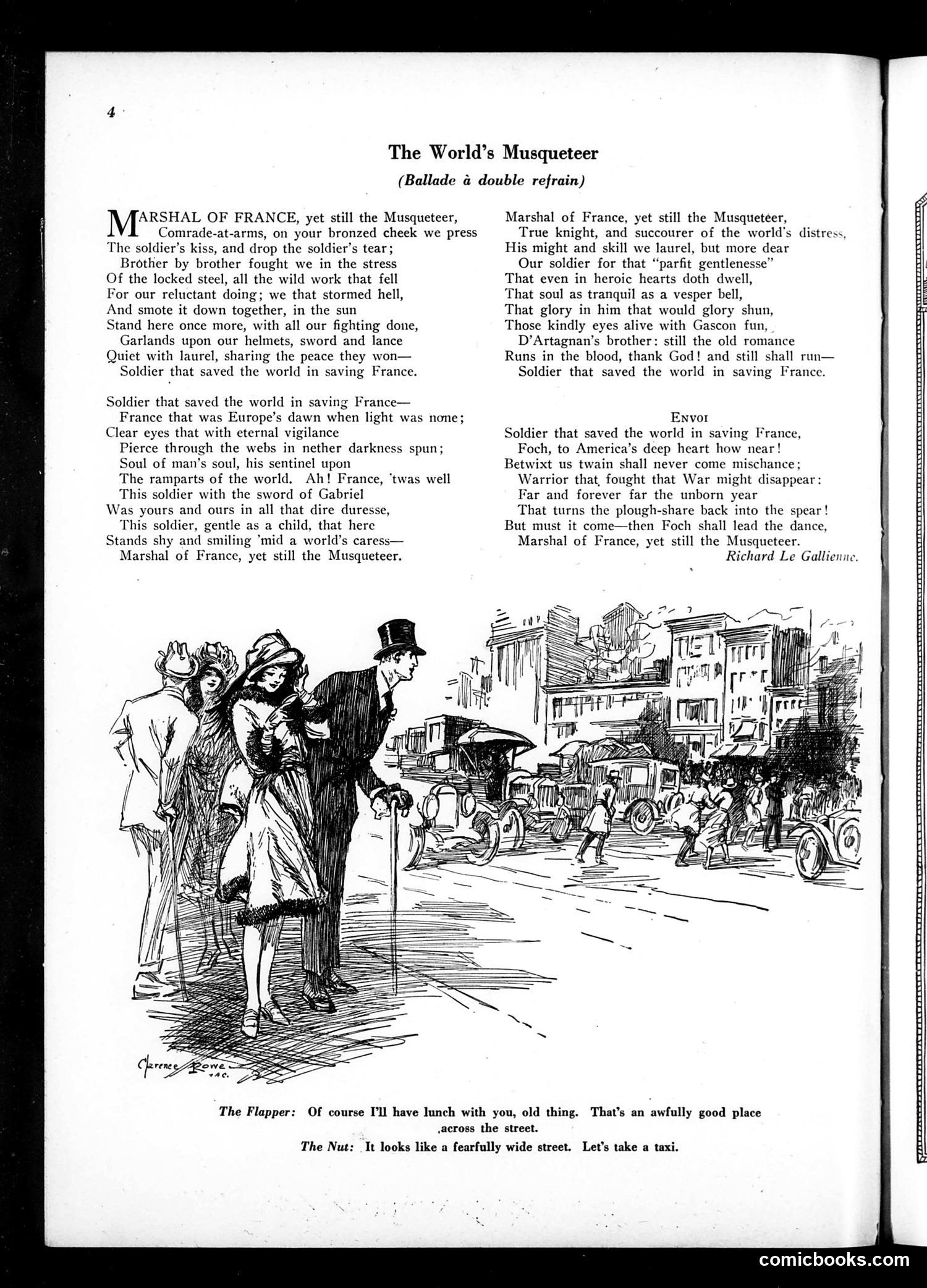
This page presents a poem by Richard Le Gallienne celebrating the "Marshal of France" as a heroic figure who "saved the world in saving France." The verses emphasize martial glory and romance, positioning this military leader as essential to European civilization. The illustration depicts a well-dressed man with two women on a busy urban street with automobiles and buildings—a modern city scene. The dialogue below references lunch plans and suggests the man is treating the situation casually ("old thing"). The satire appears to contrast the poem's glorification of martial heroism with the illustration's depiction of contemporary leisure and flirtation, suggesting irony about how modern society trivializes or romanticizes military figures. The specific "Marshal" referenced remains unclear without additional historical context.
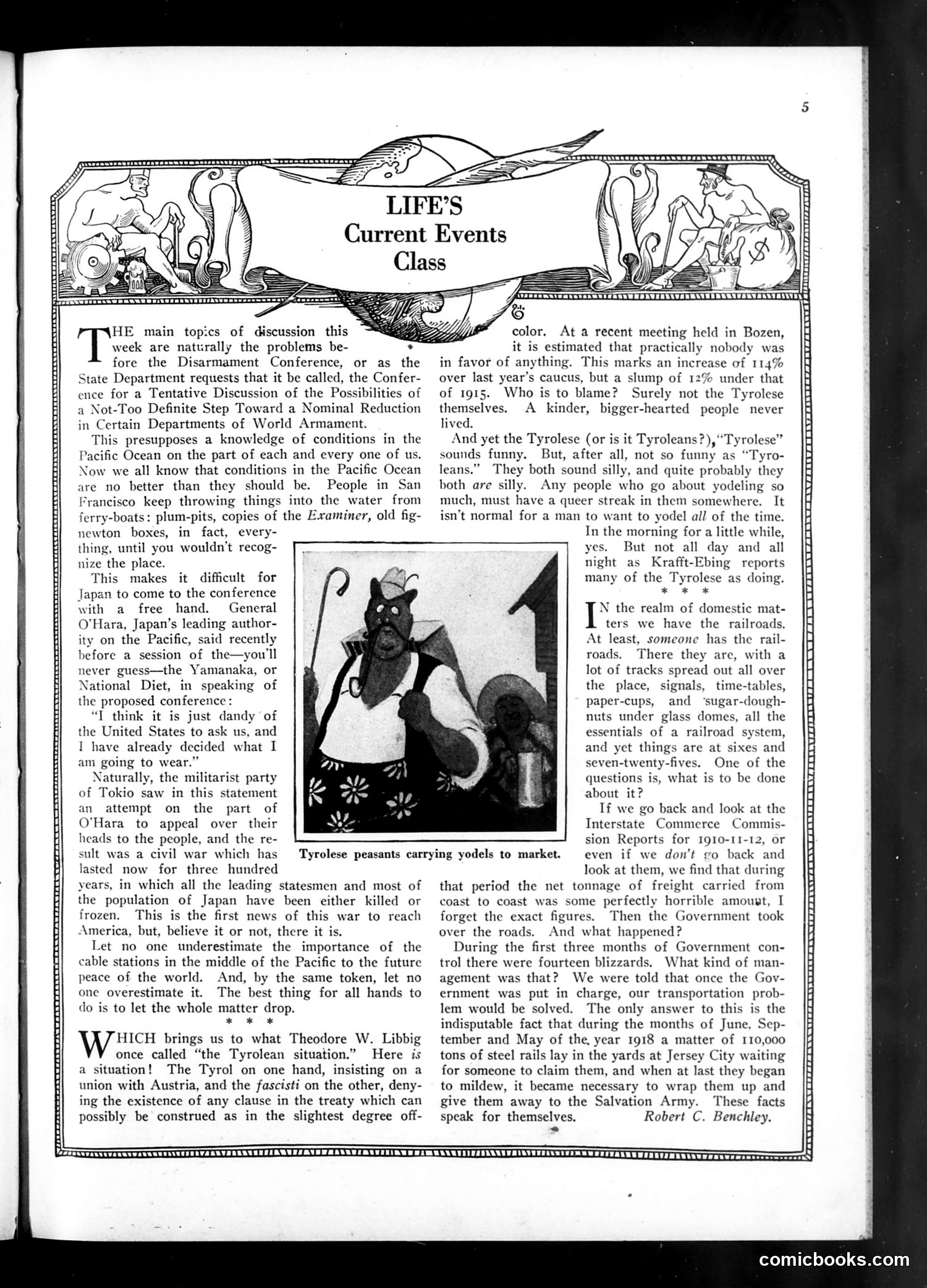
This page satirizes international tensions over the Tyrol region. The main cartoon depicts "Tyrolese peasants carrying yodels to market"—a visual pun mocking how the Tyrol situation dominates discourse while seeming trivial. The text discusses the Disarmament Conference and Japan's absence, but focuses on the "Tyrolese situation"—the author Robert C. Benchley uses this obscure regional dispute to criticize how nations obsess over minor territorial issues while ignoring larger problems like railroad infrastructure and logistics (noting 110,000 tons of steel rails abandoned at Jersey City). The satire suggests political leaders prioritize petty geopolitical squabbles over practical, meaningful governance. The cartoon's whimsical "yodels to market" image emphasizes how absurdly the Tyrol controversy is being treated.
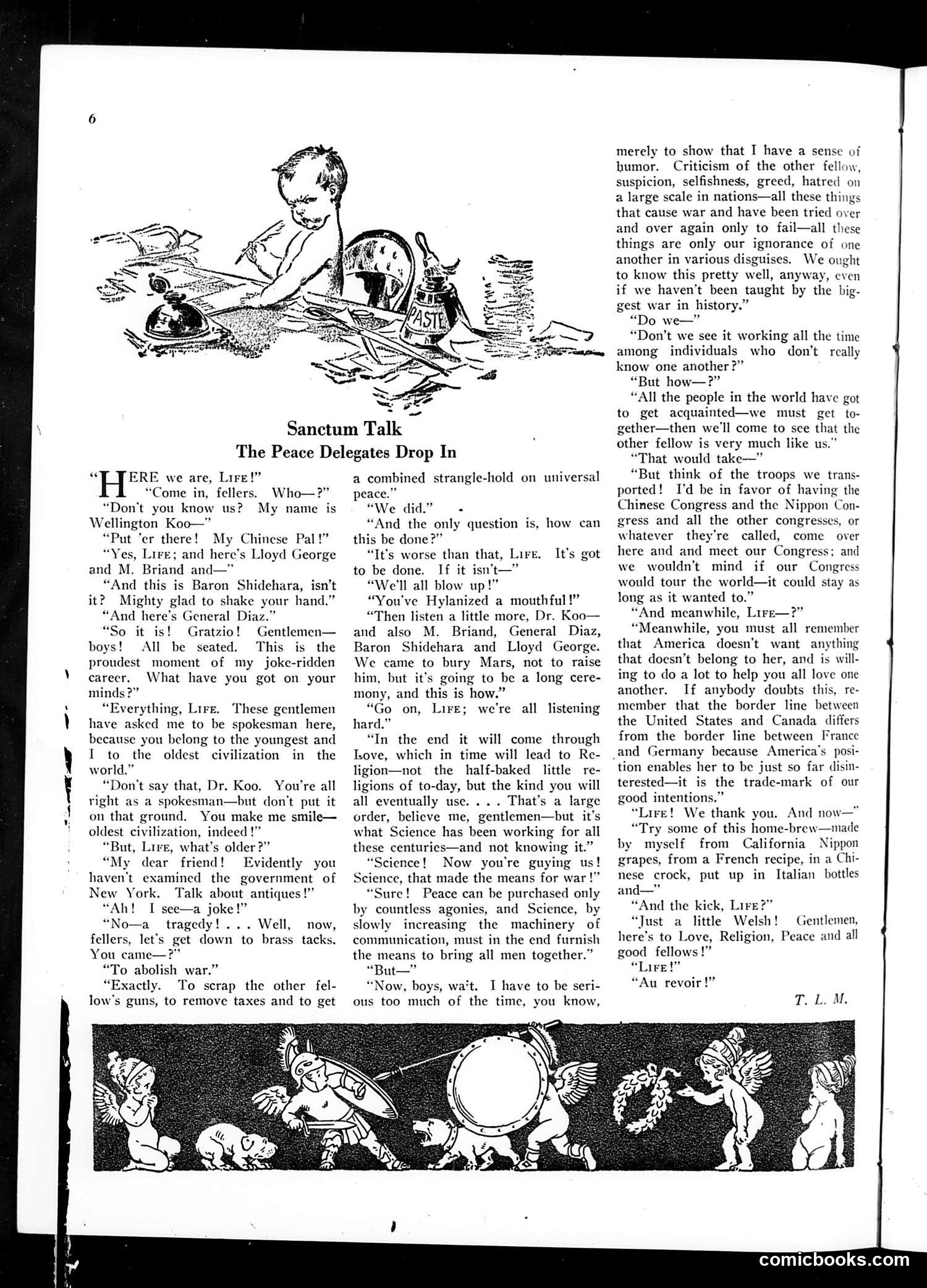
This satirical dialogue features Life magazine's editor ("Life") meeting with peace conference delegates, likely from the post-WWI era. The cartoon mocks the naïveté of idealistic peacemakers who believe international acquaintance and love will prevent future wars. The delegates—identified as Chinese, British (Lloyd George and Baron Shiddhara), and American representatives—discuss solving world conflict through understanding and science. Life's skeptical character counters that ignorance of other nations' customs persists everywhere, and sarcastically suggests America's isolationism and self-interest make such grand peace plans ineffective. The satire targets the optimism of international peace movements as disconnected from human nature and national self-interest.
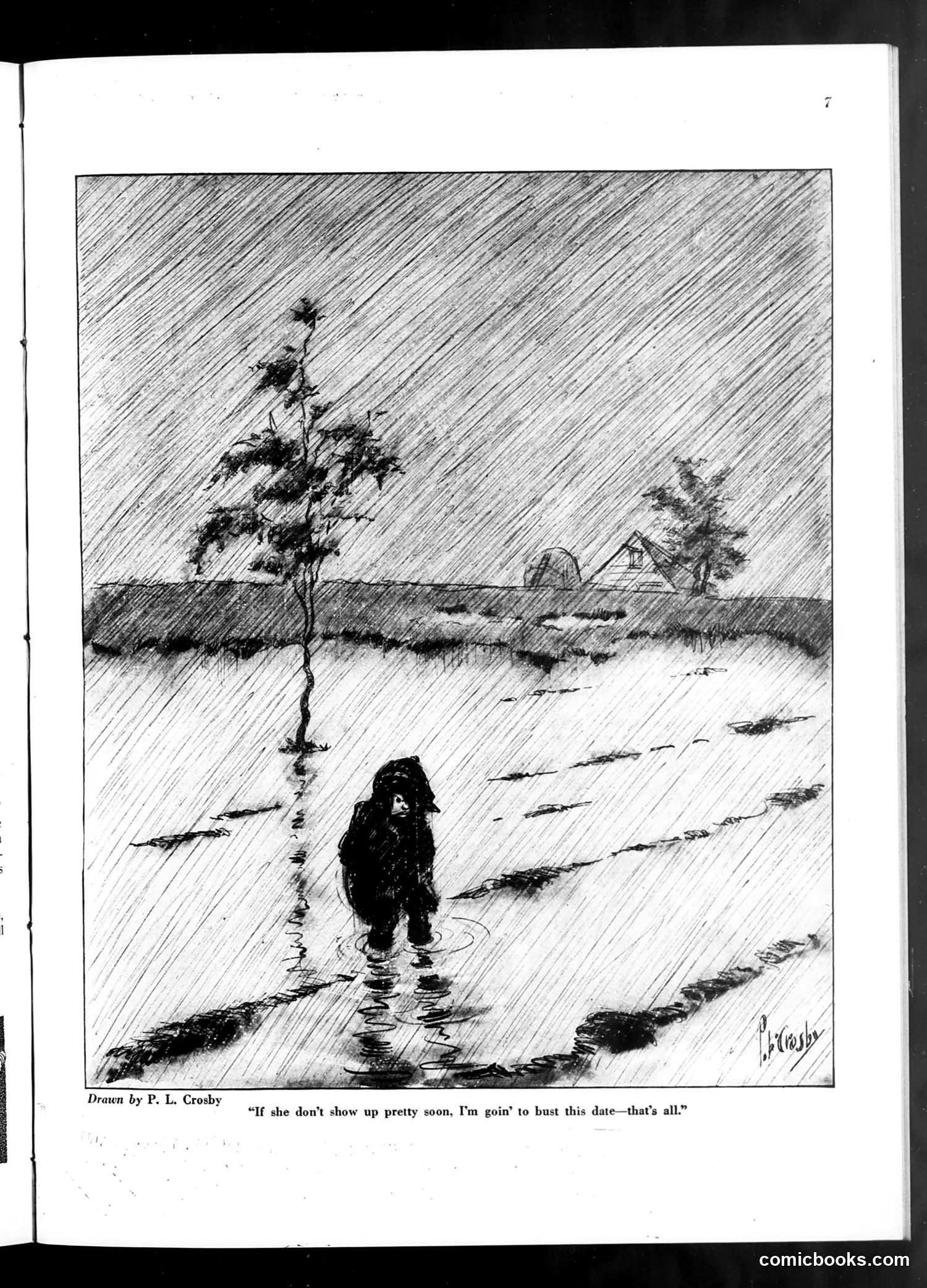
This single-panel cartoon by P. L. Crosby depicts a solitary figure standing in heavy rain in a barren landscape, with a distant house visible on the horizon. The figure appears to be waiting or standing watch. The caption reads: "If she don't show up pretty soon, I'm goin' to bust this date—that's all." The humor relies on the contrast between the figure's determined patience despite miserable weather conditions, and their threat to abandon the date. It's a commentary on dating etiquette and romantic frustration—the joke being that even in such terrible circumstances, the waiting suitor maintains their commitment while simultaneously complaining about it. The satire gently mocks both romantic devotion and male impatience in courtship situations typical of early-to-mid 20th century social dynamics.
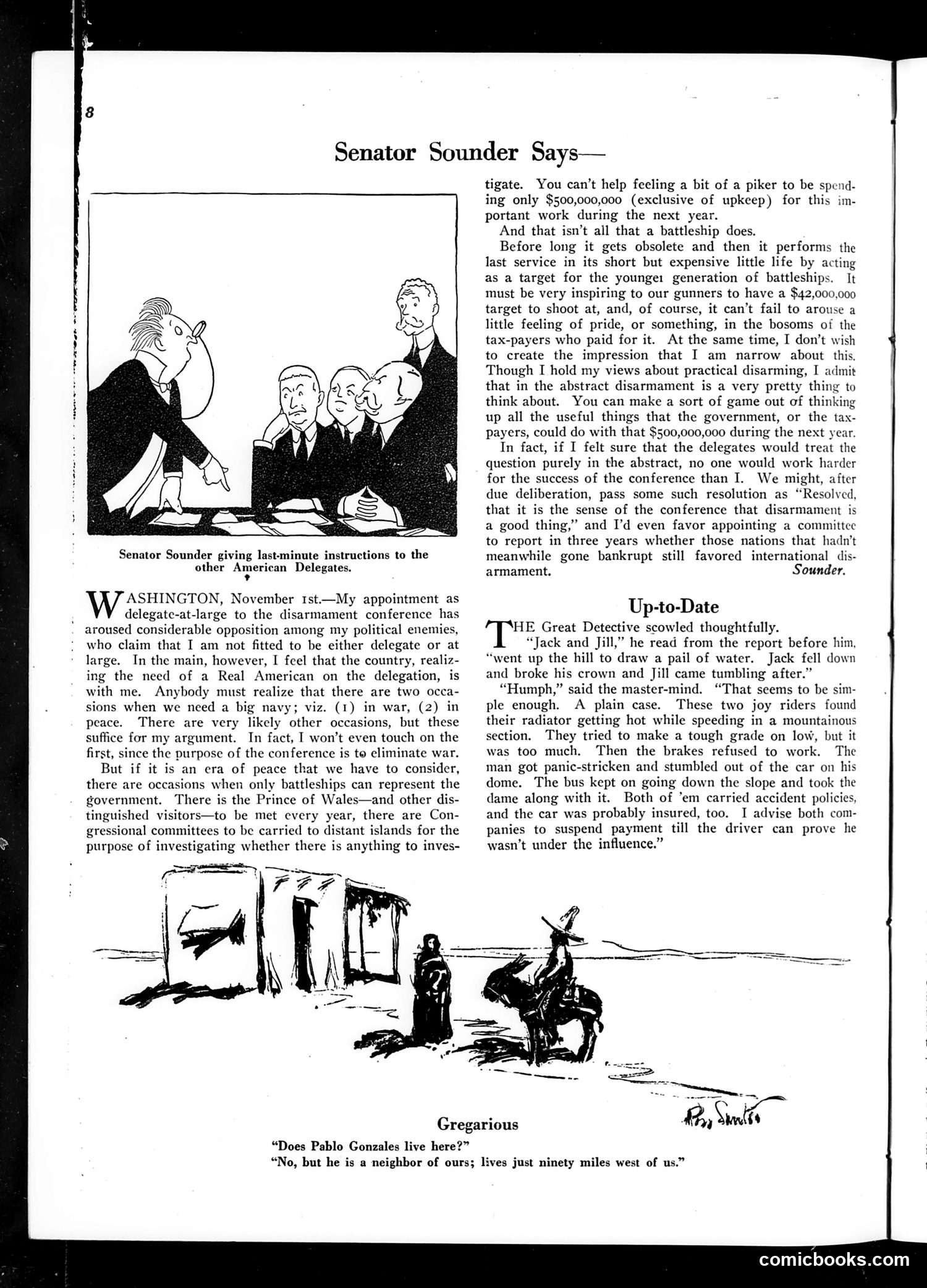
**Top Cartoon:** Senator Sounder addresses American delegates to a disarmament conference. His speech critiques spending $500 million on battleships while advocating for peace—a contradiction Sounder acknowledges as "narrow" thinking. The satire mocks politicians who support military expenditure while publicly favoring disarmament. **Bottom Cartoon ("Gregarious"):** An unrelated joke showing a figure asking if Pablo Gonzales lives at a location, receiving the reply that he's "a neighbor of ours; lives just ninety miles west of us"—likely a reference to Mexico, suggesting distant neighborliness or indifference. Both pieces reflect 1920s-era skepticism about government spending and military priorities during peace negotiations.
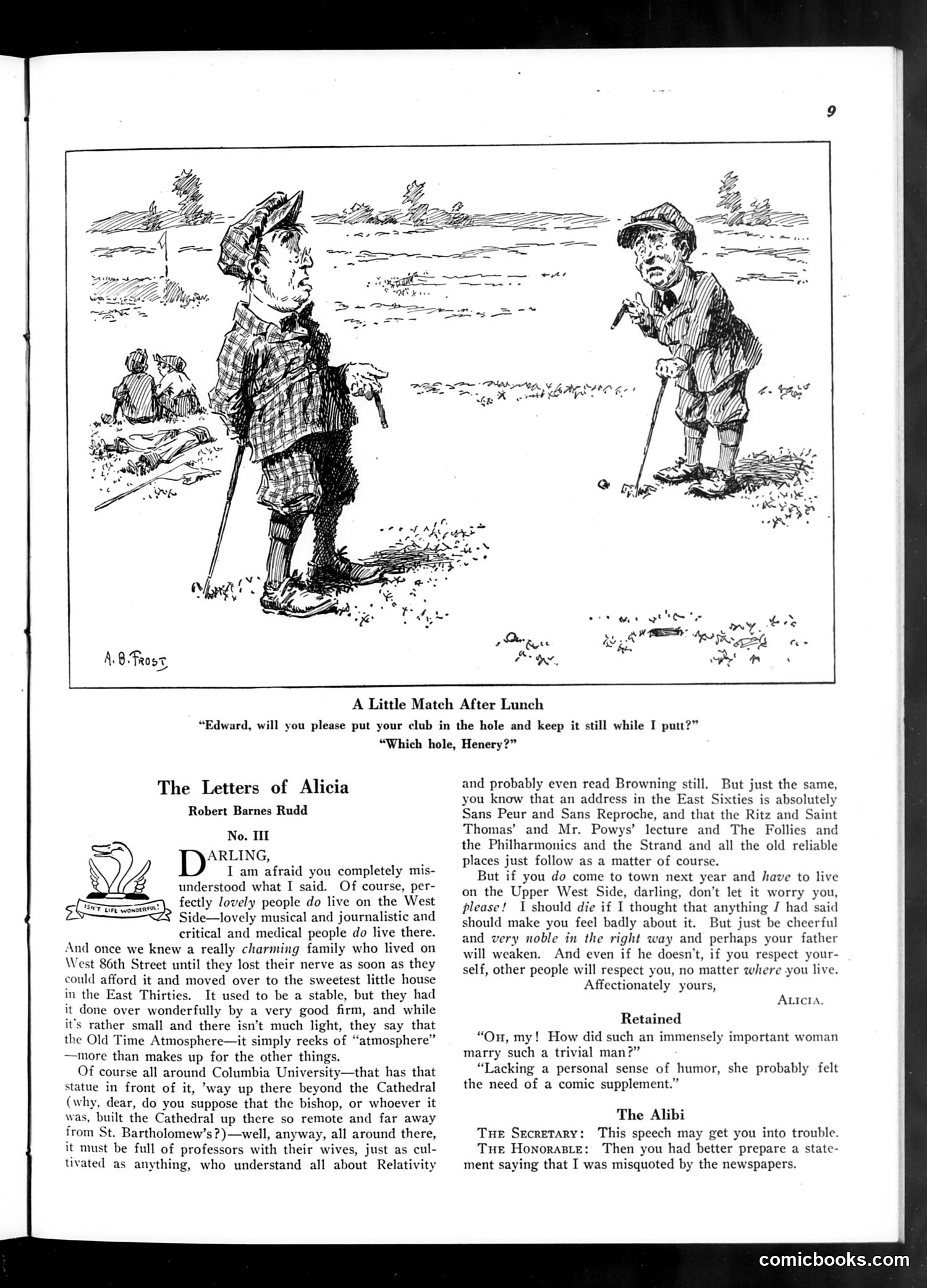
The top cartoon, "A Little Match After Lunch," depicts two golfers. One asks the other to "put your club in the hole and keep it still while I putt"—the humor relies on the double meaning of "hole," playing on the golf term while suggesting something crude. The cartoonist is A.B. Frost, a recognized illustrator of the era. Below, "The Letters of Alicia" by Robert Barnes Rudd presents correspondence addressing social life on New York's West Side. The letter discusses "charming" people living in that area and mentions Columbia University nearby, touching on class and cultural attitudes of the upper-middle-class readership Life targeted. The "Retained" and "The Alibi" sections are brief satirical snippets about social pretense and political excuses.
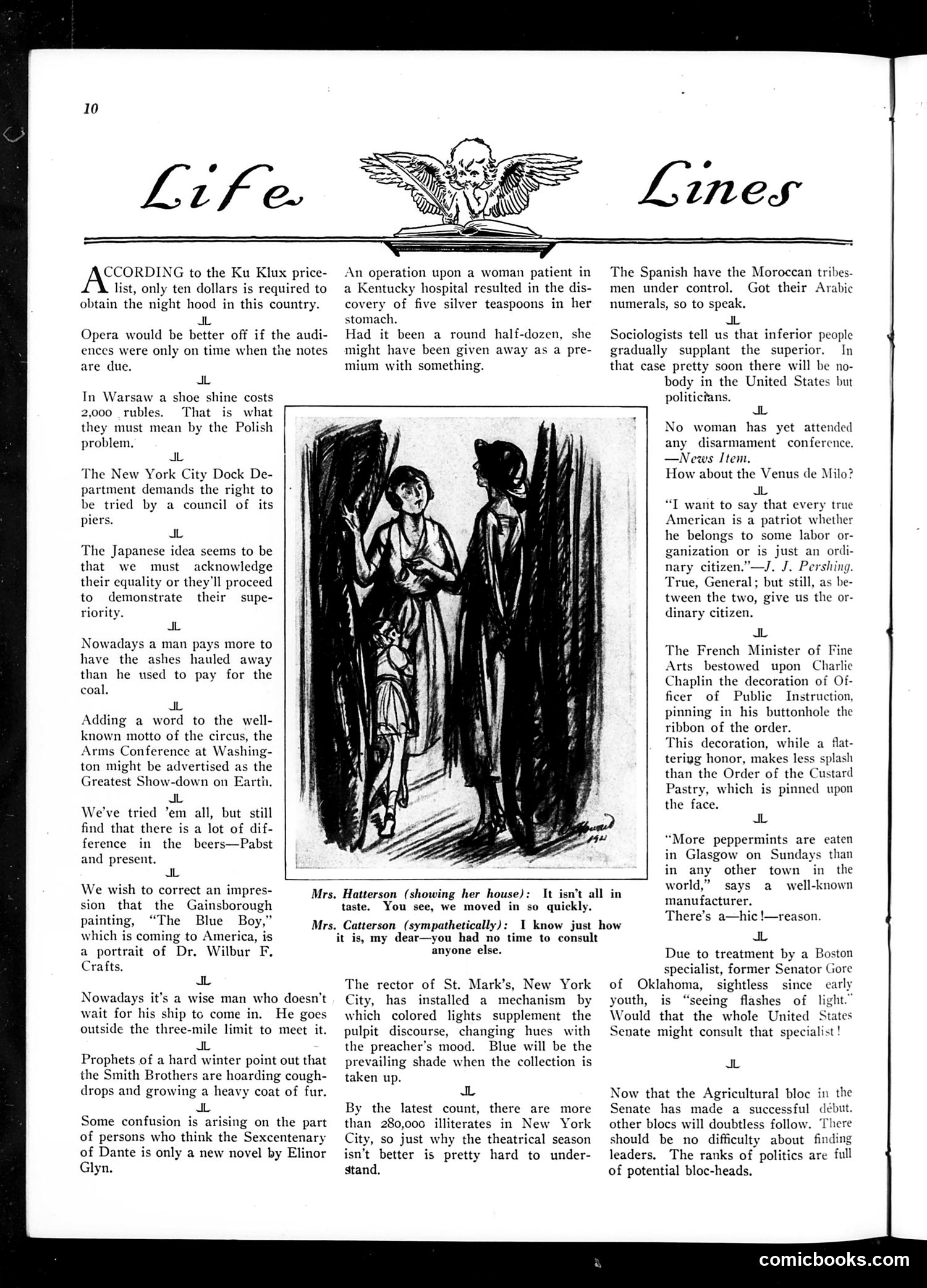
This page contains a single cartoon illustration with accompanying dialogue, centered in the "Life Lines" humor column. The sketch shows two figures in what appears to be a doorway or entrance—one woman (Mrs. Hatterson) showing her house to another woman (Mrs. Catterson, described as sympathetic). The caption reads: "It isn't all in the house. You see we moved in so quickly" / "I know just how it is, my dear—you had no time to consult anyone else." The satire targets wealthy women's social pretensions and decision-making habits. The joke suggests that proper home decoration requires consulting with others (presumably society arbiters or experts), and that moving quickly without such consultation is socially embarrassing. It mocks the anxiety among affluent women about conforming to fashionable taste standards.
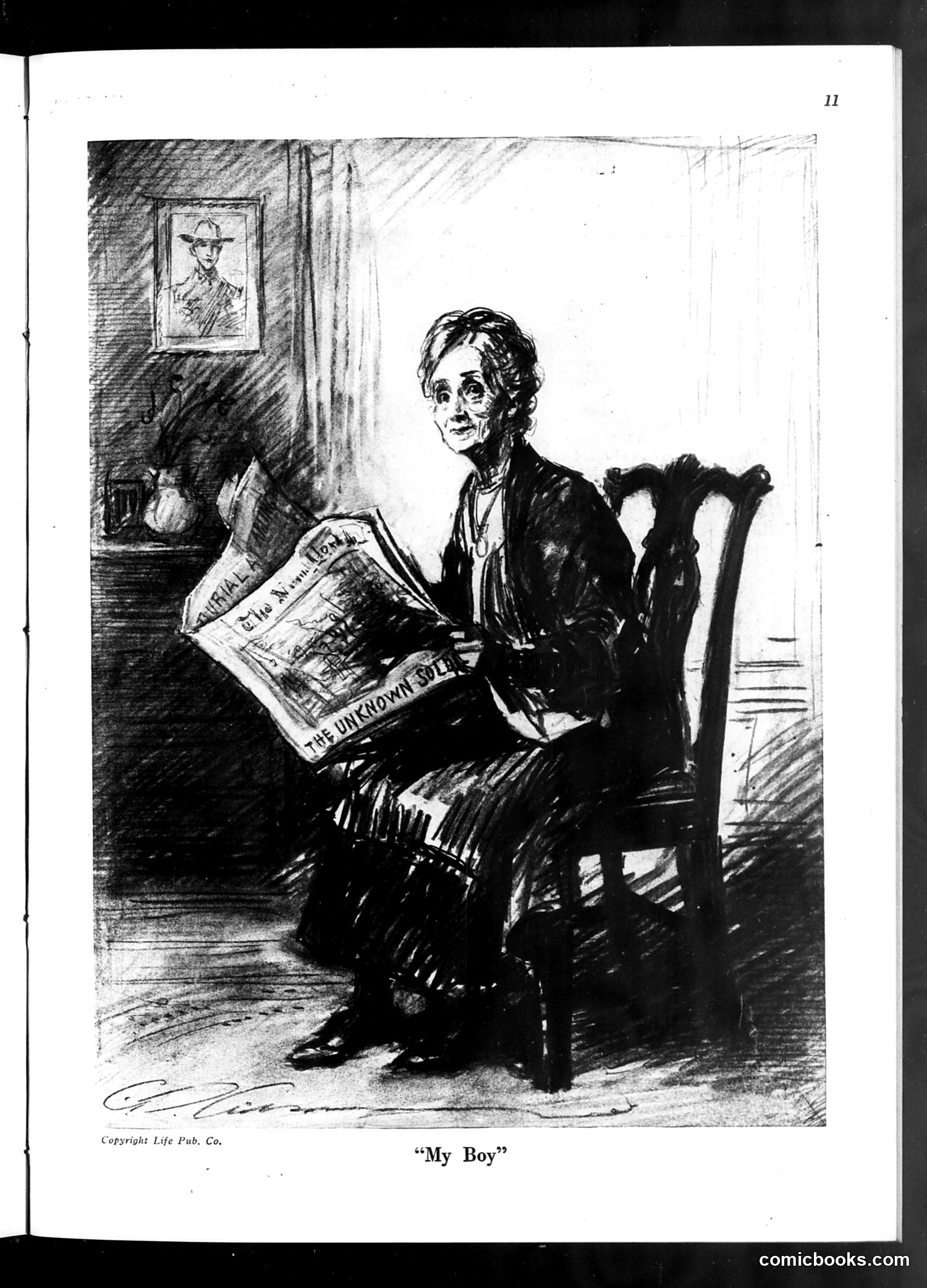
This sketch, titled **"My Boy,"** depicts a woman seated in a chair reading a newspaper headlined "THE UNKNOWN SOLDIER." A framed portrait hangs on the wall behind her—apparently of a young soldier. The satire addresses **maternal grief during WWI**. The "unknown soldier" reference suggests the woman has lost her son in the war, but cannot identify his remains. This captures the poignant tragedy many mothers faced: uncertainty about their sons' fates and inability to properly mourn specific losses. The composition emphasizes her solitary, contemplative pose—she sits alone with only the newspaper and portrait, conveying profound loneliness and loss. The work critiques war's human cost, particularly its impact on grieving families left behind without closure or certainty.
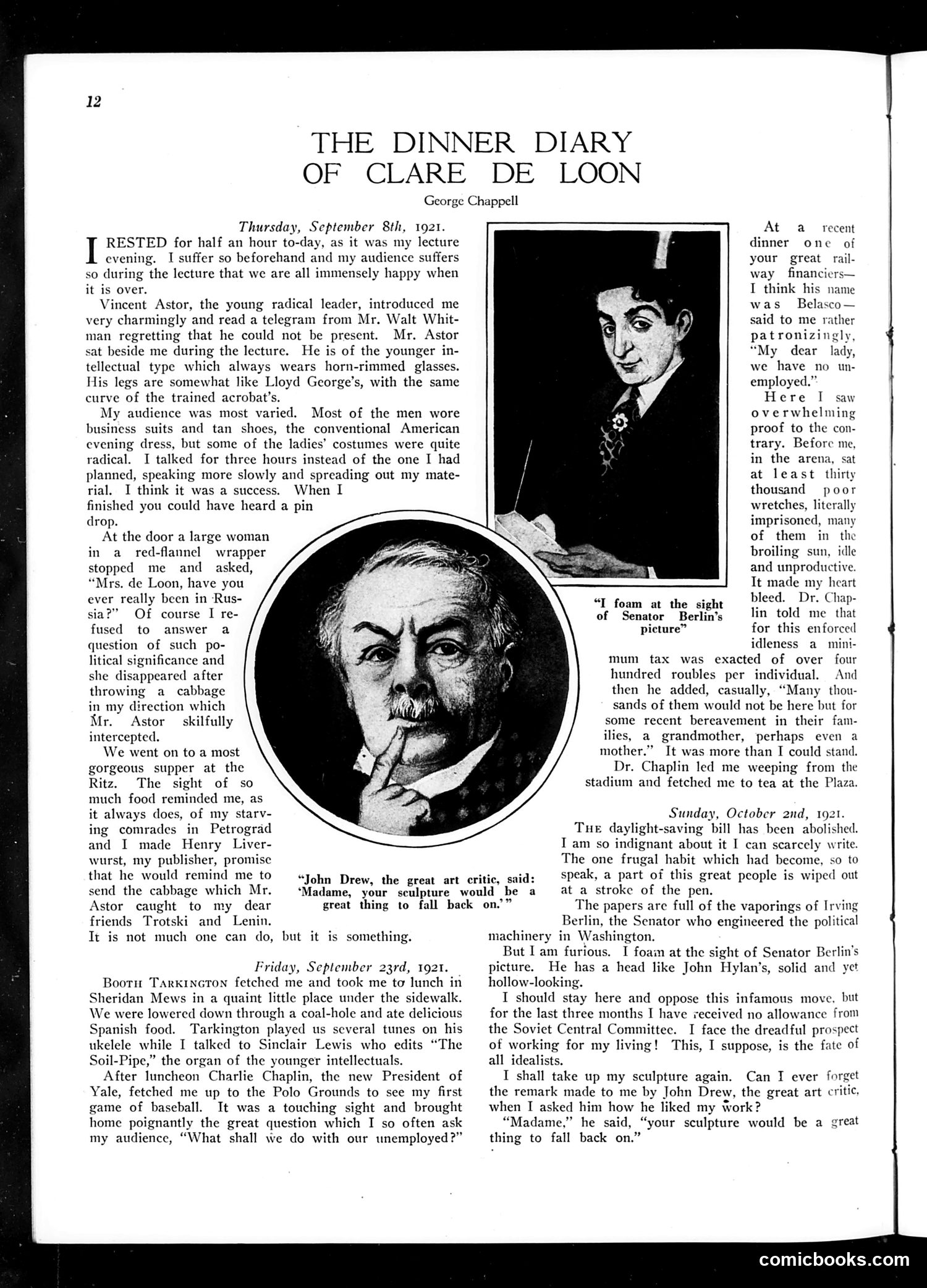
This is a satirical diary entry documenting New York society events from September-October 1921. The page features two portraits: **Vincent Astor** (top), a wealthy industrialist and railroad financier, and **John Drew** (bottom), described as "the great art critic." The humor targets the narrator's observations of the elite's pretensions and political concerns. References include Senator Berlin's tax policies affecting the wealthy, Irving Berlin's political engineering, and unemployment anxieties. The satire mocks how the upper class discusses serious social issues (unemployment, taxation) while enjoying lavish dinners and socializing. Drew's remark that her sculpture would "be a great thing to fall back on" sardonically suggests sculpture as unemployment insurance for the privileged.
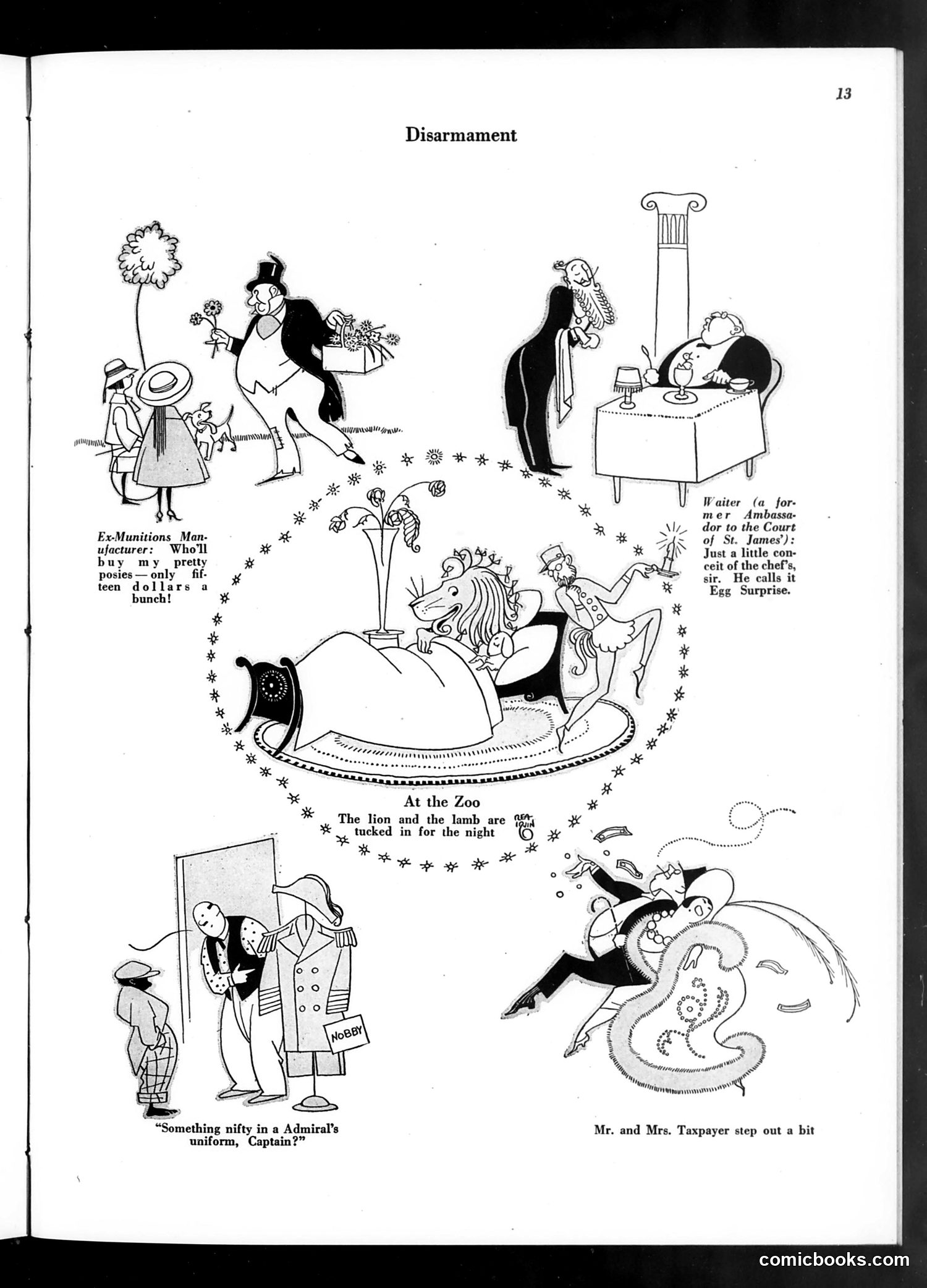
This page contains four satirical cartoons mocking 1920s disarmament efforts and social pretension: 1. **"Ex-Munitions Manufacturer"**: A wealthy industrialist who previously profited from weapons now poses as refined, claiming poverty while keeping his "pretty posies"—satirizing war profiteers' claims of financial hardship after disarmament. 2. **"At the Zoo"**: Shows a lavish dinner party amid caged animals, with text noting "The lion and the lamb are tucked in for the night"—likely referencing biblical peace metaphors while satirizing the gap between disarmament rhetoric and actual international tensions. 3. **"Former Ambassador"**: References a diplomatic figure presenting an "Egg Surprise"—unclear what specific figure or event this targets. 4. **"Mr. and Mrs. Taxpayer"**: Depicts ordinary citizens struggling with a serpent, suggesting taxpayers bear the burden of disarmament policy consequences.
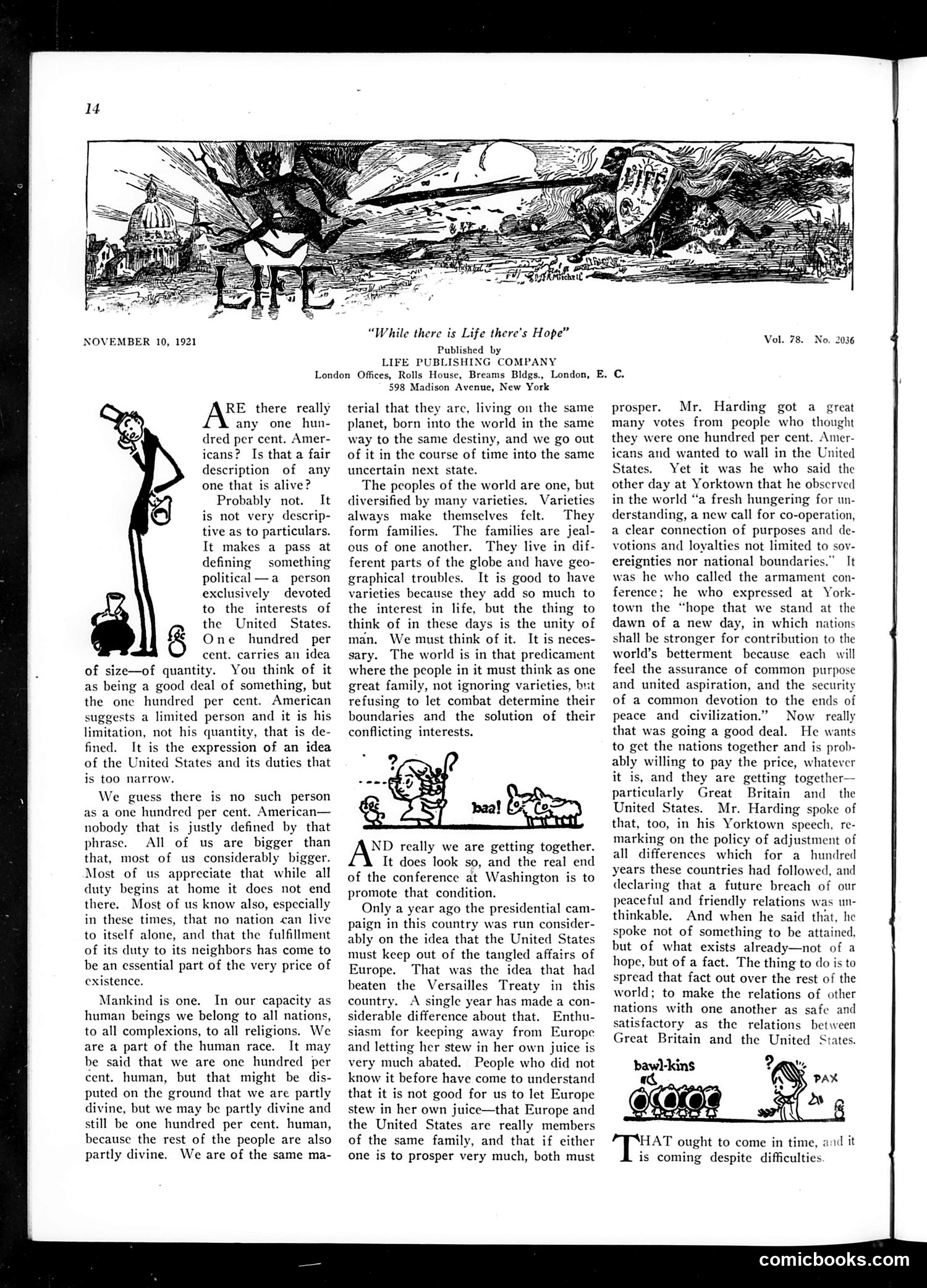
This editorial page addresses international cooperation following World War I. The main cartoon depicts a figure labeled "LIFE" observing world leaders meeting at the Washington Conference (referenced in the text). The satirical point concerns whether nations can truly unite despite their differences. The text argues that while humans are "one hundred per cent" interconnected globally, nations remain divided by competing interests. It criticizes the recent Versailles Treaty and advocates for the U.S. to engage constructively with Europe and Britain rather than isolate itself. The small decorative cartoons appear to illustrate humanity's shared nature and potential cooperation. Overall, the piece uses gentle satire to encourage American internationalism and peaceful post-war relations—a contested position in 1921 America.
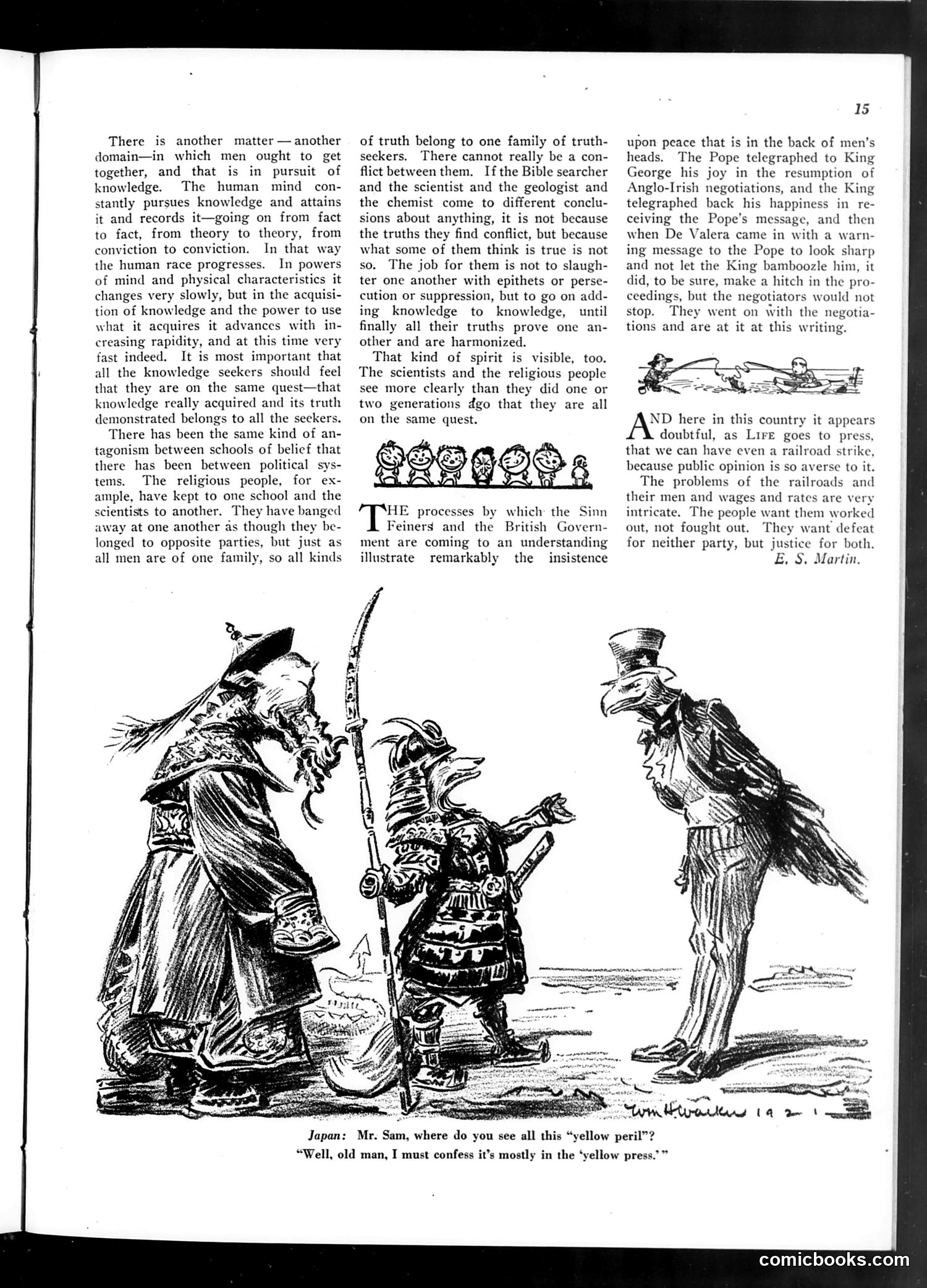
The main cartoon depicts a confrontation between Japan (represented as a military figure on the left) and what appears to be a Western diplomat or official (right), with a smaller armed figure in the middle, likely representing another power or intermediary. The caption satirizes Western fears of a "yellow peril"—the contemporary racist anxiety about Asian, particularly Japanese, expansion and threat. Japan's response—that this "peril" exists mainly in the "yellow press" (sensationalist newspapers)—suggests the cartoonist argues these fears are media-manufactured hysteria rather than genuine threats. The accompanying text discusses reconciliation between opposing groups (referencing Sinn Féin and British negotiations, plus papal involvement), implying a broader theme: that peaceful dialogue should replace manufactured conflict and xenophobic fear-mongering. The cartoon critiques how the press weaponizes racial stereotypes to create public alarm.
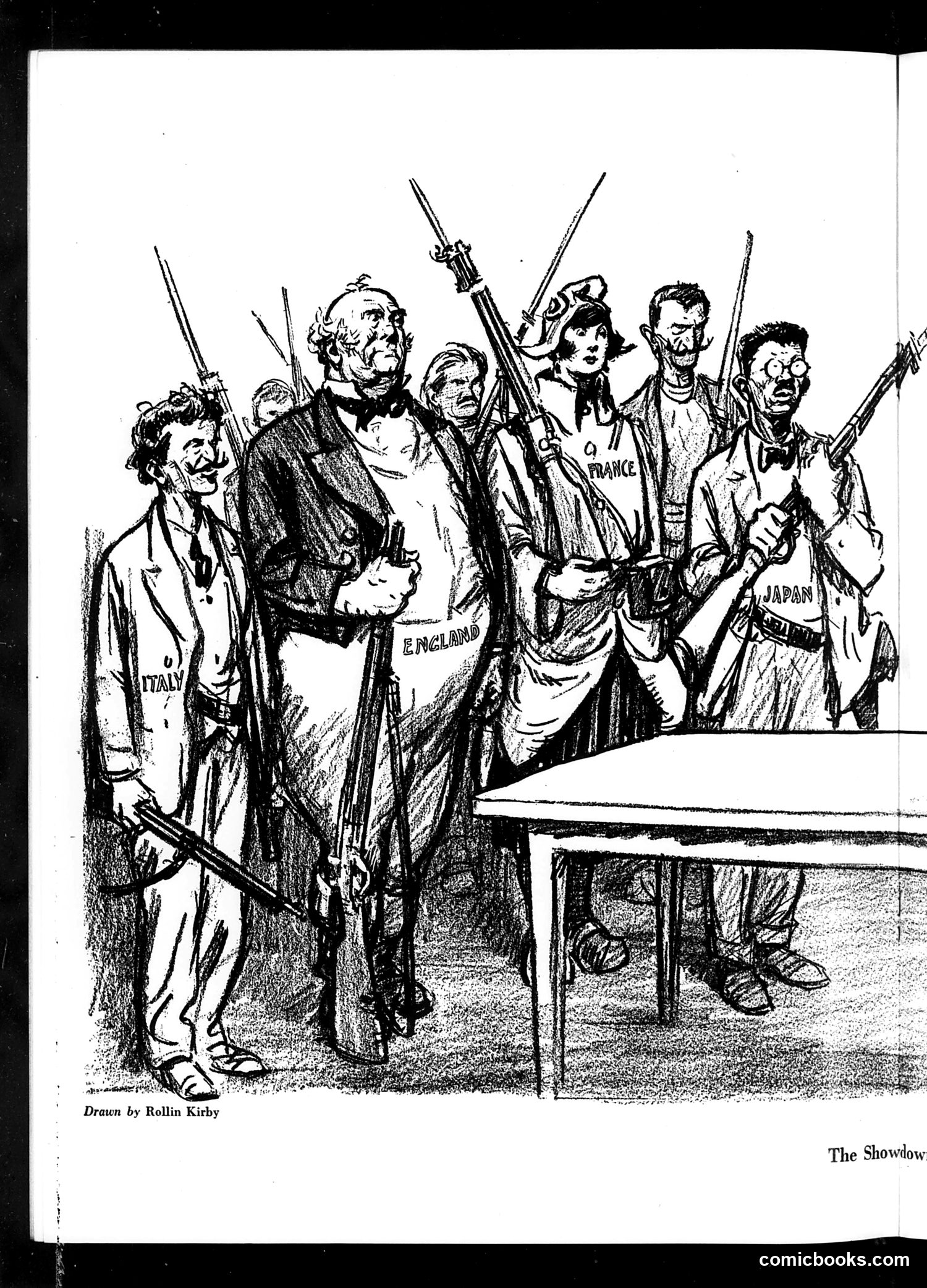
This political cartoon depicts representatives of several nations—labeled Italy, England, France, and Japan—armed with bayoneted rifles, standing in a confrontational stance. The figures appear to represent these countries as military adversaries or rivals on the brink of conflict. The cartoon's title, "The Showdown," suggests an imminent decisive confrontation or clash. The formal poses and aggressive weaponry emphasize tension and the threat of warfare between these powers. Without the publication date visible, the specific historical moment remains unclear, though the combination of these four nations suggests this likely references either pre-World War I or pre-World War II geopolitical tensions. The satirical style is typical of Rollin Kirby's political commentary in *Life* magazine.
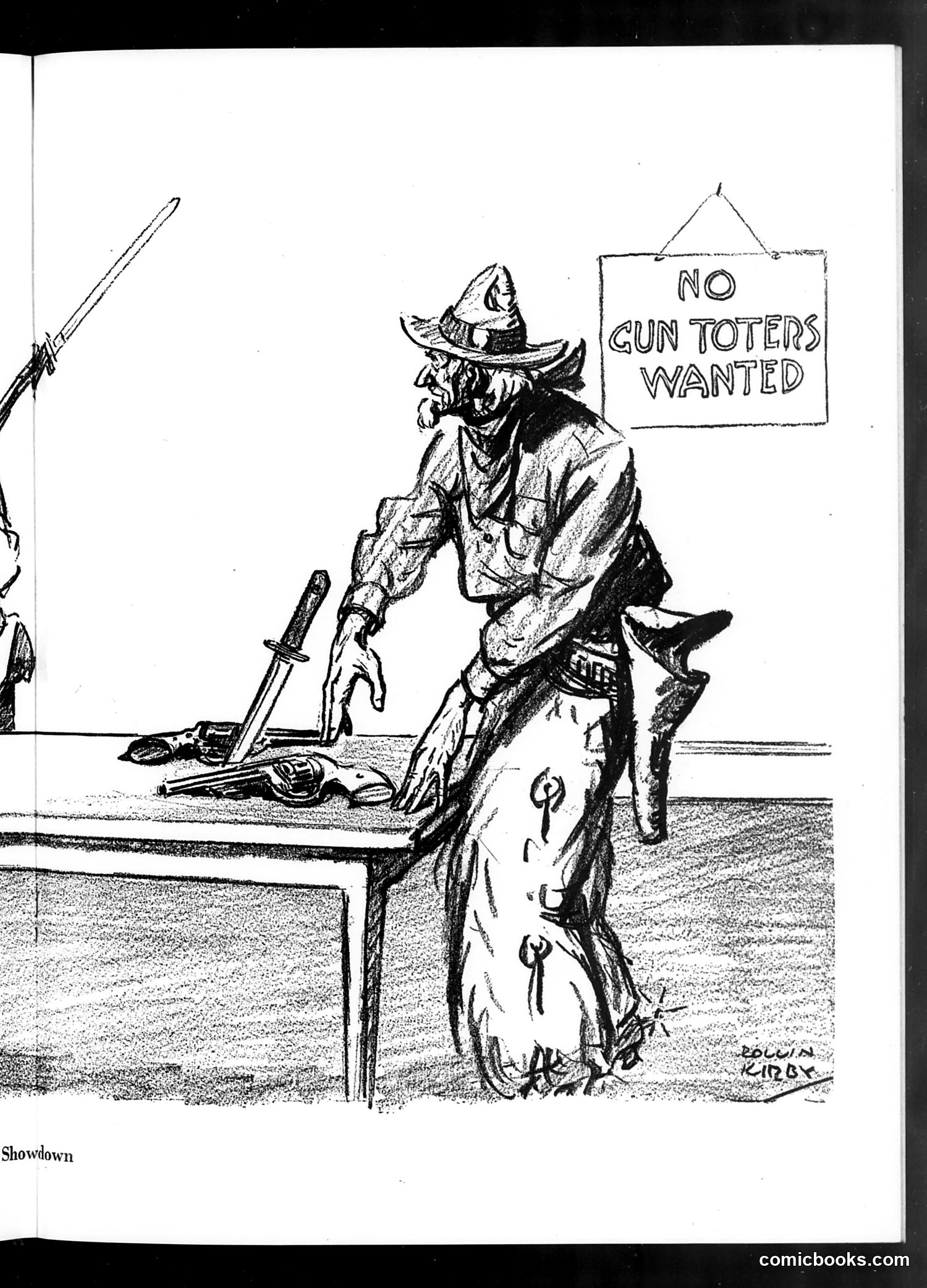
This cartoon depicts a Western gunslinger or outlaw figure posting a "No Gun Toters Wanted" sign. The satire appears to target gun violence or armed conflict through ironic inversion: a character stereotypically associated with guns and violence is explicitly rejecting armed individuals. The signature reads "Cesare Maccari" (or similar). The cartoon likely comments on either a specific contemporary conflict, labor dispute, or calls for disarmament during an era of violence. Without the magazine's date visible, the exact historical context remains unclear, though the Western imagery suggests commentary on American lawlessness or frontier-era attitudes. The joke's power lies in the contradiction: someone quintessentially armed is demanding others be unarmed.
This page reviews three Broadway plays. The critic mocks playwright Avery Hopwood's "The Demi-Virgin," acknowledging its deliberately crude humor appeals to audiences seeking salacious content—comparing such theatergoers to people who "spend their vertical hours writing on fences with chalk." The review dismisses Hopwood's material as recycled from vaudeville comedians and early 20th-century entertainment. "The Right to Strike" is criticized as a simplistic problem-play: a Lancashire railroad strike meets a counter-strike by doctors. The critic notes the ending—where a young doctor operates on the strike-leader's wife—fails to actually resolve the capital-versus-labor conflict it presents. Finally, the reviewer laments that "The Love Letter" closed before they could complete a planned pun-based review comparing it to "Love Dreams." The tone throughout is witty, dismissive social commentary typical of Life's satirical drama criticism.
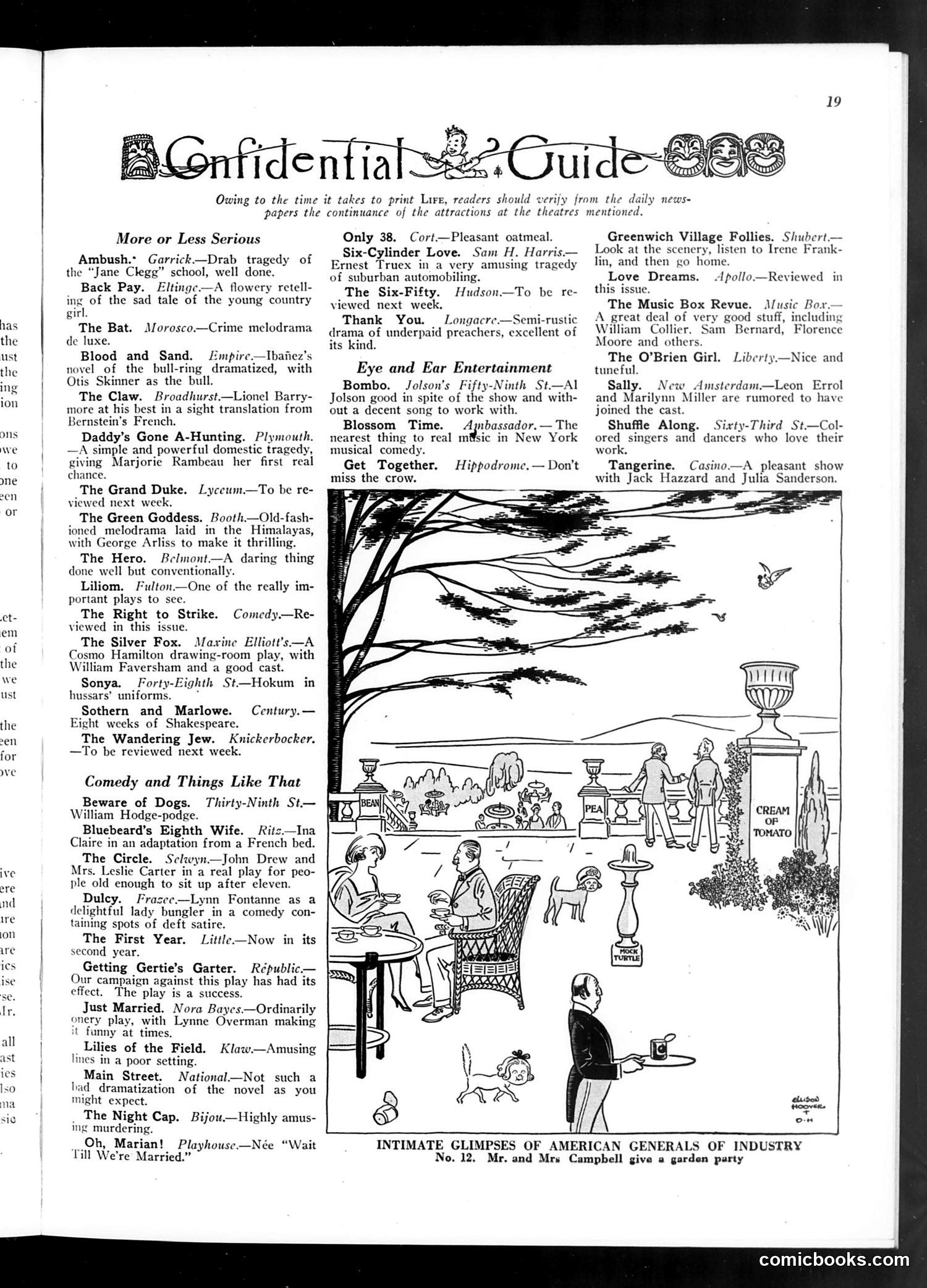
This illustration satirizes wealthy industrialists' leisure. Titled "No. 12, Mr. and Mrs Campbell give a garden party," it depicts the ultra-privileged at rest: ladies reading, men in formal dress, idle conversation, manicured gardens with classical urns, and a uniformed servant attending them. The satire lies in the contrast between these "Generals of Industry" (business titans wielding economic power) and their actual activity—accomplished nothing. The term "generals" mockingly elevates captains of industry to military rank, while the pastoral scene shows them disconnected from productive labor. For 1920s readers, this captured post-war anxieties about wealth concentration and whether industrial magnates deserved their status or merely performed leisure. The series appears to offer recurring social commentary on the idle rich.
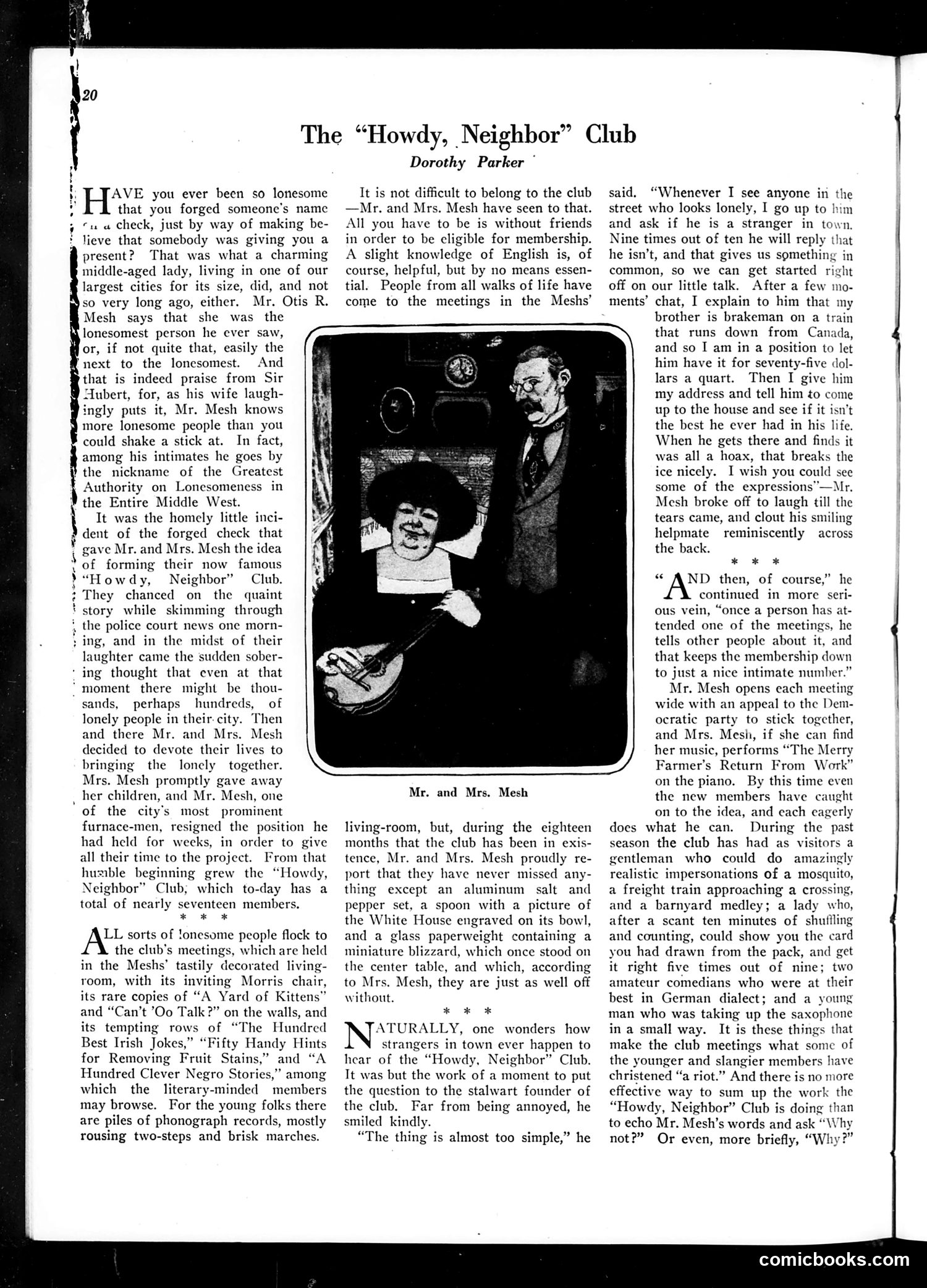
This is satirical fiction about Mr. and Mrs. Mesh, who founded a club for lonely people after reading about a woman who forged a check out of desperation for human connection. The couple devoted themselves to bringing together isolated city dwellers. The satire lies in the *earnest absurdity* of their efforts: the club operates from their living room, requires only loneliness and basic English as membership criteria, and has accumulated seventeen members in eighteen months. Parker gently mocks the Meshes' well-intentioned but somewhat bumbling approach—their crude membership screening and their tacky collection of self-help books ("Fifty Handy Hints for Removing Fruit Stains"). The photograph shows Mr. and Mrs. Mesh as ordinary, homely people. Parker's humor derives from how their sincere social mission contrasts with their limited sophistication and the club's modest, almost pathetic reality. It's a portrait of Midwestern earnestness and social awkwardness masquerading as philanthropy.
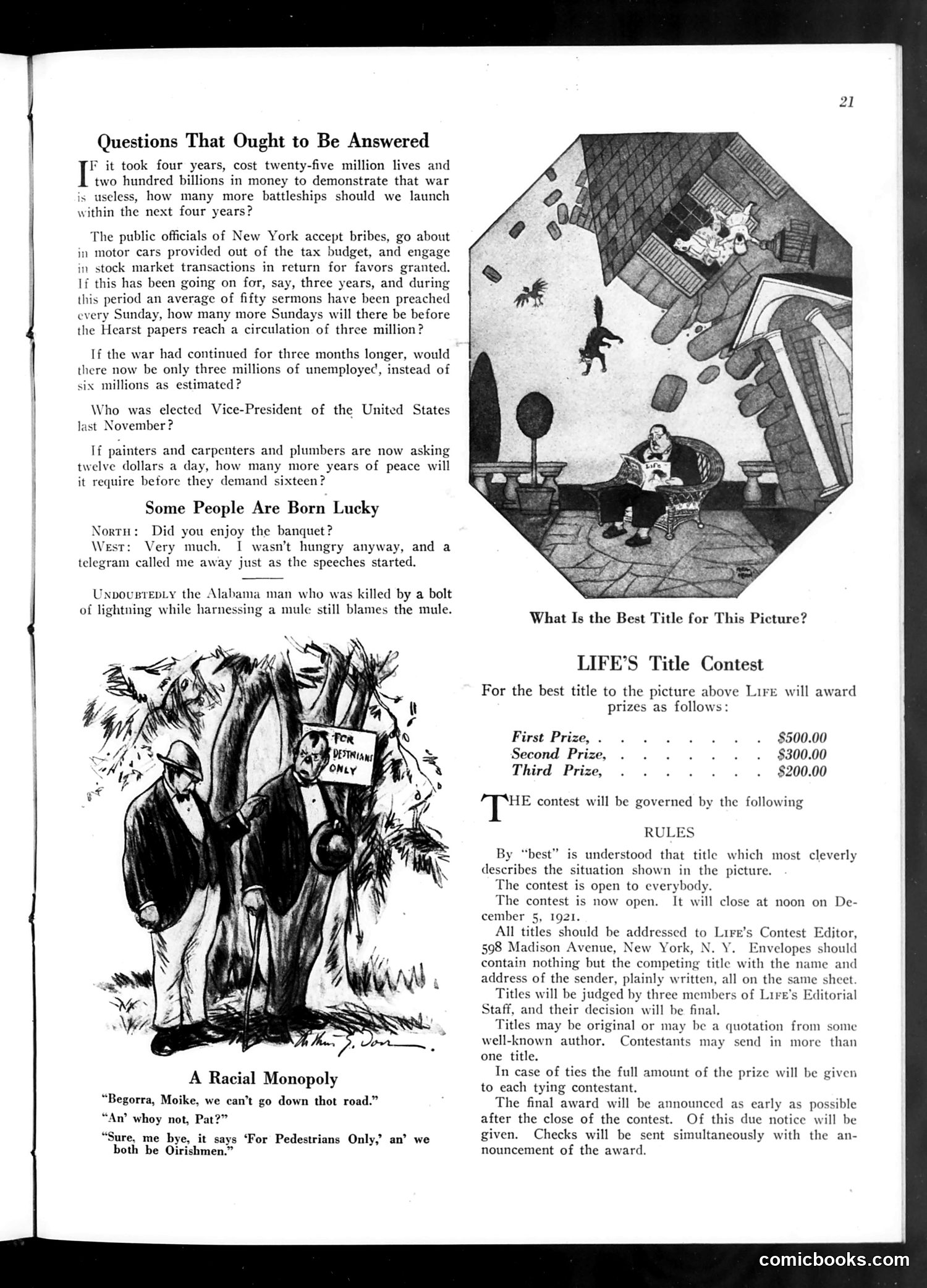
This satirical page from Life (circa 1921) uses rhetorical questions and ethnic humor to critique post-WWI America. **"Questions That Ought to Be Answered"** employs bitter irony to mock government waste and corruption. It sarcastically asks: if war was proven useless (costing 25 million lives), why build more battleships? It skewers New York officials' bribery and stock trading, and highlights the disconnect between 50 weekly sermons and ongoing corruption. The Vice-President question may reference the recent 1920 election. These questions expose societal hypocrisy and government dysfunction. **"A Racial Monopoly"** presents an Irish ethnic stereotype joke (rendered in exaggerated dialect). Two Irishmen avoid a "Pedestrians Only" road, jokingly claiming it's exclusively for non-Irish people—playing on discrimination stereotypes of the era. **"Some People Are Born Lucky"** is a light anecdote about someone conveniently called away from boring speeches. The page concludes with a **Life Title Contest** offering $500-$200 prizes for captions describing an illustration showing an urban scene with children and tenement buildings—asking readers to suggest the best title.
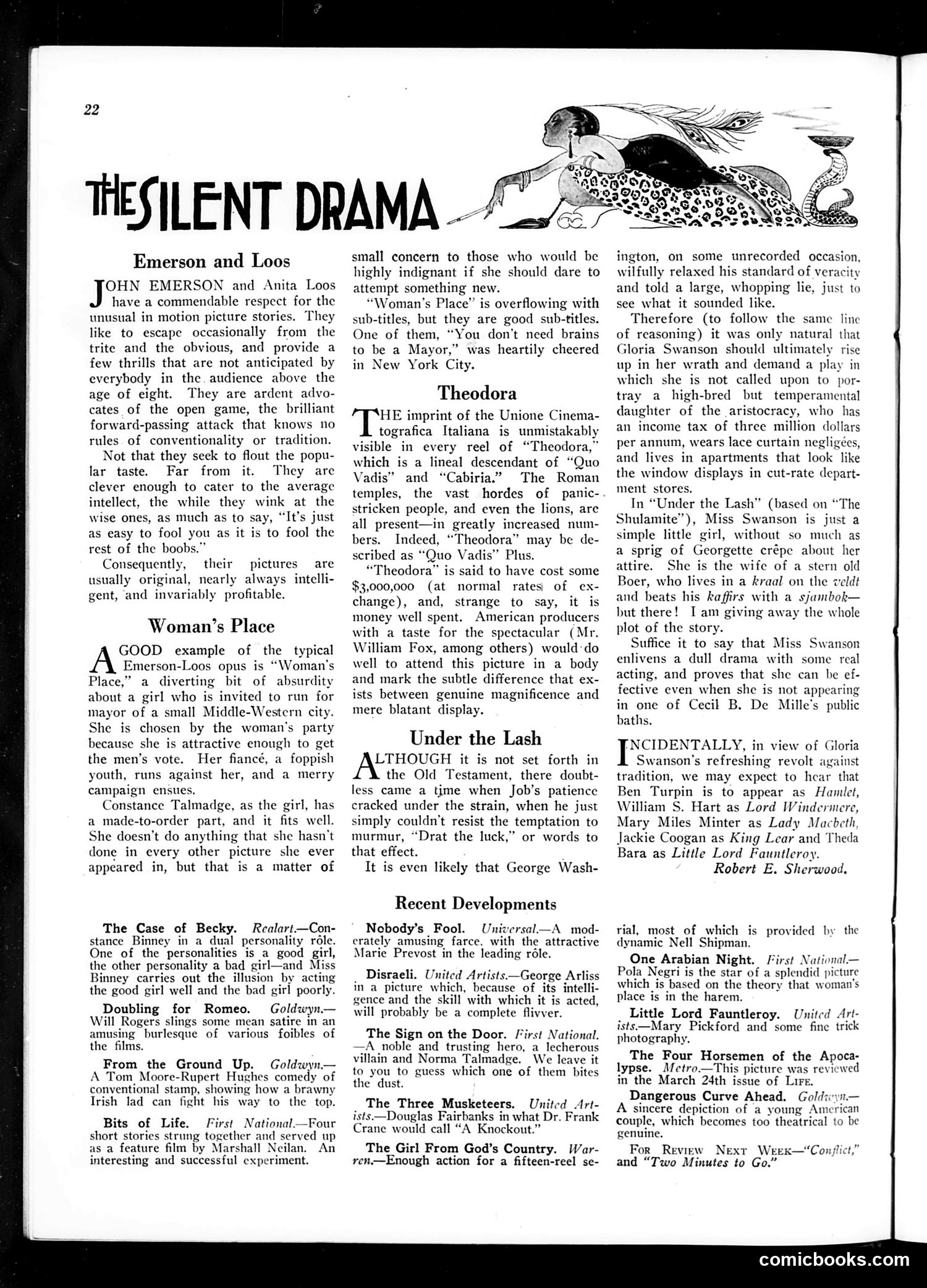
This page from *Life* magazine reviews several silent films and their stars—a typical entertainment feature from the early 1920s cinema era. The main subjects are directors John Emerson and Anita Loos, praised for creating unconventional yet commercially successful pictures. Key references include: - **"Woman's Place"**: A satirical comedy starring Constance Talmadge about a woman running for mayor—the subtitle "You don't need brains to be a Mayor" received audience applause, likely a jab at contemporary politicians. - **"Theodora"**: An Italian epic ($3 million production) compared to earlier spectacles like *Quo Vadis*, critiquing the difference between genuine magnificence and "blatant display." - **"Under the Lash"**: A film about Job's biblical patience, with a humorous suggestion that even Job would have cursed his misfortunes. The tone is witty and sophisticated, written for readers assumed familiar with current cinema and willing to appreciate both films and satirical commentary on American politics and taste.
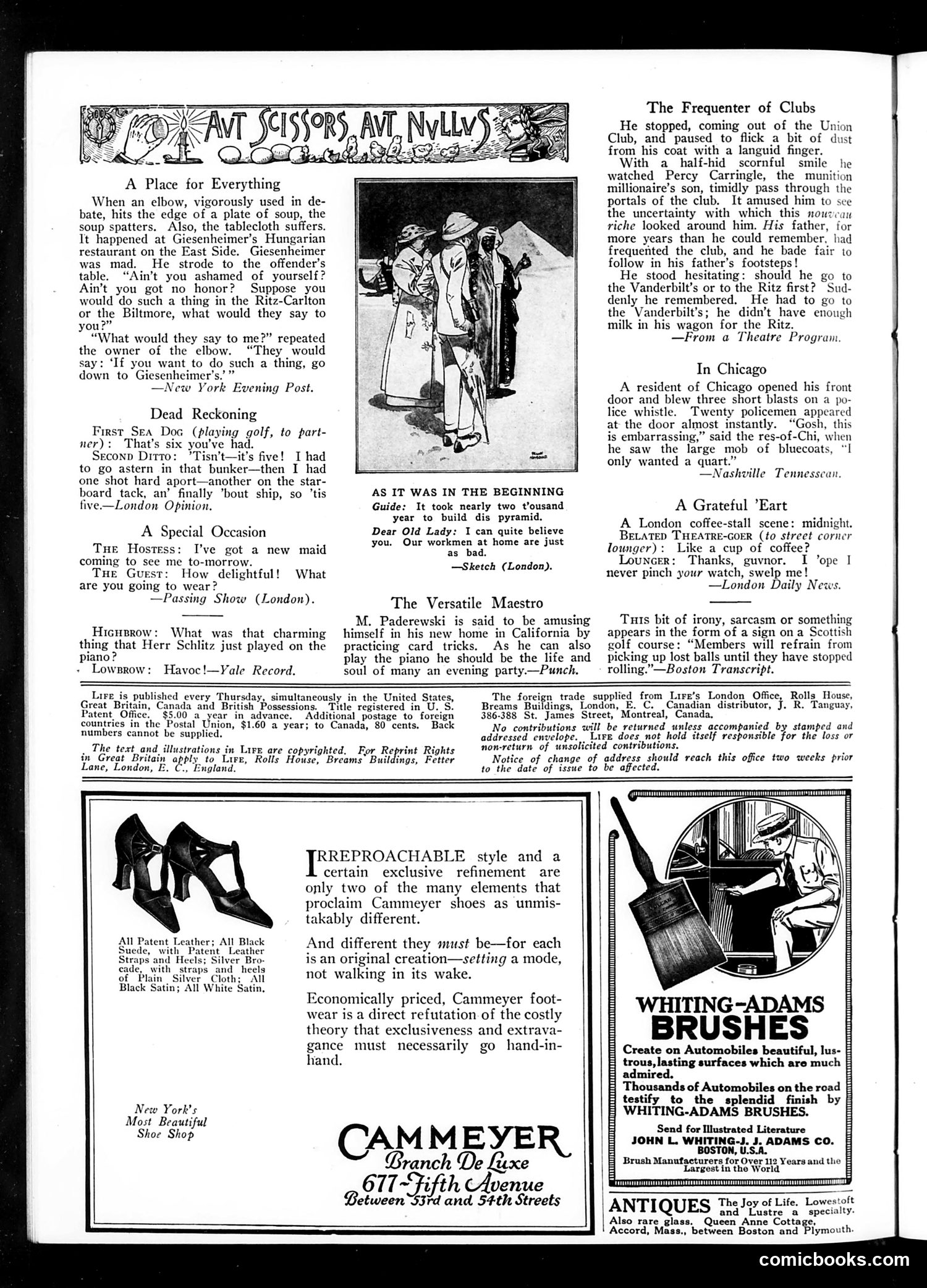
This page collects brief humorous anecdotes mocking class pretension and social awkwardness. The central illustrated piece, "The Frequenter of Clubs," depicts a wealthy club member observing a nouveau riche (newly rich) businessman, Percy Carringle, entering with obvious discomfort. The joke's ironic twist: the observer, though socially established, reveals his own lower status by mentioning he lacks "enough milk in his wagon for the Ritz"—suggesting he's a milkman, not actually wealthy. The surrounding vignettes similarly target social climbing and misplaced pride: a diner defends his casual behavior at a cheap restaurant; a Londoner's gratitude to a street lounger undercuts class hierarchies; Irish workmen allegedly move as slowly as ancient pyramid builders. The humor relies on deflating pretension through unexpected reversals and class-based ironies typical of early 20th-century satirical magazines.
This page contains three satirical pieces and advertisements: **"The Green-Eyed One"** by Ethel D. Turner satirizes jealousy and inconsistency in romantic relationships. The narrator criticizes their partner's admiration of actress Nazimova and actor John Barrymore, yet the partner dismisses the narrator's own enthusiasms—illustrating how people often begrudge others' tastes while demanding acceptance of their own. **"A Step Toward—What?"** mocks disarmament hypocrisy. Two criminals agree to discard expensive .44 revolvers for cheaper weapons to save money, then "parted, to maintain...their usual condition of armed alertness." The satire suggests that weapons-reduction agreements are meaningless if parties retain lethal capability—likely referencing contemporary disarmament conferences of the 1920s. **"Where Is Mr. Kipling?"** questions why author Rudyard Kipling isn't attending an armament conference alongside H.G. Wells, suggesting writers should influence major policy matters. The page also features advertisements for Waterman fountain pens and Pears soap, typical of the era's magazine content.
This page is primarily **advertising and humor columns**, not political cartoons. The main content features a **W.L. Douglas shoe advertisement** (left side)—a major early 20th-century shoe brand sold direct-from-factory to undercut retail prices. The ad emphasizes affordability and quality through founder W.L. Douglas's personal guarantee stamped on soles. The right side contains **satirical humor pieces** from *Life* magazine's regular features: - **"Love Finds a Way"**: A joke about a couple short $2 for a marriage license fee, forced to pawn their wedding ring to afford the bureaucratic requirement. - **"Out Where the Wheat Begins"**: A rural anecdote about grain prices during what appears to be agricultural inflation (farmer can't afford flour). - Brief quips mocking British scientists studying red-haired people in Scotland and other light social observations. There's also an **Egyptian Deities cigarette advertisement** featuring pseudo-cultural marketing to suggest refinement. The page reflects 1910s-era consumer culture, humor magazines' role as social commentators, and casual advertising style.
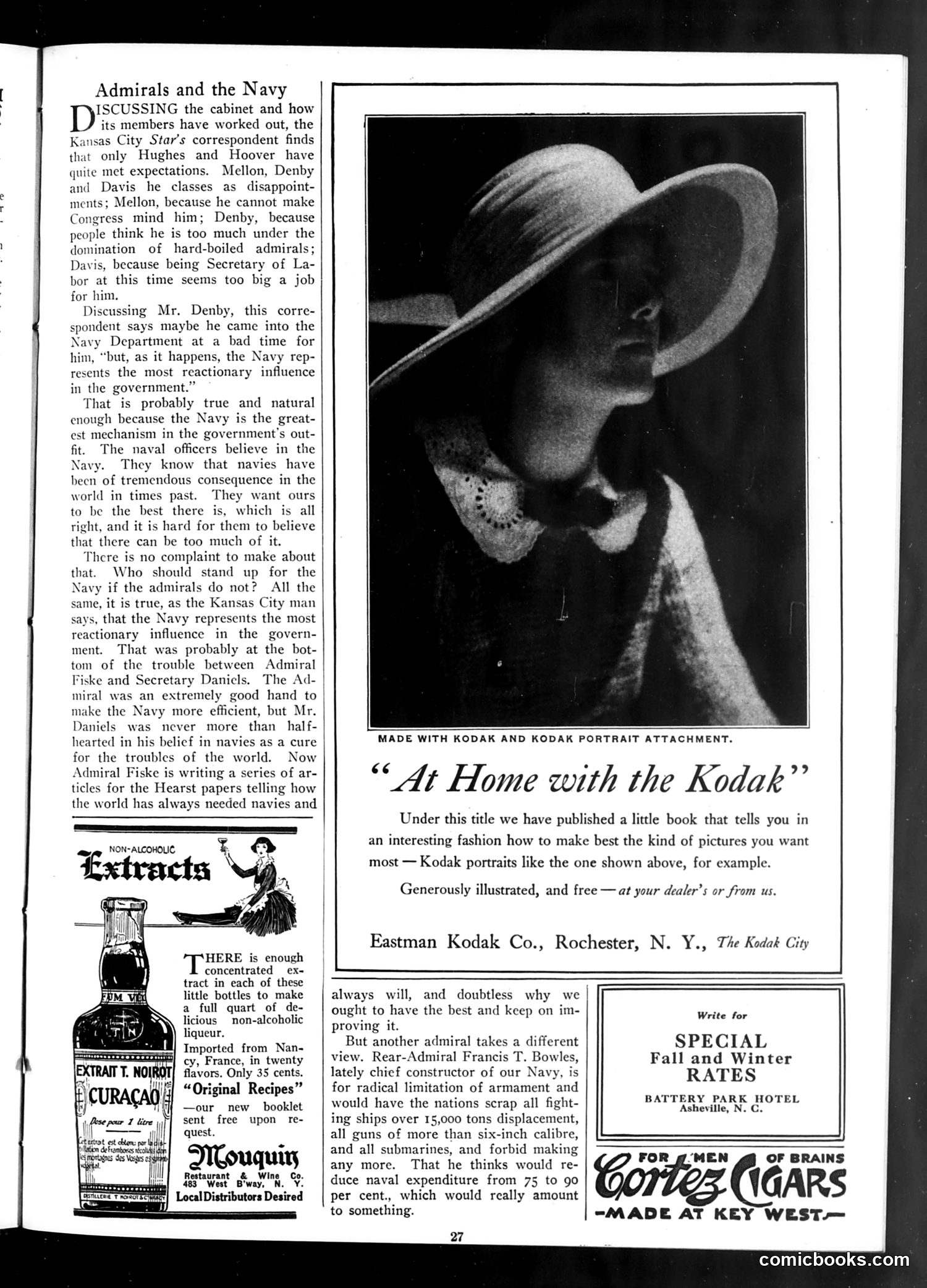
This page features a **serious editorial piece**, not a cartoon, critiquing Secretary of the Navy Edwin Denby's performance in President Harding's cabinet (early 1920s). **The Main Argument:** The Kansas City Star correspondent argues that Denby is ineffective because he's dominated by "hard-boiled admirals"—the Navy represents "the most reactionary influence in the government." Naval officers, the piece explains, inevitably prioritize expanding naval power because they believe in the Navy's historical importance, making them inherently opposed to spending restraint. **Historical Context:** The article references the earlier conflict between Admiral Bradley Fiske and Secretary Josephus Daniels, and notes that Fiske now writes pro-Navy pieces for Hearst papers. It contrasts this with Rear-Admiral Francis T. Bowles, who advocates radical disarmament—scrapping large ships and reducing naval spending 75-90%. **The Point:** The satire is subtle: the piece questions whether admirals can objectively advise on defense policy when institutional self-interest necessarily shapes their judgment. This reflects 1920s isolationist and anti-militarism sentiment following World War I.
This page is predominantly a **book review section** paired with a **commercial advertisement** for Ward's Paradise Fruit Cake—not political satire. The review section discusses contemporary fiction titles (works by Michael Sadleir, May Sinclair, George Barr McCutcheon, and others), offering critical commentary typical of Life magazine's literary coverage. The main visual content is a large **product advertisement** featuring an ornate cake box. The ad emphasizes that Ward's fruit cake contains "choicest gifts of bountiful nature from every land"—imported cherries, Hawaiian pineapples, raisins, butter, eggs, and flour. It's positioned as an ideal Thanksgiving/Christmas gift. The boast "Over 100,000 Sold Last Year / They Must Be Good!" suggests the cake's market success. There is **no political cartoon or satire** on this page. It's a straightforward early 20th-century Life magazine mixing book reviews with national brand advertising—common editorial practice of the era.
This page mixes advertisements with satirical commentary typical of Life magazine's format. **Main Content:** The left side features "Mum and the Dainty Woman"—an advertisement for antiperspirant deodorant. It humorously addresses women's social anxiety about perspiration odor, framing body odor as a threat to popularity and romantic prospects. The ad promises "Mum" will solve this "trouble" without stopping natural bodily functions. **Satire Section:** "Scandalous" mocks the difference between British and American scandal culture. The piece criticizes Americans for manufacturing scandals about contemporary figures while the British prefer rehashing historical scandals (Byron, Wordsworth, Queen Victoria). The author argues Americans demand "realism" in scandals—seeing actual people in motor cars—whereas British society finds past scandals more respectable. **The Brief Jokes:** A short exchange about education and another about theatrical productions ("Hamlet" vs. "The Jest" being interchangeable) highlight pretension and superficial sophistication. The page reflects 1920s attitudes about femininity, propriety, and cultural differences between nations.
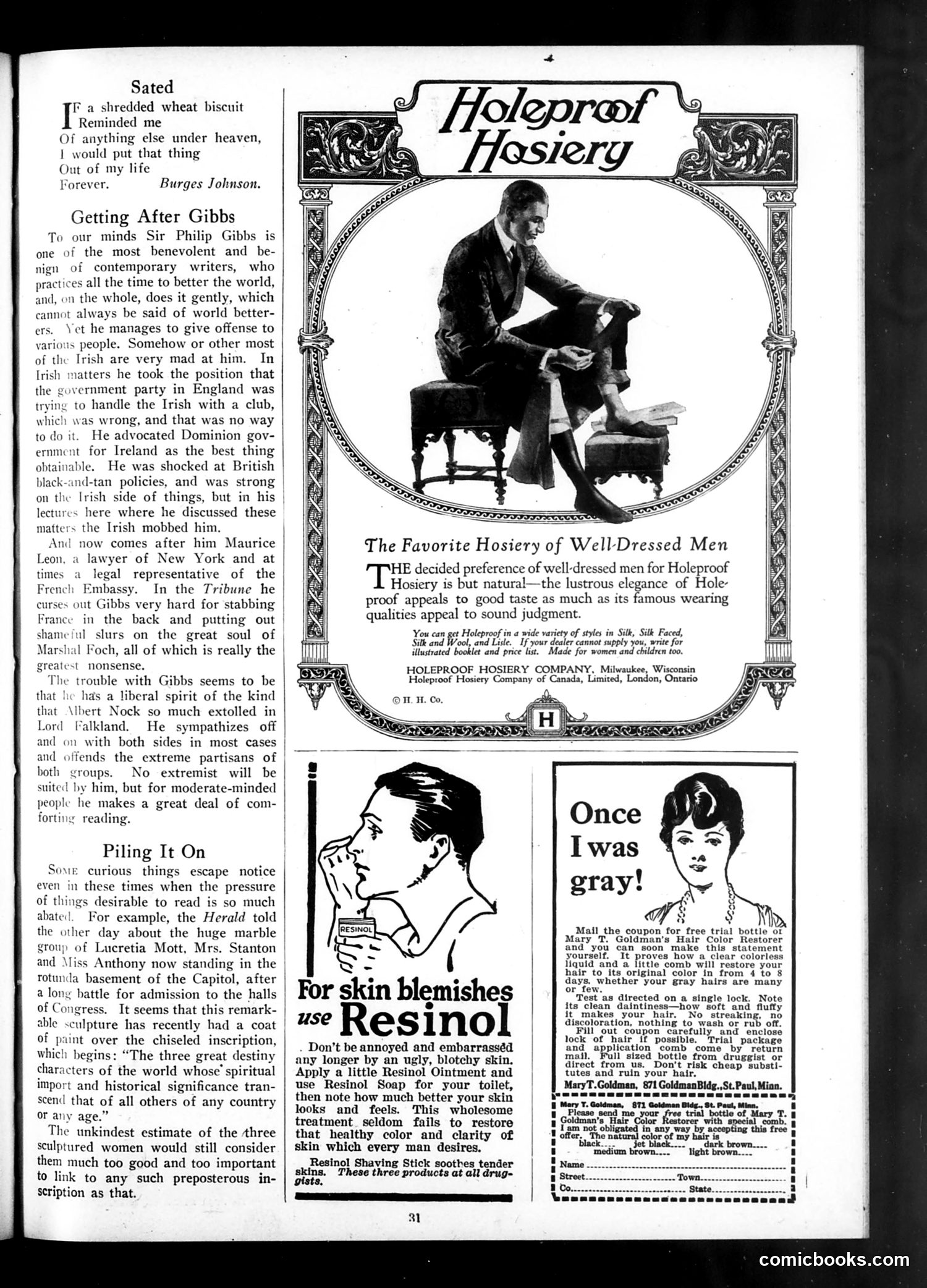
This page contains literary criticism and advertisements rather than political cartoons. The main article "Getting After Gibbs" discusses Sir Philip Gibbs, a British writer whom Irish readers attacked during lectures. Gibbs had advocated for Irish Dominion status and criticized British "black-and-tan" military policies, taking what the author calls a "liberal" middle position. Now Maurice Leon, a French Embassy lawyer, is publicly denouncing Gibbs in the Tribune for allegedly slandering Marshal Foch and France. The piece's ironic point: Gibbs' moderate, sympathetic approach to multiple perspectives offends extremists on both sides—neither Irish nationalists nor French patriots will accept his nuanced views. The remainder consists of advertisements: Holeproof Hosiery (featuring a man in formal wear), Resinol skin treatment, and Mary T. Goldman's hair coloring product ("Once I was gray!"). These ads reflect early 20th-century consumer culture and grooming standards.
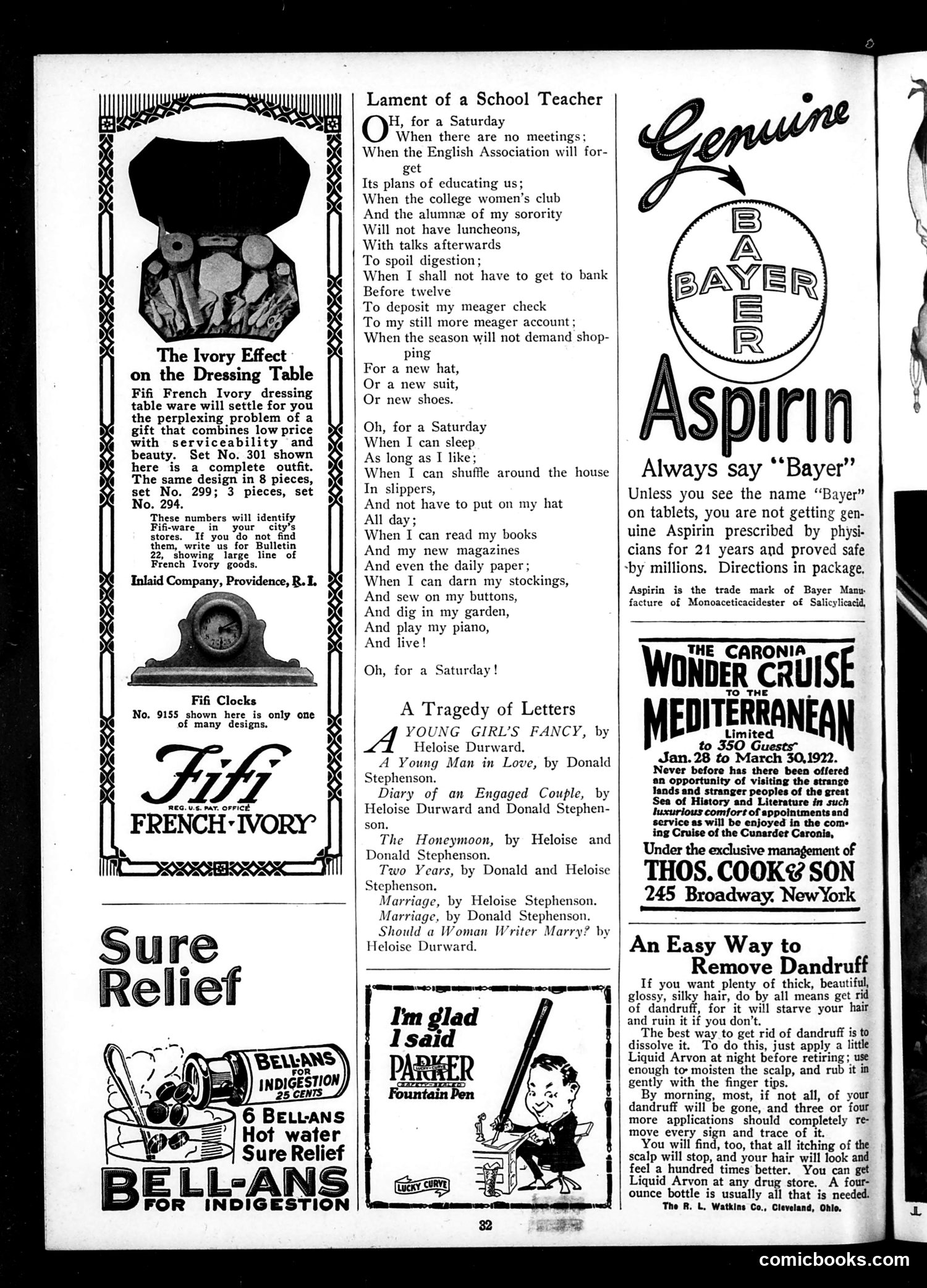
This satirical poem mocks the exhausting social obligations imposed on female teachers in the 1920s. The speaker yearns for a Saturday free from mandatory professional duties: English Association meetings, alumni club luncheons, and sorority events designed to "spoil digestion." Beyond work itself, she's trapped in constant commercial demands—shopping for hats, suits, and shoes to maintain proper appearance. The poem's emotional climax reveals the real complaint: she wants one day to simply exist—sleeping late, wearing slippers, reading, mending stockings, gardening, playing piano, and "live!" The satire targets both the rigid social expectations constraining professional women and the commercialism that monetizes even their leisure time. The repeated "Oh, for a Saturday!" emphasizes how utterly unattainable simple rest and autonomy have become for educated, employed women, even one day weekly.