
Life, 1921-11-10 · page 20 of 34
Life — November 10, 1921 — page 20: what you’re looking at
What you’re looking at
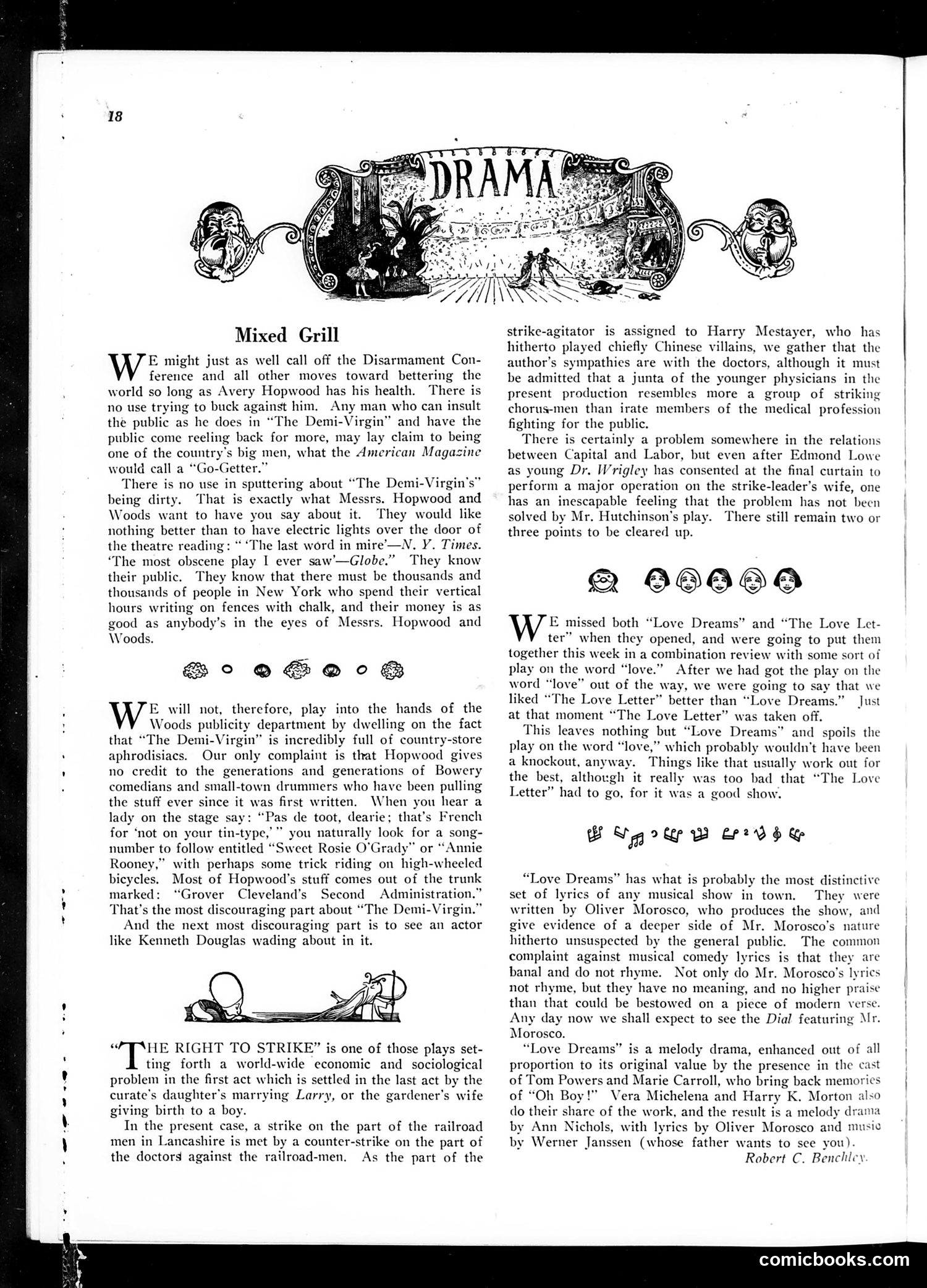
This page reviews three Broadway plays. The critic mocks playwright Avery Hopwood's "The Demi-Virgin," acknowledging its deliberately crude humor appeals to audiences seeking salacious content—comparing such theatergoers to people who "spend their vertical hours writing on fences with chalk." The review dismisses Hopwood's material as recycled from vaudeville comedians and early 20th-century entertainment. "The Right to Strike" is criticized as a simplistic problem-play: a Lancashire railroad strike meets a counter-strike by doctors. The critic notes the ending—where a young doctor operates on the strike-leader's wife—fails to actually resolve the capital-versus-labor conflict it presents. Finally, the reviewer laments that "The Love Letter" closed before they could complete a planned pun-based review comparing it to "Love Dreams." The tone throughout is witty, dismissive social commentary typical of Life's satirical drama criticism.
📄 Transcribed text from this page (OCR, searchable)
Machine-transcribed from the original scan — historical spelling and the odd misread are preserved.
-3we ew lw - Mixed Grill E might just as well call off the Disarmament Con- ference and all other moves toward bettering the world so long as Avery Hopwood has his health. There is no use trying to buck against him, Any man who can insult the public as he does in “The Demi-Virgin” and have the public come reeling back for more, may lay claim to being one of the country’s big men, what the American Magazine would call a “Go-Getter.” There is no use in sputtering about “The Demi-Virgin’s” being dirty. That is exactly what Messrs. Hopwood and Woods want to have you say about it. They would like nothing better than to have electric lights over the door of the theatre reading: “ ‘The last word in mire’—N. Y. Times. ‘The most obscene play I ever saw’—Globe.” They know their public. They know that there must be thousands and thousands of people in New York who spend their vertical hours writing on fences with chalk, and their money is as good as anybody’s in the eyes of Messrs. Hopwood and Woods. Be ©Ge0G E will not, therefore, play into the hands of the Woods publicity department by dwelling on the fact that “The Demi-Virgin” is incredibly full of country-store aphrodisiacs. Our only complaint is that Hopwood gives no credit to the generations and generations of Bowery comedians and small-town drummers who have been pulling the stuff ever since it was first written. When you hear a lady on the stage say: “Pas de toot, dearie; that’s French for ‘not on your tin-type,’” you naturally look for a song- number to follow entitled “Sweet Rosie O'Grady” or “Annie Rooney,” with perhaps some trick riding on high-wheeled Most of Hopwood's stuff comes out of the trunk “Grover Cleveland’s Second Administration.” That's the most discouraging part about “The Demi-Virgin.” And the next most discouraging part is to see an actor like Kenneth Douglas wading about in it. “ HE RIGHT TO STRIKE” is one of those plays set- ting forth a world-wide economic and sociological problem in the first act which is settled in the last act by the curate’s daughter's marrying Larry, or the gardener’s wife giving birth to a boy. In the present case, a strike on the part of the railroad men in Lancashire is met by a counter-strike on the part of the doctors against the railroad-men. As the part of the strike-agitator is assigned to Harry Mestayer, who has hitherto played chiefly Chinese villains, we gather that the author’s sympathies are with the doctors, although it must be admitted that a junta of the younger physicians in the present production resembles more a group of. striking chorus-men than irate members of the medical profession fighting for the public. There is certainly a problem somewhere in the relations between Capital and Labor, but even after Edmond Lowe as young Dr. Wrigley has consented at the final curtain to perform a major operation on the strike-leader’s wife, one has an inescapable feeling that the problem has not been solved by Mr. Hutchinson's play. There still remain two or three points to be cleared up. 2 E missed both “Love Dreams” and “The Love Let- ter” when they opened, and were going to put them together this week in a combination review with some sort of play on the word “love.” After we had got the play on the word “love” out of the way, we were going to say that we liked “The Love Letter” better than “Love Dreams.” Just at that moment “The Love Letter” was taken off. This leaves nothing but “Love Dreams” and spoils the play on the word “love,” which probably wouldn't have been a knockout, anyway. Things like that usually work out for the best, although it really was too bad that “The Love Letter” had to go, for it was a good show. CMe re w odee “Love Dreams” has what is probably the most distinctive set of lyrics of any musical show in town, They were written by Oliver Morosco, who produces the show, and give evidence of a deeper side of Mr. Morosco’s nature hitherto unsuspected by the general public. The common complaint against musical comedy lyrics is that they are banal and do not rhyme. Not only do Mr. Morosco’s lyrics not rhyme, but they have no meaning, and no higher praise than that could be bestowed on a piece of modern ve Any day now we shall expect to see the Dial featuring Mr. Morosco. “Love Dreams” is a melody drama, enhanced out of all proportion to its original value by the presence in the cast of Tom Powers and Marie Carroll, who bring back memories of “Oh Boy Vera Michelena and Harry K. Morton also do their share of the work, and the result is a melody drama by Ann Nichols, with lyrics by Oliver Morosco and musiv by Werner Janssen (whose father wants to see you). Robert C. Benchilex comicbooks.com