
Life, 1921-11-10 · page 29 of 34
Life — November 10, 1921 — page 29: what you’re looking at
What you’re looking at
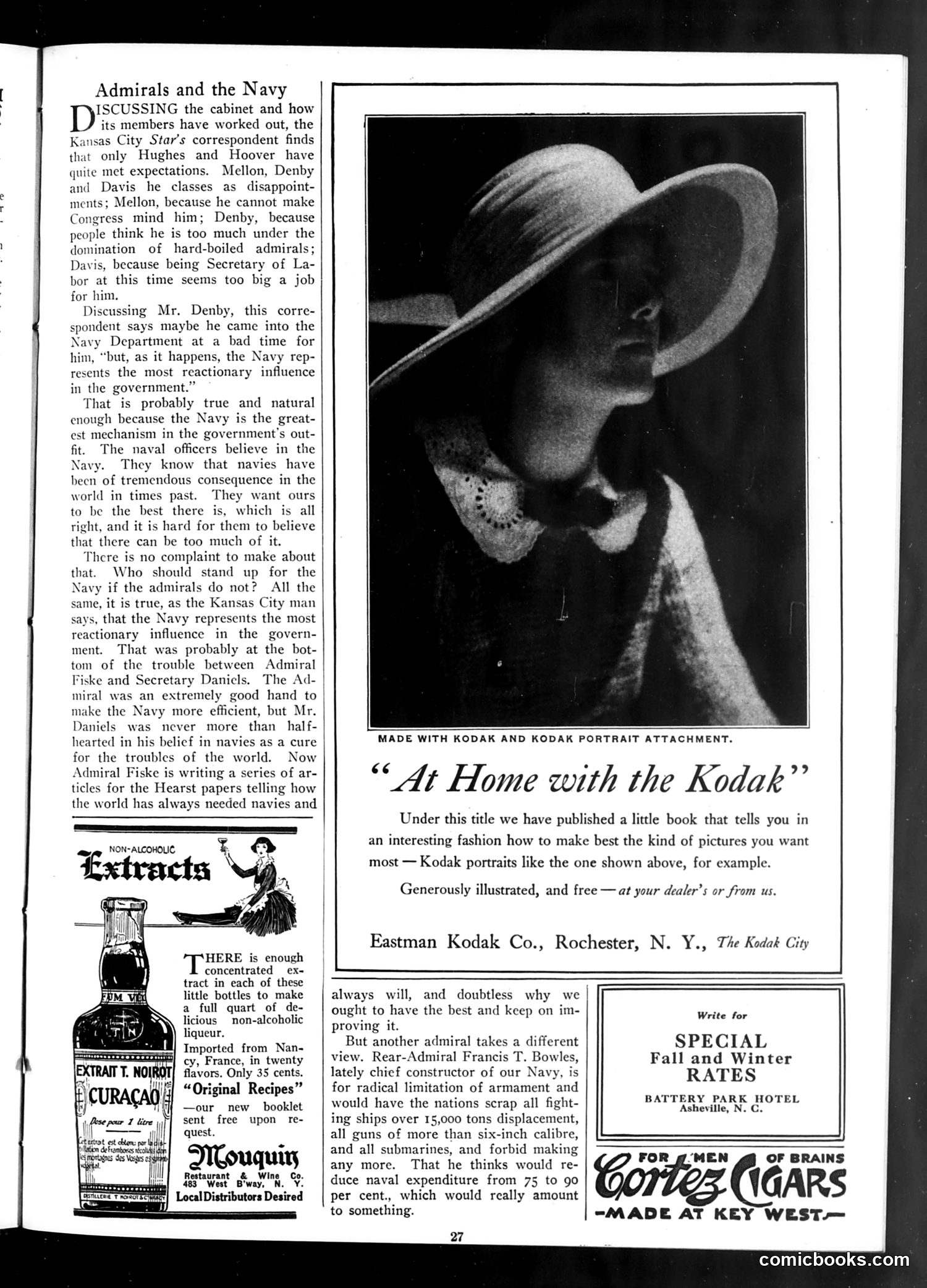
This page features a **serious editorial piece**, not a cartoon, critiquing Secretary of the Navy Edwin Denby's performance in President Harding's cabinet (early 1920s). **The Main Argument:** The Kansas City Star correspondent argues that Denby is ineffective because he's dominated by "hard-boiled admirals"—the Navy represents "the most reactionary influence in the government." Naval officers, the piece explains, inevitably prioritize expanding naval power because they believe in the Navy's historical importance, making them inherently opposed to spending restraint. **Historical Context:** The article references the earlier conflict between Admiral Bradley Fiske and Secretary Josephus Daniels, and notes that Fiske now writes pro-Navy pieces for Hearst papers. It contrasts this with Rear-Admiral Francis T. Bowles, who advocates radical disarmament—scrapping large ships and reducing naval spending 75-90%. **The Point:** The satire is subtle: the piece questions whether admirals can objectively advise on defense policy when institutional self-interest necessarily shapes their judgment. This reflects 1920s isolationist and anti-militarism sentiment following World War I.
📄 Transcribed text from this page (OCR, searchable)
Machine-transcribed from the original scan — historical spelling and the odd misread are preserved.
Admirals and the Navy ISCUSSING the cabinet and how its members have worked out, the Kansas City Star’s correspondent finds that only Hughes and Hoover have quite met expectations. Mellon, Denby and Davis he classes as disappoint- ments; Mellon, because he cannot make Congress mind him; Denby, because people think he is too much under the domination of hard-boiled admirals; Davis, because being Secretary of La- bor at this time seems too big a job for him. Discussing Mr. Denby, this corre- spondent says maybe he came into the Navy Department at a bad time for him, “but, as it happens, the Navy rep- resents the most reactionary influence in the government.” That is probably true and natural enough because the Navy is the great- est mechanism in the government's out- fit. The naval officers believe in the Navy. They know that navies have been of tremendous consequence in the world in times past. They want ours to be the best there is, which is all right, and it is hard for them to believe that there can be too much of it. There is no complaint to make about that. Who should stand up for the Navy if the admirals do not? All the same, it is true, as the Kansas City man says, that the Navy represents the most reactionary influence in the govern- ment. That was probably at the bot- tom of the trouble between Admiral Fiske and Secretary Daniels. The Ad- miral was an extremely good hand to | make the Navy more efficient, but Mr. Daniels was never more than_half- hearted in his belief in navies as a cure for the troubles of the world. Now Admiral Fiske is writing a series of ar- ticles for the Hearst papers telling how the world has always needed navies and wwe NON-ALCOHOUC HERE is enough concentrated ex- tract in each of these little bottles to make a full quart of de- licious non-alcoholic liqueur. Imported from Nan- cy, France, in twenty flavors. Only 35 cents. “Original Recipes” new booklet free upon re- —our sent quest. JlKouquir, Bewer halh, &: Local Distributors Desired MADE WITH KODAK AND KODAK PORTRAIT ATTACHMENT. “At Home with the Kodak” Under this title we have published a little book that tells you in an interesting fashion how to make best the kind of pictures you want most — Kodak portraits like the one shown above, for example. Generously illustrated, and free —at your dealer’s or from us. Eastman Kodak Co., Rochester, N. Y., The Kodak City always will, and doubtless why we ought to have the best and keep on im- proving it. But another admiral takes a different view. Rear-Admiral Francis T. Bowles, lately chief constructor of our Navy, is for radical limitation of armament and would have the nations scrap all fight- ing ships over 15,000 tons displacement, all guns of more than six-inch calibre, and all submarines, and forbid making any more. That he thinks would re- duce naval expenditure from 75 to 90 per cent., which would really amount to something. 27 Write for SPECIAL Fall and Winter RATES BATTERY PARK HOTEL Asheville, N. C. FOR _g MEN OF BRAINS IGARS “MADE AT KEY WEST.— comicbooks.com