
Life, 1921-11-10 · page 7 of 34
Life — November 10, 1921 — page 7: what you’re looking at
What you’re looking at
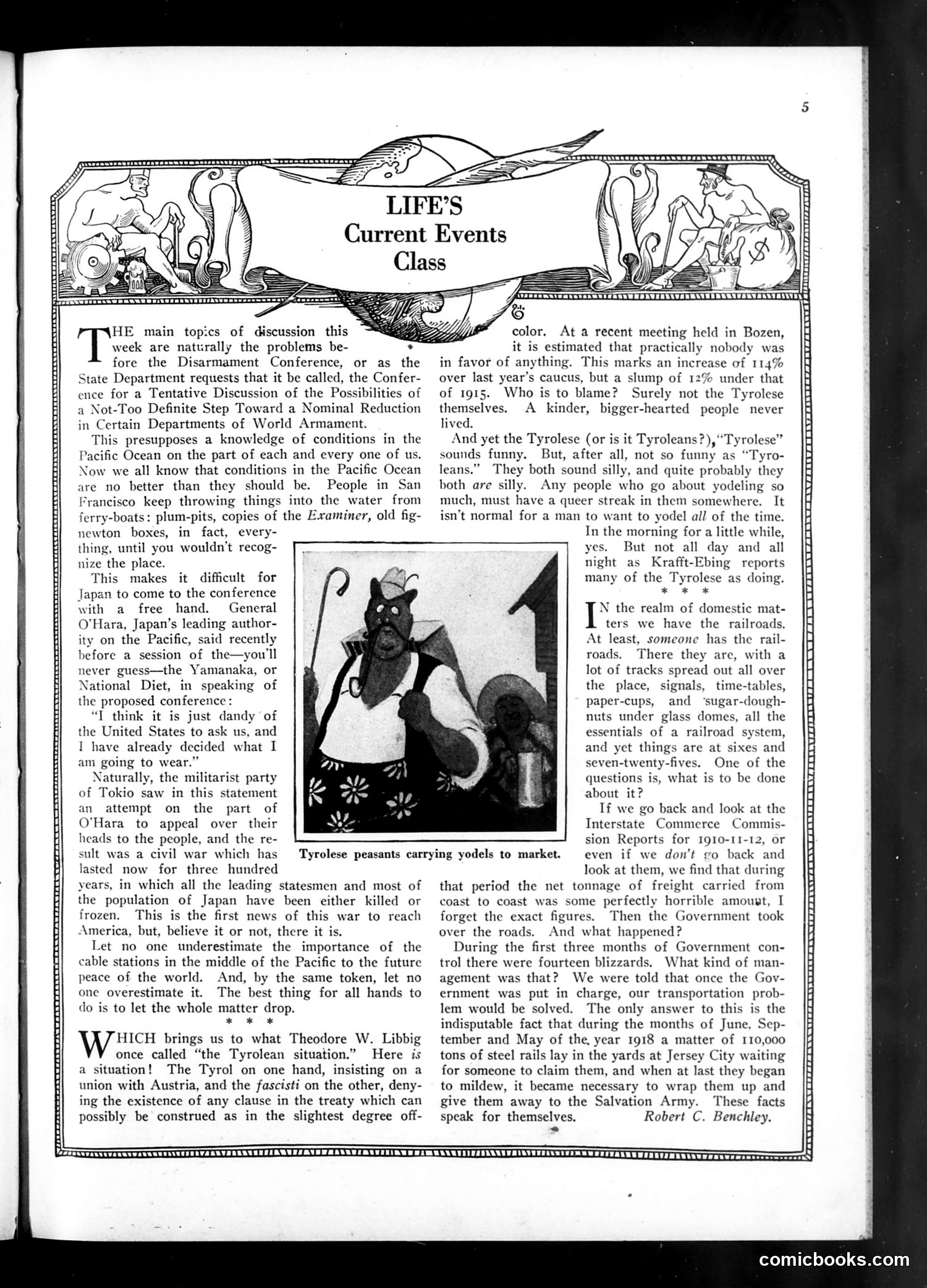
This page satirizes international tensions over the Tyrol region. The main cartoon depicts "Tyrolese peasants carrying yodels to market"—a visual pun mocking how the Tyrol situation dominates discourse while seeming trivial. The text discusses the Disarmament Conference and Japan's absence, but focuses on the "Tyrolese situation"—the author Robert C. Benchley uses this obscure regional dispute to criticize how nations obsess over minor territorial issues while ignoring larger problems like railroad infrastructure and logistics (noting 110,000 tons of steel rails abandoned at Jersey City). The satire suggests political leaders prioritize petty geopolitical squabbles over practical, meaningful governance. The cartoon's whimsical "yodels to market" image emphasizes how absurdly the Tyrol controversy is being treated.
📄 Transcribed text from this page (OCR, searchable)
Machine-transcribed from the original scan — historical spelling and the odd misread are preserved.
week are nattrally the problems be- fore the Disarmament Conference, or as the State Department requests that it be called, the Confer- ence for a Tentative Discussion of the Possibilities of a Not-Too Definite Step Toward a Nominal Reduction in Certain Departments of World Armament. This presupposes a knowledge of conditions in the Pacific Ocean on the part of each and every one of us. Now we all know that conditions in the Pacific Ocean re no better than they should be. People in San Francisco keep throwing things into the water from ferry-boats: plum-pits, copies of the Examiner, old fig- newton boxes, in fact, every- thing, until you wouldn't recog- nize the place. This makes it difficult for Japan to come to the conference with a free hand. General O'Hara, Japan’s leading author- ity on the Pacific, said recently before a session of the—you'll never guess—the Yamanaka, or National Diet, in speaking of the proposed conference : “I think it is just dandy of the United States to ask us, and I have already decided what I am going to wear.” Naturally, the militarist party of Tokio saw in this statement an attempt on the part of O'Hara to appeal over their heads to the people, and the re- sult was a civil war which has lasted now for three hundred years, in which all the leading statesmen and most of the population of Japan have been either killed or frozen. This is the first news of this war to reach America, but, believe it or not, there it is. Let no one underestimate the importance of the cable stations in the middle of the Pacific to the future peace of the world. And, by the same token, let no one overestimate it. The best thing for all hands to do is to let the whole matter drop. * ok * Te main topics of discussion this HICH brings us to what Theodore W. Libbig once called “the Tyrolean situation.” Here is a situation!’ The Tyrol on one hand, insisting on a union with Austria, and the fascisti on the other, deny- ing the existence of any clause in the treaty which can possibly be construed as in the slightest degree off- Tyrolese peasants carrying yodels to market. color. At a recent meeting held in Bozen, it is estimated that practically nobody was in favor of anything. This marks an increase of 114% over last year’s caucus, but a slump of 12% under that of 1915. Who is to blame? Surely not the Tyrolese themselves. A kinder, bigger-hearted people never lived. And yet the Tyrolese (or is it Tyroleans?),“Tyrolese” sounds funny, But, after all, not so funny as “Tyro- leans.” They both sound silly, and quite probably they both are silly. Any people who go about yodeling so much, must have a queer streak in them somewhere. It isn’t normal for a man to want to yodel all of the time. In the morning for a little while, yes. But not all day and all night as Kraff ing reports many of the Tyrolese as doing. * kok N the realm of domestic mat- ters we have the railroads. At least, someone has the rail- roads. There they are, with a lot of tracks spread out all over the place, signals, time-tables, paper-cups, and ‘sugar-dough- nuts under glass domes, all the essentials of a railroad system, and yet things are at sixes and seven-twenty-fives. One of the questions is, what is to be done about it? If we go back and look at the Interstate Commerce Commis- sion Reports for 1910-11-12, or even if we don’t go back and look at them, we find that during that period the net tonnage of freight carried from coast to coast was some perfectly horrible amoust, I forget the exact figures. Then the Government took over the roads. And what happened? During the first three months of Government con- trol there were fourteen blizzards. What kind of man- agement was that? We were told that once the Gov- ernment was put in charge, our transportation prob- lem would be solved. The only answer to this is the indisputable fact that during the months of June, Sep- tember and May of the, year 1918 a matter of 110,000 tons of steel rails lay in the yards at Jersey City waiting for someone to claim them, and when at last they began to mildew, it became necessary to wrap them up and give them away to the Salvation Army. These facts speak for themselves. Robert C. Benchley. PY comicbooks.com