
Life, 1921-11-10 · page 16 of 34
Life — November 10, 1921 — page 16: what you’re looking at
What you’re looking at
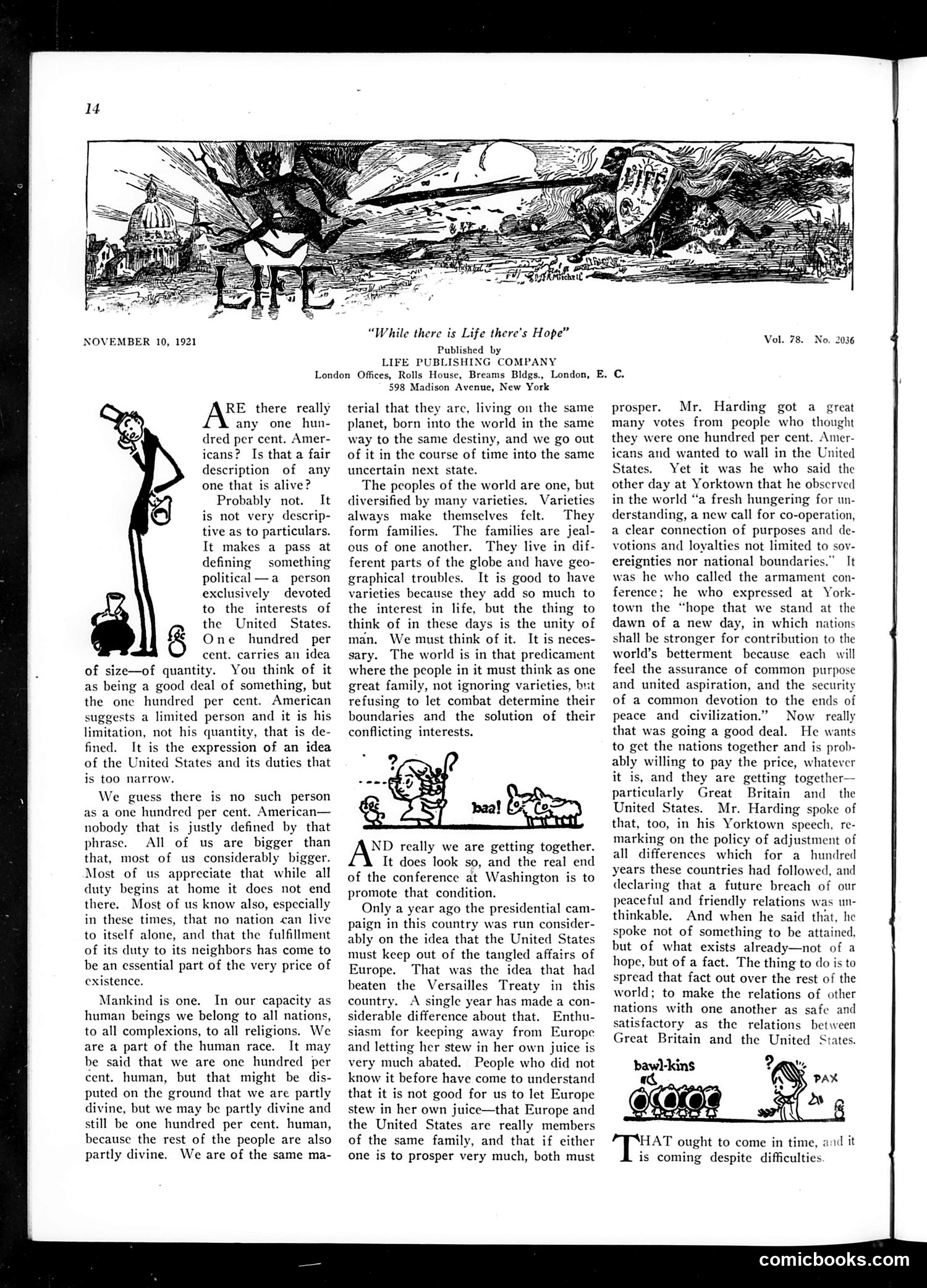
This editorial page addresses international cooperation following World War I. The main cartoon depicts a figure labeled "LIFE" observing world leaders meeting at the Washington Conference (referenced in the text). The satirical point concerns whether nations can truly unite despite their differences. The text argues that while humans are "one hundred per cent" interconnected globally, nations remain divided by competing interests. It criticizes the recent Versailles Treaty and advocates for the U.S. to engage constructively with Europe and Britain rather than isolate itself. The small decorative cartoons appear to illustrate humanity's shared nature and potential cooperation. Overall, the piece uses gentle satire to encourage American internationalism and peaceful post-war relations—a contested position in 1921 America.
📄 Transcribed text from this page (OCR, searchable)
Machine-transcribed from the original scan — historical spelling and the odd misread are preserved.
NOVEMBER 10, 1921 “While there is Life there's Hope” Published by LIFE PUBLISHING COMPANY London Offices, Rolls House, Breams Bldgs., London, E. C. RE there really any one hun- dred per cent. Amer- icans? Is that a fair description of any one that is alive? Probably not. It is not very descrip- tive as to particulars. It makes a pass at defining something political —a person exclusively to the devoted interests of the United States. & One hundred per cent. carries an idea of size—of quantity. You think of it as being a good deal of something, but the one hundred per cent. American suggests a limited person and it is his limitation, not his quantity, that is de- fined. It is the expression of an idea of the United States and its duties that is too narrow. We guess there is no such person as a one hundred per cent. American— nobody that is justly defined by that phrase. All of us are bigger than that, most of us considerably bigger. Most of us appreciate that while all duty begins at home it does not end there. Most of us know also, especially in these times, that no nation can live to itself alone, and that the fulfillment of its duty to its neighbors has come to be an essential part of the very price of existence. Mankind is one. In our capacity as human beings we belong to all nations, to all complexions, to all religions. We are a part of the human race. It may be said that we are one hundred per cent. human, but that might be dis- puted on the ground that we are partly divine, but we may be partly divine and still be one hundred per cent. human, because the rest of the people are also partly divine. We are of the same ma- 598 Madison Avenue, New York terial that they are, living on the same planet, born into the world in the same way to the same destiny, and we go out of it in the course of time into the same uncertain next state. The peoples of the world are one, but diversified by many varieties. Varieties always make themselves felt. They form families. The families are jeal- ous of one another. They live in dif- ferent parts of the globe and have geo- graphical troubles. It is good to have varieties because they add so much to the interest in life, but the thing to think of in these days is the unity of man. We must think of it. It is neces- gary. The world is in that predicament where the people in it must think as one great family, not ignoring varieties, but refusing to let combat determine their boundaries and the solution of their conflicting interests. AY? really we are getting together. It does look so, and the real end of the conference at Washington is to promote that condition. Only a year ago the presidential cam- paign in this country was run consider- ably on the idea that the United States must keep out of the tangled affairs of Europe. That was the idea that had beaten the Versailles Treaty in this country. A single year has made a con- siderable difference about that. Enthu- siasm for keeping away from Europe and letting her stew in her own juice is very much abated. People who did not know it before have come to understand that it is not good for us to let Europe stew in her own juice—that Europe and the United States are really members of the same family, and that if either one is to prosper very much, both must prosper. Mr. Harding got a great many votes from people who thought they were one hundred per cent. Amer- icans and wanted to wall in the United States. Yet it was he who said the other day at Yorktown that he observed in the world “a fresh hungering for un- derstanding, a new call for co-operation, a clear connection of purposes and de- votions and loyalties not limited to sov- ereignties nor national boundaries.” It was he who called the armament con- ference; he who expressed at York- town the “hope that we stand at the dawn of a new day, in which nations shall be stronger for contribution to the world’s betterment because each will feel the assurance of common purpose and united aspiration, and the security of a common devotion to the ends of peace and civilization.” Now really that was going a good deal. He wants to get the nations together and is prob- ably willing to pay the price, whatever it is, and they are getting together— particularly Great Britain and the United States. Mr. Harding spoke of that, too, in his Yorktown speech, re- marking on the policy of adjustment of all differences which for a hundred years these countries had followed, and declaring that a future breach of our peaceful and friendly relations was un- thinkable. And when he said that, he spoke not of something to be attained, but of what exists already—not of a hope, but of a fact. The thing to do is to spread that fact out over the rest of the world; to make the relations of other nations with one another as safe and satisfactory as the relations between Great Britain and the United States. bawl-kins LS ‘HAT ought to come in time, and it is coming despite difficulties comicbooks.com