
Life, 1921-11-10 · page 14 of 34
Life — November 10, 1921 — page 14: what you’re looking at
What you’re looking at
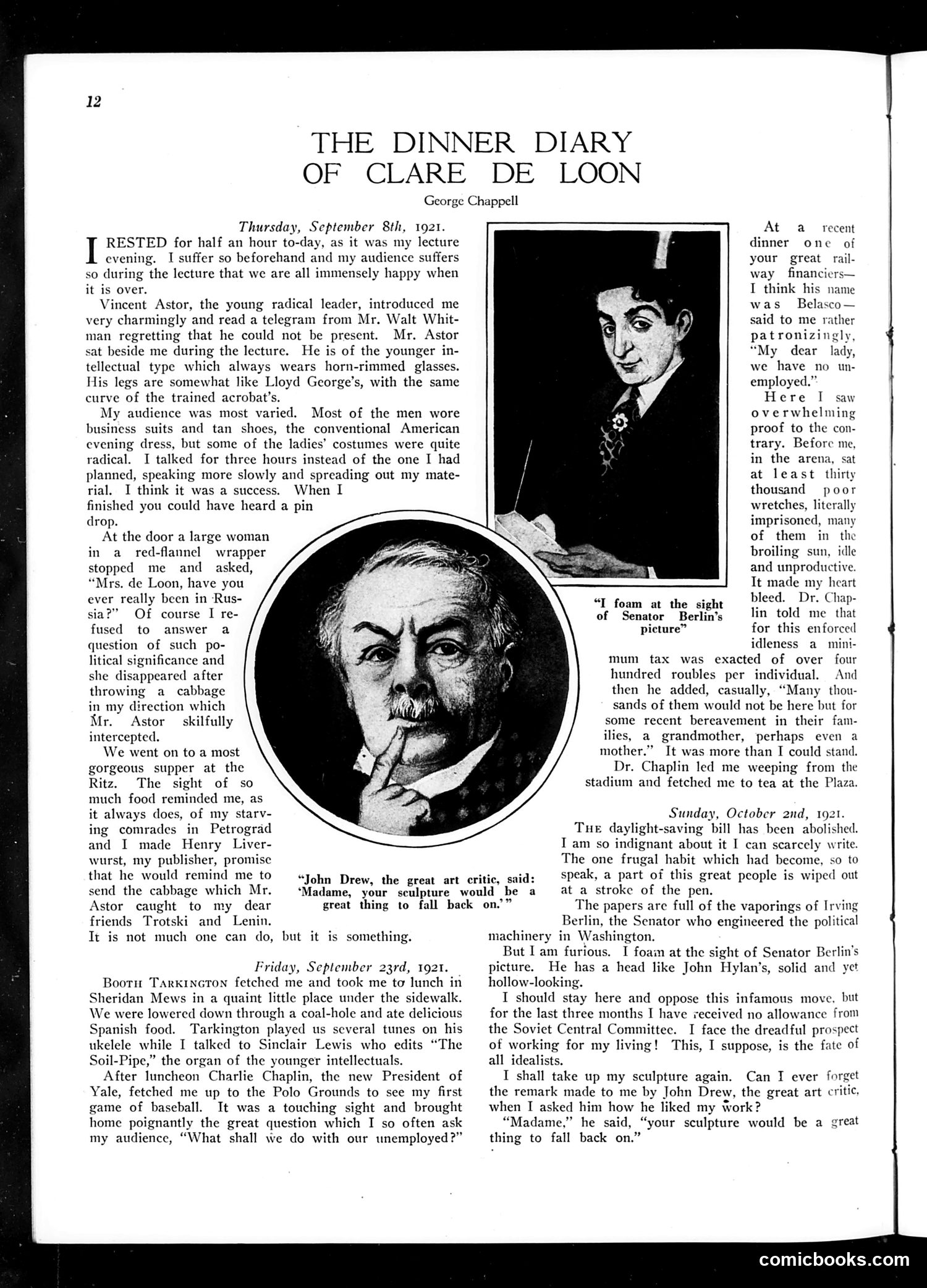
This is a satirical diary entry documenting New York society events from September-October 1921. The page features two portraits: **Vincent Astor** (top), a wealthy industrialist and railroad financier, and **John Drew** (bottom), described as "the great art critic." The humor targets the narrator's observations of the elite's pretensions and political concerns. References include Senator Berlin's tax policies affecting the wealthy, Irving Berlin's political engineering, and unemployment anxieties. The satire mocks how the upper class discusses serious social issues (unemployment, taxation) while enjoying lavish dinners and socializing. Drew's remark that her sculpture would "be a great thing to fall back on" sardonically suggests sculpture as unemployment insurance for the privileged.
📄 Transcribed text from this page (OCR, searchable)
Machine-transcribed from the original scan — historical spelling and the odd misread are preserved.
Thursday, September 8th, 1921. RESTED for half an hour to-day, as it was my lecture evening. I suffer so beforehand and my audience suffers so during the lecture that we are all immensely happy when it is over. Vincent Astor, the young radical leader, introduced me very charmingly and read a telegram from Mr. Walt Whit- man regretting that he could not be present. Mr. Astor sat beside me during the lecture. He is of the younger in- tellectual type which always wears horn-rimmed glasses. His legs are somewhat like Lloyd George's, with the same curve of the trained acrobats. My audience was most varied. Most of the men wore business suits and tan shoes, the conventional American evening dress, but some of the ladies’ costumes were quite radical. I talked for three hours instead of the one I had planned, speaking more slowly and spreading out my mate- rial. I think it was a success. When I finished you could have heard a pin drop. At the door a large woman in a red-flannel wrapper stopped me and asked, “Mrs. de Loon, have you ever really been in Rus- sia?” Of course I re- fused to answer a question of such po- litical significance and she disappeared after throwing a cabbage in my direction which Mr. Astor _ skilfully intercepted. We went on to a most gorgeous supper at the Ritz. The sight of so much food reminded me, as it always does, of my starv- ing comrades in Petrograd and I made Henry Liver- wurst, my publisher, promise that he would remind me to send the cabbage which Mr. Astor caught to my dear friends Trotski and Lenin. It is not much one can do, but it is something. Friday, September 23rd, 1921. Bootn TArkincTon fetched me and took me to lunch in Sheridan Mews in a quaint little place under the sidewalk. We were lowered down through a coal-hole and ate delicious Spanish food. Tarkington played us several tunes on his ukelele while I talked to Sinclair Lewis who edits “The Soil-Pipe,” the organ of the younger intellectuals. After luncheon Charlie Chaplin, the new President of Yale, fetched me up to the Polo Grounds to see my first game of baseball. It was a touching sight and brought home poignantly the great question which I so often ask my audience, “What shall we do with our unemployed?” THE DINNER DIARY OF CLARE DE LOON George Chappell “John Drew, the great art critic, said: ‘Madame, your sculpture would great thing to fall back on.’” At a dinner one of your great rail- way financiers— I think his name recent was Belasco— said to me rather patronizingly, “My dear lady, we have no un- employed.” Here I saw overwhelming proof to the con- trary. Before me, in the arena, sat at least thirty thousand poor wretches, literally imprisoned, many of them in the broiling sun, idle and unproductive. It made my heart bleed. Dr. Chap- lin told me that for this enforced idleness a mini- mum tax was exacted of over four hundred roubles per individual. And then he added, casually, “Many thou- sands of them would not be here but for some recent bereavement in their fam- ilies, a grandmother, perhaps even a mother.” It was more than I could stand. Dr. Chaplin led me weeping from the stadium and fetched me to tea at the Plaza. “I foam at the sight of Senator Berlin’s picture” Sunday, October 2nd, 1921. Tue daylight-saving bill has been abolished. I am so indignant about it I can scarcely write. The one frugal habit which had become, so to speak, a part of this great people is wiped out at a stroke of the pen. The papers are full of the vaporings of Irving Berlin, the Senator who engineered the political machinery in Washington. But | am furious. I foam at the sight of Senator Berlin's picture. He has a head like John Hylan’s, solid and yet hollow-looking. I should stay here and oppose this infamous move, but for the last three months I have received no allowance from the Soviet Central Committee. I face the dreadful prospect of working for my living! This, I suppose, is the fate of all idealists. I shall take up my sculpture again. Can I ever forget the remark made to me by John Drew, the great art critic, when I asked him how he liked my Work? “Madame,” he said, “your sculpture would be a great thing to fall back on.” be a comicbooks.com