
Life, 1921-11-10 · page 24 of 34
Life — November 10, 1921 — page 24: what you’re looking at
What you’re looking at
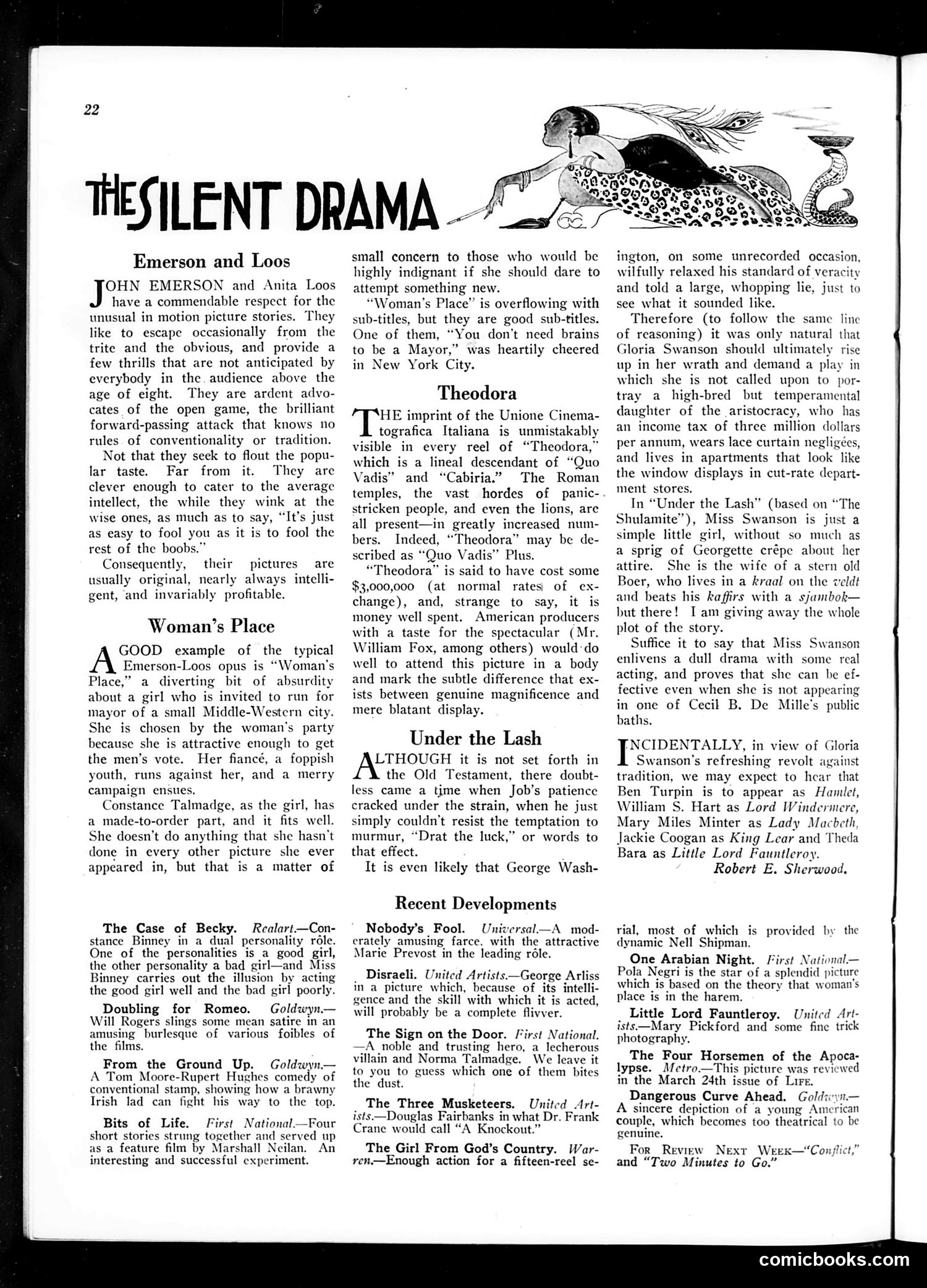
This page from *Life* magazine reviews several silent films and their stars—a typical entertainment feature from the early 1920s cinema era. The main subjects are directors John Emerson and Anita Loos, praised for creating unconventional yet commercially successful pictures. Key references include: - **"Woman's Place"**: A satirical comedy starring Constance Talmadge about a woman running for mayor—the subtitle "You don't need brains to be a Mayor" received audience applause, likely a jab at contemporary politicians. - **"Theodora"**: An Italian epic ($3 million production) compared to earlier spectacles like *Quo Vadis*, critiquing the difference between genuine magnificence and "blatant display." - **"Under the Lash"**: A film about Job's biblical patience, with a humorous suggestion that even Job would have cursed his misfortunes. The tone is witty and sophisticated, written for readers assumed familiar with current cinema and willing to appreciate both films and satirical commentary on American politics and taste.
📄 Transcribed text from this page (OCR, searchable)
Machine-transcribed from the original scan — historical spelling and the odd misread are preserved.
THESILENT DRAMA - Emerson and Loos OHN EMERSON and Anita Loos have a commendable respect for the unusual in motion picture stories. They like to escape occasionally from the trite and the obvious, and provide a few thrills that are not anticipated by everybody in the. audience above the age of eight. They are ardent advo- cates of the open game, the brilliant forward-passing attack that knows no rules of conventionality or tradition. Not that they seek to flout the popu- lar taste. Far from it. They are clever enough to cater to the average intellect, the while they wink at the wise ones, as much as to say, “It’s just as easy to fool you as it is to fool the rest of the boobs.” Consequently, their pictures are usually original, nearly always intelli- gent, and invariably profitable. Woman’s Place GOOD example of the typical Emerson-Loos opus is “Woman's Place,” a diverting bit of absurdity about a girl who is invited to run for mayor of a small Middle-Western city. She is chosen by the woman's party because she is attractive enough to get the men’s vote. Her fiancé, a foppish youth, runs against her, and a merry campaign ensues. Constance Talmadge, as the girl, has a made-to-order part, and it fits well. She doesn’t do anything that she hasn't done in every other picture she ever appeared in, but that is a matter of The Case of Becky. Realart—Con- stance Binney in a dual personality rdle. One of the personalities is a good girl, the other personality a bad girl—and Miss Binney carries out the illusion by acting the good girl well and the bad girl poorly. Doubling for Romeo. Goldwyn— Will Rogers slings some mean satire in an amusing burlesque of various foibles of the films. From the Ground Up. Goldwyn.— A Tom Moore-Rupert Hughes comedy of conventional stamp, showing how a brawny Irish lad can fight his way to the top. Bits of Life. First National—Four short stories strung together and served up as a feature film by Marshall Neilan. An interesting and successful experiment. small concern to those who would be highly indignant if she should dare to attempt something new. “Woman's Place” is overflowing with sub-titles, but they are good sub-titles. One of them, “You don’t need brains to be a Mayor,” was heartily cheered in New York City. Theodora HE imprint of the Unione Cinema- tografica Italiana is unmistakably visible in every reel of “Theodora,” which is a lineal descendant of “Quo Vadis” and “Cabiria.” The Roman temples, the vast hordes of panic- stricken people, and even the lions, are all present—in greatly increased num- bers. Indeed, “Theodora” may be de- scribed as “Quo Vadis” Plus. “Theodora” is said to have cost some $3,000,000 (at normal rates) of ex- change), and, strange to say, it is money well spent. American producers with a taste for the spectacular (Mr. William Fox, among others) would-do well to attend this picture in a body and mark the subtle difference that ex- ists between genuine magnificence and mere blatant display. Under the Lash LTHOUGH it is not set forth in the Old Testament, there doubt- less came a time when Job’s patience cracked under the strain, when he just simply couldn't resist the temptation to murmur, “Drat the luck,” or words to that effect. It is even likely that George Wash- Recent Developments Nebody’s Fool. Universal—A _ mod- erately amusing farce. with the attractive Marie Prevost in the leading réle. _ Disraeli. United Artists—George Arliss in a picture which, because of its intelli- gence and the skill with which it is acted, will probably be a complete flivver. The Sign on the Door. First National. A noble and trusting hero, a lecherous villain and Norma Talmadge. We leave it to you to guess which one of them bites the dust. The Three Musketeers. United Art- ists —Douglas Fairbanks in what Dr. Frank Crane would call “A Knockout.” The Girl From God’s Country. War- ren—Enough action for a fifteen-reel se- ington, on some unrecorded occasion, wilfully relaxed his standard of veracity and told a large, whopping lie, just to see what it sounded like. Therefore (to follow the same linc of reasoning) it was only natural that Gloria Swanson should ultimately rise up in her wrath and demand a play in which she is not called upon to por- tray a high-bred but temperamental daughter of the aristocracy, who has an income tax of three million dollars per annum, wears lace curtain negligées, and lives in apartments that look like the window displays in cut-rate depart- ment stores, In “Under the Lash” (based on “The Shulamite”), Miss Swanson is just a simple little girl, without so much as a sprig of Georgette crépe about her attire. She is the wife of a stern old Boer, who lives in a kraal on the veldt and beats his kaffirs with a sjambok— but there! I am giving away the whole plot of the story. Suffice it to say that Miss Swanson enlivens a dull drama with some real acting, and proves that she can he ef- fective even when she is not appearing in one of Cecil B. De Mille’s public baths. NCIDENTALLY, in view of Gloria Swanson’s refreshing revolt against tradition, we may expect to hear that Ben Turpin is to appear as Hamlet, William S. Hart as Lord Windermere, Mary Miles Minter as Lady Macbeth, Jackie Coogan as King Lear and Theda Bara as Little Lord Fauntleroy. Robert E. Sherwood. rial, most of which is provided by the dynamic Nell Shipman. One Arabian Night. First National— Pola Negri is the star of a splendid picture which is based on the theory that woman's place is in the harem. Little Lord Fauntleroy. United Art- ists—Mary Pickford and some fine trick photography. The Four Horsemen of the Apoca- lypse. Mctro—This picture was reviewe in the March 24th issue of Lire. Dangerous (Curve Ahead. Goldzy.— A sincere depiction of a young American couple, which becomes too theatrical to be genuine. For Review Next Weex—‘“Conflict,” and “Two Minutes to Go.” comicbooks.com