
Life, 1921-11-10 · page 8 of 34
Life — November 10, 1921 — page 8: what you’re looking at
What you’re looking at
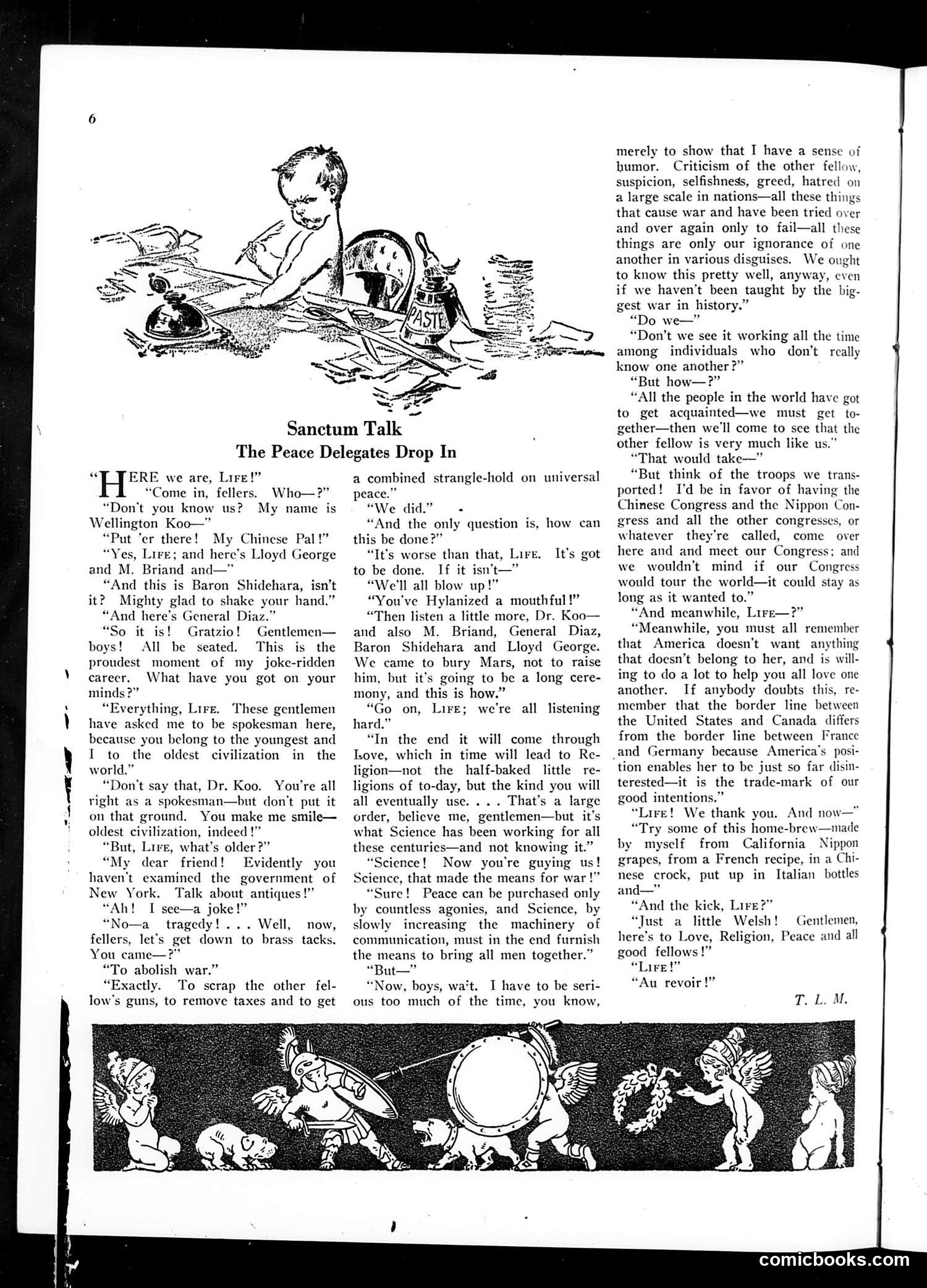
This satirical dialogue features Life magazine's editor ("Life") meeting with peace conference delegates, likely from the post-WWI era. The cartoon mocks the naïveté of idealistic peacemakers who believe international acquaintance and love will prevent future wars. The delegates—identified as Chinese, British (Lloyd George and Baron Shiddhara), and American representatives—discuss solving world conflict through understanding and science. Life's skeptical character counters that ignorance of other nations' customs persists everywhere, and sarcastically suggests America's isolationism and self-interest make such grand peace plans ineffective. The satire targets the optimism of international peace movements as disconnected from human nature and national self-interest.
📄 Transcribed text from this page (OCR, searchable)
Machine-transcribed from the original scan — historical spelling and the odd misread are preserved.
i-—_ww Sanctum Talk The Peace Delegates Drop In «¢ ERE we are, Lire!” Come in, fellers. “Don't you know us? Wellington Koo—” “Put ‘er there! My Chinese Pal!” “Yes, Lire; and here’s Lloyd George and M. Briand and—” “And this is Baron Shidehara, isn’t it? Mighty glad to shake your hand.” “And here’s General Diaz.” “So it is! Gratzio! Gentlemen— boys! All be seated. This is the proudest moment of my joke-ridden career. What have you got on your Who—?” My name is “Everything, Lire. These gentlemen have asked me to be spokesman here, because you belong to the youngest and I to the oldest civilization in the world.” “Don't say that, Dr. Koo. You're all right as a spokesman—but don't put it on that ground. You make me smile— oldest civilization, indeed!” “But, Lire, what’s older?” “My dear friend! Evidently you haven't examined the government of New York. Talk about antiques!” “Ah! I see—a joke!” “No—a_ tragedy! ... Well, now, fellers, let's get down to brass tacks. You came—?” “To abolish war.” “Exactly. To scrap the other fel- low’s guns, to remove taxes and to get a combined strangle-hold on universal peace.” “We did.” + “And the only question is, how can this be done?” “It’s worse than that, Lire. to be done. If it isn’t—” “We'll all blow up!” “You've Hylanized a mouthful!” “Then listen a little more, Dr. Koo— and also M. Briand, General Diaz, Baron Shidehara and Lloyd George. We came to bury Mars, not to raise him, but it’s going to be a long cere- mony, and this is how.” “Go on, Lire; we're all listening hard.” “In the end it will come through Love, which in time will lead to Re- ligion—not the half-baked little re- ligions of to-day, but the kind you will all eventually use. ... That’s a large order, believe me, gentlemen—but it’s what Science has been working for all these centuries—and not knowing it.” “Science! Now you're guying us! Science, that made the means for war!” “Sure! Peace can be purchased only by countless agonies, and Science, by slowly increasing the machinery of communication, must in the end furnish the means to bring all men together.” “But—” ow, boys, wa'‘t. I have to be seri- ous too much of the time, you know, It’s got merely to show that I have a sense of humor. Criticism of the other fellow, suspicion, selfishness, greed, hatred on a large scale in nations—all these things that cause war and have been tried over and over again only to fail—all these things are only our ignorance of one another in various disguises. We ought to know this pretty well, anyway, even if we haven't been taught by the big- gest war in history.” “Do we—” “Don’t we see it working all the time among individuals who don’t really know one another?” “But how—?” “All the people in the world have got to get acquainted—we must get to- gether—then we'll come to sce that the other fellow is very much like us.” “That would take—” “But think of the troops we trans- ported! I'd be in favor of having the Chinese Congress and the Nippon Con- gress and all the other congresses, or whatever they're called, come over here and and mect our Congress; and we wouldn’t mind if our Congress would tour the world—it could stay as long as it wanted to.” “And meanwhile, Lire—?” “Meanwhile, you must all remember that America doesn’t want anything that doesn’t belong to her, and is will- ing to do a lot to help you all love one another. If anybody doubts this, re- member that the border line between the United States and Canada differs from the border line between France _and Germany because America’s posi- tion enables her to be just so far disin- terested—it is the trade-mark of our good intentions.” “Lire! We thank you. And now—" “Try some of this home-brew—made by myself from California Nippon grapes, from a French recipe, in a Chi- nese crock, put up in Italian bottles and—” “And the kick, Lire?” ‘Just a little Welsh! Gentlemen, here’s to Love, Religion, Peace and all good fellows!” “Lire!” “Au revoir comicbooks.com