
Life, 1921-11-10 · page 22 of 34
Life — November 10, 1921 — page 22: what you’re looking at
What you’re looking at
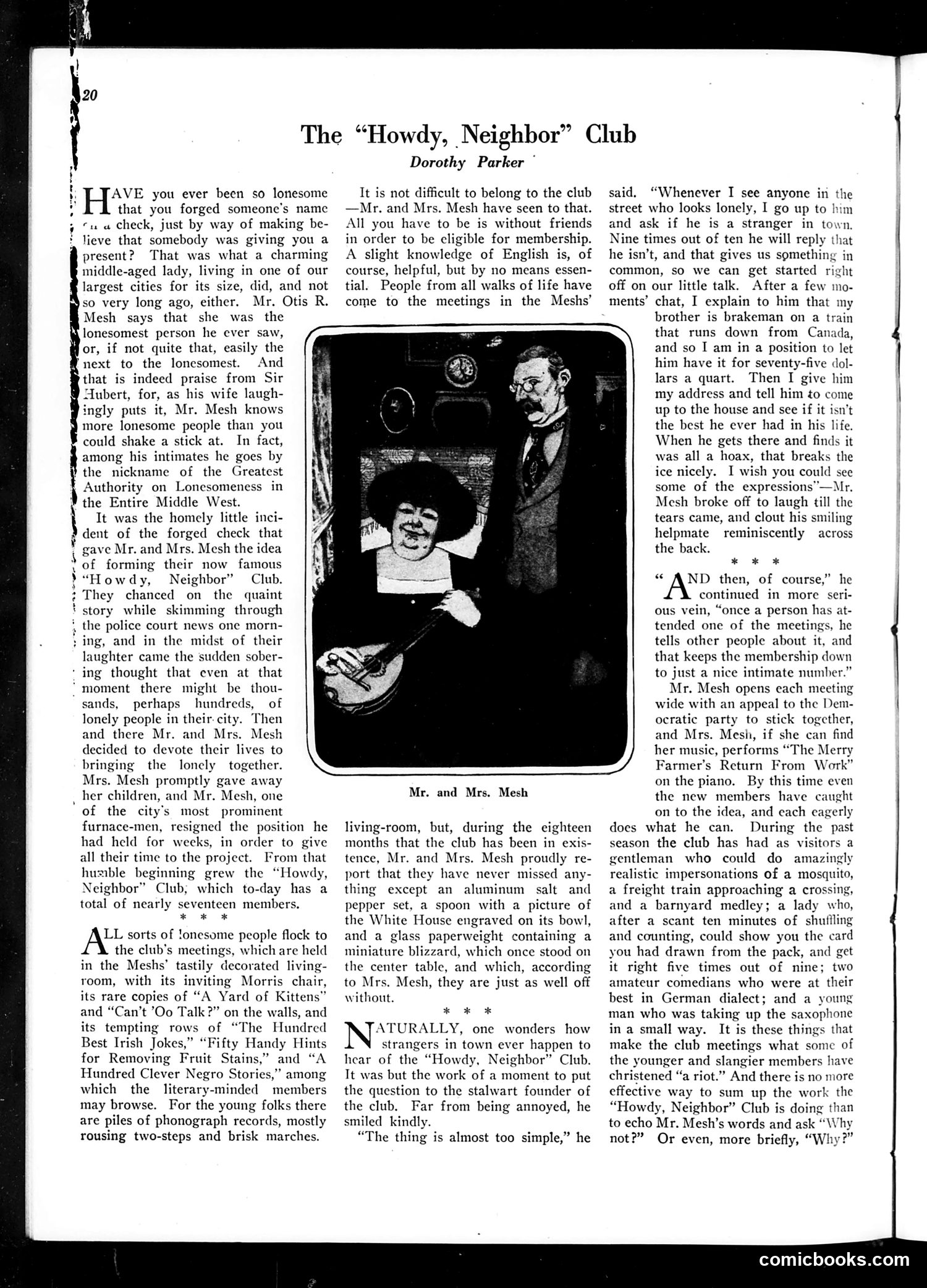
This is satirical fiction about Mr. and Mrs. Mesh, who founded a club for lonely people after reading about a woman who forged a check out of desperation for human connection. The couple devoted themselves to bringing together isolated city dwellers. The satire lies in the *earnest absurdity* of their efforts: the club operates from their living room, requires only loneliness and basic English as membership criteria, and has accumulated seventeen members in eighteen months. Parker gently mocks the Meshes' well-intentioned but somewhat bumbling approach—their crude membership screening and their tacky collection of self-help books ("Fifty Handy Hints for Removing Fruit Stains"). The photograph shows Mr. and Mrs. Mesh as ordinary, homely people. Parker's humor derives from how their sincere social mission contrasts with their limited sophistication and the club's modest, almost pathetic reality. It's a portrait of Midwestern earnestness and social awkwardness masquerading as philanthropy.
📄 Transcribed text from this page (OCR, searchable)
Machine-transcribed from the original scan — historical spelling and the odd misread are preserved.
AVE you ever been so lonesome that you forged someone's name «ua check, just by way of making be- lieve that somebody was giving you a That was what a charming present? middle-aged lady, living in one of our largest cities for its size, did, and not so very long ago, either. Mr. Otis R. \ Mesh says that she was the lonesomest person he ever saw, or, if not quite that, easily the next to the lonesomest. And that is indeed praise from Sir Hubert, for, as his wife laugh- ingly puts it, Mr. Mesh knows more lonesome people than you could shake a stick at. In fact, among his intimates he goes by } the nickname of the Greatest Authority on Lonesomeness in t. It was the homely little inci- dent of the forged check that gave Mr. and Mrs. Mesh the idea . of forming their now famous >“Howdy, Neighbor” Club. 7 They chanced on the quaint story while skimming through the police court news one morn- ; ing, and in the midst of their laughter came the sudden sober- ‘ing thought that even at that “moment there might be thou- sands, perhaps hundreds, of lonely people in their. city. Then and there Mr. and Mrs. Mesh decided to devote their lives to bringing the lonely together. Mrs. Mesh promptly gave away , her children, and Mr. Mesh, one of the city’s most prominent furnace-men, resigned the position he had held for weeks, in order to give all their time to the project. From that humble beginning grew the “Howdy, Neighbor” Club; which to-day has a total of nearly seventeen members. * Ok Ok LL sorts of !onesome people flock to the club's meetings, which are held in the Meshs’ tastily decorated living- room, with its inviting Morris chair, its rare copies of “A Yard of Kittens and “Can’t ’Oo Talk?” on the walls, and its tempting rows of “The Hundred Best Irish Jokes,” “Fifty Handy Hints for Removing Fruit Stains,” and “A Hundred Clever Negro Stories,” among which the literary-minded members may browse. For the young folks there are piles of phonograph records, mostly rousing two-steps and brisk marches. The “Howdy, Neighbor” Club Dorothy Parker ° It is not difficult to belong to the club —Mr. and Mrs. Mesh have seen to that. All you have to be is without friends in order to be eligible for membership. A slight knowledge of English is, of course, helpful, but by no means essen- tial. People from all walks of life have come to the meetings in the Meshs’ Mr. and Mrs. Mesh living-room, but, during the eighteen months that the club has been in exis- tence, Mr. and Mrs. Mesh proudly re- port that they have never missed any- thing except an aluminum salt and pepper set, a spoon with a picture of the White House engraved on its bowl, and a glass paperweight containing a miniature blizzard, which once stood on the center table, and which, according to Mrs. Mesh, they are just as well off without. * ok OF ATURALLY, one wonders how strangers in town ever happen to hear of the “Howdy, Neighbor” Club. It was but the work of a moment to put the question to the stalwart founder of the club. Far from being annoyed, he smiled kindly. “The thing is almost too simple,” he said. “Whenever I see anyone in the street who looks lonely, I go up to him and ask if he is a stranger in town, Nine times out of ten he will reply that he isn’t, and that gives us something in common, so we can get started right off on our little talk. After a few mo- ments’ chat, I explain to him that my brother is brakeman on a train that runs down from Canada, and so I am in a position to let him have it for seventy-five dol- lars a quart. Then I give him my address and tell him to come up to the house and see if it isn’t the best he ever had in his life. When he gets there and finds it was all a hoax, that breaks the ice nicely. I wish you could see some of the expressions’—Mr. Mesh broke off to laugh till the tears came, and clout his smiling helpmate reminiscently across the back. * Ok “AN? then, of course,” he continued in more seri- ous vein, “once a person has at- tended one of the meetings, he tells other people about it, and that keeps the membership down to just a nice intimate number.” Mr. Mesh opens each meeting wide with an appeal to the Dem- ocratic party to stick together, and Mrs. Mesh, if she can find her music, performs “The Merry Farmer’s Return From Work” on the piano. By this time even the new members have caught on to the idea, and each eagerly does what he can. During the past season the club has had as visitors a gentleman who could do amazingly realistic impersonations of a mosquito, a freight train approaching a crossing, and a barnyard medley; a lady who, after a scant ten minutes of shufiling and counting, could show you the card you had drawn from the pack, and get it right five times out of nine; two amateur comedians who were at their best in German dialect; and a young man who was taking up the saxophone in a small way. It is these things that make the club meetings what some of the younger and slangier members have christened “a riot.” And there is no more effective way to sum up the work the “Howdy, Neighbor” Club is doing than to echo Mr. Mesh’s words and ask “\Vhy not?” Or even, more briefly, “Why?” comicbooks.com